UEG's educational platform for gastroenterology education bringing recordings, courses, guidelines, and more together in one place.
Most popular content
Rate for better recommendations!
Your feedback helps us show you more of what you like and less of what you dislike!
Log in to access this content.
Free for all myUEG account holders. Your access level is set automatically based on your occupation. Medical professionals get full access to all content. If you are a non-medical user, you can only access UEG Week content from congresses you attended.
Not sure what you can access? Learn more about account types.
Difficult stones: Is it the stone or the endoscopist?
1 San Matteo Hospital, Pavia, Italy
Event
Topics
Citation
Published
Log in to access this content.
Free for all myUEG account holders. Your access level is set automatically based on your occupation. Medical professionals get full access to all content. If you are a non-medical user, you can only access UEG Week content from congresses you attended.
Not sure what you can access? Learn more about account types.
Pancreas necrosis: What to do after initial drainage
1 St. Antonius Ziekenhuis, Nieuwegein, Netherlands
Event
Topics
Citation
Published
Log in to access this content.
Free for all myUEG account holders. Your access level is set automatically based on your occupation. Medical professionals get full access to all content. If you are a non-medical user, you can only access UEG Week content from congresses you attended.
Not sure what you can access? Learn more about account types.
Variceal bleeding from Ligation to Sengstaken
1 Clinic for Interdisciplinary Endoscopy, Hamburg, Germany
Event
Topics
Citation
Published
Log in to access this content.
Free for all myUEG account holders. Your access level is set automatically based on your occupation. Medical professionals get full access to all content. If you are a non-medical user, you can only access UEG Week content from congresses you attended.
Not sure what you can access? Learn more about account types.
Diverticulitis: When not to be worried?
1 Univertsity of Oslo, Oslo, Norway
Event
Topics
Session
Citation
Published
Log in to access this content.
Free for all myUEG account holders. Your access level is set automatically based on your occupation. Medical professionals get full access to all content. If you are a non-medical user, you can only access UEG Week content from congresses you attended.
Not sure what you can access? Learn more about account types.
Predicting therapy response in HCC and CCC
1 LMU München, Munich, Germany
Event
Session
Citation
Published
Log in to access this content.
Free for all myUEG account holders. Your access level is set automatically based on your occupation. Medical professionals get full access to all content. If you are a non-medical user, you can only access UEG Week content from congresses you attended.
Not sure what you can access? Learn more about account types.
Acute pancreatitis: When to reserve an ITU bed?
1 University Hospital LMU Munich, München, Germany
Event
Topics
Session
Citation
Published
Log in to access this content.
Free for all myUEG account holders. Your access level is set automatically based on your occupation. Medical professionals get full access to all content. If you are a non-medical user, you can only access UEG Week content from congresses you attended.
Not sure what you can access? Learn more about account types.
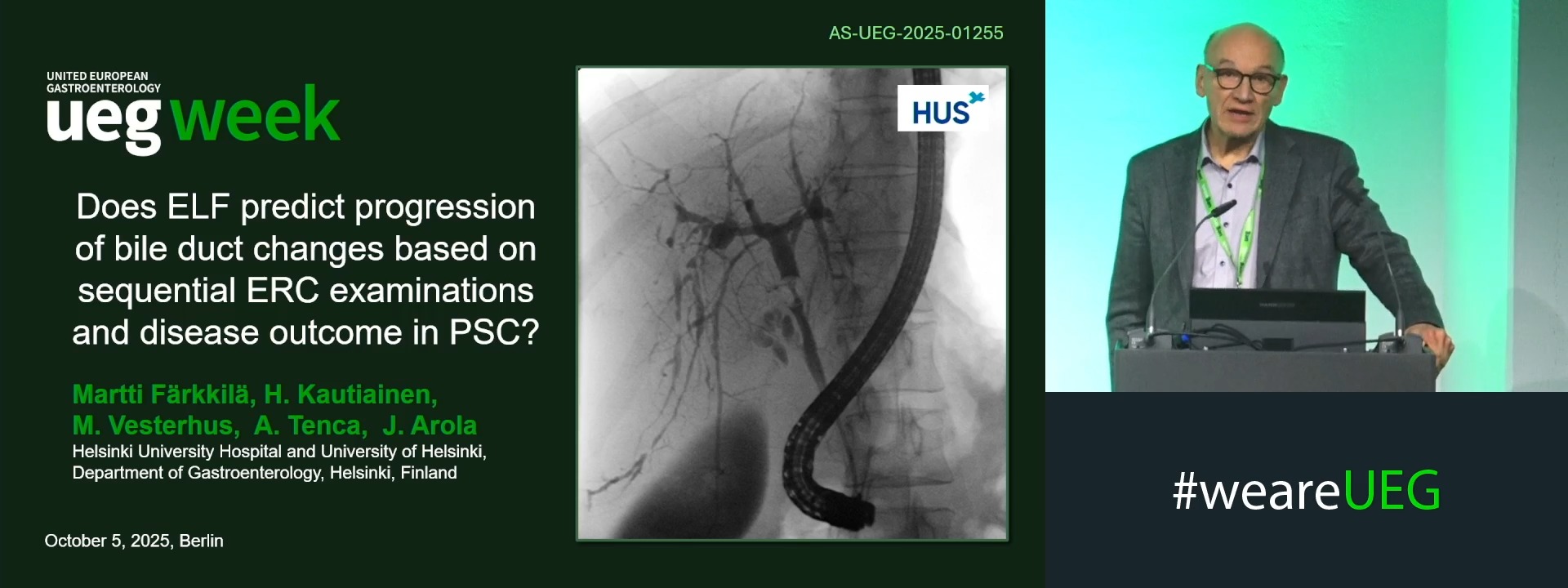
DOES ELF PREDICT PROGRESSION BILE DUCT CHANGES BASED ON SEQUENTIAL ERC EXAMINATIONS AND DISEASE OUTCOME IN PSC?
1 Helsinki University Hospital, Helsinki, Finland
2 University of Eastern Finland, Kuopio, Finland
3 Haraldsplass Deaconess Hospital, Bergen, Norway
4 Clinic of Gastroenterology - Helsinki University Hospital, Helsinki, Finland
5 University of Helsinki, Helsinki, Finland