UEG's educational platform for gastroenterology education bringing recordings, courses, guidelines, and more together in one place.
Most popular content
Rate for better recommendations!
Your feedback helps us show you more of what you like and less of what you dislike!
Log in to access this content.
Free for all myUEG account holders. Your access level is set automatically based on your occupation. Medical professionals get full access to all content. If you are a non-medical user, you can only access UEG Week content from congresses you attended.
Not sure what you can access? Learn more about account types.
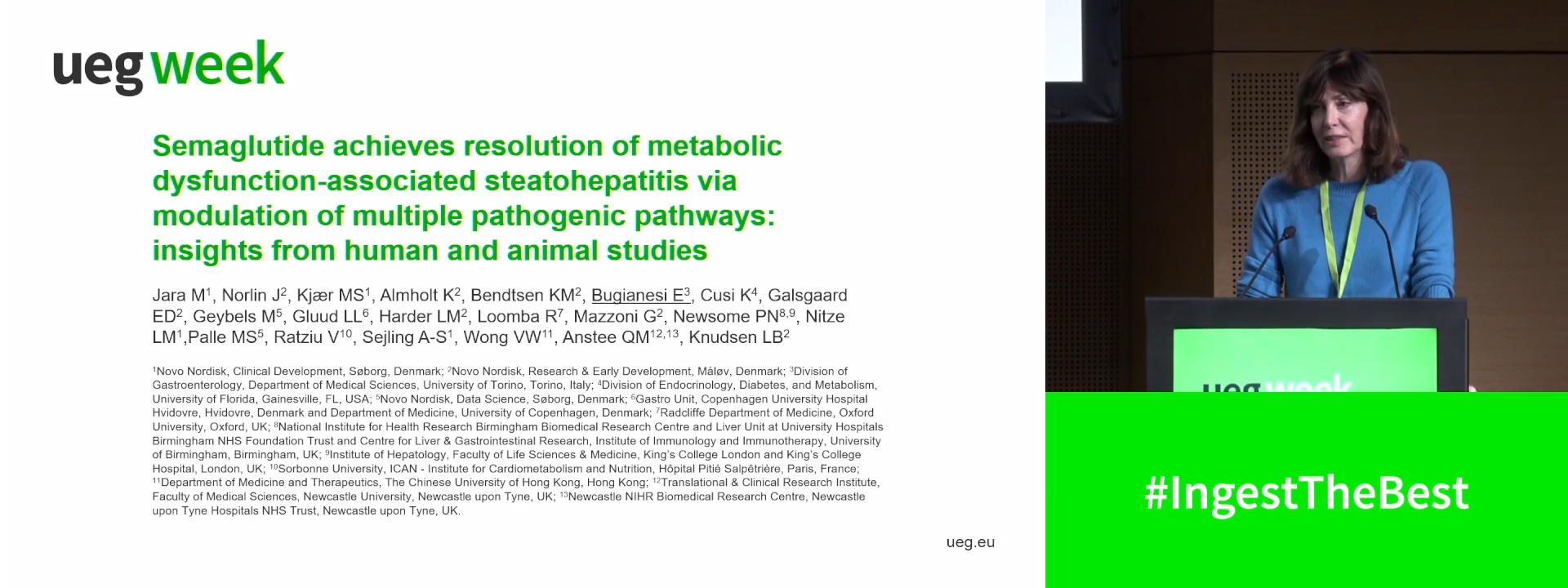
SEMAGLUTIDE ACHIEVES RESOLUTION OF METABOLIC DYSFUNCTION-ASSOCIATED STEATOHEPATITIS VIA MODULATION OF MULTIPLE PATHOGENIC PATHWAYS: INSIGHTS FROM HUMAN AND ANIMAL OMICS STUDIES
M Jara 1, J Norlin 2, M S Kjær 1, K Almholt 2, K M Bendtsen 2, Elisabetta Bugianesi 3, K Cusi 4, E D Galsgaard 2, M Geybels 5, Lise Lotte Gluud 6, L M Harder 2, Rohit Loomba 7, G Mazzoni 2, Philip Newsome 8, L M Nitze 1, M S Palle 5, Vlad Ratziu 9, A-S Sejling 1, V W Wong 10, Quentin Anstee 11, L B Knudsen 2
1 Novo Nordisk, Clinical Development, Søborg, Denmark
2 Novo Nordisk, Research & Early Development, Måløv, Denmark
3 Division of Gastroenterology, Department of Medical Sciences, University of Torino, Torino, Italy
4 Division of Endocrinology, Diabetes, and Metabolism, University of Florida, Gainesville, FL, United States
5 Novo Nordisk, Data Science, Søborg, Denmark
6 Gastro Unit, Copenhagen University Hospital Hvidovre, Hvidovre, Denmark and Department of Medicine, University of Copenhagen, Hvidovre, Denmark
7 Radcliffe Department of Medicine, Oxford University, Oxford, United Kingdom
8 National Institute for Health Research Birmingham Biomedical Research Centre and Liver Unit at University Hospitals Birmingham NHS Foundation Trust and Centre for Liver & Gastrointestinal Research, Birmingham, United Kingdom|||Institute of Hepatology, Fac
9 Sorbonne University, ICAN - Institute for Cardiometabolism and Nutrition, Hôpital Pitié Salpêtrière, Paris, France
10 Department of Medicine and Therapeutics, The Chinese University of Hong Kong, Hong Kong, China
11 Translational & Clinical Research Institute, Faculty of Medical Sciences, Newcastle University, Newcastle upon Tyne, United Kingdom|||Newcastle NIHR Biomedical Research Centre, Newcastle upon Tyne Hospitals NHS Trust, Newcastle upon Tyne, United Kingdom
Event
Topics
Submission format
Citation
Published
Log in to access this content.
Free for all myUEG account holders. Your access level is set automatically based on your occupation. Medical professionals get full access to all content. If you are a non-medical user, you can only access UEG Week content from congresses you attended.
Not sure what you can access? Learn more about account types.
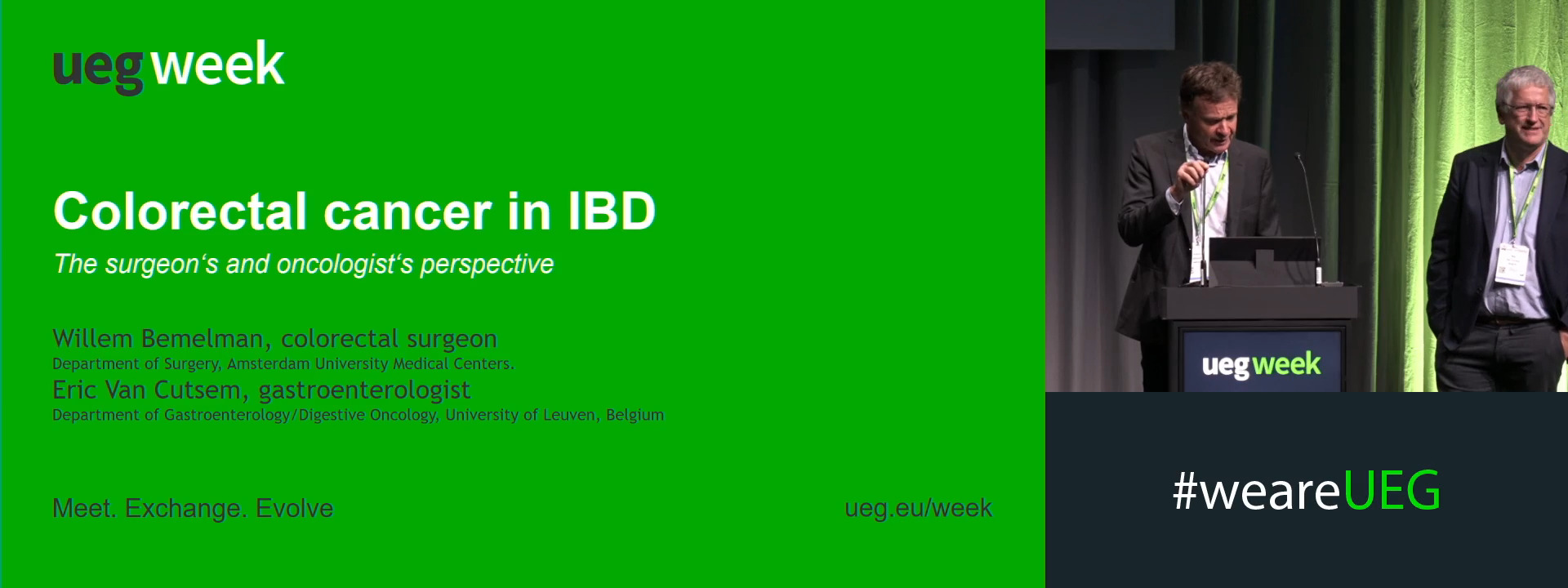
Colorectal cancer in IBD: Surgeon and oncologist's perspective
1 Academisch Medisch centrum Dept. of Surgery - Department of Surgery, Academisch Medisch centrum Dept, Amsterdam, Netherlands
2 University Hosp. Gasthuisberg/Leuven, Leuven, Belgium
Event
Session
Citation
Published
Log in to access this content.
Free for all myUEG account holders. Your access level is set automatically based on your occupation. Medical professionals get full access to all content. If you are a non-medical user, you can only access UEG Week content from congresses you attended.
Not sure what you can access? Learn more about account types.
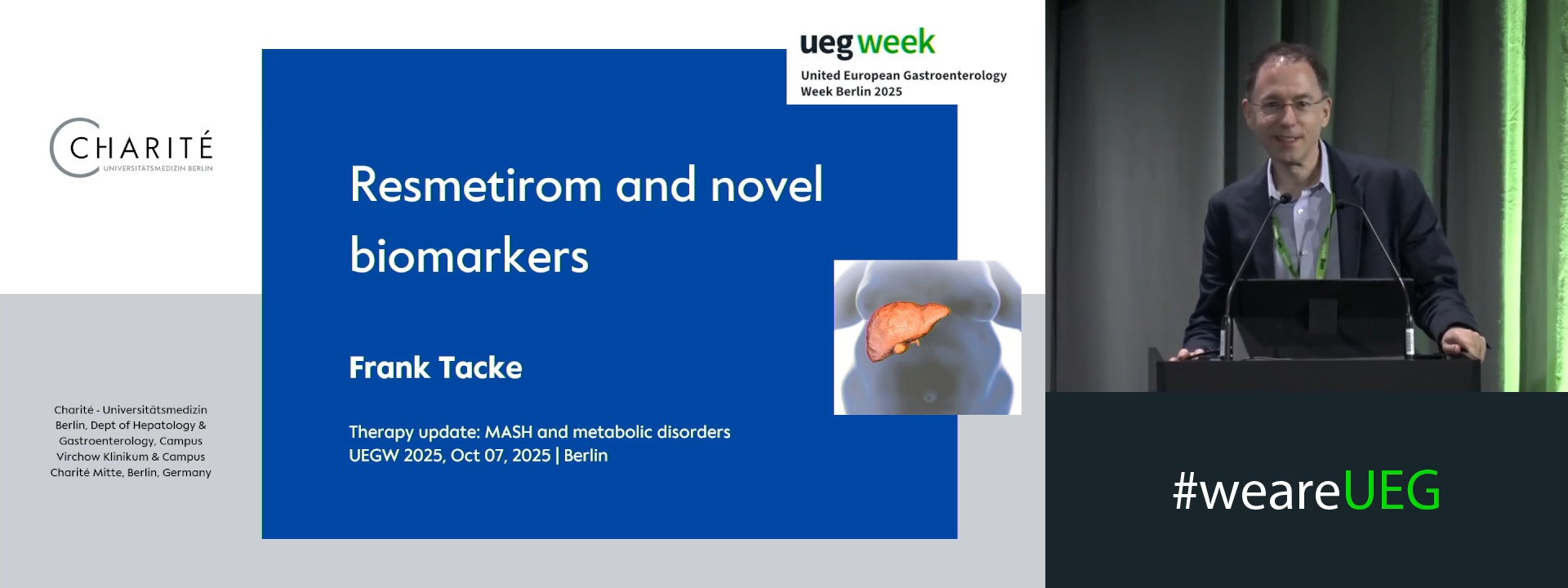
Resmetirom and novel biomarkers
1 Charité Universitaetsmedizin Berlin, Dept of Hepatology & Gastroenterology, Berlin, Germany
Event
Citation
Published

Log in to access this content.
Free for all myUEG account holders. Your access level is set automatically based on your occupation. Medical professionals get full access to all content. If you are a non-medical user, you can only access UEG Week content from congresses you attended.
Not sure what you can access? Learn more about account types.
MICROBIAL DYSBIOSIS, INFLAMMATION, AND THE GUT-BRAIN AXIS IN IRRITABLE BOWEL SYNDROME: INSIGHTS FROM THE DISCOVERIE COHORT
Jorge Francisco Vazquez Castellanos 1, Jeroen Raes 1, Javier Santos 2, Amanda Rodriguez 2, Maaike Van Den Houte 3, Dan Lucian Dumitrascu 4, Andrei Pop 5, Jekkel Eva 6, Giovanni Barbara 7, Maria Raffaella Barbaro 8, Magnus Simrén 9, Irina Midenfjord 10, Danique Mulder 11, Michelle Bosman 12, Daisy Mae Jonkers 13, Mareike Aichholzer 14, Juan Garcia 2, Carmen Alonso-Cotoner 15, Stefanie Schmitteckert 16, Arno Lukas 17, Ricardo Brandwijk 18, Lindsey De Commer 1, Muriel Derrien 1, Lindsay Devolder 1, Chloë Verspecht 1, Iris Reniers 1, Ami De Weerdt 1, Daniel Ekhlas 1, Jan Tack 19, Lukas Van Oudenhove 20, Ricard Farré Marti 3, John F. Cryan 21, Gerard Clarke 22
1 KU-Leuven/VIB, Leuven, Belgium
2 Institut de Recerca Vall d`Hebron, Barcelona, Spain
3 KU Leuven, Leuven, Belgium
4 University of Medicine and Pharmacy, Cluj-Napoca, Romania
5 Iuliu Hatieganu University of Medicine and Pharmacy, ClujNapoca, Romania
6 Semmelweis University, Budapest, Hungary
7 University of Bologna, Bologna, Italy
8 University of Bologna Dept. of Medical and Surgical Sciences, Bologna, Italy
9 Sahlgrenska University Hospital - Dept of Internal Medicine, Sahlgrenska University Hospital ; Gothe, Gothenburg, Sweden
10 Institute of Medicine, Gothenburg, Sweden
11 Radboud University Medical Center, Nijmegen, Netherlands
12 Maastricht University Medical Center +, Venlo, Netherlands
13 Maastricht University Medical Center - Department of Internal Medicine, Division of Gastroenterology, Maastricht, Netherlands
14 Goethe University, University Hospital, Frankfurt, Germany
15 Hospital Val Hebron, Barcelona, Spain
16 University Hospital Heidelberg, Heidelberg, Germany
17 emergenTec, Vienna, Austria
18 Hycult Biotech, Uden, Netherlands
19 University of Leuven, University Hospital Gasthuisberg, Leuven, Belgium
20 Katholieke Universiteit Leuven, Leuven, Belgium
21 University College Cork, Cork, Ireland
22 g.clarke@ucc.ie, Corke, Ireland
Event
Topics
Submission format
Citation
Published
Log in to access this content.
Free for all myUEG account holders. Your access level is set automatically based on your occupation. Medical professionals get full access to all content. If you are a non-medical user, you can only access UEG Week content from congresses you attended.
Not sure what you can access? Learn more about account types.
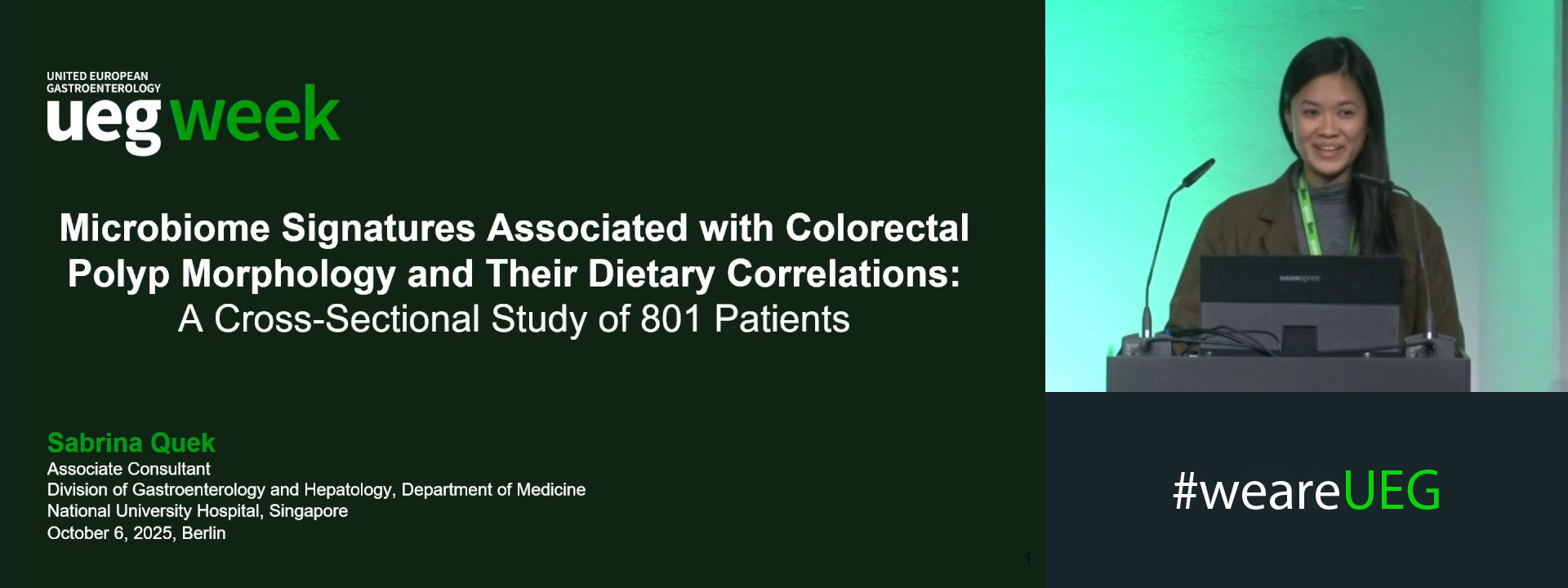
MICROBIOME SIGNATURES ASSOCIATED WITH COLORECTAL POLYP MORPHOLOGY AND THEIR DIETARY CORRELATIONS: A CROSS-SECTIONAL STUDY OF 801 PATIENTS
Sabrina Quek 1, Liu Lin 2, Shi Min Sim 2, Xiaodan Cai 2, Shanni Chen 2, Thavit Ang Kheng Soon 2, Raymond Liang 3, Calvin Koh 2, Ker Kan Tan 4, Jeremy Lim 5, Feng Zhu 2, Khay Guan Yeoh 6, Jonathan Lee 7
1 Division of Gastroenterology and Hepatology, National University Hospital, Singapore, Singapore, Singapore
2 National University of Singapore, Yong Loo Lin School of Medicine, Singapore, Singapore
3 Tan Tock Seng Hospital, Singapore, Singapore
4 National University Hospital, Singapore, Singapore
5 Asia Microbiome Library Pte Ltd, Singapore, Singapore
6 National University of Singapore, Yong Loo Lin School of Medicine, Singapore, Singapore|||Division of Gastroenterology and Hepatology, National University Hospital, Singapore, Singapore, Singapore
7 National University of Singapore, Yong Loo Lin School of Medicine, Singapore, Singapore|||National University Health System, Singapore, Singapore, Singapore|||iHealthtech, National University of Singapore, Singapore, Singapore
Event
Submission format
Session
Citation
Published
Log in to access this content.
Free for all myUEG account holders. Your access level is set automatically based on your occupation. Medical professionals get full access to all content. If you are a non-medical user, you can only access UEG Week content from congresses you attended.
Not sure what you can access? Learn more about account types.
THE PODIUM STUDY: A THREE-ARM COMPARISON OF TARGET THERAPIES AFTER ANTI-TNFΑ IN ULCERATIVE COLITIS – AN INTERIM ANALYSIS
Giuseppe Privitera 1, Cristina Bezzio 2, Edoardo Vincenzo Savarino 3, Daniela Pugliese 4, Daniele Noviello 5, Iago Rodríguez-Lago 6, Manuel Barreiro de Acosta 7, Sara Onali 8, Massimo Claudio Fantini 8, Konstantinos Karmiris 9, Henit Yanai 10, Ana Gutiérrez-Casbas 11, Luca Pastorelli 1, María Chaparro 12, Yamile Zabana 13, Alessandro Armuzzi 2
1 Università degli Studi di Milano, Milan, Italy
2 IBD Center, IRCCS Humanitas Research Hospital, Rozzano, Milan, Italy
3 University of Padua, Division of Gastroenterology, Padua, Italy
4 Fondazione Policlinico Universitario "A. Gemelli" IRCCS, Rome, Italy
5 University of Milan, Milano, Italy
6 Hospital Universitario de Galdakao, Bilbao, Spain
7 University Hospital of Santiago, Santiago de Compostela, Spain
8 University of Cagliari, Cagliari, Italy
9 Venizeleio General Hospital, Heraklion, Greece
10 RABIN Medical Center, Tel Aviv, Israel
11 Hospital General Universitario Alicante, Alicante, Spain
12 Hospital Universitario de La Princesa, Madrid, Spain
13 Hospital Universitari Mútua Terrassa, Terrassa, Spain
Event
Submission format
Citation
Published
Log in to access this content.
Free for all myUEG account holders. Your access level is set automatically based on your occupation. Medical professionals get full access to all content. If you are a non-medical user, you can only access UEG Week content from congresses you attended.
Not sure what you can access? Learn more about account types.
Who is at risk?
1 University Hospital North Tees NHS Dept. of Gastroenterology - Gastroenterology, University Hospital, Stockton-on-Tees, United Kingdom
Event
Topics
Session