UEG's content platform for gastroenterology education bringing recordings, courses, guidelines, and more together in one place.
Trending on Gutflix
Rate for better recommendations!
Your feedback helps us show you more of what you like and less of what you dislike!
Log in to continue.
This content is part of Gutflix. Log in with your myUEG account, or create one free, to watch it.
Not sure what you can access? Learn more about account types.
Can surgery be the cure?
Affiliations
1 ASST Fatebenefratelli Sacco - Ospedale Luigi Sacco Polo Universitario, Milano, Italy
Log in to continue.
This content is part of Gutflix. Log in with your myUEG account, or create one free, to watch it.
Not sure what you can access? Learn more about account types.
When the acid is gone: Dealing with gastric atrophy
Affiliations
1 Fondazione IRCCS Policlinico San Matteo, University of Pavia, Pavia, Italy
Log in to continue.
This content is part of Gutflix. Log in with your myUEG account, or create one free, to watch it.
Not sure what you can access? Learn more about account types.
Life after liver transplant
Affiliations
1 Hospital Clínic de Barcelona, Barcelona, Spain
Log in to continue.
This content is part of Gutflix. Log in with your myUEG account, or create one free, to watch it.
Not sure what you can access? Learn more about account types.
Management of pouchitis and Crohn’s disease of the pouch
Affiliations
1 Columbia University Irving Medical Center, New York, United States of America
Log in to continue.
This content is part of Gutflix. Log in with your myUEG account, or create one free, to watch it.
Not sure what you can access? Learn more about account types.
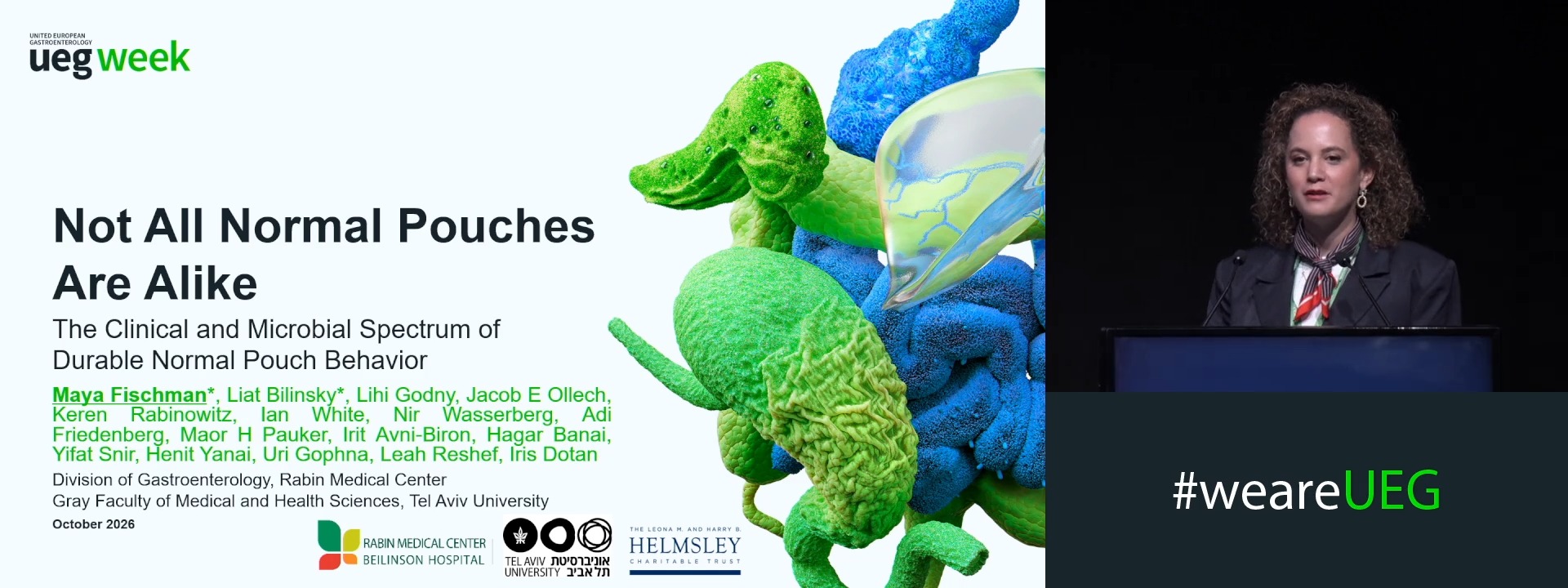
NOT ALL NORMAL POUCHES ARE ALIKE: THE CLINICAL AND MICROBIAL SPECTRUM OF DURABLE NORMAL POUCH BEHAVIOR
Maya Fischman 1, Liat Bilinsky 2, Lihi Godny 1,2, Jacob E. Ollech 2,3, Keren M Rabinowitz 1,2, Ian White 2,4, Nir Wasserberg 2,4, Adi Friedeberg 1, Maor Pauker 1, Irit Avni-Biron 1,2, Hagar Banai Eran 1,2, Yifat Snir 1,2, Henit Yanai 1,2, Leah Reshef 2, Uri Gophna 2, Iris Dotan 1,2
Affiliations
1 Rabin Medical Center, Beilinson Campus, Petah Tikva, Israel
2 Tel Aviv University, Tel Aviv, Israel
3 Meir Medical Center, Kfar Sava, Israel
4 Rabin Medical Center, Petah Tikva, Israel
Log in to continue.
This content is part of Gutflix. Log in with your myUEG account, or create one free, to watch it.
Not sure what you can access? Learn more about account types.
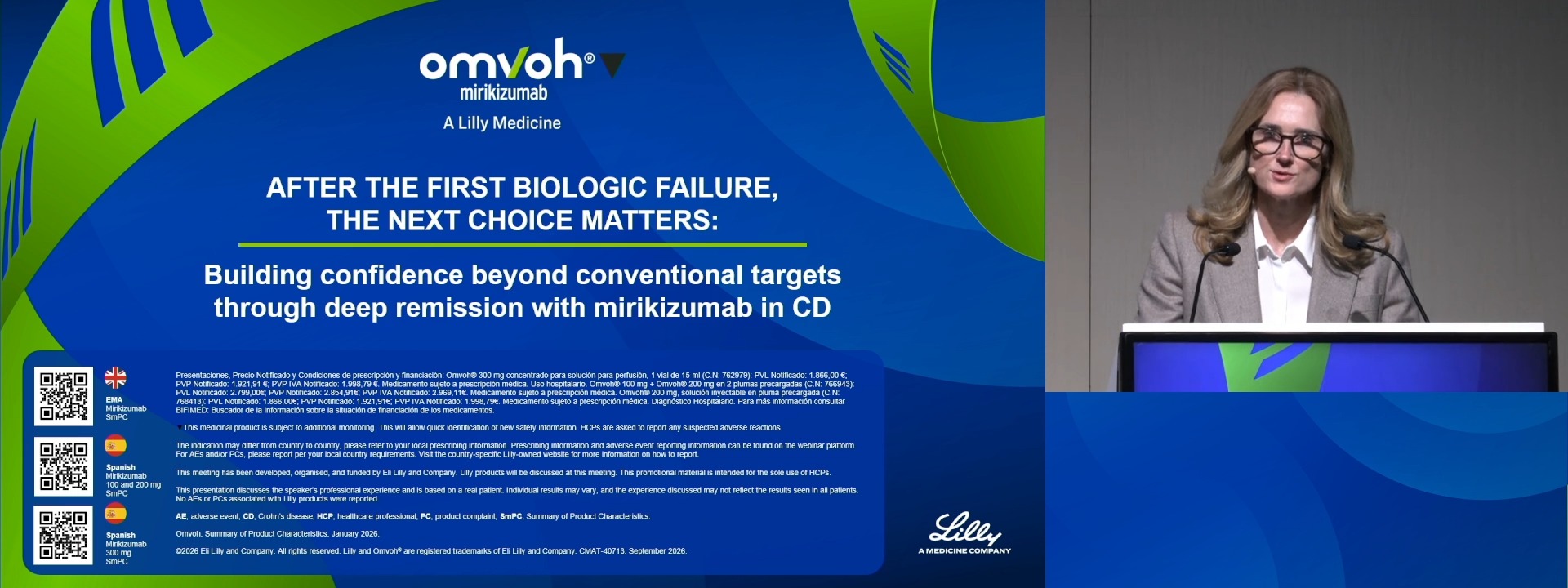
After the first biologic failure, the next choice matters: Building confidence beyond conventional targets through deep remission with mirikizumab in CD (Eli Lilly and Company) (Complete Session)
Affiliations
1 Translational Gastroenterology Unit, Oxford University Hospital, Oxford, United Kingdom
2 University Hospitals Leuven, Leuven, Belgium
3 Department of Internal Medicine I, University Hospital Schleswig-Holstein, Kiel University, Kiel, Germany