UEG's educational platform for gastroenterology education bringing recordings, courses, guidelines, and more together in one place.
Most popular content
Rate for better recommendations!
Your feedback helps us show you more of what you like and less of what you dislike!
Log in to access this content.
Free for all myUEG account holders. Your access level is set automatically based on your occupation. Medical professionals get full access to all content. If you are a non-medical user, you can only access UEG Week content from congresses you attended.
Not sure what you can access? Learn more about account types.
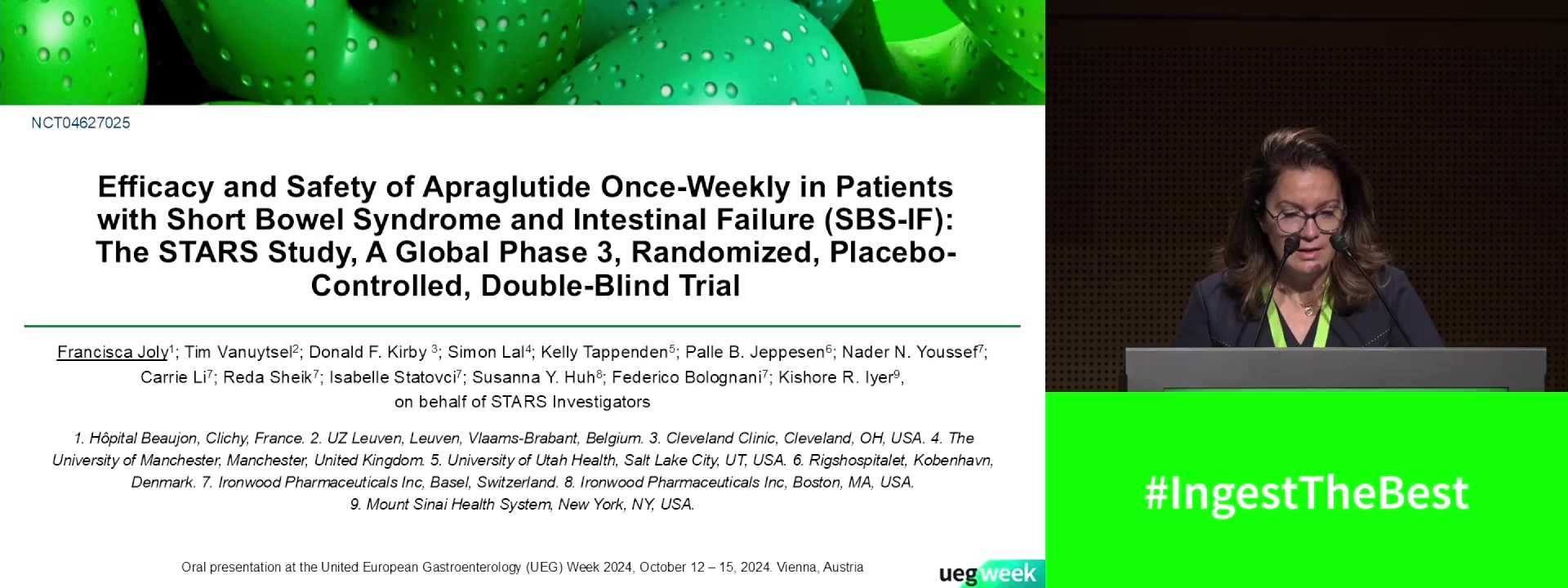
EFFICACY AND SAFETY OF APRAGLUTIDE ONCE-WEEKLY IN PATIENTS WITH SHORT BOWEL SYNDROME AND INTESTINAL FAILURE (SBS-IF): RESULTS FROM THE STARS STUDY – A GLOBAL PHASE 3 DOUBLE-BLIND, RANDOMIZED, PLACEBO-CONTROLLED TRIAL
Francisca Joly 1, Tim Vanuytsel 2, Donald Kirby 3, Simon Lal 4, Kelly Tappenden 5, Palle Bekker Jeppesen 6, Nader N. Youssef 7, Carrie Li 7, Reda Sheik 7, Isabelle Statovci 7, Susanna Huh 8, Federico Bolognani 7, Kishore Iyer 9
1 Beaujon Hospital Service de Gastroenterologie, Clichy, France
2 KU Leuven, Leuven, Belgium
3 Cleveland Clinic, Cleveland, United States
4 University of Manchester, Manchester, United Kingdom
5 The University of Utah, Salt Lake City, United States
6 Rigshospitalet, Copenhagen, Denmark
7 Ironwood Pharmaceuticals, Basel, Switzerland
8 Ironwood Pharmaceuticals, Boston, United States
9 Mount Sinai Medical Center, New York, United States
Event
Topics
Submission format
Session
Citation
Published
Log in to access this content.
Free for all myUEG account holders. Your access level is set automatically based on your occupation. Medical professionals get full access to all content. If you are a non-medical user, you can only access UEG Week content from congresses you attended.
Not sure what you can access? Learn more about account types.
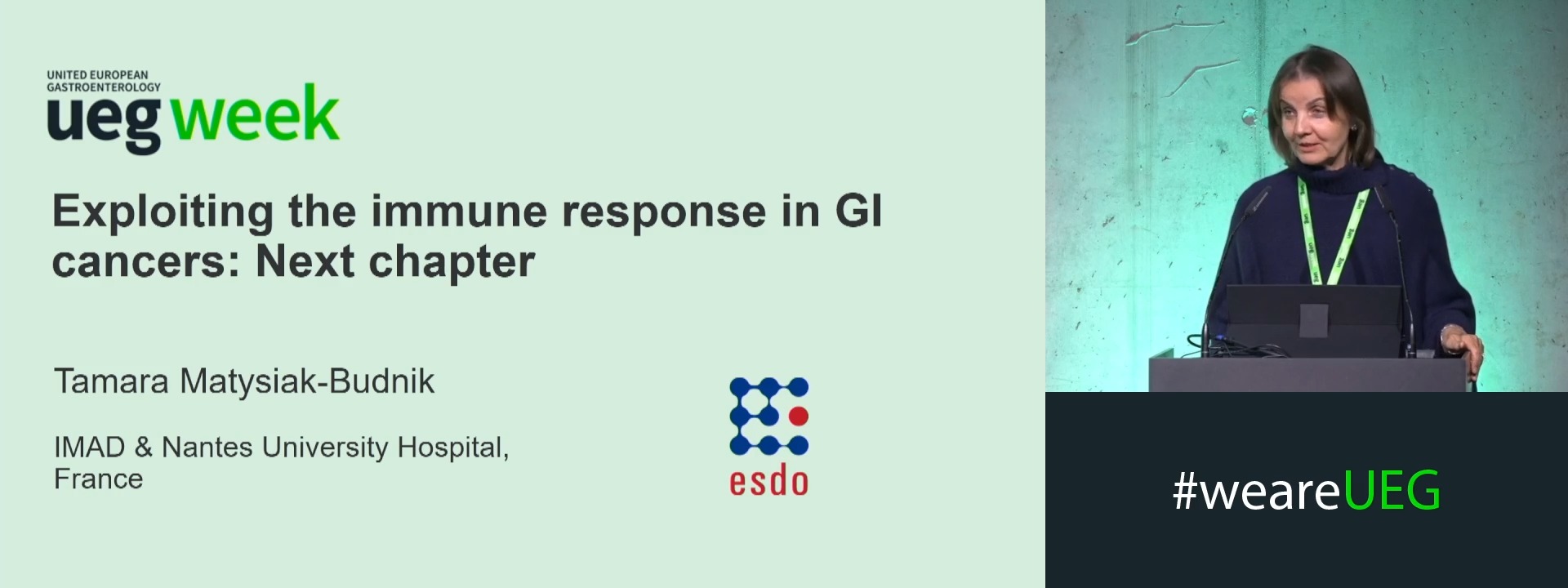
Exploiting the immune response in GI cancer: Next chapter
1 CHU de Nantes IMAD, Nantes, France
Event
Topics
Citation
Published
Log in to access this content.
Free for all myUEG account holders. Your access level is set automatically based on your occupation. Medical professionals get full access to all content. If you are a non-medical user, you can only access UEG Week content from congresses you attended.
Not sure what you can access? Learn more about account types.
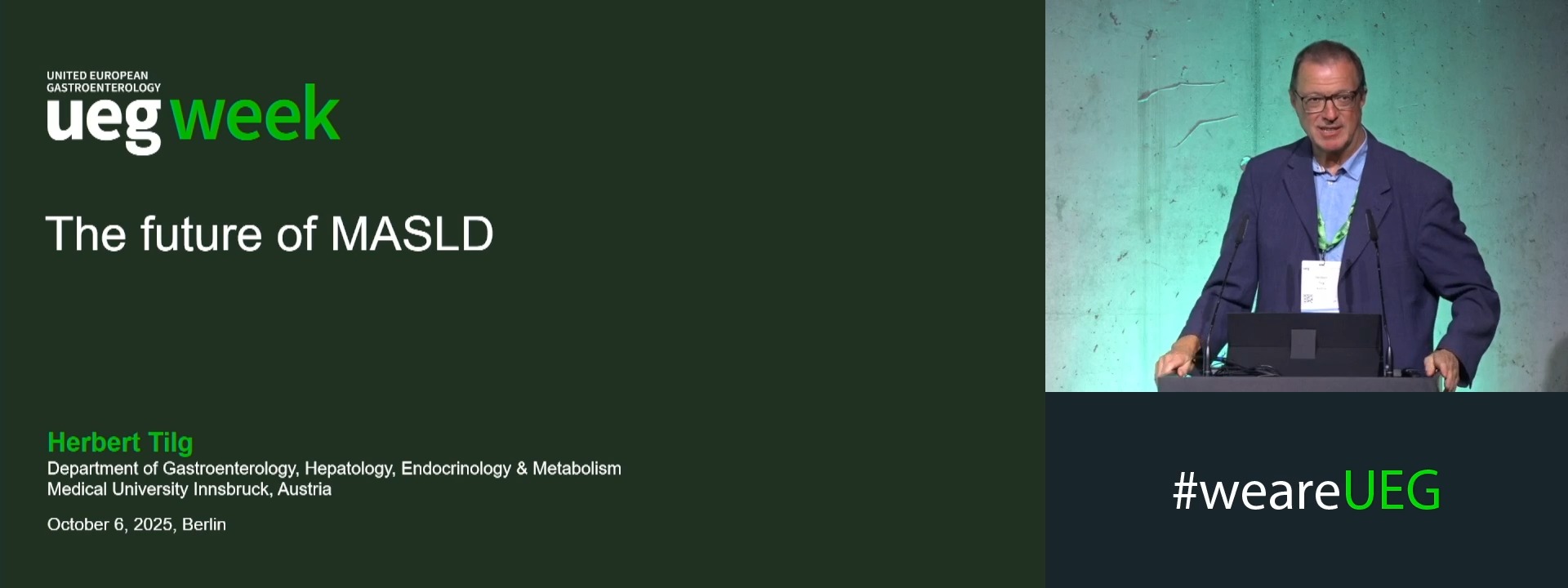
The future of MASLD
1 Innsbruck Medical University - Department of Medicine, Innsbruck Medical University; Innsbruck/AT, Innsbruck, Austria
Event
Topics
Citation
Published
Log in to access this content.
Free for all myUEG account holders. Your access level is set automatically based on your occupation. Medical professionals get full access to all content. If you are a non-medical user, you can only access UEG Week content from congresses you attended.
Not sure what you can access? Learn more about account types.
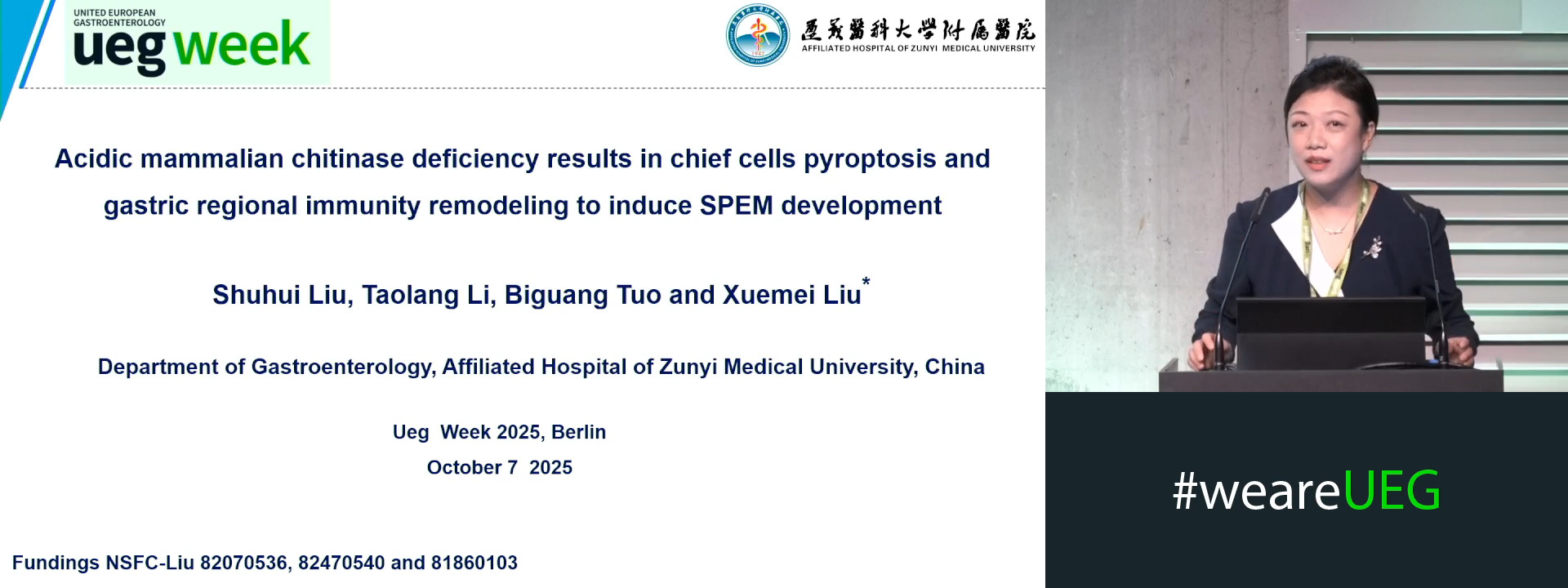
ACIDIC MAMMALIAN CHITINASE DEFICIENCY RESULTS IN CHIEF CELLS PYROPTOSIS AND GASTRIC REGIONAL IMMUNITY REMODELING IS THE NEW CELLULAR ORIGIN OF SPEM
1 Affiliated Hospital of Zunyi Medical University, Zunyi, China
Event
Topics
Submission format
Citation
Published
Log in to access this content.
Free for all myUEG account holders. Your access level is set automatically based on your occupation. Medical professionals get full access to all content. If you are a non-medical user, you can only access UEG Week content from congresses you attended.
Not sure what you can access? Learn more about account types.
Panel discussion: When the alarm bells go off - Approach to acute severe colitis
Event
Citation
Published
Log in to access this content.
Free for all myUEG account holders. Your access level is set automatically based on your occupation. Medical professionals get full access to all content. If you are a non-medical user, you can only access UEG Week content from congresses you attended.
Not sure what you can access? Learn more about account types.
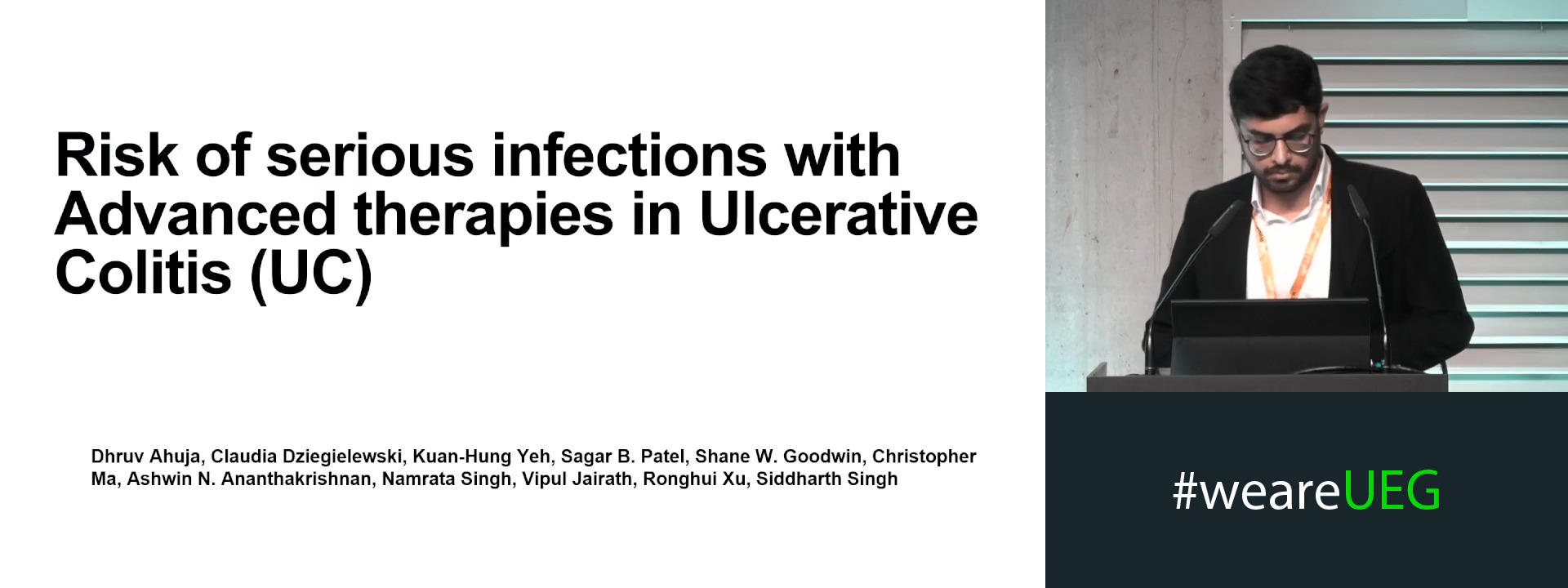
COMPARATIVE RISK OF ADVANCED BIOLOGICAL AGENTS FOR SERIOUS INFECTIONS IN PATIENTS WITH ULCERATIVE COLITIS: ANALYSIS FROM REAL WORLD COHORT
Dhruv Ahuja 1, Claudia Dziegielewski 2, Kuan-Hung Yeh 2, Sagar B. Patel 2, Shane W. Goodwin 3, Christopher Ma 4, Ashwin N. Ananthakrishnan 5, Namrata Singh 6, Vipul Jairath 3, Ronghui Xu 7, Siddharth Singh 2
1 University of California, San Diego, USA; Indira Gandhi Hospital, New Delhi, San Diego, United States
2 University of California, San Diego, USA, San Diego, United States
3 Western University, London, Ontario, Canada, Ontario, Canada
4 University of Caglary, Calgary, Canada
5 Harvard Medical School, Boston, Massachusetts, USA, Boston, United States
6 University of Washington, Seattle, Washington, USA, Seattle, United States
7 University of California, San Diego, San Diego, United States
Event
Submission format
Session
Citation
Published
Log in to access this content.
Free for all myUEG account holders. Your access level is set automatically based on your occupation. Medical professionals get full access to all content. If you are a non-medical user, you can only access UEG Week content from congresses you attended.
Not sure what you can access? Learn more about account types.
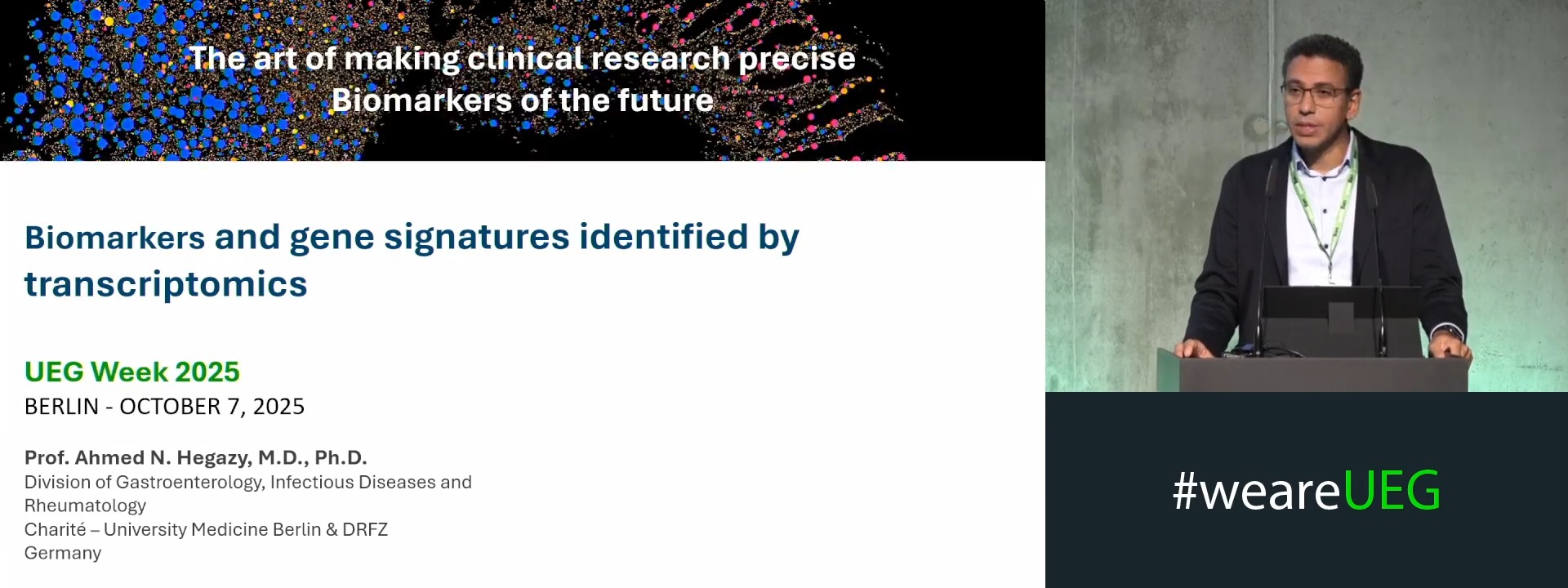
Biomarkers and gene signatures identified by transcriptomics
1 Charité – Universitätsmedizin Berlin, Berlin, Germany