UEG's educational platform for gastroenterology education bringing recordings, courses, guidelines, and more together in one place.
Most popular content
Rate for better recommendations!
Your feedback helps us show you more of what you like and less of what you dislike!
Log in to access this content.
Free for all myUEG account holders. Your access level is set automatically based on your occupation. Medical professionals get full access to all content. If you are a non-medical user, you can only access UEG Week content from congresses you attended.
Not sure what you can access? Learn more about account types.

ESCC-ECURA: A NOVEL SCORING SYSTEM TO ASSESS CURABILITY AFTER ENDOSCOPIC SUBMUCOSAL DISSECTION FOR SUPERFICIAL ESOPHAGEAL SQUAMOUS CELL CARCINOMA
1 Changhai Hospital, Naval Medical University, Shanghai, China
Conference
Topics
Submission format
Citation
Published
Log in to access this content.
Free for all myUEG account holders. Your access level is set automatically based on your occupation. Medical professionals get full access to all content. If you are a non-medical user, you can only access UEG Week content from congresses you attended.
Not sure what you can access? Learn more about account types.
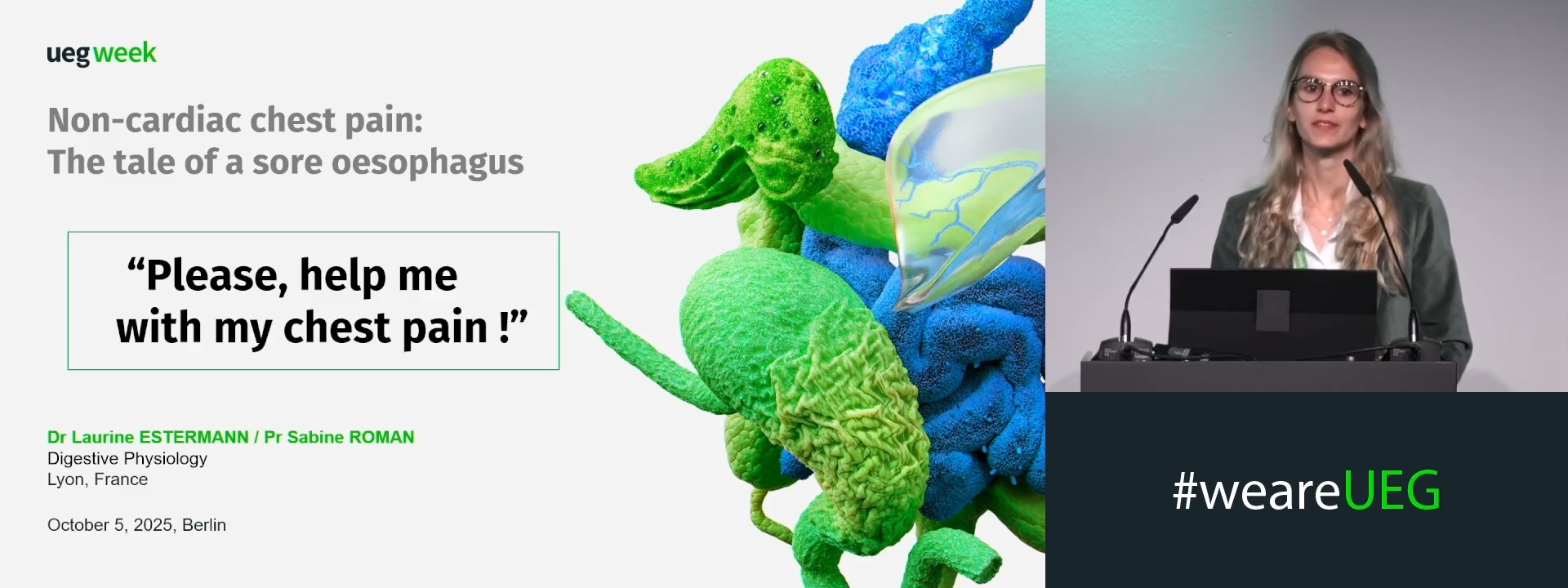
"Please, help me with my chest pain!"
1 Hospices Civils de Lyon, Lyon, France
Event
Topics
Citation
Published
Log in to access this content.
Free for all myUEG account holders. Your access level is set automatically based on your occupation. Medical professionals get full access to all content. If you are a non-medical user, you can only access UEG Week content from congresses you attended.
Not sure what you can access? Learn more about account types.
ONE SUBCUTANEOUS INJECTION OF MIRIKIZUMAB IS BIOEQUIVALENT TO TWO SUBCUTANEOUS INJECTIONS: RESULTS FROM A PHARMACOKINETIC COMPARABILITY STUDY IN HEALTHY PARTICIPANTS
Yuki Otani 1, Christopher D. Payne 1, Edward V Loftus Jr 2, Geert R. D'Haens 3, Shomron Ben-Horin 4, Abhishek Upadhya K 1, Kris Todd 1, Paola Pellanda 1, Xin Zhang 1
1 Eli Lilly and Company, Indianapolis, United States
2 Mayo Clinic College of Medicine and Science, Rochester, United States
3 Amsterdam University Medical Centers, Amsterdam, Netherlands
4 University of Tel Aviv, Sheba Medical Center, Tel-Hashomer, Israel
Conference
Topics
Submission format
Session
Citation
Published
Log in to access this content.
Free for all myUEG account holders. Your access level is set automatically based on your occupation. Medical professionals get full access to all content. If you are a non-medical user, you can only access UEG Week content from congresses you attended.
Not sure what you can access? Learn more about account types.
DOES THE CURRENT THERAPEUTIC PARADIGM CHANGE THE OUTCOME IN PATIENTS AT THE FIRST EPISODE OF ACUTE SEVERE ULCERATIVE COLITIS REFRACTORY TO CORTICOSTEROIDS?
Pedro Lages Martins 1, Maria Francisco 1, RITA MATOS PRATA 1, Sara Mendez Santos 1, Verónica Pavão Borges 1, Joana saiote 1, Diana Filipa Bernardo Carvalho 1, Jaime Ramos 1
1 Unidade Local de Saúde São José, Lisbon, Portugal
Conference
Topics
Submission format
Session
Citation
Published
Log in to access this content.
Free for all myUEG account holders. Your access level is set automatically based on your occupation. Medical professionals get full access to all content. If you are a non-medical user, you can only access UEG Week content from congresses you attended.
Not sure what you can access? Learn more about account types.
SURVEY OF MANAGEMENT HABITS & EMOTIONAL IMPACT IN PATIENTS WITH SELF-REPORTED IRRITABLE BOWEL SYNDROME (IBS)
1 Reckitt, Hull, United Kingdom
2 Reckitt, Slough, United Kingdom
Conference
Topics
Submission format
Session
Citation
Published
Log in to access this content.
Free for all myUEG account holders. Your access level is set automatically based on your occupation. Medical professionals get full access to all content. If you are a non-medical user, you can only access UEG Week content from congresses you attended.
Not sure what you can access? Learn more about account types.
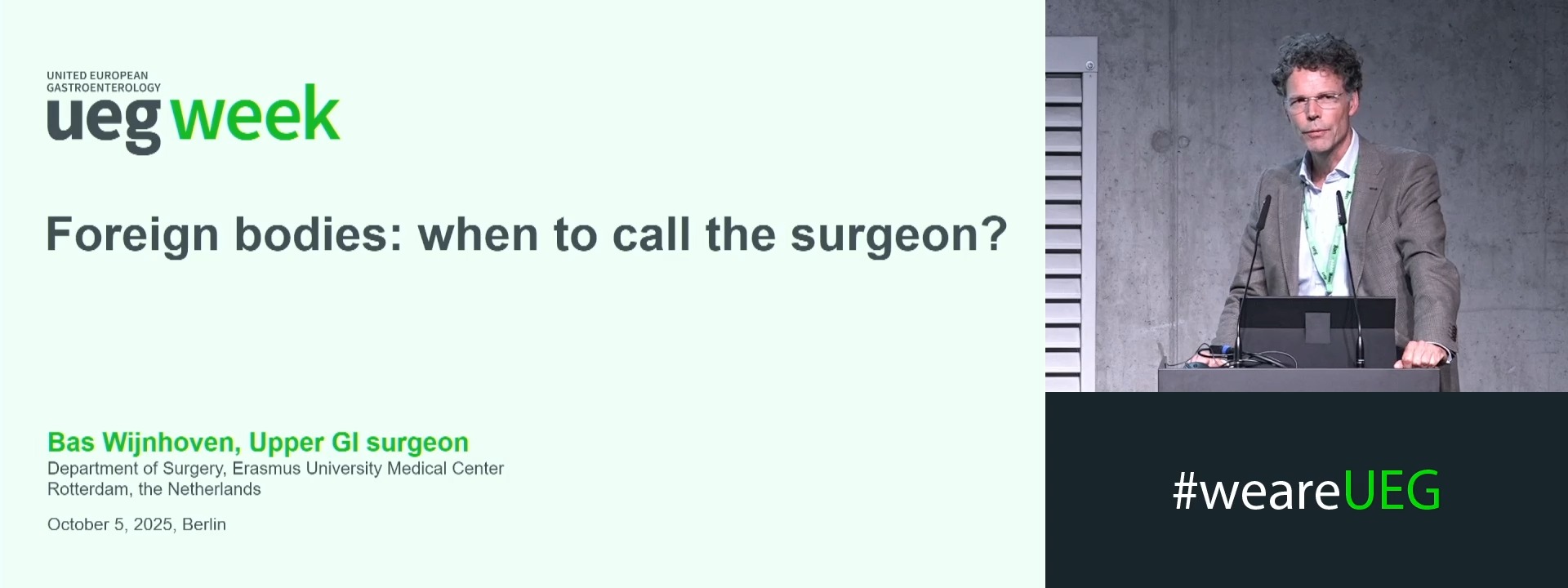
When to call the surgeon?
1 Erasmus MC Rotterdam Dept. of Surgery, Rotterdam, Netherlands
Event
Topics
Session
Citation
Published
Log in to access this content.
Free for all myUEG account holders. Your access level is set automatically based on your occupation. Medical professionals get full access to all content. If you are a non-medical user, you can only access UEG Week content from congresses you attended.
Not sure what you can access? Learn more about account types.
INCIDENCE AND RISK FACTORS FOR DISEASE PROGRESSION IN PATIENTS WITH ULCERATIVE PROCTITIS: A RETROSPECTIVE COHORT STUDY
Robert-Jan Pierik 1, Lauranne Derikx 1, Jildou Hoekstra 2, Richard Post 1, Rosanne van Dongen 2, Annemarie de Vries 1, Alexander Bodelier 2
1 Erasmus University Medical Center, Rotterdam, Netherlands
2 Amphia Hospital, Breda, Netherlands
Conference
Topics