UEG Week Recordings UEG Week Posters Online courses Guidelines Mistakes in... Podcasts Webinars
Visit ueg.eu Create myUEG account Log In

Filters:

UEG Online Course
accredited
Share via Email Share on Facebook Share on X Share on LinkedIn Share on Bluesky

Log in to access this content.

Free for all myUEG account holders. Your access level is set automatically based on your occupation. Medical professionals get full access to all content. If you are a non-medical user, you can only access UEG Week content from congresses you attended.

Log In Create a free account

Not sure what you can access? Learn more about account types.

The diagnosis and treatment of gastro-oesophageal reflux disease (GORD) have been driven by our knowledge of its pathophysiology. From equating GORD with oesophagitis and hiatal hernia to identifying the role of transient lower oesophageal sphincter relaxations, different GORD phenotypes and microscopic features, the pathophysiology is now understood to be multifactorial.

This online course covers the different components that contribute to the pathophysiology of GORD by following the path of the refluxate. The role of the stomach, antireflux barrier, refluxate, clearance mechanisms, mucosa and symptom perception are each considered in turn.  

Learning objectives

  • To understand that the pathophysiology of GORD is multifactorial
  • To become familiar with each of the individual pathophysiology abnormalities
  • To realize that patients with different GORD phenotypes may have different underlying pathophysiological mechanisms
  • To recognize that treatment of GORD should be designed to modify the specific pathophysiology
  • To appreciate that patients with GORD who have similar symptoms but different pathophysiology mechanisms may need different treatments

Target audience

This course is suitable for gastroenterologists in training, but is also appropriate for physicians and surgeons in other disciplines, as well as nurses, biotechnicians and advanced-years’ medical students who have an interest in gastroenterology. 


GORD Pathophysiology - Part 1

GORD Pathophysiology - Part 1

Daniel Sifrim, Kornilia Nikaki

Event

GORD Pathophysiology Part 1

Topics

Neurogastroenterology & Motility Oesophagus

Accreditation status

accredited

Duration

1 hour

Published

2018
Login to access
UEG Online Course
New
accredited
Share via Email Share on Facebook Share on X Share on LinkedIn Share on Bluesky

Log in to access this content.

Free for all myUEG account holders. Your access level is set automatically based on your occupation. Medical professionals get full access to all content. If you are a non-medical user, you can only access UEG Week content from congresses you attended.

Log In Create a free account

Not sure what you can access? Learn more about account types.

This course builds on foundational concepts to examine contemporary mechanisms driving GORD phenotypes. We revisit key epidemiological and clinical distinctions before exploring gastric physiology, including postprandial acid–bile dynamics, H. pylori-related acid output, motility patterns, obesity-related changes, and post-surgical anatomy. Oesophagogastric junction competence (LES pressure, TLESRs, hiatal hernia) and refluxate characteristics (acidic to gaseous; PPI-modified) are discussed with emphasis on symptom generation. We detail epithelial biology, micro- and macroinflammatory responses across NERD and erosive disease, and advances in nociceptive signalling, receptor expression, central modulation, and hypervigilance. Key clinical studies, cytokine-driven pathways, and emerging therapeutic approaches are highlighted. The course concludes with implications for diagnosis, phenotype-guided management, and outstanding research questions.

GORD Pathophysiology  - Part 2

GORD Pathophysiology - Part 2

Edoardo Savarino, Ahsen Ustaoglu

Event

GORD Pathophysiology Part 2

Topics

Neurogastroenterology & Motility

Accreditation status

accredited

Duration

1 hour

Published

2026
Login to access
UEG Online Course
accredited
Share via Email Share on Facebook Share on X Share on LinkedIn Share on Bluesky

Log in to access this content.

Free for all myUEG account holders. Your access level is set automatically based on your occupation. Medical professionals get full access to all content. If you are a non-medical user, you can only access UEG Week content from congresses you attended.

Log In Create a free account

Not sure what you can access? Learn more about account types.

Gastro-oesophageal reflux disease (GORD) is a highly prevalent condition that negatively impacts quality of life and confers considerable healthcare costs. Although various symptoms are associated with GORD, none are characteristic for diagnosis of the disease.

This online course covers needs in the diagnosis of GORD, symptoms and questionnaires, the PPI test, endoscopy and biopsies, reflux monitoring, oesophageal manometry, barium studies and other biomarkers. Conclusive, inconclusive and paediatric GORD are also considered. 

Learning objectives

  • To understand how to reach a conclusive diagnosis of GORD
  • To know how to reach a conclusive diagnosis of no GORD
  • To understand how to deal with an inconclusive diagnosis

Target audience

This course is suitable for gastroenterologists in training and physicians and surgeons in other disciplines, as well as nurses, biotechnicians and advanced-years’ medical students who have an interest in gastroenterology. 

GORD Diagnosis

GORD Diagnosis

Daniel Sifrim, Kornilia Nikaki

Event

GORD Diagnosis

Topics

Neurogastroenterology & Motility Oesophagus

Accreditation status

accredited

Duration

1 hour

Published

2018
Login to access
UEG Mistakes In Articles
Share via Email Share on Facebook Share on X Share on LinkedIn Share on Bluesky

Log in to access this content.

Free for all myUEG account holders. Your access level is set automatically based on your occupation. Medical professionals get full access to all content. If you are a non-medical user, you can only access UEG Week content from congresses you attended.

Log In Create a free account

Not sure what you can access? Learn more about account types.

According to the Montreal definition, “[gastro-oesophageal reflux disease (GORD)] is a condition which develops when the reflux of stomach contents causes troublesome symptoms and/or complications.”1 GORD has a negative effect on quality of life and is frequently encountered in clinical practice, with an estimated prevalence of around 24% in Europe. In the US, GORD-related healthcare costs account for $9 billion per year. A variety of symptoms are associated with GORD—heartburn and regurgitation are typical symptoms, while chest pain, cough and sore throat are considered atypical symptoms—but none is pathognomonic

Mistakes in gastro-oesophageal reflux disease diagnosis and how to avoid them

Mistakes in gastro-oesophageal reflux disease diagnosis and how to avoid them

Francois Mion, Sabine Roman

Topics

Neurogastroenterology & Motility Oesophagus

Citation

Roman S and Mion F. Mistakes in gastro-oesophageal reflux disease and how to avoid them. UEG Education 2017; 17: 24–26.

Published

2024
UEG Podcast Episode
UEG Podcast
Share via Email Share on Facebook Share on X Share on LinkedIn Share on Bluesky

Log in to access this content.

Free for all myUEG account holders. Your access level is set automatically based on your occupation. Medical professionals get full access to all content. If you are a non-medical user, you can only access UEG Week content from congresses you attended.

Log In Create a free account

Not sure what you can access? Learn more about account types.

Academic do's & don'ts

Gianluca Ianiro, Egle Dieninyte - Misiune

Published

2024
UEG Presentation
Share via Email Share on Facebook Share on X Share on LinkedIn Share on Bluesky
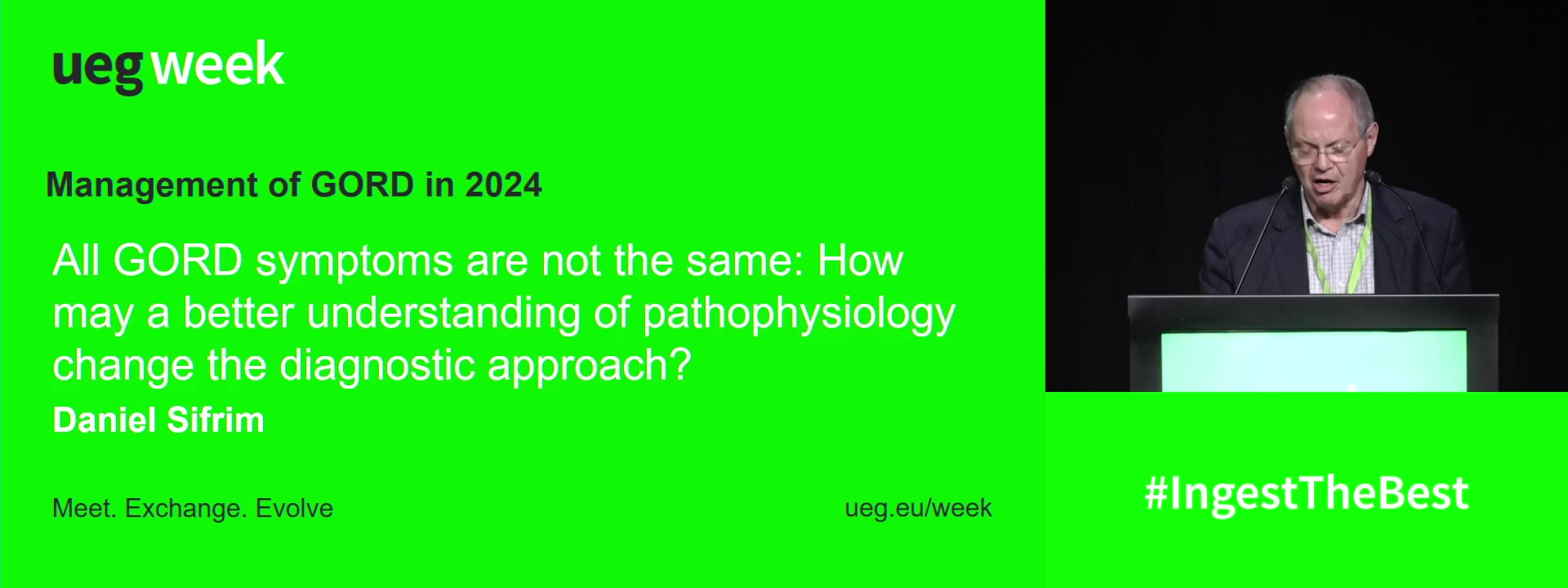
All GORD symptoms are not the same: How may a better understanding of pathophysiology change the diagnostic approach?

Log in to access this content.

Free for all myUEG account holders. Your access level is set automatically based on your occupation. Medical professionals get full access to all content. If you are a non-medical user, you can only access UEG Week content from congresses you attended.

Log In Create a free account

Not sure what you can access? Learn more about account types.

All GORD symptoms are not the same: How may a better understanding of pathophysiology change the diagnostic approach?

Daniel Sifrim 1

1 Queen Mary University London, Blizard Institute, London, United Kingdom

Event

UEG Postgraduate Teaching Programme Vienna 2024

Topics

Education & Training Neurogastroenterology & Motility Oesophagus Primary Care Stomach & H. Pylori Surgery

Session

Management of GORD in 2024

Citation

United European Gastroenterology Journal 2024; 12 (Supplement 8)

Published

2024
UEG Podcast Episode
UEG Podcast
Share via Email Share on Facebook Share on X Share on LinkedIn Share on Bluesky

Log in to access this content.

Free for all myUEG account holders. Your access level is set automatically based on your occupation. Medical professionals get full access to all content. If you are a non-medical user, you can only access UEG Week content from congresses you attended.

Log In Create a free account

Not sure what you can access? Learn more about account types.

Oesophageal cancer with Massimiliano di Pietro (Part 1)

Massimiliano di Pietro, Pradeep Mundre

Topics

Digestive Oncology Endoscopy Oesophagus

Published

2025

The global reference point for the digestive health community

Platform Publisher

United European Gastroenterology

Wickenburggasse 1 1080 Vienna, Austria

Contact us

support@ueg.eu

ueg.eu

T: +43 1 997 1639

Legal

Terms & Conditions

Imprint

Privacy Policy

Explore

My Bookmarks

My recommendations

My fields of interest

© 2026 United European Gastroenterology

Change fields of interest

These fields are selected based on the interests in your myUEG profile.
Click the item to unselect it. You can select multiple items.