UEG's educational platform for gastroenterology education bringing recordings, courses, guidelines, and more together in one place.
Most popular content
Rate for better recommendations!
Your feedback helps us show you more of what you like and less of what you dislike!
Log in to access this content.
Free for all myUEG account holders. Your access level is set automatically based on your occupation. Medical professionals get full access to all content. If you are a non-medical user, you can only access UEG Week content from congresses you attended.
Not sure what you can access? Learn more about account types.

CLINICAL PROOF OF PRINCIPLE AND FAVORABLE TOLERABILITY PROFILE SHOWN WITH ORALLY DOSED MORF-057 AS INDUCTION THERAPY FOR MODERATELY TO SEVERELY ACTIVE UC: PHASE 2A EMERALD-1 STUDY RESULTS
Bruce E. Sands 1, Stefan Schreiber 2, Silvio Danese 3, Jaroslaw Kierkus 4, Brihad Abhyankar 5, Michael Choi 5, Carolyn Soo 5, Yujun Wu 5, Fangui Sun 5, Dooyoung Lee 5, Dan Cui 5, Cuyue Tang 5, Maloy Mangada 5, Ali Hussain 5, Peter Linde 6, Adrian Ray 6, Oladele Babalola 5, Sharon Brown 5, Sarah Hammer 5, Kerry McConie 5, Bruce Rogers 5, Laurent Peyrin-Biroulet 7, Brian G. Feagan 8
1 Icahn School of Medicine at Mount Sinai, New York, United States
2 University Hospital Schleswig-Holstein, Kiel, Germany
3 Vita-Salute San Raffaele University - IRCCS San Raffaele Scientific Institute, Milan, Italy
4 Children’s Memorial Health Institute, Warsaw, Poland
5 Morphic Therapeutic, Waltham, United States
6 Past Employee of Morphic Therapeutic, Waltham, United States
7 Inserm U1256, Nancy University Hospital, Vandoeuvre-les-Nancy, France
8 The University of Western Ontario, London, Canada
Conference
Topics
Submission format
Citation
Published
Log in to access this content.
Free for all myUEG account holders. Your access level is set automatically based on your occupation. Medical professionals get full access to all content. If you are a non-medical user, you can only access UEG Week content from congresses you attended.
Not sure what you can access? Learn more about account types.

SODIUM BUTYRATE SUPPLEMENTATION SIGNIFICANTLY IMPROVED CLINICAL OUTCOMES AND QUALITY OF LIFE IN PATIENTS WITH CROHN’S DISEASE – RESULTS FROM A RANDOMISED PLACEBO-CONTROLLED STUDY
Sonia Facchin 1, Matteo Calgaro 2, Mattia Pandolfo 2, Carlo Redavid 1, Brigida Barberio 3, Fabiana Zingone 1, Fabiana Zingone 2, Edoardo Vincenzo Savarino 1
1 University of Padua, Padova, Italy
2 University of Verona, Verona, Italy
3 Azienda Ospedaliera Di Padova, Padova, Italy
Conference
Topics
Submission format
Citation
Published
Log in to access this content.
Free for all myUEG account holders. Your access level is set automatically based on your occupation. Medical professionals get full access to all content. If you are a non-medical user, you can only access UEG Week content from congresses you attended.
Not sure what you can access? Learn more about account types.

IMPACT OF OZANIMOD (OZA) ON INTERLEUKIN-17A (IL-17A) LEVELS AND THE ASSOCIATION WITH OZA EFFICACY IN PATIENTS (PTS) WITH MODERATELY TO SEVERELY ACTIVE ULCERATIVE COLITIS (UC): RESULTS FROM THE PHASE 3 TRUE NORTH (TN) STUDY
1 Bristol Myers Squibb, Princeton, United States
2 University of Leuven, Leuven, Belgium
Conference
Topics
Submission format
Session
Citation
Published
Log in to access this content.
Free for all myUEG account holders. Your access level is set automatically based on your occupation. Medical professionals get full access to all content. If you are a non-medical user, you can only access UEG Week content from congresses you attended.
Not sure what you can access? Learn more about account types.

EFFICACY AND SAFETY OF ETRASIMOD IN PATIENTS WITH ULCERATIVE COLITIS STRATIFIED BY BODY MASS INDEX: A POST HOC ANALYSIS FROM THE ELEVATE UC CLINICAL PROGRAMME
Andres Yarur 1, Millie Long 2, Joana Torres 3, Neilanjan Nandi 4, Raymond Cross 5, Arcangelo M. Abbatemarco 6, David Blanco 7, Wojciech Niezychowski 7, Catherine M Crosby 8, Joseph Wu 9, Gokul Pradeep 10, Martina Goetsch 11, Remo Panaccione 12
1 Cedars-Sinai Medical Center, Los Angeles, United States
2 University of North Carolina, Chapel Hill, United States
3 Hospital Beatriz Ângelo, Loures, Portugal|||Hospital da Luz, Lisbon, Portugal|||Universidade de Lisboa, Lisbon, Portugal
4 Penn Presbyterian Medical Center, University of Pennsylvania, Philadelphia, United States
5 University of Maryland School of Medicine, Baltimore, United States
6 Pfizer Inc, New York, United States
7 Pfizer Inc, Collegeville, United States
8 Pfizer Inc, La Jolla, United States
9 Pfizer Inc, Cambridge, United States
10 Pfizer Healthcare India Private Ltd, Chennai, India
11 Pfizer AG, Zürich, Switzerland
12 University of Calgary, Calgary, Canada
Conference
Topics
Submission format
Session
Citation
Published
Log in to access this content.
Free for all myUEG account holders. Your access level is set automatically based on your occupation. Medical professionals get full access to all content. If you are a non-medical user, you can only access UEG Week content from congresses you attended.
Not sure what you can access? Learn more about account types.
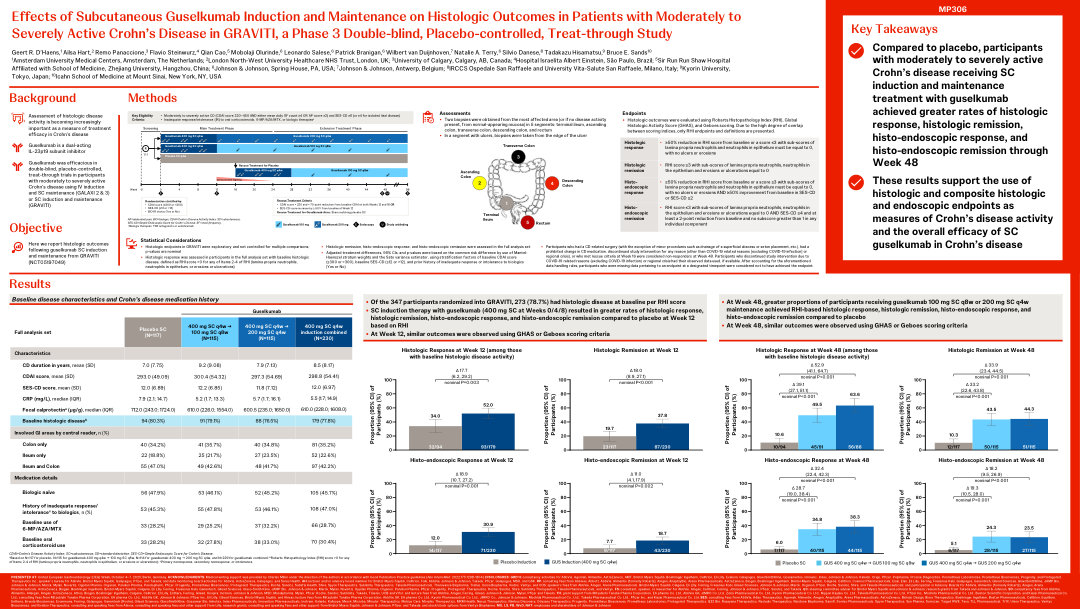
EFFECTS OF SUBCUTANEOUS GUSELKUMAB INDUCTION AND MAINTENANCE ON HISTOLOGIC OUTCOMES IN PATIENTS WITH MODERATELY TO SEVERELY ACTIVE CROHN’S DISEASE IN GRAVITI, A PHASE 3 DOUBLE-BLIND, PLACEBO-CONTROLLED, TREAT-THROUGH STUDY
Geert R. D'Haens 1, Ailsa L Hart 2, Remo Panaccione 3, Flavio Steinwurz 4, Qian Cao 5, Mobolaji Olurinde 6, Leonardo Salese 6, Patrick Branigan 6, Wilbert van Duijnhoven 7, Natalie Terry 6, Silvio Danese 8, Tadakazu Hisamatsu 9, Bruce E. Sands 10
1 Amsterdam University Medical Centers, Amsterdam, Netherlands
2 London North-West University Healthcare NHS Trust, London, United Kingdom
3 University of Calgary, Calgary, Canada
4 Hospital Israelita Albert Einstein, São Paulo, Brazil
5 Sir Run Run Shaw Hospital Affiliated with School of Medicine, Zhejiang University, Hangzhou, China
6 Johnson & Johnson, Spring House, United States
7 Johnson & Johnson, Antwerp, Belgium
8 IRCCS Ospedale San Raffaele and University Vita-Salute San Raffaele, Milano, Italy
9 Kyorin University, Tokyo, Japan
10 Icahn School of Medicine at Mount Sinai, New York, United States
Conference
Topics
Submission format
Citation
Published
Log in to access this content.
Free for all myUEG account holders. Your access level is set automatically based on your occupation. Medical professionals get full access to all content. If you are a non-medical user, you can only access UEG Week content from congresses you attended.
Not sure what you can access? Learn more about account types.

PATIENTS WITH FIBROSTENOTIC CROHN’S DISEASE CAN TOLERATE A HIGH-FIBER, LOW-FAT DIET AND EXPERIENCE AN IMPROVEMENT IN SYMPTOMS: RESULTS OF A CATERED DIET INTERVENTION STUDY
Maria A. Quintero 1, Luis C. Garces 1, Oriana Damas 2, Cristiana Mangarelli 1, Irina Fernandez 1, Hajar Hazime 1, Norma Solis 2, Rose Killian 1, Payton Mendygral 1, Mailenis Ortega 2, David Kerman 2, Amar R. Deshpande 2, Siobhan Proksell 2, Ingrid Barrera 1, Maria T. Abreu 3
1 University of Miami, Miami, United States
2 University of Miami, Miller School of Medicine, Miami, United States
3 University of Miami, Miller School of Medicine, Coral Gables, United States
Conference
Topics
Submission format
Session
Citation
Published
Log in to access this content.
Free for all myUEG account holders. Your access level is set automatically based on your occupation. Medical professionals get full access to all content. If you are a non-medical user, you can only access UEG Week content from congresses you attended.
Not sure what you can access? Learn more about account types.

REAL-WORLD STUDY ON VEDOLIZUMAB EFFICACY AND SAFETY AFTER THE TRANSITION FROM INTRAVENOUS TO SUBCUTANEOUS VEDOLIZUMAB IN INFLAMMATORY BOWEL DISEASE PATIENTS
Vlasta Orsic Fric 1, Vladimir Borzan 1, Ines Šahinović 1, Andrej Borzan 2, Marija Tripolski 3, Sven Kurbel 2
1 University Hospital Center Osijek, Osijek, Croatia|||Faculty of Medicine, J. J. Strossmayer University of Osijek, Osijek, Croatia
2 Faculty of Medicine, J. J. Strossmayer University of Osijek, Osijek, Croatia
3 University Hospital Center Osijek, Osijek, Croatia
Conference
Topics
Submission format
Session