UEG's educational platform for gastroenterology education bringing recordings, courses, guidelines, and more together in one place.
Most popular content
Rate for better recommendations!
Your feedback helps us show you more of what you like and less of what you dislike!
Log in to access this content.
Free for all myUEG account holders. Your access level is set automatically based on your occupation. Medical professionals get full access to all content. If you are a non-medical user, you can only access UEG Week content from congresses you attended.
Not sure what you can access? Learn more about account types.

IN PATIENTS WITH GASTROESOPHAGEAL REFLUX DISEASE GERD-Q SCORE CORRELATES WITH METHYLBUTYRIC ACID, CAPROIC ACID AND ENANTIIC ACID IN STOOL SAMPLES
1 Federal Research Center of Nutrition and Biotechnology, Moscow, Russian Federation|||Russian Medical Academy of Continuing Professional Education, Moscow, Russian Federation
2 Federal Research Center of Nutrition and Biotechnology, Moscow, Russian Federation
Conference
Topics
Submission format
Citation
Published
Log in to access this content.
Free for all myUEG account holders. Your access level is set automatically based on your occupation. Medical professionals get full access to all content. If you are a non-medical user, you can only access UEG Week content from congresses you attended.
Not sure what you can access? Learn more about account types.
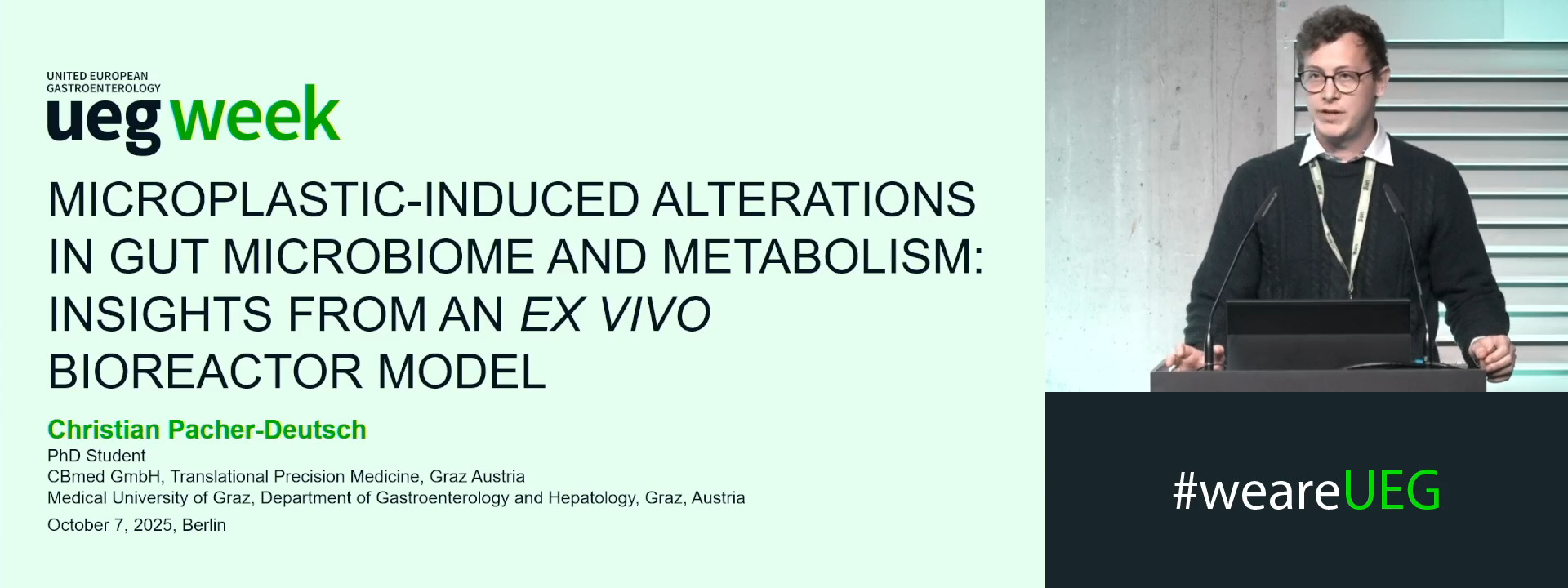
MICROPLASTIC-INDUCED ALTERATIONS IN GUT MICROBIOME AND METABOLISM: INSIGHTS FROM AN EX VIVO BIOREACTOR MODEL
Christian Pacher-Deutsch 1, Kristina Žukauskaitė 1, Cigdem Akar 2, Maximilian Nepel 2, Lukas Kogler 3, Hansjörg Habisch 2, Serena Ducoli 4, Stefania Federici 4, Tobias Madl 5, Verena Pichler 6, Angela Horvath 1, Vanessa Stadlbauer 7
1 Center for Biomarker Research in Medicine (CBmed), Graz, Austria|||Medical University of Graz, Graz, Austria
2 Medical University of Graz, Graz, Austria
3 Center for Biomarker Research in Medicine (CBmed), Graz, Austria|||University of Vienna, Vienna, Austria|||Medical University of Vienna, Vienna, Austria
4 University of Brescia, Brescia, Italy
5 Medical University of Graz, Graz, Austria|||BioTechMed-Graz, Graz, Austria
6 Center for Biomarker Research in Medicine (CBmed), Graz, Austria|||University of Vienna, Vienna, Austria
7 Center for Biomarker Research in Medicine (CBmed), Graz, Austria|||Medical University of Graz, Graz, Austria|||BioTechMed-Graz, Graz, Austria
Event
Topics
Submission format
Citation
Published
Log in to access this content.
Free for all myUEG account holders. Your access level is set automatically based on your occupation. Medical professionals get full access to all content. If you are a non-medical user, you can only access UEG Week content from congresses you attended.
Not sure what you can access? Learn more about account types.
WHEN CROHN'S RETURNS: CRITICAL RISK FACTORS FOR POST-ILEOCECAL RESECTION RECURRENCE
Luisa Bertin 1, Arianna Senatore 1, Camilla Cavagna 1, Benedetta Masoni 2, Silvia Ferretti 2, Alessandro Armuzzi 2, Cristina Bezzio 2, Miriana Zanconato 1, Gianluca Semprucci 1, Davide Giuseppe Ribaldone 3, Adele Capello 3, Giorgia Bodini 4, ANDREA PASTA 4, Francesco Calabrese 4, Linda Ceccarelli 5, Francesco Costa 5, Lorenzo Bertani 6, Marco Marino 7, Luca Navarria 7, Gianluca Benevento 8, Renato Sablich 8, Marta Ascolani 9, Andrea Buda 10, Gaia Riguccio 10, Nicoletta Merlini 11, Elisabetta Dal Pont 12, Daniele Canova 13, Edoardo Vincenzo Savarino 1, Fabiana Zingone 1
1 University of Padova, Padova, Italy
2 IBD Center, IRCCS Humanitas Research Hospital, Rozzano, Italy
3 University of Turin, Turin, Italy
4 Policlinico San Martino, Genova, Italy
5 AOU Pisa, Pisa, Italy
6 University of Pisa, Pisa, Italy
7 Azienda Sanitaria Universitaria Friuli Centrale, Udine, Italy
8 Ospedale S.Maria degli Angeli, Pordenone, Italy
9 Ospedale Ca'Foncello, Treviso, Italy
10 Ospedale di Santa Maria del Prato di Feltre, Feltre, Italy
11 Ospedale Vittorio Emanuele III, Montecchio, Italy
12 Ospedale San Martino di Belluno, Belluno, Italy
13 San Bortolo Hospital, Vicenza, Italy
Conference
Topics
Submission format
Citation
Published
Log in to access this content.
Free for all myUEG account holders. Your access level is set automatically based on your occupation. Medical professionals get full access to all content. If you are a non-medical user, you can only access UEG Week content from congresses you attended.
Not sure what you can access? Learn more about account types.
CMV INFECTION IN ULCERATIVE COLITIS: FOCUS ON TISSUE PCR AND IMMUNOHISTOCHEMISTRY
Raffaella Rima 1, Chiara Maria Penati 2, Francesco Maria Stalla 3, Mariabeatrice Rita Daniela Principi 4, Stefano Okolicsanyi 2
1 Umberto Parini Hospital, Aosta, Italy|||Azienda Ospedaliero Universitaria Consorziale Policlinico, Bari, Italy
2 Umberto Parini Hospital, Aosta, Italy
3 Mauriziano Hospital, Turin, Italy
4 Azienda Ospedaliero Universitaria Consorziale Policlinico, Bari, Italy
Conference
Topics
Submission format
Citation
Published
Log in to access this content.
Free for all myUEG account holders. Your access level is set automatically based on your occupation. Medical professionals get full access to all content. If you are a non-medical user, you can only access UEG Week content from congresses you attended.
Not sure what you can access? Learn more about account types.
CLINICAL EFFECTIVENESS OF VEDOLIZUMAB IN CHINESE PATIENTS WITH ULCERATIVE COLITIS: FINAL RESULTS FROM THE VALUE, A MULTICENTER PROSPECTIVE STUDY
1 Qilu Hospital of Shandong University, Jinan, China
2 Integrated Clinical Microecology Center, Shenzhen Hospital, Southern Medical University, Shenzhen, China
3 The First Affiliated Hospital of Xi'an Jiaotong University, Xi'an, China
4 Takeda Pharmaceutical Company, Shanghai, China
5 The First Affiliated Hospital, Sun Yat-sen University, Guangzhou, China
Conference
Topics
Submission format
Session
Citation
Published
Log in to access this content.
Free for all myUEG account holders. Your access level is set automatically based on your occupation. Medical professionals get full access to all content. If you are a non-medical user, you can only access UEG Week content from congresses you attended.
Not sure what you can access? Learn more about account types.
CYTOMEGALOVIRUS COLITIS IN SEVERE INFLAMMATORY BOWEL DISEASE FLARES: PREVALENCE AND ASSOCIATED FACTORS
Feriel Sahbani 1, Emna Belhadj Mabrouk 2, Mensi Asma 3, Shema Ayadi 4, Leila Mouelhi 5, Radhouane Debbeche 6
1 University Hospital Rabta, Tunis, Tunisia
2 Charles Nicole Hospital, Ezzahra, Tunisia
3 Hospital La Rabta, Ben Arous, Tunisia
4 Charles Nicolle Hospital, Tunis, Tunisia
5 Hopital Charles Nicolle, Bab Saadoun Tunis, Tunisia
6 Charles Nicole Hospital, Tunis, Tunisia
Conference
Topics
Submission format
Session
Citation
Published
Log in to access this content.
Free for all myUEG account holders. Your access level is set automatically based on your occupation. Medical professionals get full access to all content. If you are a non-medical user, you can only access UEG Week content from congresses you attended.
Not sure what you can access? Learn more about account types.
MIRIKIZUMAB SUSTAINS IMPROVEMENT IN FATIGUE, ABDOMINAL PAIN, AND STOOL FREQUENCY FOLLOWING 104 WEEKS OF CONTINUOUS TREATMENT FOR CROHN’S DISEASE: RESULTS FROM THE VIVID-2 OPEN-LABEL EXTENSION STUDY
Peter Bossuyt 1, Ashwin Ananthakrishnan 2, Aisha Vadhariya 3, Na Lu 4, Guanglei Yu 3, Jianmin Wu 3, Jessica Allegretti 5, Minhu Chen 6
1 Imelda GI Clinical Research Centre, Bonheiden, Belgium
2 Division of Gastroenterology, Massachusetts General Hospital and Harvard Medical School, Boston, Massachusetts, United States
3 Eli Lilly and Company, Indianapolis, United States
4 Precision Statistics Consulting Inc, Woodbury, United States
5 Division of Gastroenterology, Hepatology and Endoscopy, Department of Medicine, Brigham & Women's Hospital, Boston, United States
6 The First Affiliated Hospital, Sun Yat-sen University, Guangzhou, China
Conference
Topics