UEG's educational platform for gastroenterology education bringing recordings, courses, guidelines, and more together in one place.
Most popular content
Rate for better recommendations!
Your feedback helps us show you more of what you like and less of what you dislike!
Log in to access this content.
Free for all myUEG account holders. Your access level is set automatically based on your occupation. Medical professionals get full access to all content. If you are a non-medical user, you can only access UEG Week content from congresses you attended.
Not sure what you can access? Learn more about account types.

CLINICAL OUTCOMES OF CANCER PATIENTS WITH GASTROINTESTINAL IMMUNE-RELATED ADVERSE EVENTS DURING THERAPY WITH IMMUNE CHECKPOINT INHIBITORS: EXPERIENCE OF A TERTIARY CARE OUTPATIENT GASTROENTEROLOGY CLINIC
Serena Porcari 1, Franziska Deutschbein 1, William Fusco 1, Ettore D'Argento 1, Emilio Bria 1, Giovanni Schinzari 1, Eleonora Palluzzi 1, Olga Martelli 1, Mariagrazia Distefano 1, Carolina Maria Sassu 1, Serena Maria Boccia 1, Laura Vertechy 1, Ida Paris 1, Claudia Marchetti 2, Giampaolo Tortora 1, Antonio Gasbarrini 1, Giovanni Cammarota 1, Gianluca Ianiro 1
1 Fondazione Policlinico Universitario 'A.Gemelli' - IRCCS, Roma, Italy
2 Fondazione Policlinico Universitario 'A.Gemelli' - IRCCS, Roma, Italy|||Università Cattolica del Sacro Cuore, Roma, Italy
Conference
Topics
Submission format
Session
Citation
Published
Log in to access this content.
Free for all myUEG account holders. Your access level is set automatically based on your occupation. Medical professionals get full access to all content. If you are a non-medical user, you can only access UEG Week content from congresses you attended.
Not sure what you can access? Learn more about account types.
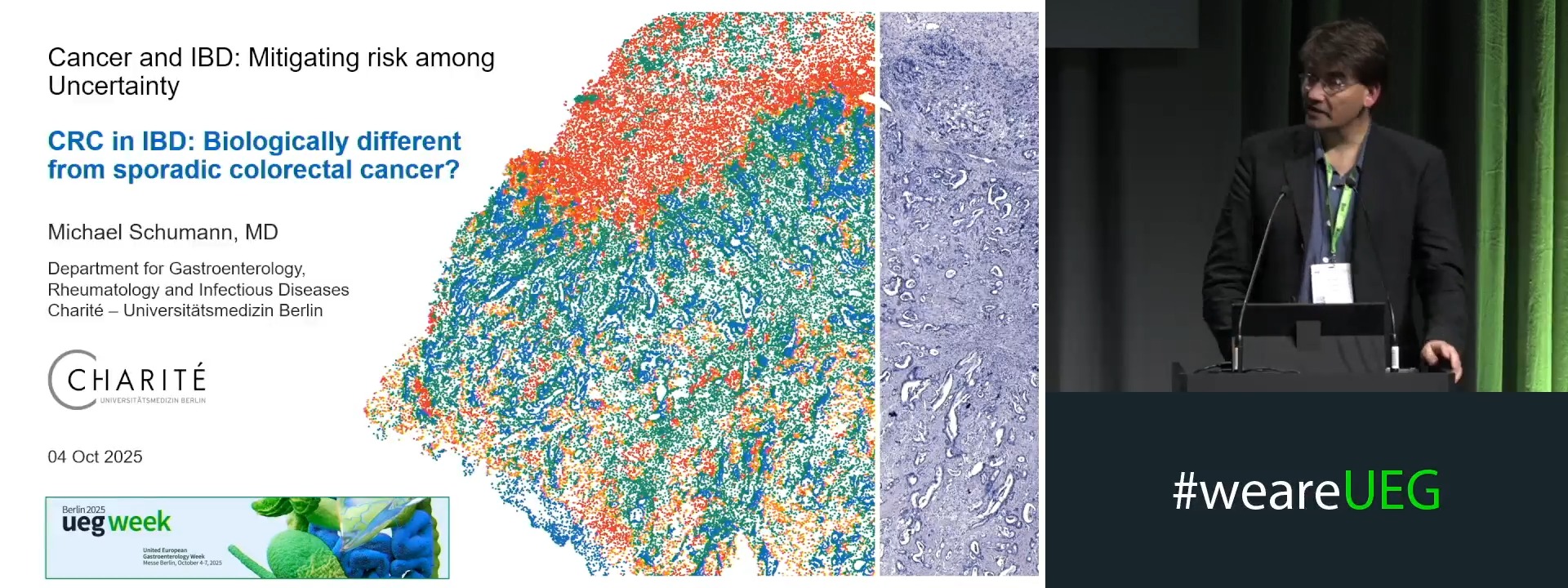
CRC in IBD: Biologically different from sporadic colorectal cancer?
1 Charité Berlin, Berlin, Germany
Event
Topics
Citation
Published
Log in to access this content.
Free for all myUEG account holders. Your access level is set automatically based on your occupation. Medical professionals get full access to all content. If you are a non-medical user, you can only access UEG Week content from congresses you attended.
Not sure what you can access? Learn more about account types.
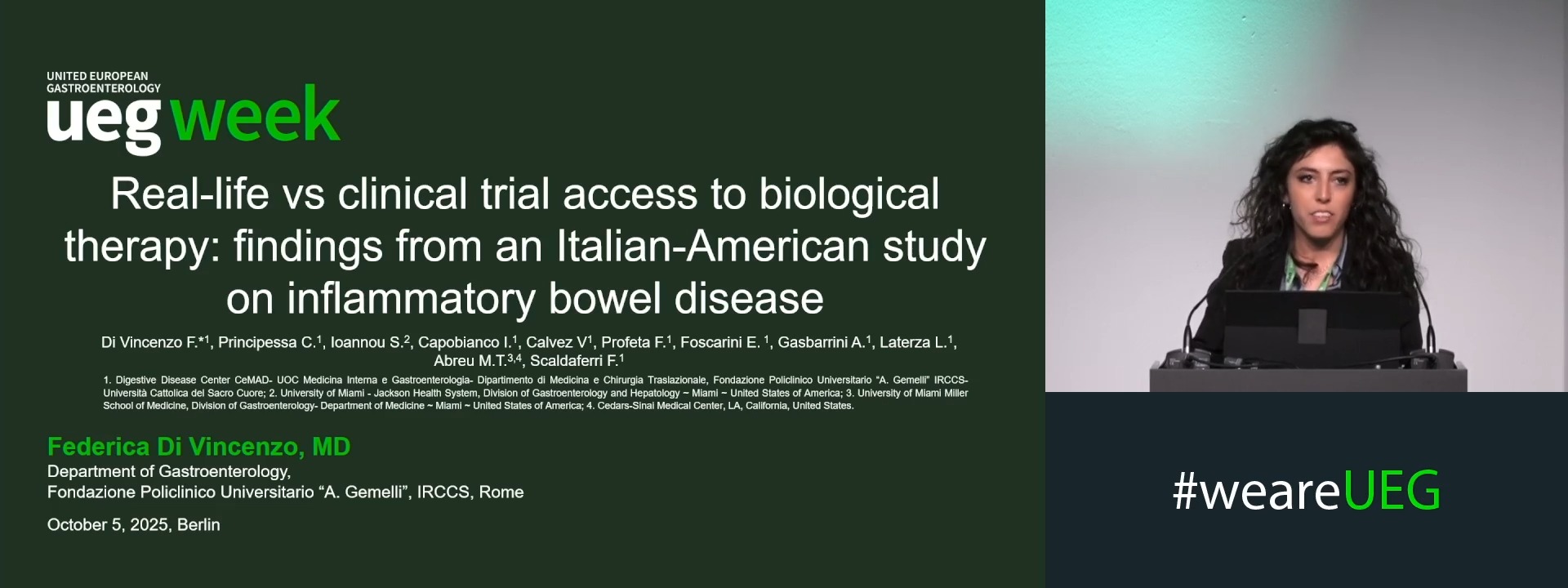
REAL-LIFE VS CLINICAL TRIAL ACCESS TO BIOLOGICAL THERAPY: FINDINGS FROM AN ITALIAN-AMERICAN STUDY ON INFLAMMATORY BOWEL DISEASE
Federica Di Vincenzo 1, Stephanie Ioannou 2, Chiara Principessa 3, Ivan Capobianco 1, Antonio Gasbarrini 4, Lucrezia Laterza 4, Maria T. Abreu 5, Franco Scaldaferri 4
1 Fondazione Policlinico Universitario "A. Gemelli" IRCCS, Università Cattolica del Sacro Cuore, Roma, Italy
2 University of Miami - Jackson Health System, Miami, United States
3 Università Cattolica del Sacro Cuore, Roma, Italy
4 Fondazione Policlinico Universitario "A. Gemelli", IRCCS, Università Cattolica del Sacro Cuore, Rome, Italy
5 University of Miami Miller School of Medicine, Department of Medicine, Division of Gastroenterology, Miami, FL 33136; F. Widjaja Inflammatory Bowel Disease Institute, Cedars-Sinai Medical Center, Los Angeles, United States
Event
Submission format
Session
Citation
Published
Log in to access this content.
Free for all myUEG account holders. Your access level is set automatically based on your occupation. Medical professionals get full access to all content. If you are a non-medical user, you can only access UEG Week content from congresses you attended.
Not sure what you can access? Learn more about account types.
THE QUALITY AND YIELD OF DEDICATED ENDOSCOPY FOR BARRETT’S OESOPHAGUS IS HIGHER THAN THAT IN CONVENTIONAL SERVICE: A MULTICENTRE RETROSPECTIVE COMPARATIVE STUDY
Champika Gamakaranage 1, Elizabeth Ratcliffe 2, James Britton 2, Richard Keld 3, neeraj prasad 3, Mark Murgatroyd 4, Daniel Plant 5, Matthew Johnston 5, Jenni Marsh 3, Claudia Cipriano 6, Nasar Aslam 7, Vinay Sehgal 7, Anjan Dhar 8, Shaheen Hamdy 6, John McLaughlin 6, Yeng Ang 6
1 The University of Manchester, Manchester, United Kingdom|||Wrightington Wigan and Leigh Teaching Hospitals NHS FT, Wigan, United Kingdom
2 Northern Care Alliance NHS FT, Salford, United Kingdom
3 Wrightington Wigan and Leigh Teaching Hospitals NHS FT, Wigan, United Kingdom
4 Bolton NHS FT, Bolton, United Kingdom
5 County Durham and Darlington NHS FT, Darlington, United Kingdom
6 The University of Manchester, Manchester, United Kingdom|||Northern Care Alliance NHS FT, Salford, United Kingdom
7 University College London Hospital NHS FT, London, United Kingdom
8 County Durham and Darlington NHS FT, Darlington, United Kingdom|||Teeside University, Middlesbrough, United Kingdom
Conference
Topics
Submission format
Citation
Published
Log in to access this content.
Free for all myUEG account holders. Your access level is set automatically based on your occupation. Medical professionals get full access to all content. If you are a non-medical user, you can only access UEG Week content from congresses you attended.
Not sure what you can access? Learn more about account types.
PROXIMAL LOCATION AS A PREDICTOR OF METACHRONOUS COLORECTAL CANCER AFTER EXCISION OF ADENOMAS
Sandra Baile Maxía 1, Carolina Mangas-Sanjuan 1, Uri Ladabaum 2, Carmen Sanchez Ardila 3, Noelia Sala Miquel 4, Víctor Ausina Poüs 4, Pedro Zapater 4, Rodrigo Jover 5
1 Instituto de Investigación Sanitaria y Biomédica de Alicante (ISABIAL), Alicante, Spain|||Hospital General Universitario Dr Balmis de Alicante, Alicante, Spain
2 Stanford University School of Medicine, Stanford CA, United States
3 Universidad Miguel Hernández, Alicante, Spain
4 Hospital General Universitario Dr Balmis de Alicante, Alicante, Spain
5 Hospital General Universitario Dr Balmis de Alicante, Alicante, Spain|||Instituto de Investigación Sanitaria y Biomédica de Alicante (ISABIAL), Alicante, Spain
Conference
Topics
Submission format
Citation
Published
Log in to access this content.
Free for all myUEG account holders. Your access level is set automatically based on your occupation. Medical professionals get full access to all content. If you are a non-medical user, you can only access UEG Week content from congresses you attended.
Not sure what you can access? Learn more about account types.
SYSTEMATIC REVIEW AND META-ANALYSIS OF PARTICIPATION AND YIELD OVER TIME WITH FECAL IMMUNOCHEMICAL TEST-BASED COLORECTAL CANCER SCREENING
1 Hospital General Universitario Dr Balmis de Alicante, Alicante, Spain|||Instituto de Investigación Sanitaria y Biomédica de Alicante (ISABIAL), Alicante, Spain
2 Stanford University School of Medicine, Stanford CA, United States
3 Universidad Miguel Hernández, Alicante, Spain
Conference
Topics
Submission format
Session
Citation
Published
Log in to access this content.
Free for all myUEG account holders. Your access level is set automatically based on your occupation. Medical professionals get full access to all content. If you are a non-medical user, you can only access UEG Week content from congresses you attended.
Not sure what you can access? Learn more about account types.
PERCUTANEOUS ENDOSCOPIC GASTROSTOMY (PEG) IN PEDIATRIC CANCER PATIENTS: EFFICACY AND SAFETY ANALYSIS FROM A RETROSPECTIVE COHORT
Sophia Andreola Borba 1, Thais Pontes 1, Ulli Kaize Barbosa Pimentel 1, João Gabriel Magalhães Bertazo Silveira 1, Eduardo Magalhães Carvalho 1, Amalia Costa Coimbra 1, Catia Carolina Fabris 1, Nathalia Ribeiro Cantudo de Souza 1, Henrique Coelho Stumpf 1, Marina Dodsworth de Barros 1, Felipe Alves Mota Rebello de Mendonça 1, Alexandre Iachan 1, Simone Guaraldi da Silva 1, Maria Aparecida Ferreira 1, Gustavo Francisco De Souza e Mello 1
1 Instituto Nacional do Cancer, Rio de Janeiro, Brazil
Conference
Topics
Submission format
Session