UEG's educational platform for gastroenterology education bringing recordings, courses, guidelines, and more together in one place.
Most popular content
Rate for better recommendations!
Your feedback helps us show you more of what you like and less of what you dislike!
Log in to access this content.
Free for all myUEG account holders. Your access level is set automatically based on your occupation. Medical professionals get full access to all content. If you are a non-medical user, you can only access UEG Week content from congresses you attended.
Not sure what you can access? Learn more about account types.

PATIENTS WITH FIBROSTENOTIC CROHN’S DISEASE CAN TOLERATE A HIGH-FIBER, LOW-FAT DIET AND EXPERIENCE AN IMPROVEMENT IN SYMPTOMS: RESULTS OF A CATERED DIET INTERVENTION STUDY
Maria A. Quintero 1, Luis C. Garces 1, Oriana Damas 2, Cristiana Mangarelli 1, Irina Fernandez 1, Hajar Hazime 1, Norma Solis 2, Rose Killian 1, Payton Mendygral 1, Mailenis Ortega 2, David Kerman 2, Amar R. Deshpande 2, Siobhan Proksell 2, Ingrid Barrera 1, Maria T. Abreu 3
1 University of Miami, Miami, United States
2 University of Miami, Miller School of Medicine, Miami, United States
3 University of Miami, Miller School of Medicine, Coral Gables, United States
Conference
Topics
Submission format
Session
Citation
Published
Log in to access this content.
Free for all myUEG account holders. Your access level is set automatically based on your occupation. Medical professionals get full access to all content. If you are a non-medical user, you can only access UEG Week content from congresses you attended.
Not sure what you can access? Learn more about account types.
THE IMPACT OF NUTRITIONAL SUPPLEMENTATION ON CLINICAL ACTIVITY, QUALITY OF LIFE AND DISABILITY OF PATIENTS WITH IBD: A BRAZILIAN MULTICENTER LONGITUDINAL STUDY
Marina Amorim Lopes 1, Ryan Nunes Yoshio Yoshihara 1, Natália Salvador Castelhano 1, Luana Ferreira Pereira 1, Lara Janine de Pinho Morais 1, Enya Zucari Nogueira 1, Julio Baima 2, Jose Miguel Parente 3, Rogerio Parra 4, Sender Jankiel Miszputen 5, Lígia Yukie Sassaki 1
1 São Paulo State University, Botucatu, Brazil
2 UNESP Botucatu / Uninove Bauru, Botucatu, Brazil
3 Universidade Federal do Piauí - Centro de Ciências da Saúde, Terezina, Brazil
4 HC Ribeirão Preto, Ribeirão Preto, Brazil
5 EPM UNIFESP, São Paulo, Brazil
Conference
Topics
Submission format
Session
Citation
Published
Log in to access this content.
Free for all myUEG account holders. Your access level is set automatically based on your occupation. Medical professionals get full access to all content. If you are a non-medical user, you can only access UEG Week content from congresses you attended.
Not sure what you can access? Learn more about account types.
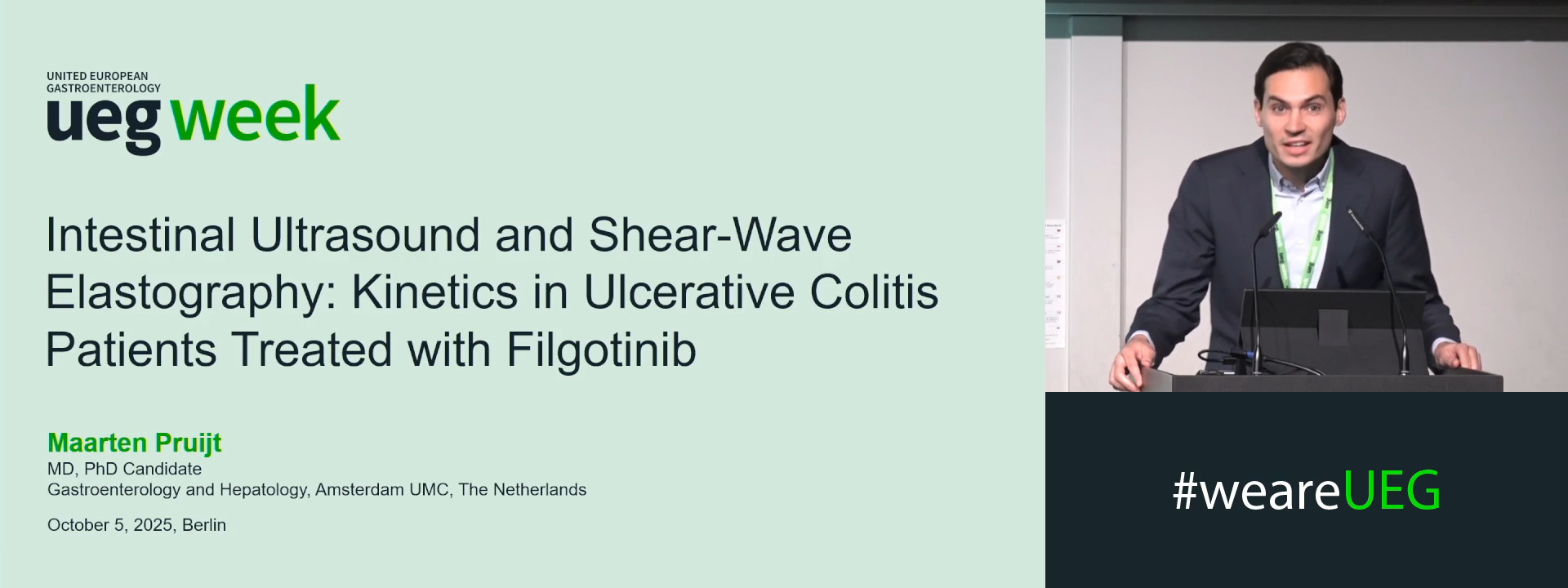
INTESTINAL ULTRASOUND AND SHEAR-WAVE ELASTOGRAPHY: KINETICS IN ULCERATIVE COLITIS PATIENTS TREATED WITH FILGOTINIB
Maarten Pruijt 1, Christoph Teichert 1, Floris de Voogd 1, Reimer Janssen 1, Mark Lowenberg 1, Rogier Goetgebuer 1, Geert R. D'Haens 1, Krisztina Barbara Gecse 1
1 Amsterdam UMC, Amsterdam, Netherlands
Event
Topics
Submission format
Session
Citation
Published
Log in to access this content.
Free for all myUEG account holders. Your access level is set automatically based on your occupation. Medical professionals get full access to all content. If you are a non-medical user, you can only access UEG Week content from congresses you attended.
Not sure what you can access? Learn more about account types.
SINGLE-CENTER EXPERIENCE OF MANAGMENT OF PERFORATION AFTER ENDOSCOPICAL SUBMUCOSAL DISSECTION (ESD) USING OVER-THE-SCOPE CLIP (OTSC)
Giulia Leonardi 1, Benedetta Toro 1, Francesco Bronzini 1, Francesco Rettura 1, Matteo Blois 1, Maria Rita Falcone 1, Chiara Sterpi 1, Raffaele Manta 1
1 Ospedale di Livorno, Livorno, Italy
Conference
Submission format
Session
Citation
Published
Log in to access this content.
Free for all myUEG account holders. Your access level is set automatically based on your occupation. Medical professionals get full access to all content. If you are a non-medical user, you can only access UEG Week content from congresses you attended.
Not sure what you can access? Learn more about account types.
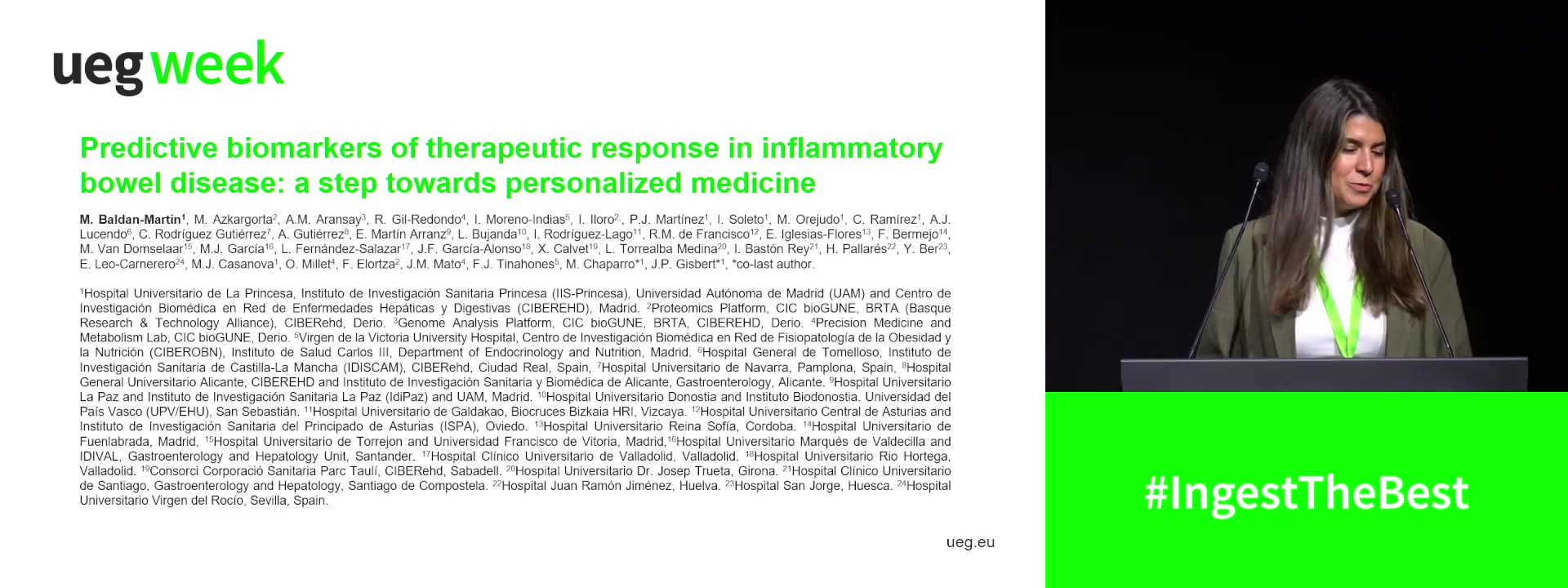
PREDICTIVE BIOMARKERS OF THERAPEUTIC RESPONSE IN INFLAMMATORY BOWEL DISEASE: A STEP TOWARDS PERSONALIZED MEDICINE
Montse Baldan Martin 1, Mikel Azkargorta 2, Ana M. Aransay 3, Rubén Gil-Redondo 4, Isabel Moreno-Indias 5, Ibon Iloro 2, Paula J Martínez 1, Irene Soleto 1, Macarena Orejudo del Río 1, Cristina Ramírez 1, Alfredo J. Lucendo 6, Cristina Rodríguez Gutiérrez 7, Ana Gutiérrez-Casbas 8, Eduardo Martín-Arranz 9, Luis Bujanda Fernández de Piérola 10, Iago Rodríguez-Lago 11, Ruth María de Francisco García 12, Eva Iglesias-Flores 13, Fernando Bermejo 14, Manuel Van Domselaar 15, María José García 16, Luis Fernández-Salazar 17, Francisco Javier Garcia-Alonso 18, Xavier Calvet 19, Leyanira Torrealba Medina 20, Iria Bastón-Rey 21, Hector Pallares Manrique 22, Yolanda Ber Nieto 23, Eduardo Leo-Carnerero 24, María José Casanova 1, Oscar Millet 4, Felix Elortza 2, Jose Mato 4, Francisco J Tinahones 5, María Chaparro 1, Javier Gisbert 1
1 Hospital Universitario de La Princesa, Instituto de Investigación Sanitaria Princesa (IIS-Princesa), Universidad Autónoma de Madrid (UAM) and Centro de Investigación Biomédica en Red de Enfermedades Hepáticas y Digestivas (CIBERehd), Madrid, Spain
2 Proteomics Platform, CIC bioGUNE, BRTA (Basque Research & Technology Alliance), CIBERehd, Derio, Spain
3 Genome Analysis Platform, CIC bioGUNE, Basque Research and Technology Alliance (BRTA), CIBERehd, Derio, Spain
4 Precision Medicine and Metabolism Lab, CIC bioGUNE, Derio, Spain
5 Virgen de la Victoria University Hospital, Centro de Investigación Biomédica en Red de Fisiopatología de la Obesidad y la Nutrición (CIBEROBN), Instituto de Salud Carlos III, Department of Endocrinology and Nutrition, Madrid, Spain
6 Hospital General de Tomelloso, Instituto de Investigación Sanitaria de Castilla-La Mancha (IDISCAM), CIBERehd, Ciudad Real, Spain
7 Hospital Universitario de Navarra, Pamplona, Spain
8 Hospital General Universitario Alicante, CIBERehd and Instituto de Investigación Sanitaria y Biomédica de Alicante, Alicante, Spain
9 Hospital Universitario La Paz and Instituto de Investigación Sanitaria La Paz (IdiPaz) and UAM, Madrid, Spain
10 Hospital Universitario Donostia and Instituto Biodonostia. Universidad del País Vasco (UPV/EHU)., San Sebastián, Spain
11 Hospital Universitario de Galdakao, Biocruces Bizkaia HRI, Vizcaya, Spain
12 Hospital Universitario Central de Asturias and Instituto de Investigación Sanitaria del Principado de Asturias (ISPA), Oviedo, Spain
13 Hospital Universitario Reina Sofía, Cordoba, Spain
14 Hospital Universitario de Fuenlabrada, Madrid, Spain
15 Hospital Universitario de Torrejon and Universidad Francisco de Vitoria, Madrid, Spain
16 Hospital Universitario Marqués de Valdecilla and IDIVAL, Santander, Spain
17 Hospital Clínico Universitario de Valladolid, Valladolid, Spain
18 Hospital Universitario Rio Hortega, Valladolid, Spain
19 Consorci Corporació Sanitaria Parc Taulí, CIBERehd, Sabadell, Spain
20 Hospital Universitario Dr. Josep Trueta, Girona, Spain
21 Hospital Clínico Universitario de Santiago, Santiago de Compostela, Spain
22 Hospital Juan Ramón Jiménez, Huelva, Spain
23 Hospital San Jorge, Huesca, Spain
24 Hospital Universitario Virgen del Rocío, Sevilla, Spain
Event
Submission format
Citation
Published
Log in to access this content.
Free for all myUEG account holders. Your access level is set automatically based on your occupation. Medical professionals get full access to all content. If you are a non-medical user, you can only access UEG Week content from congresses you attended.
Not sure what you can access? Learn more about account types.
EFFICACY AND SAFETY OF ETRASIMOD IN PATIENTS WITH ULCERATIVE COLITIS STRATIFIED BY BODY MASS INDEX: A POST HOC ANALYSIS FROM THE ELEVATE UC CLINICAL PROGRAMME
Andres Yarur 1, Millie Long 2, Joana Torres 3, Neilanjan Nandi 4, Raymond Cross 5, Arcangelo M. Abbatemarco 6, David Blanco 7, Wojciech Niezychowski 7, Catherine M Crosby 8, Joseph Wu 9, Gokul Pradeep 10, Martina Goetsch 11, Remo Panaccione 12
1 Cedars-Sinai Medical Center, Los Angeles, United States
2 University of North Carolina, Chapel Hill, United States
3 Hospital Beatriz Ângelo, Loures, Portugal|||Hospital da Luz, Lisbon, Portugal|||Universidade de Lisboa, Lisbon, Portugal
4 Penn Presbyterian Medical Center, University of Pennsylvania, Philadelphia, United States
5 University of Maryland School of Medicine, Baltimore, United States
6 Pfizer Inc, New York, United States
7 Pfizer Inc, Collegeville, United States
8 Pfizer Inc, La Jolla, United States
9 Pfizer Inc, Cambridge, United States
10 Pfizer Healthcare India Private Ltd, Chennai, India
11 Pfizer AG, Zürich, Switzerland
12 University of Calgary, Calgary, Canada
Conference
Topics
Submission format
Session
Citation
Published
Log in to access this content.
Free for all myUEG account holders. Your access level is set automatically based on your occupation. Medical professionals get full access to all content. If you are a non-medical user, you can only access UEG Week content from congresses you attended.
Not sure what you can access? Learn more about account types.
POST-MARKET USE OF TEDUGLUTIDE IN A LARGE COHORT OF ADULTS WITH SHORT BOWEL SYNDROME: EVOLUTION AND OUTCOMES
Brune de Dreuille 1, Alexandre Nuzzo 2, Julie Bataille 3, Charlotte Mailhat 4, Lore Billiauws 1, Maude Le Gall 5, Francisca Joly 1
1 Hôpital Beaujon (AP-HP), Clichy, France|||INSERM UMR 1149, Université de Paris Cité, Paris, France
2 Hôpital Beaujon (AP-HP), Clichy, France|||INSERM UMR1148, Université de Paris Cité, Paris, France
3 Hôpital Beaujon (AP-HP), Clichy, France
4 GETAID, Paris, France
5 INSERM UMR 1149, Université de Paris Cité, Paris, France
Conference
Topics