UEG's educational platform for gastroenterology education bringing recordings, courses, guidelines, and more together in one place.
Most popular content
Rate for better recommendations!
Your feedback helps us show you more of what you like and less of what you dislike!
Log in to access this content.
Free for all myUEG account holders. Your access level is set automatically based on your occupation. Medical professionals get full access to all content. If you are a non-medical user, you can only access UEG Week content from congresses you attended.
Not sure what you can access? Learn more about account types.
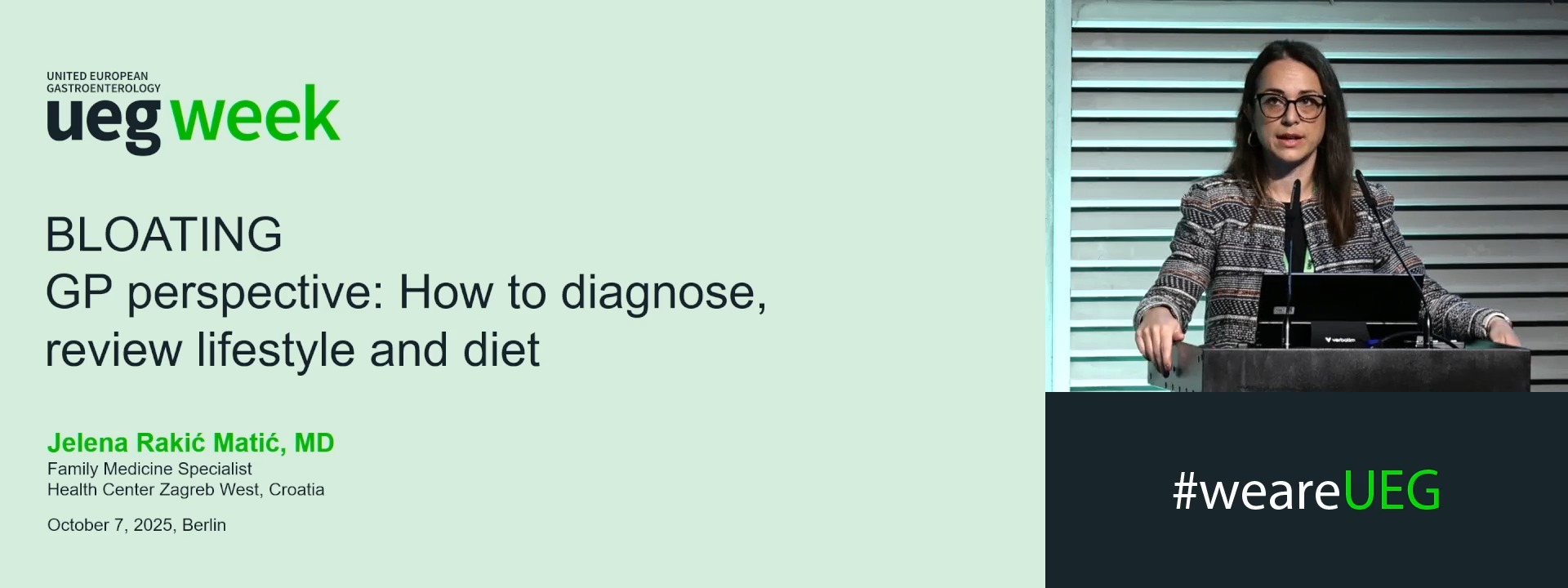
GP perspective: How to diagnose, review lifestyle and diet
1 Health Care Center Zagreb West, ZAGREB, Croatia
Event
Topics
Session
Citation
Published
Log in to access this content.
Free for all myUEG account holders. Your access level is set automatically based on your occupation. Medical professionals get full access to all content. If you are a non-medical user, you can only access UEG Week content from congresses you attended.
Not sure what you can access? Learn more about account types.

KNOWLEDGE AND MISCONCEPTIONS OF PATIENTS WITH IRRITABLE BOWEL SYNDROME ENROLLED IN A THERAPEUTIC PATIENT EDUCATION PROGRAM
Fabien Wuestenberghs 1, Pauline Jouet 1, Nicolas Ezratty 1, Ludovic ATTELLY 1, Anne-Sophie Schmitt 1, Mourad Benallaoua 1, Jean-Jacques Raynaud 1, Robert Benamouzig 1, Jean Marc Sabate 1
1 APHP, Avicenne Hospital, Sorbonne Paris Nord University, Bobigny, France
Conference
Topics
Submission format
Session
Citation
Published
Log in to access this content.
Free for all myUEG account holders. Your access level is set automatically based on your occupation. Medical professionals get full access to all content. If you are a non-medical user, you can only access UEG Week content from congresses you attended.
Not sure what you can access? Learn more about account types.
POSSIBLE MECHANISMS UNDERLYING THE EFFECTS OF FAECAL MICROBIOTA TRANSPLANTATION IN PATIENTS WITH IRRITABLE BOWEL SYNDROME
Magdy El-Salhy 1, Tora Skarvatun 2, Dag Arne Lihaug Hoff 3, Elisabeth Kjelsvik Steinsvik 4, Johan Lunding 5, Odd Helge Gilja 2, Jan Gunnar Hatlebakk 6
1 University of Bergen, Haukelands University Hospital, Bergen, Norway
2 University of Bergen, Bergen, Norway
3 Aalesund Hospital, Møre & Romsdal Hospital trust, Aalesund, Norway
4 Haukeland University Hospital, Bergen, Norway
5 Diakonhjemmet Sykehus, Nesbru, Norway
6 Haukeland University Hospital Dept. of Medicine, Bergen, Norway
Conference
Topics
Submission format
Citation
Published
Log in to access this content.
Free for all myUEG account holders. Your access level is set automatically based on your occupation. Medical professionals get full access to all content. If you are a non-medical user, you can only access UEG Week content from congresses you attended.
Not sure what you can access? Learn more about account types.
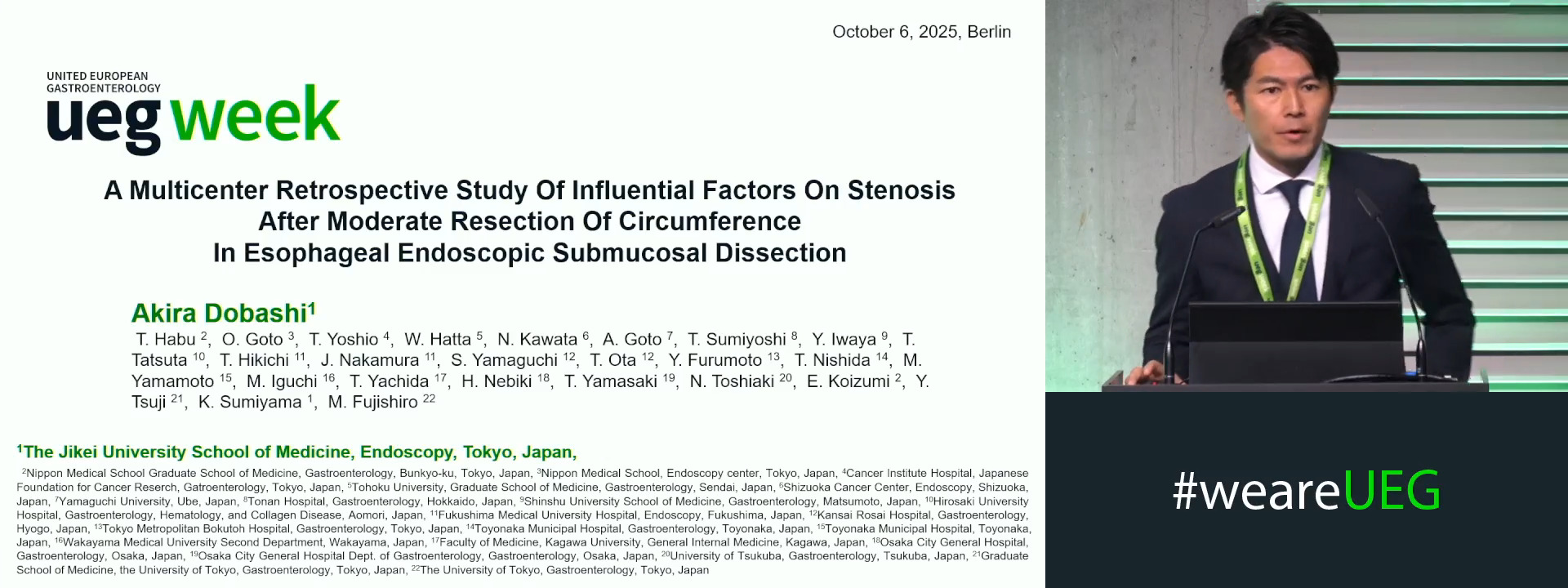
A MULTICENTER RETROSPECTIVE STUDY OF INFLUENTIAL FACTORS ON STENOSIS AFTER MODERATE RESECTION OF CIRCUMFERENCE IN ESOPHAGEAL ENDOSCOPIC SUBMUCOSAL DISSECTION
Akira Dobashi 1, Tsugumi Habu 2, Osamu Goto 3, Toshiyuki Yoshio 4, Waku Hatta 5, Noboru Kawata 6, Atsushi Goto 7, Unknown Unknown 8, Yugo Iwaya 9, Tetsuya Tatsuta 10, Takuto Hikichi 11, Jun Nakamura 11, Shinjiro Yamaguchi 12, Takashi Ohta 12, Yohei Furumoto 13, Tsutomu Nishida 14, Masashi Yamamoto 14, Mikitaka Iguchi 15, Tatsuo Yachida 16, Hiroko Nebiki 17, Tomoaki Yamasaki 17, Toshiaki Narasaka 18, Eriko Koizumi 2, Yosuke Tsuji 19, Kazuki Sumiyama 1, Mitsuhiro Fujishiro 19
1 The Jikei University School of Medicine, Tokyo, Japan
2 Nippon Medical School Graduate School of Medicine, Bunkyo-ku, Tokyo, Japan
3 Nippon Medical School, Tokyo, Japan
4 Cancer Institute Hospital, Japanese Foundation for Cancer Reserch, Tokyo, Japan
5 Tohoku University, Graduate School of Medicine, Sendai, Japan
6 Shizuoka Cancer Center, Shizuoka, Japan
7 Yamaguchi University Graduate School of Medicine, Ube, Japan
8 Tonan Hospital, Hokkaido, Japan
9 Shinshu University School of Medicine, Matsumoto, Japan
10 Hirosaki University Hospital, Aomori, Japan
11 Fukushima Medical University Hospital, Fukushima, Japan
12 Kansai Rosai Hospital, Hyogo, Japan
13 Tokyo Metropolitan Bokutoh Hospital, Tokyo, Japan
14 Toyonaka Municipal Hospital, Toyonaka, Japan
15 Wakayama Medical University, Wakayama, Japan
16 Faculty of Medicine, Kagawa University, Kagawa, Japan
17 Osaka City General Hospital, Osaka, Japan
18 University of Tsukuba, Tsukuba, Japan
19 The University of Tokyo, Tokyo, Japan
Event
Topics
Submission format
Citation
Published
Log in to access this content.
Free for all myUEG account holders. Your access level is set automatically based on your occupation. Medical professionals get full access to all content. If you are a non-medical user, you can only access UEG Week content from congresses you attended.
Not sure what you can access? Learn more about account types.
IRRITABLE BOWEL SYNDROME AND NEUROPSYCHIATRIC DISORDERS: A CROSS-SECTIONAL STUDY OF 1.56 MILLION ADOLESCENTS
Maya Fischman 1, Yaron Cohen 1, Omer Akiva 1, Dorit Tzur 2, Estela Derazne 2, saleh daher 3, Shmuel Fay 2, Jacob Rotschield 2, Aya Bardugo 4, Meir Schechter 5, Itai Ghersin 6
1 Hebrew University of Jerusalem, Jerusalem, Israel
2 Medical Corps, Ramat Gan, Israel
3 Medical Corps, Ramat Gan, Israel|||Hadassah-Hebrew University Medical Center, Jerusalem, Israel
4 Medical Corps, Ramat Gan, Israel|||Medical Corps, Ramat Gan, Israel
5 Hebrew University of Jerusalem, Jerusalem, Israel|||Medical Corps, Ramat Gan, Israel
6 St. Mark's Hospital, London, United Kingdom|||Rambam Health Care Campus, Haifa, Israel
Conference
Topics
Submission format
Session
Citation
Published
Log in to access this content.
Free for all myUEG account holders. Your access level is set automatically based on your occupation. Medical professionals get full access to all content. If you are a non-medical user, you can only access UEG Week content from congresses you attended.
Not sure what you can access? Learn more about account types.
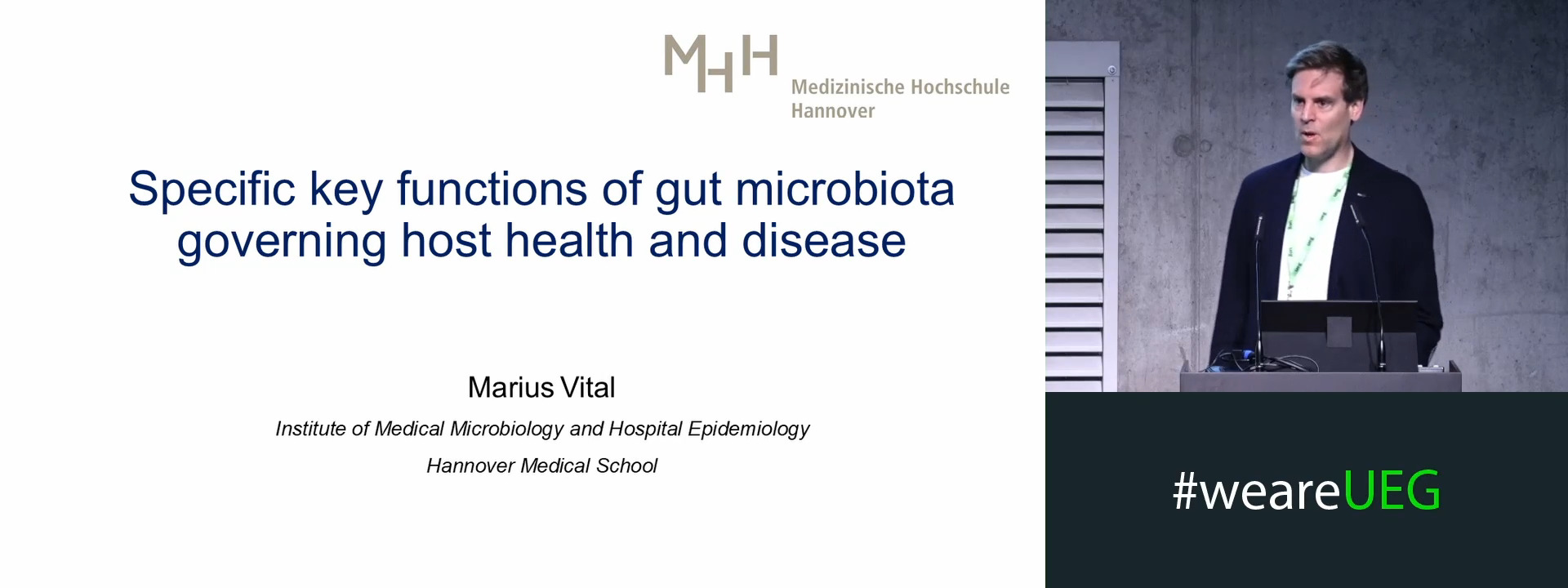
Specific key function of gut microbiota
1 Deutsches Zentrum für Infektionsforschung, Braunschweig, Germany
Event
Topics
Citation
Published
Log in to access this content.
Free for all myUEG account holders. Your access level is set automatically based on your occupation. Medical professionals get full access to all content. If you are a non-medical user, you can only access UEG Week content from congresses you attended.
Not sure what you can access? Learn more about account types.
THE EFFECTS OF PERSONALITY TRAITS ON PSYCHOLOGICAL FACTORS AND QUALITY OF LIFE IN IRRITABLE BOWEL SYNDROME: AN EXPLORATORY STUDY
Sylvester R. Groen 1, Zsa Zsa Weerts 1, Lisa Vork 2, Zlatan Mujagic 1, Carsten Leue 3, Sandra Mulkens 3, Joanna W. Kruimel 1, Daisy Mae Jonkers 1, Ad A Masclee 1, Daniel Keszthelyi 1
1 MUMC, Maastricht, Netherlands|||Maastricht University, Maastricht, Netherlands
2 Maastricht University, Maastricht, Netherlands|||MUMC, Maastricht, Netherlands
3 Maastricht University, Maastricht, Netherlands|||MUMC+, Maastricht, Netherlands
Conference
Topics
Submission format
Session