UEG's educational platform for gastroenterology education bringing recordings, courses, guidelines, and more together in one place.
Most popular content
Rate for better recommendations!
Your feedback helps us show you more of what you like and less of what you dislike!
Log in to access this content.
Free for all myUEG account holders. Your access level is set automatically based on your occupation. Medical professionals get full access to all content. If you are a non-medical user, you can only access UEG Week content from congresses you attended.
Not sure what you can access? Learn more about account types.

CLINICAL APPLICATION EVALUATION OF NATURAL ORIFICE ENDOLUMINAL ENDOSCOPIC GALLBLADDER SURGERY (GB-NOEES): A SINGLE-CENTER RETROSPECTIVE STUDY
1 Peking University, Beijing, China
2 China University of Geosciences, Beijing, China
Conference
Topics
Submission format
Citation
Published
Log in to access this content.
Free for all myUEG account holders. Your access level is set automatically based on your occupation. Medical professionals get full access to all content. If you are a non-medical user, you can only access UEG Week content from congresses you attended.
Not sure what you can access? Learn more about account types.
Training with simulators
1 ESGENA Scientific Secretary, Ulm, Germany
Event
Topics
Citation
Published
Log in to access this content.
Free for all myUEG account holders. Your access level is set automatically based on your occupation. Medical professionals get full access to all content. If you are a non-medical user, you can only access UEG Week content from congresses you attended.
Not sure what you can access? Learn more about account types.
For the medical oncologist
1 Université libre de Bruxelles, Bruxelles, Belgium
Event
Topics
Citation
Published
Log in to access this content.
Free for all myUEG account holders. Your access level is set automatically based on your occupation. Medical professionals get full access to all content. If you are a non-medical user, you can only access UEG Week content from congresses you attended.
Not sure what you can access? Learn more about account types.
CLINICOPATHOLOGICAL FEATURES ASSOCIATED WITH SUBMUCOSAL INVASIVE CANCER (SMIC) IN LARGE NON-PEDUNCULATED COLORECTAL POLYPS: DEFINING THE RISK IN MORPHOLOGICAL SUBTYPES OF LNPCP
Homira Ayubi 1, Jemma Bhoday 2, Ciaran Judge 1, Ali Eqbal 1, Olaolu Olabintan 1, Ademola Adeyeye 2, Bu Hayee 2, Sri Thrumurthy 2, Shraddha Gulati 1, Amyn Haji 2, Andrew Emmanuel 1
1 King's College Hospital, London, United Kingdom
2 Kings College Hospital, London, United Kingdom
Event
Submission format
Citation
Published
Log in to access this content.
Free for all myUEG account holders. Your access level is set automatically based on your occupation. Medical professionals get full access to all content. If you are a non-medical user, you can only access UEG Week content from congresses you attended.
Not sure what you can access? Learn more about account types.
COMPARISON OF ENDOSCOPIC ULTRASOUND-GUIDED VERSUS PERCUTANEOUS BILIARY DRAINAGE FOR PREOPERATIVE MANAGEMENT OF MALIGNANT DISTAL BILIARY OBSTRUCTION AFTER FAILED ERCP: A MULTICENTER RETROSPECTIVE STUDY
Itonaga Masahiro 1, Mamoru Takenaka 2, Hideyuki Shiomi 3, Koh Kitagawa 4, Shuhei Shintani 5, Hirotsugu Maruyama 6, Ryota Sagami 7, Tsukasa Ikeura 8, Takeshi Ogura 9, Yusuke Ishida 10, Koichiro Mandai 11, Satoshi Sugimori 12, Yoshiki Imamura 13, Atsuhiro Masuda 14, Kenji Ikezawa 15, Atsushi Shimizu 16, Misako Nagai 4, Atsushi Nakai 2, Ryota Nakano 3, Masayuki Kitano 16
1 Wakayama Medical University, Wakayama City, Japan
2 Kindai University Faculty of Medicine, Osaka, Japan
3 Hyogo Medical University, Hyogo, Japan
4 Nara Medical University, Nara, Japan
5 Shiga University of Medical Science, Otsu, Japan
6 Osaka City University Graduate School of Medicine, Osaka, Japan
7 Oita University, Yufu, Japan
8 Kansai Medical University, Hirakata, Japan
9 Osaka Medical and Pharmaceutical University Hospital, Takatsuki, Japan
10 Fukuoka University Faculty of Medicine, Fukuoka, Japan
11 Kyoto Second Red Cross Hospital, Kyoto, Japan
12 Osaka City Genaral Hospital, Osaka, Japan
13 Ehime University Graduate School of Medicine, Ehime, Japan
14 Kobe graduate school of medicine, Kobe, Japan
15 Osaka International Cancer Institute, Osaka, Japan
16 Wakayama Medical University, Wakayama, Japan
Event
Topics
Submission format
Citation
Published
Log in to access this content.
Free for all myUEG account holders. Your access level is set automatically based on your occupation. Medical professionals get full access to all content. If you are a non-medical user, you can only access UEG Week content from congresses you attended.
Not sure what you can access? Learn more about account types.
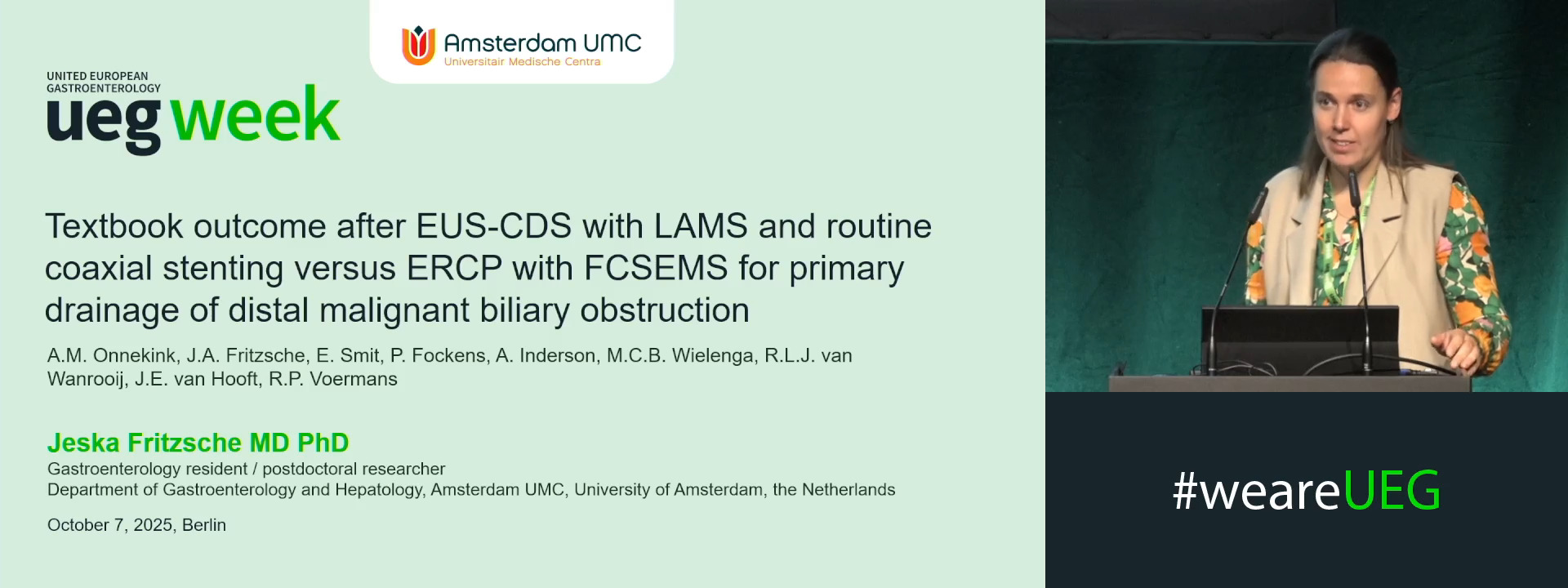
EUS-CDS WITH LAMS AND COAXIAL STENT VERSUS ERCP WITH FCSEMS FOR PRIMARY DRAINAGE OF DISTAL MALIGNANT BILIARY OBSTRUCTION: A POST-HOC ANALYSIS OF TWO PROSPECTIVE COHORTS
Anke Onnekink 1, Jeska A. Fritzsche 2, Esmée Smit 2, Marc G. Besselink 3, Paul Fockens 2, Akin Inderson 1, Mattheus Carolus Benignus Wielenga 2, Roy .L.J Van Wanrooij 4, Jeanin van Hooft 1, Rogier P. Voermans 3
1 Leiden University Medical Center, Leiden, Netherlands
2 Amsterdam UMC, location University of Amsterdam, Amsterdam, Netherlands|||Cancer Center Amsterdam, Amsterdam, Netherlands
3 Cancer Center Amsterdam, Amsterdam, Netherlands|||Amsterdam UMC, location University of Amsterdam, Amsterdam, Netherlands
4 Amsterdam UMC, location Vrije Universiteit, Amsterdam, Netherlands|||Cancer Center Amsterdam, Amsterdam, Netherlands
Event
Topics
Submission format
Citation
Published
Log in to access this content.
Free for all myUEG account holders. Your access level is set automatically based on your occupation. Medical professionals get full access to all content. If you are a non-medical user, you can only access UEG Week content from congresses you attended.
Not sure what you can access? Learn more about account types.
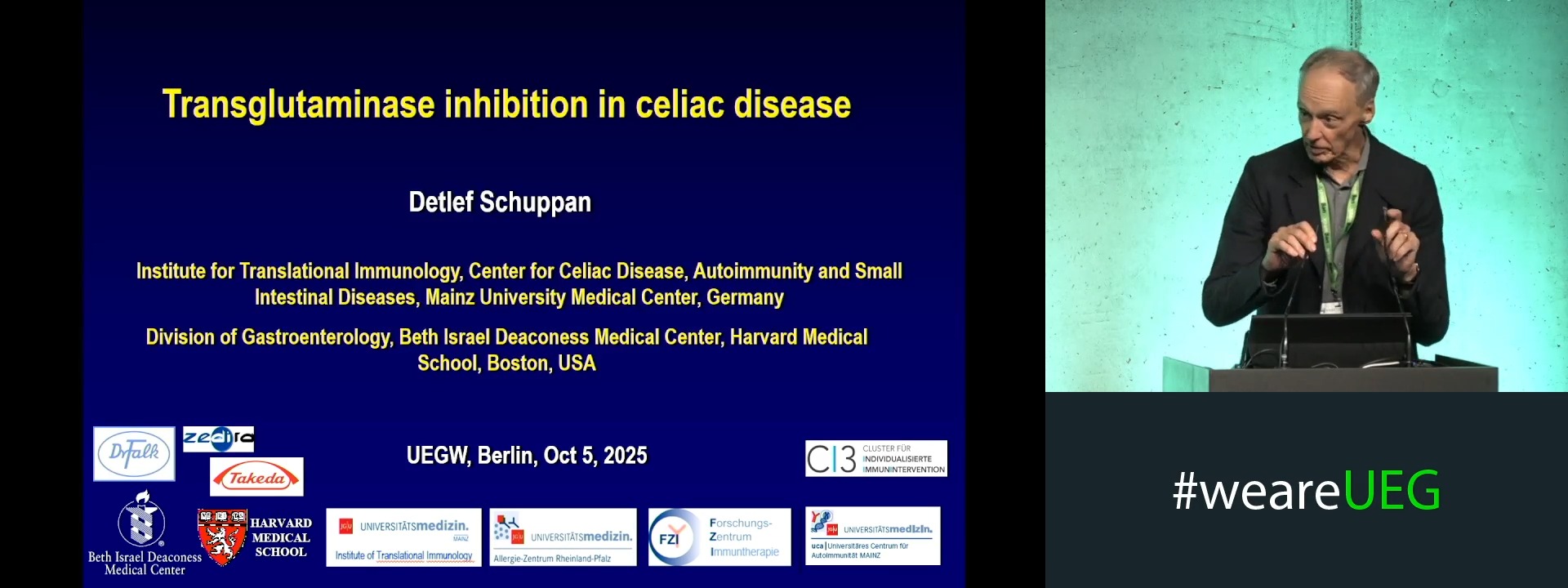
Transglutaminase inhibition in CeD
1 Medical University Mainz - Institute of Translational Immunology, Medical University Mainz ; Mainz/D, Mainz, Germany