UEG's educational platform for gastroenterology education bringing recordings, courses, guidelines, and more together in one place.
Most popular content
Rate for better recommendations!
Your feedback helps us show you more of what you like and less of what you dislike!
Log in to access this content.
Free for all myUEG account holders. Your access level is set automatically based on your occupation. Medical professionals get full access to all content. If you are a non-medical user, you can only access UEG Week content from congresses you attended.
Not sure what you can access? Learn more about account types.

KLF4 ORCHESTRATES MYELOID-ENDOTHELIAL CROSSTALK VIA CXCL2/CXCL3-CXCR2 AXIS TO DRIVE NEUTROPHIL EXTRACELLULAR TRAPS AND INFLAMMATORY CASCADES IN ACETAMINOPHEN-INDUCED LIVER INJURY
1 Tongji University, Shanghai, China
2 Tongji University Tongji Hospital, Shanghai, China
Conference
Topics
Submission format
Citation
Published
Log in to access this content.
Free for all myUEG account holders. Your access level is set automatically based on your occupation. Medical professionals get full access to all content. If you are a non-medical user, you can only access UEG Week content from congresses you attended.
Not sure what you can access? Learn more about account types.
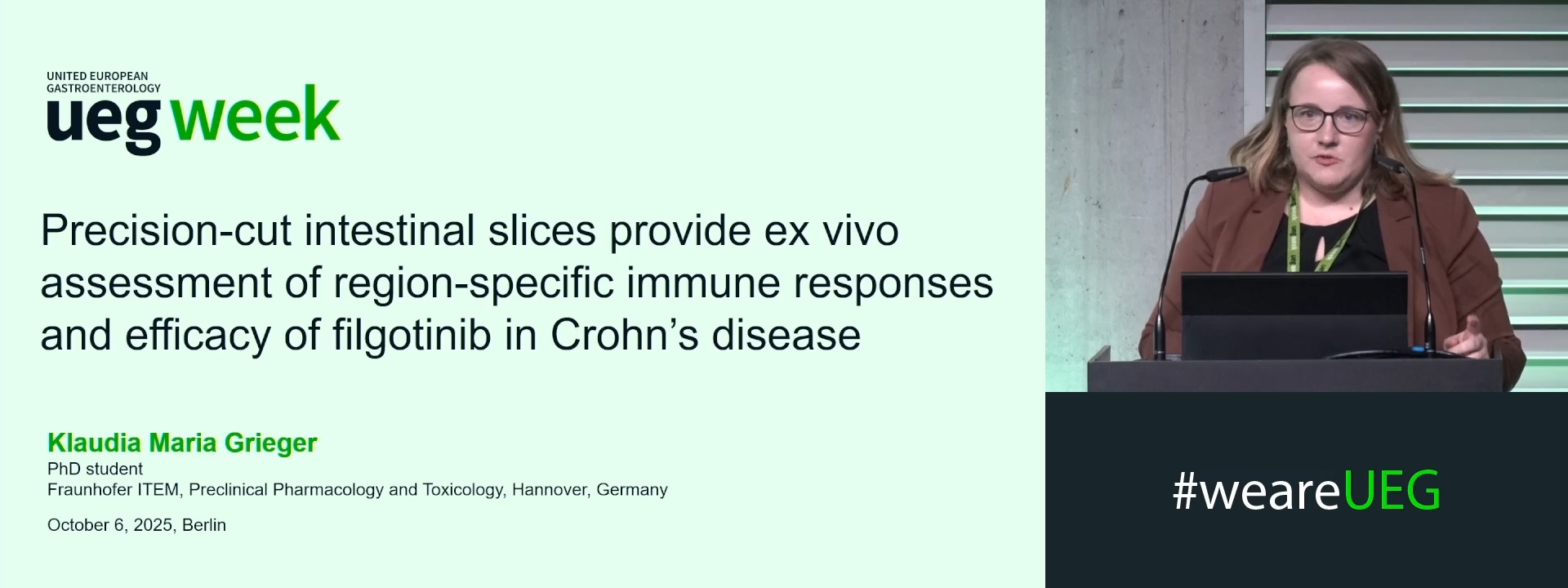
PRECISION-CUT INTESTINAL SLICES PROVIDE EX VIVO ASSESSMENT OF REGION-SPECIFIC IMMUNE RESPONSES AND EFFICACY OF FILGOTINIB IN CROHN'S DISEASE
Klaudia Maria Grieger 1, Valerie Beneke 1, Vanessa Neuhaus 1, Ulf Kulik 2, Heiko Aselmann 3, Benjamin Gundert 3, Armin Braun 1, Christina Hesse 1, Susann Dehmel 1, Katherina Sewald 1
1 Fraunhofer Institute for Toxicology and Experimental Medicine, Hannover, Germany
2 Hannover Medical school (MHH), Hannover, Germany
3 KRH Klinikum Region Hannover, Hannover, Germany
Event
Submission format
Citation
Published
Log in to access this content.
Free for all myUEG account holders. Your access level is set automatically based on your occupation. Medical professionals get full access to all content. If you are a non-medical user, you can only access UEG Week content from congresses you attended.
Not sure what you can access? Learn more about account types.
Nurse Programme (Complete Session)
Event
Session
Citation
Published
Log in to access this content.
Free for all myUEG account holders. Your access level is set automatically based on your occupation. Medical professionals get full access to all content. If you are a non-medical user, you can only access UEG Week content from congresses you attended.
Not sure what you can access? Learn more about account types.
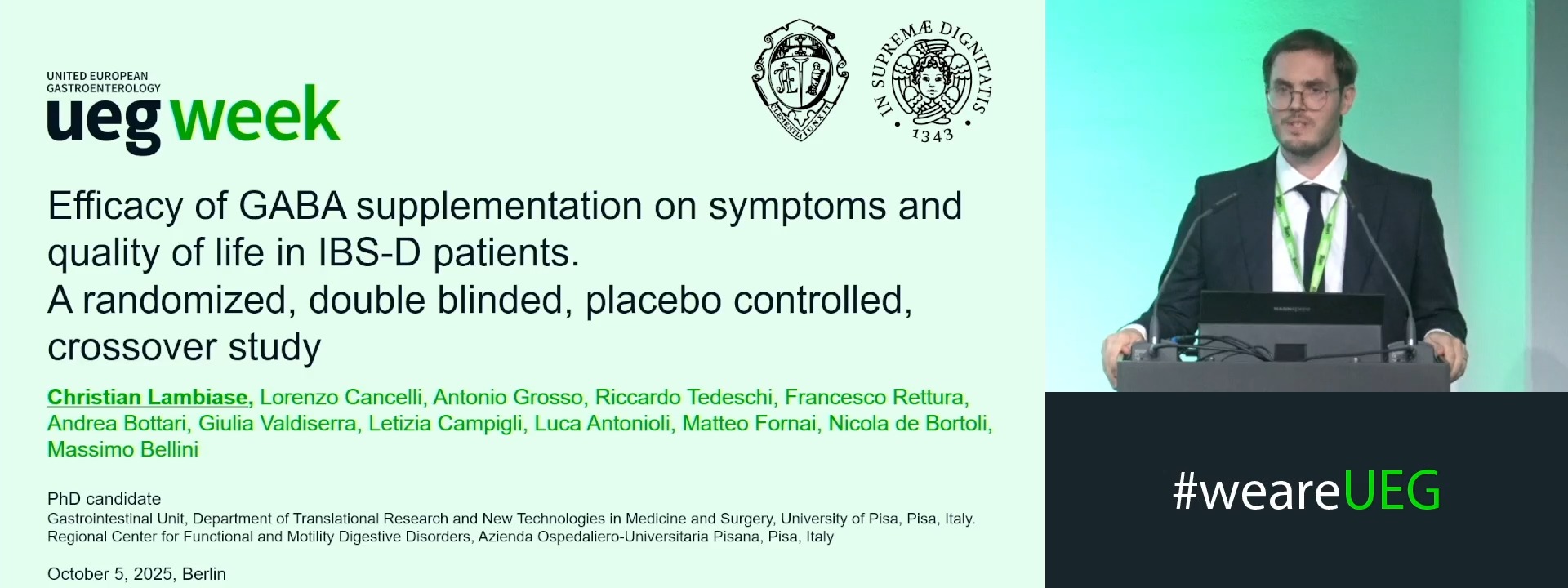
EFFECTS OF GAMMA-AMINOBUTYRIC ACID SUPPLEMENTATION ON SYMPTOMS AND QUALITY OF LIFE IN IBS-D PATIENTS. PRELIMINARY RESULTS FROM A RANDOMIZED, DOUBLE BLINDED, PLACEBO CONTROLLED, CROSSOVER STUDY
Christian Lambiase 1, Lorenzo Cancelli 1, Antonio Grosso 1, Riccardo Tedeschi 1, Francesco Rettura 1, Andrea Bottari 1, Giulia Valdiserra 2, Letizia Campigli 2, Luca Antonioli 2, Matteo Fornai 2, Nicola de Bortoli 1, Massimo Bellini 1
1 University of Pisa, Pisa, Italy|||Azienda Ospedaliero-Universitaria Pisana, Pisa, Italy
2 University of Pisa, Pisa, Italy
Event
Topics
Submission format
Session
Citation
Published
Log in to access this content.
Free for all myUEG account holders. Your access level is set automatically based on your occupation. Medical professionals get full access to all content. If you are a non-medical user, you can only access UEG Week content from congresses you attended.
Not sure what you can access? Learn more about account types.
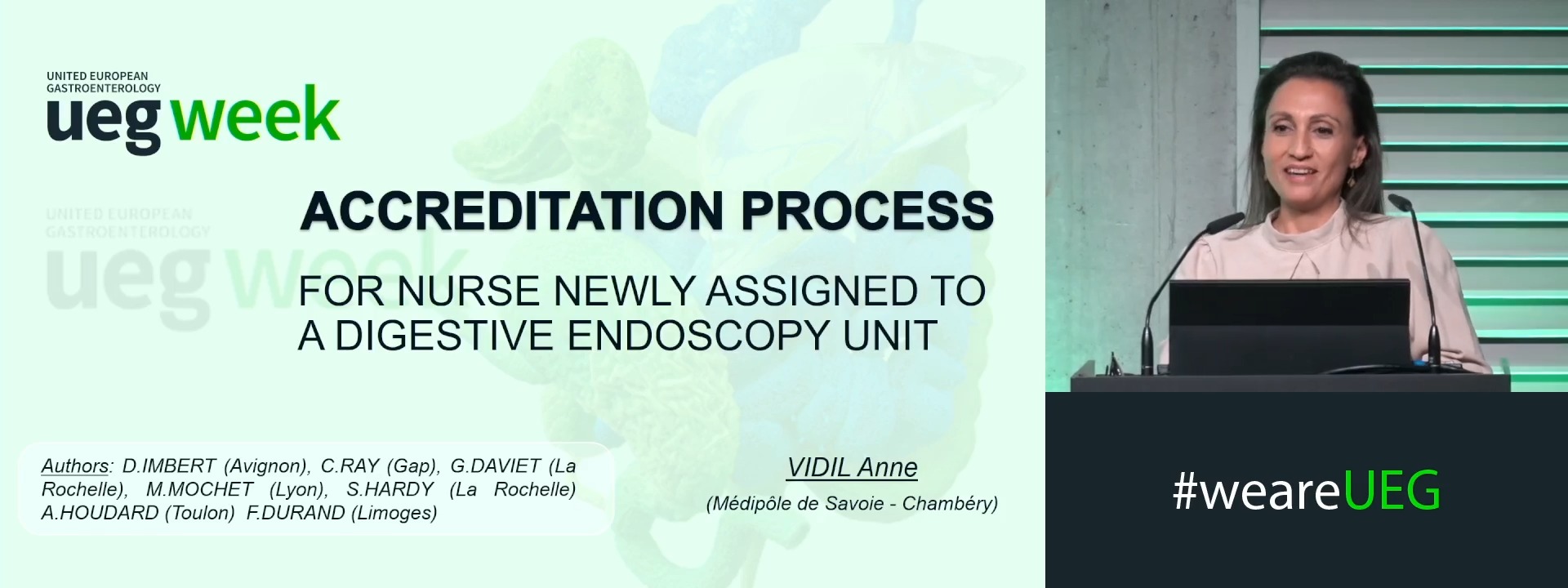
Accreditation for a newly recruited endoscopy nurse
1 None, None, France
Event
Topics
Citation
Published
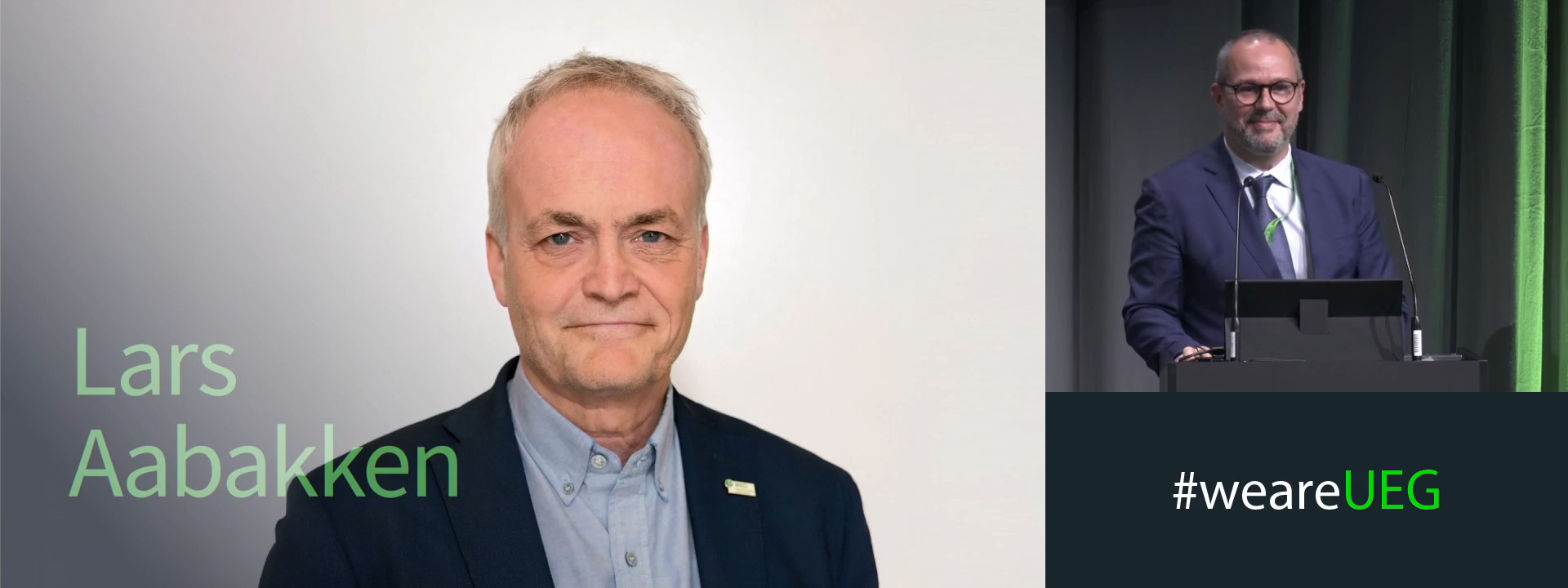
Log in to access this content.
Free for all myUEG account holders. Your access level is set automatically based on your occupation. Medical professionals get full access to all content. If you are a non-medical user, you can only access UEG Week content from congresses you attended.
Not sure what you can access? Learn more about account types.
Laudatio UEG Lifetime Achievement Awardee
1 IPO Porto, Porto, Portugal
Event
Topics
Session
Citation
Published
Log in to access this content.
Free for all myUEG account holders. Your access level is set automatically based on your occupation. Medical professionals get full access to all content. If you are a non-medical user, you can only access UEG Week content from congresses you attended.
Not sure what you can access? Learn more about account types.
COLD SNARE POLYPECTOMY VERSUS HOT ENDOSCOPIC MUCOSAL RESECTION FOR LARGE NON-PEDUNCULATED COLORECTAL POLYPS: A SYSTEMATIC REVIEW AND META-ANALYSIS OF RANDOMIZED CONTROLLED TRIALS
Andrea Sorge 1, Michele Montori 2, Maria Eva Argenziano 3, Pieter Jan Poortmans 4, Daniele Balducci 5, Gian Eugenio Tontini 6, Sander Smeets 3, Tamás Tornai 3, Massimo Del Fabbro 7, Sandro Sferrazza 8, Lobke Desomer 9, Gabriele Gallo Afflitto 10, David James Tate 3
1 Gent University Hospital, Gent, Belgium|||University of Milan, Milan, Italy
2 Gent University Hospital, Gent, Belgium|||Università Politecnica delle Marche, Ancona, Italy
3 Gent University Hospital, Gent, Belgium
4 Gent University Hospital, Gent, Belgium|||University Hospital Ghent, University Hospital Brussels, Asse, Belgium
5 Università Politecnica delle Marche, Ancona, Italy
6 Fondazione IRCCS Ca' Granda Ospedale Maggiore Policlinico, Milan, Italy
7 University of Milan, Milan, Italy
8 Arnas Ospedale Civico Palermo, Palermo, Italy
9 AZ Delta vzw, Roeselare, Belgium
10 University of Rome “Tor Vergata”, Rome, Italy
Conference
Topics