UEG's educational platform for gastroenterology education bringing recordings, courses, guidelines, and more together in one place.
Most popular content
Rate for better recommendations!
Your feedback helps us show you more of what you like and less of what you dislike!
Log in to access this content.
Free for all myUEG account holders. Your access level is set automatically based on your occupation. Medical professionals get full access to all content. If you are a non-medical user, you can only access UEG Week content from congresses you attended.
Not sure what you can access? Learn more about account types.

LESS IS MORE! NATIONAL WASTE ASSESSMENT AND A NOVEL WASTE REDUCTION STRATEGY BASED ON A PROSPECTIVE MULTICENTRE STUDY IN GERMANY
Lukas Welsch 1, Mireen Friedrich-Rust 2, Andrea Tal 3, Norbert Haider 4, Sarah Kim 5, Maximilian Schneider 3, Laura Schmitt 3, Lisa Wittersheim 4, Sabine Schmitt 1, Alica Heide 2, Myriam Heilani 2, Stefan Zeuzem 2, Axel Eickhoff 1, Florian Alexander Michael 2
1 Klinikum Hanau, Hanau, Germany
2 University Hospital Frankfurt, Frankfurt, Germany
3 Internistische Praxisgemeinschaft Hanau (IPG), Hanau, Germany
4 Magen-Darm-Zentrum Darmstadt (MDZ), Hanau, Germany
5 Klinikum Hanau, Hanau, Germany|||University Hospital Frankfurt, Frankfurt, Germany
Conference
Submission format
Citation
Published
Log in to access this content.
Free for all myUEG account holders. Your access level is set automatically based on your occupation. Medical professionals get full access to all content. If you are a non-medical user, you can only access UEG Week content from congresses you attended.
Not sure what you can access? Learn more about account types.
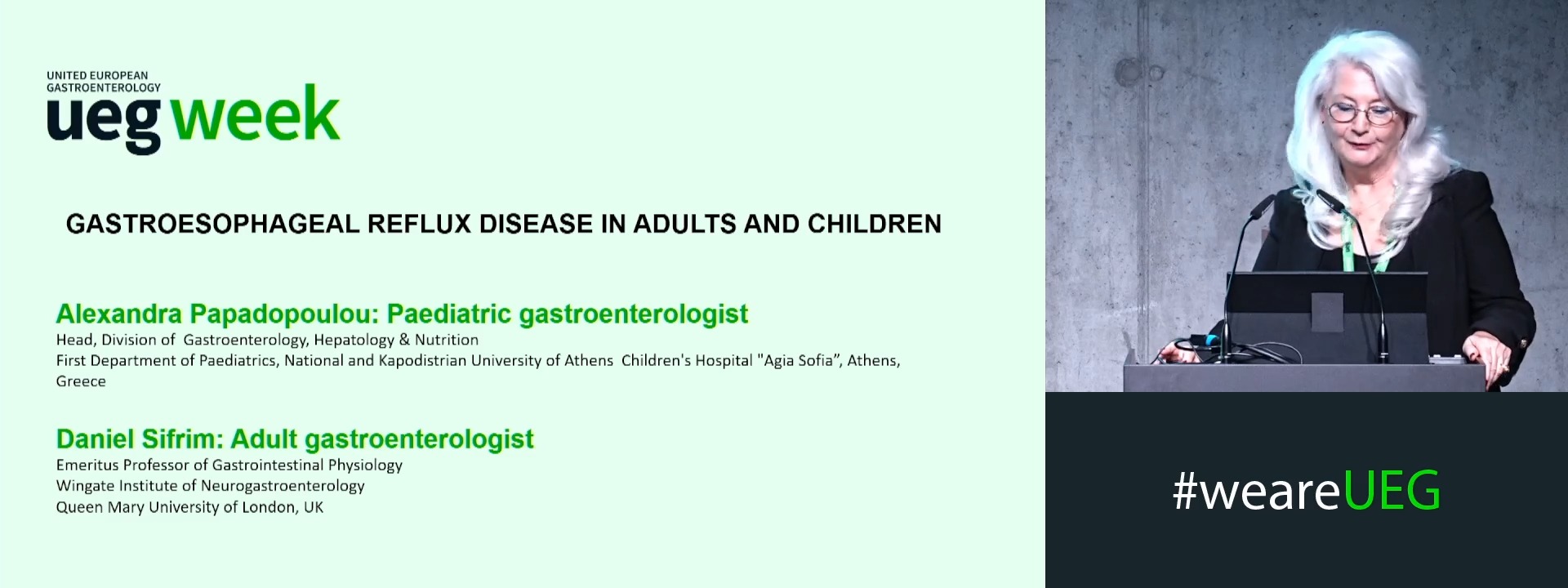
Reflux: Paediatric and adult gastroenterologist
1 University of Athens, Athens, Greece
2 Queen Mary University London, Blizard Institute, London, United Kingdom
Event
Session
Citation
Published
Log in to access this content.
Free for all myUEG account holders. Your access level is set automatically based on your occupation. Medical professionals get full access to all content. If you are a non-medical user, you can only access UEG Week content from congresses you attended.
Not sure what you can access? Learn more about account types.
DIFFERENT EFFECT OF LOCAL SPHINCTER STIMULATION ON ANAL FUNCTION AND SYMPTOMS OF URGE VS. PASSIVE FECAL INCONTINENCE
1 Jessenius faculty of Medicine in Martin, Comenius University, Slovakia, Martin, Slovakia
Conference
Topics
Submission format
Session
Citation
Published
Log in to access this content.
Free for all myUEG account holders. Your access level is set automatically based on your occupation. Medical professionals get full access to all content. If you are a non-medical user, you can only access UEG Week content from congresses you attended.
Not sure what you can access? Learn more about account types.
SPLENIC VEIN THROMBOSIS PREVALENCE IN CHRONIC PANCREATITIS: A SYSTEMATIC REVIEW AND META‐ANALYSIS
Ruben Zsolt Borbély 1, Jakub Hoferica 2, Brigitta Teutsch 3, Eszter Ágnes Szalai 4, Peter Jeno Hegyi 5, Balint Eross 3, Nándor Faluhelyi 6, Peter Hegyi 7
1 Semmelweis University, Budapest, Hungary|||Bajcsy-Zsilinszky Hospital, Budapest, Hungary
2 Semmelweis University, Budapest, Hungary|||Comenius University, Martin, Slovakia
3 Semmelweis University, Budapest, Hungary|||Semmelweis University, Budapest, Hungary|||University of Pecs, Pecs, Hungary
4 Semmelweis University, Budapest, Hungary
5 Semmelweis University, Budapest, Hungary|||Semmelweis University, Budapest, Hungary
6 Semmelweis University, Budapest, Hungary|||University of Pecs, Pecs, Hungary
7 Semmelweis University, Budapest, Hungary|||University of Pecs, Pecs, Hungary|||University of Szeged, Szeged, Hungary
Conference
Topics
Submission format
Session
Citation
Published
Log in to access this content.
Free for all myUEG account holders. Your access level is set automatically based on your occupation. Medical professionals get full access to all content. If you are a non-medical user, you can only access UEG Week content from congresses you attended.
Not sure what you can access? Learn more about account types.
THE ASSOCIATION OF ENDOSCOPIC OUTCOMES WITH LONG-TERM CLINICAL IMPROVEMENTS IN RISANKIZUMAB-TREATED PATIENTS WITH MODERATE TO SEVERE CROHN’S DISEASE: POST HOC RESULTS FROM THE PHASE 3 SEQUENCE TRIAL
Vipul Jairath 1, Namita Joshi 2, Christopher Ma 3, Peter Bossuyt 4, Nidhi Shukla 2, Kristina Kligys 2, Javier Zambrano 2, Toni Anschutz 2, Brooke Kim 2, Brian G. Feagan 5
1 Western University, London, Canada|||Western University, London, Canada
2 AbbVie, North Chicago, United States
3 University of Calgary, Calgary, Canada|||University of Calgary, Calgary, Canada
4 Imelda General Hospital, Bonheiden, Belgium
5 Alimentiv Inc., London, Canada
Conference
Topics
Submission format
Citation
Published
Log in to access this content.
Free for all myUEG account holders. Your access level is set automatically based on your occupation. Medical professionals get full access to all content. If you are a non-medical user, you can only access UEG Week content from congresses you attended.
Not sure what you can access? Learn more about account types.
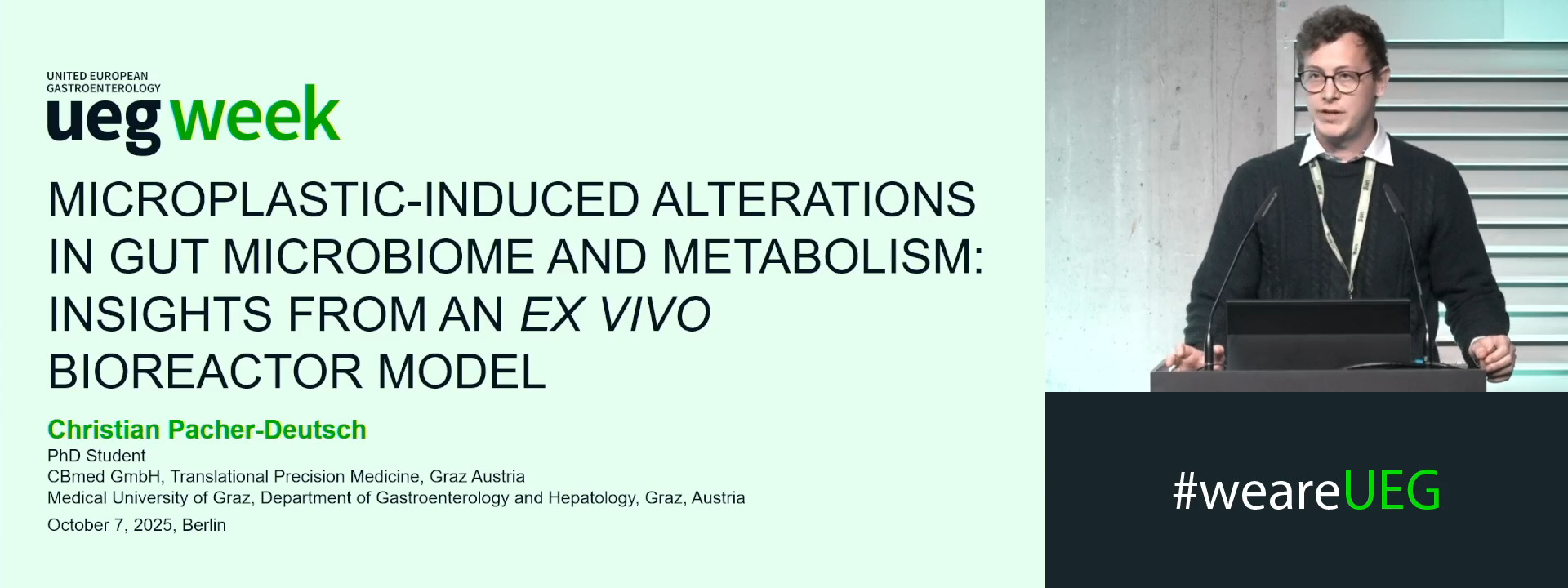
MICROPLASTIC-INDUCED ALTERATIONS IN GUT MICROBIOME AND METABOLISM: INSIGHTS FROM AN EX VIVO BIOREACTOR MODEL
Christian Pacher-Deutsch 1, Kristina Žukauskaitė 1, Cigdem Akar 2, Maximilian Nepel 2, Lukas Kogler 3, Hansjörg Habisch 2, Serena Ducoli 4, Stefania Federici 4, Tobias Madl 5, Verena Pichler 6, Angela Horvath 1, Vanessa Stadlbauer 7
1 Center for Biomarker Research in Medicine (CBmed), Graz, Austria|||Medical University of Graz, Graz, Austria
2 Medical University of Graz, Graz, Austria
3 Center for Biomarker Research in Medicine (CBmed), Graz, Austria|||University of Vienna, Vienna, Austria|||Medical University of Vienna, Vienna, Austria
4 University of Brescia, Brescia, Italy
5 Medical University of Graz, Graz, Austria|||BioTechMed-Graz, Graz, Austria
6 Center for Biomarker Research in Medicine (CBmed), Graz, Austria|||University of Vienna, Vienna, Austria
7 Center for Biomarker Research in Medicine (CBmed), Graz, Austria|||Medical University of Graz, Graz, Austria|||BioTechMed-Graz, Graz, Austria
Event
Topics
Submission format
Citation
Published
Log in to access this content.
Free for all myUEG account holders. Your access level is set automatically based on your occupation. Medical professionals get full access to all content. If you are a non-medical user, you can only access UEG Week content from congresses you attended.
Not sure what you can access? Learn more about account types.
INFLUENCE OF BILIARY STRICTURE LOCATION ON AI PERFORMANCE IN DIGITAL SINGLE-OPERATOR CHOLANGIOSCOPY: A MULTICENTER TRANSATLANTIC STUDY
Francisco Mendes 1, Mariano Gonzalez Haba 2, Miguel Mascarenhas-Saraiva 1, Tiago Ribeiro 3, Belén Agudo Castillo 2, António Miguel Martins Pinto da Costa 2, Miguel Martins 1, Grace Kim 4, Yousef Fazel 5, Ana Pérez González 2, João Afonso 1, Joana Mota 1, Maria Almeida 1, Pedro Cardoso 1, João Ferreira 6, Uzma D. Siddiqui 4, Jessica Widmer 5, Guilherme Macedo 3
1 São João University Hospital, Porto, Portugal|||WGO Gastroenterology and Hepatology Training Center, Porto, Portugal
2 Hospital Universitario Puerta de Hierro Majadahonda, Madrid, Spain
3 WGO Gastroenterology and Hepatology Training Center, Porto, Portugal|||São João University Hospital, Porto, Portugal
4 University of Chicago Medicine, Chicago, United States
5 New York University Langone Hospital, New York, United States
6 Faculty of Engineering of the University of Porto, Porto, Portugal
Conference
Topics