UEG's educational platform for gastroenterology education bringing recordings, courses, guidelines, and more together in one place.
Most popular content
Rate for better recommendations!
Your feedback helps us show you more of what you like and less of what you dislike!
Log in to access this content.
Free for all myUEG account holders. Your access level is set automatically based on your occupation. Medical professionals get full access to all content. If you are a non-medical user, you can only access UEG Week content from congresses you attended.
Not sure what you can access? Learn more about account types.

IMPACT OF DRUG HOLIDAYS ON TREATMENT PERSISTENCE OF BIOLOGICAL AGENTS IN CROHN’S DISEASE: INSIGHTS FROM THE PERSISTENCE AUSTRALIAN NATIONAL IBD COHORT (PANIC5) OVER 79,677 PATIENT-YEARS
Rupert W Leong 1, John Chetwood 1, Aviv Pudipeddi 1, Thanaboon Chaemsupaphan 1, Chang Ho Ryan Choi 1, Viraj Kariyawasam 1
1 Concord Hospital, Sydney, Australia
Conference
Topics
Submission format
Citation
Published
Log in to access this content.
Free for all myUEG account holders. Your access level is set automatically based on your occupation. Medical professionals get full access to all content. If you are a non-medical user, you can only access UEG Week content from congresses you attended.
Not sure what you can access? Learn more about account types.
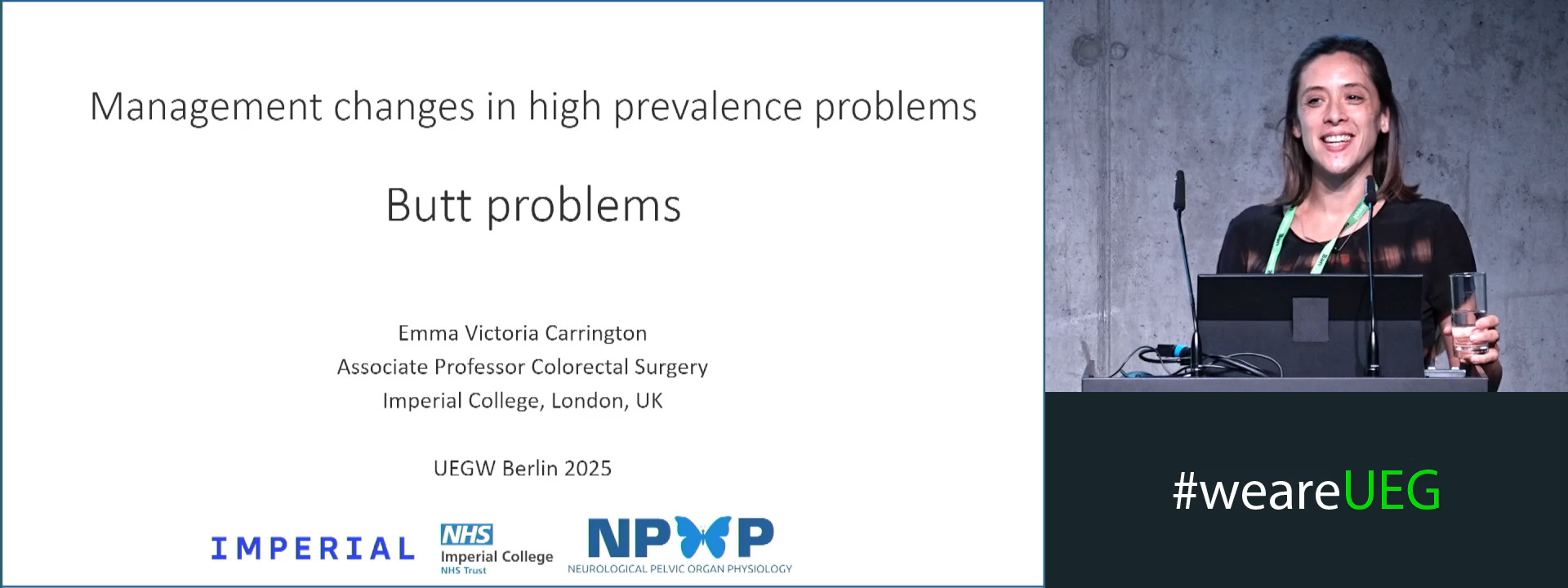
Butt problems
1 University of North Carolina / NCRBSI, London, United Kingdom
Event
Topics
Citation
Published
Log in to access this content.
Free for all myUEG account holders. Your access level is set automatically based on your occupation. Medical professionals get full access to all content. If you are a non-medical user, you can only access UEG Week content from congresses you attended.
Not sure what you can access? Learn more about account types.
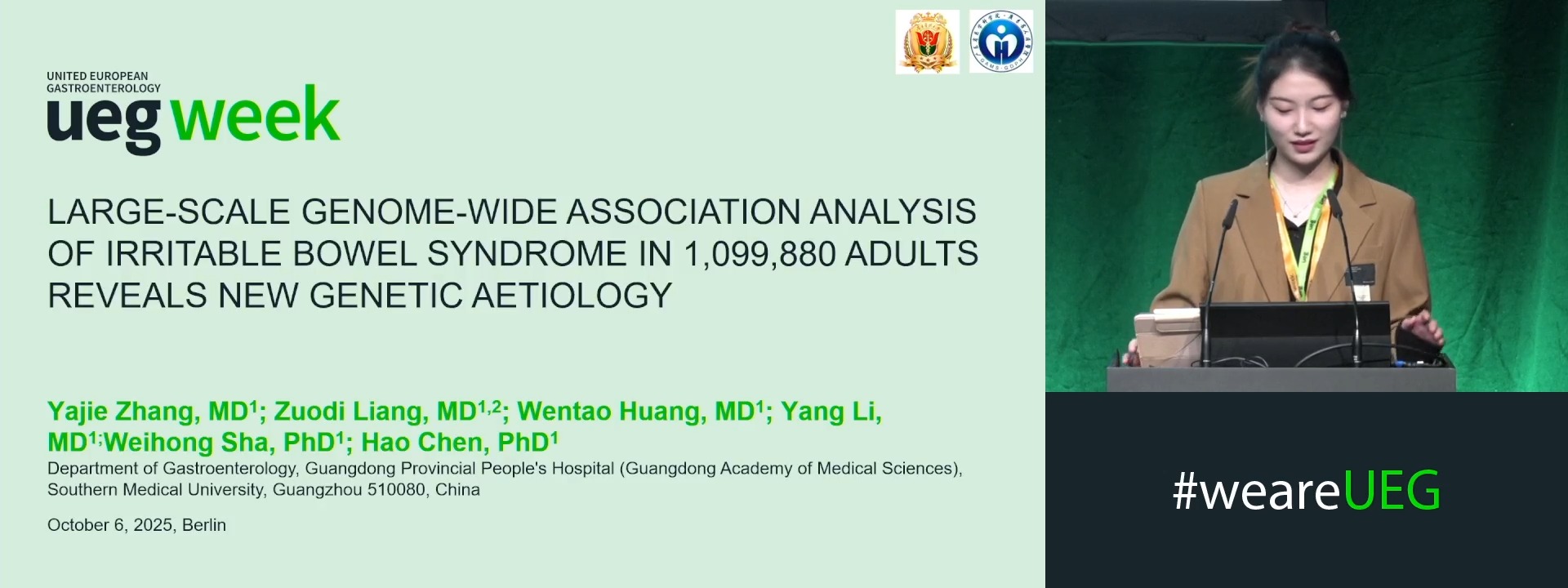
LARGE-SCALE GENOME-WIDE ASSOCIATION ANALYSIS OF IRRITABLE BOWEL SYNDROME IN 1,099,880 ADULTS REVEALS NEW GENETIC AETIOLOGY
1 Department of Gastroenterology, Guangdong Provincial People's Hospital (Guangdong Academy of Medical Sciences), Southern Medical University, Guang Zhou, China
2 School of Medicine of South China University of Technology, Guang Zhou, China|||Department of Gastroenterology, Guangdong Provincial People's Hospital (Guangdong Academy of Medical Sciences), Southern Medical University, Guang Zhou, China
Event
Topics
Submission format
Session
Citation
Published
Log in to access this content.
Free for all myUEG account holders. Your access level is set automatically based on your occupation. Medical professionals get full access to all content. If you are a non-medical user, you can only access UEG Week content from congresses you attended.
Not sure what you can access? Learn more about account types.
Panel discussion: Therapy update - EoE
Event
Session
Citation
Published
Log in to access this content.
Free for all myUEG account holders. Your access level is set automatically based on your occupation. Medical professionals get full access to all content. If you are a non-medical user, you can only access UEG Week content from congresses you attended.
Not sure what you can access? Learn more about account types.
FILGUITO: ONE-YEAR REAL-WORLD EFFECTIVENESS AND SAFETY OF FILGOTINIB IN ULCERATIVE COLITIS – RESULTS FROM A MULTICENTER ANDALUSIAN REGISTRY
Antonio M Caballero-Mateos 1, Claudio Trigo Salado 2, Álvaro Suárez Toribio 2, Maria Mar Martin Rodriguez 3, Francisco Javier Rodriguez-González 4, Teresa Valdes-Delgado 5, Hector Pallares Manrique 6, Maria Cristina Bailon Gaona 7, JOSE MANUEL BENITEZ CANTERO 8, Ana Maria Trapero-Martínez 9, Raúl Olmedo-Martín 10, Alvaro Hernández Martínez 11
1 Hospital Santa Ana, Motril, Granada, Spain
2 Hospital Virgen del Rocío, Sevilla, Spain
3 Hosp. Universitario Virgen De Las Nieves General, Granada, Spain
4 Hospital Virgen de la Victoria, Málaga, Spain
5 Hospital Universitario Virgen Macarena, Seville, Spain
6 H. juan ramon jimenez, Huelva, Spain
7 Hospital Clínico San Cecilio, Granada, Spain
8 Hospital Universitario Reina Sofia, Cordoba, Spain
9 Hospital Universitario de Jaén, Jaén, Spain
10 Hospital Regional de Málaga, Málaga, Spain
11 Hospital Torrecárdenas, Almería, Spain
Conference
Topics
Submission format
Citation
Published
Log in to access this content.
Free for all myUEG account holders. Your access level is set automatically based on your occupation. Medical professionals get full access to all content. If you are a non-medical user, you can only access UEG Week content from congresses you attended.
Not sure what you can access? Learn more about account types.
INTERNATIONAL CONSENSUS ON CHRONIC INTESTINAL PSEUDO-OBSTRUCTION IN ADULTS
Bert Broeders 1, Heithem Soliman 2, Rebecca E Burgell 3, Michael Camilleri 4, Roberto De Giorgio 5, Claudia Defilippi 6, Kee Wook Jung 7, Simon Lal 8, Ana Maria Madrid 6, Carolina Malagelada 9, Atsushi Nakajima 10, Loris Pironi 11, Tim Vanuytsel 12, Nicholas Verne 13, Arved Weimann 14, May Wong 15, Vincenzo Stanghellini 16, Jan Tack 17
1 Ku Leuven, Leuven, Belgium
2 Hôpital Louis Mourier - AP-HP, Colombes, France
3 Alfred Health and Monash University, Prahran, Australia
4 Mayo Clinic Dept. of Gastroenterology Charlton Bldg., Rm. 8-110, Rochester, MN, United States
5 University of Ferrara, Ferarra, Italy
6 Hospital Clinico Universidad de Chile, Santiago, Chile
7 Asan Medical Center, Seoul, Korea, Republic of
8 Salford Royal Foundation Trust, Salford, United Kingdom
9 Hospital Vall d`Hebron, Barcelona, Spain
10 Yokohama City University Hosp. Dept. of Gastroenterology, Yokohama, Japan
11 University of Bologna S. Orsola-Malpighi Hospital, Bologna, Italy
12 KU Leuven, Leuven, Belgium
13 University of Tennessee College of Medicine, Memphis, United States
14 St. George Hospital, Leipzig, Germany
15 Royal North Shore Hospital, Sydney, Australia
16 University of Bologna Policlinico S.Orsola-Malpighi Internal Med. & Gastroenterology - Department of, Bologna, Italy
17 University of Leuven, University Hospital Gasthuisberg, Leuven, Belgium
Conference
Topics
Submission format
Session
Citation
Published
Log in to access this content.
Free for all myUEG account holders. Your access level is set automatically based on your occupation. Medical professionals get full access to all content. If you are a non-medical user, you can only access UEG Week content from congresses you attended.
Not sure what you can access? Learn more about account types.
Panel Discussion: Diabetes in GI disorders
Event
Session