UEG's educational platform for gastroenterology education bringing recordings, courses, guidelines, and more together in one place.
Most popular content
Rate for better recommendations!
Your feedback helps us show you more of what you like and less of what you dislike!
Log in to access this content.
Free for all myUEG account holders. Your access level is set automatically based on your occupation. Medical professionals get full access to all content. If you are a non-medical user, you can only access UEG Week content from congresses you attended.
Not sure what you can access? Learn more about account types.

EVALUATION OF THE DIAGNOSTIC ACCURACY OF CHATGPT-4 IN RECOGNITION AND CLASSIFICATION OF ESOPHAGEAL VARICES: A MULTICENTER STUDY
Giulia Navazzotti 1, ANDREA PASTA 1, Francesco Calabrese 1, Marcello Fabio Maida 2, Giovanni Marasco 3, Gianluca Esposito 4, Arnaldo Amato 5, Andrea Anderloni 6, Irene Maria Bambina Bergna 7, Elisabetta Dell'Unto 4, Alessandro Vitello 2, Tommaso Pessarelli 7, Sebastiano Ziola 8, DAVIDE SCALVINI 9, Elisa Marabotto 10, Giorgia Bodini 11, Edoardo Giovanni Giannini 1, Manuele Furnari 12
1 University of Genoa, Genoa, Italy
2 Department of Medicine and Surgery, University of Enna ‘Kore’, Caltanissetta, Italy
3 University of Bologna, Bologna, Italy
4 Sant’Andrea Hospital, Sapienza University of Rome, Italy, Rome, Italy
5 Gastroenterology Unit, Ospedale Valduce, Como, Italy, Como, Italy
6 Humanitas Research Hospital, Milan, Italy
7 Università degli studi di Milano, Milano, Italy
8 University of Genoa, IRCCS Ospedale Policlinico San Martino, Genoa, Italy, Genoa, Italy
9 University of Pavia, Pavia, Italy
10 OSP Policlinico San Martino, Genova, Italy
11 Policlinico San Martino, Genova, Italy
12 University of Genoa., Genoa, Italy
Conference
Topics
Submission format
Citation
Published
Log in to access this content.
Free for all myUEG account holders. Your access level is set automatically based on your occupation. Medical professionals get full access to all content. If you are a non-medical user, you can only access UEG Week content from congresses you attended.
Not sure what you can access? Learn more about account types.
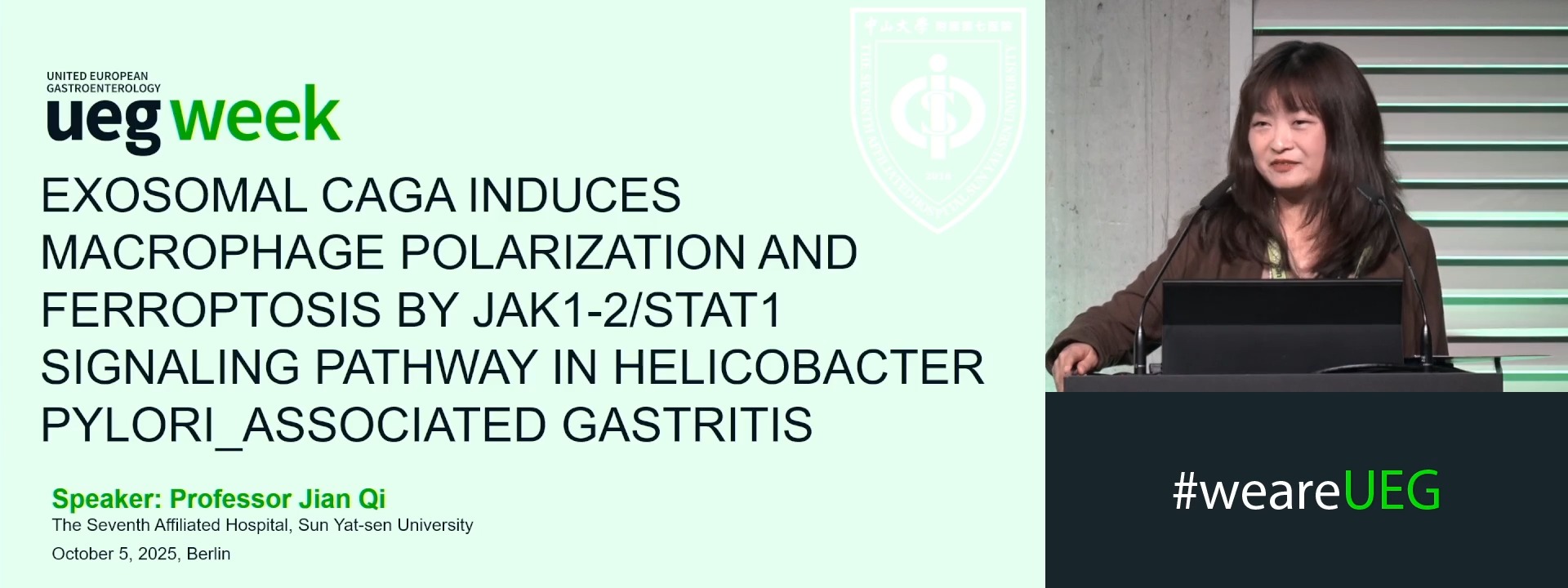
EXOSOMAL CAGA INDUCES MACROPHAGE POLARIZATION AND FERROPTOSIS BY JAK1-2/STAT1 SIGNALING PATHWAY IN HELICOBACTER PYLORI-ASSOCIATED GASTRITIS
1 The Seventh Affiliated Hospital, Sun Yat-Sen University, Shenzhen, China
Event
Submission format
Citation
Published
Log in to access this content.
Free for all myUEG account holders. Your access level is set automatically based on your occupation. Medical professionals get full access to all content. If you are a non-medical user, you can only access UEG Week content from congresses you attended.
Not sure what you can access? Learn more about account types.
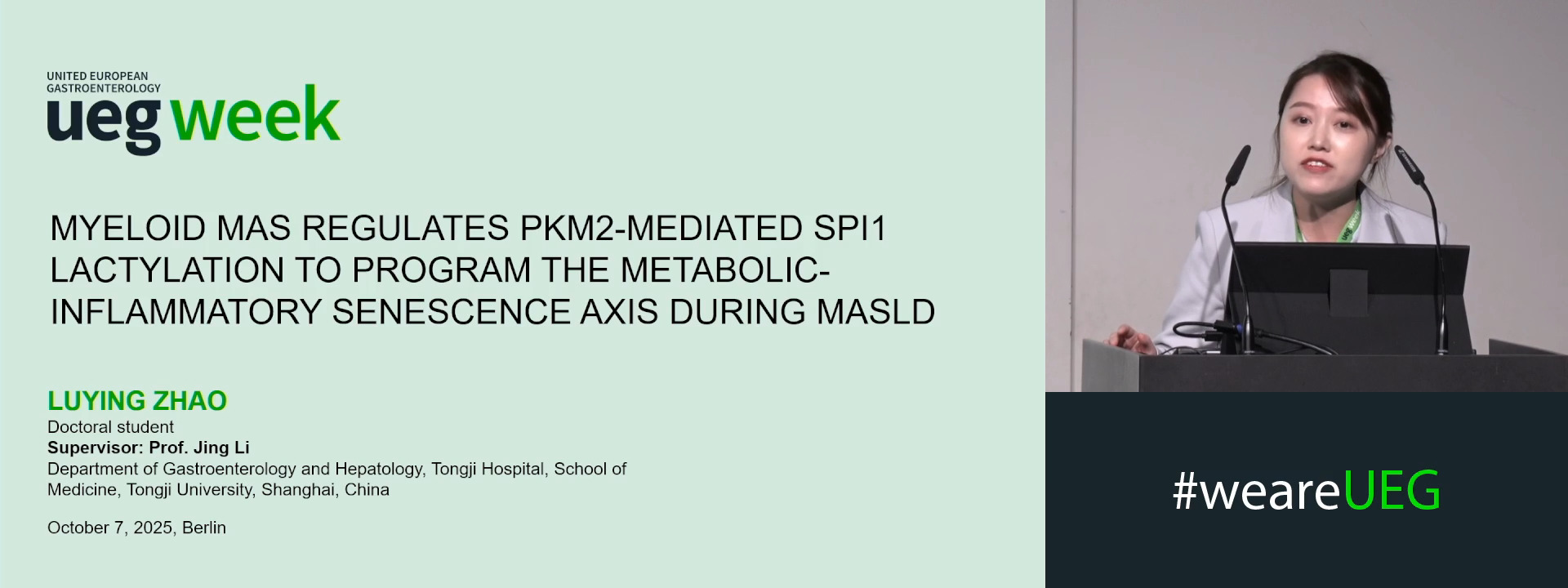
MYELOID MAS REGULATES PKM2-MEDIATED SPI1 LACTYLATION TO PROGRAM THE METABOLIC-INFLAMMATORY SENESCENCE AXIS OF MONONUCLEAR PHAGOCYTE SYSTEM DURING THE METABOLIC DYSFUNCTION-ASSOCIATED STEATOTIC LIVER DISEASE (MASLD)
1 Tongji Hospital, Tongji University School of Medicine, Shanghai, China
Event
Submission format
Session
Citation
Published
Log in to access this content.
Free for all myUEG account holders. Your access level is set automatically based on your occupation. Medical professionals get full access to all content. If you are a non-medical user, you can only access UEG Week content from congresses you attended.
Not sure what you can access? Learn more about account types.
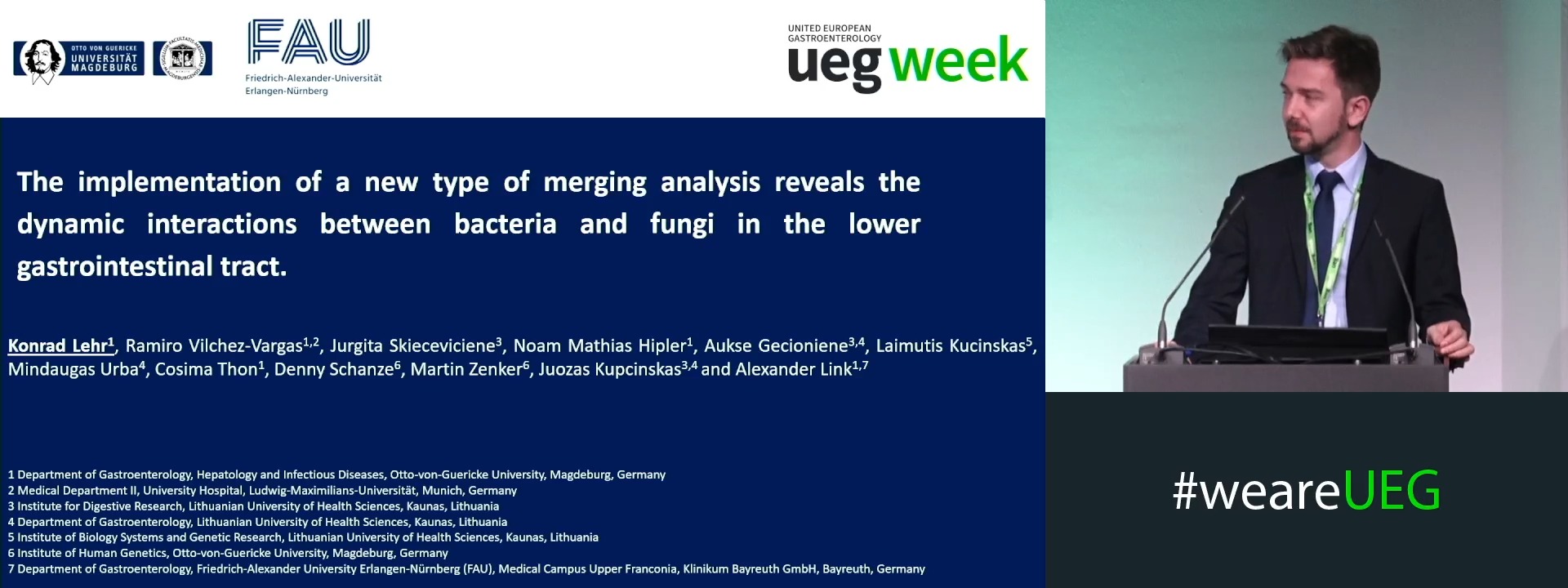
THE IMPLEMENTATION OF A NEW TYPE OF MERGING ANALYSIS REVEALS THE DYNAMIC INTERACTIONS BETWEEN BACTERIA AND FUNGI IN THE LOWER GASTROINTESTINAL TRACT
Konrad Lehr 1, Ramiro Vilchez-Vargas 2, Jurgita Skieceviciene 3, Noam Hipler 1, Aukse Gecioniene 4, Laimutis Kucinskas 3, Mindaugas Urba 3, Cosima Thon 1, Denny Schanze 1, Unknown Unknown 1, Juozas Kupcinskas 4, Alexander Link 1
1 Otto-von-Guericke University, Magdeburg, Germany
2 Otto-von-Guericke University, Magdeburg, Germany|||Ludwig-Maximilians-University, Munich, Germany
3 Lithuanian University of Health Sciences, Kaunas, Lithuania
4 Lithuanian University of Health Sciences, Kaunas, Lithuania|||Lithuanian University of Health Sciences, Kaunas, Lithuania
Event
Topics
Submission format
Citation
Published
Log in to access this content.
Free for all myUEG account holders. Your access level is set automatically based on your occupation. Medical professionals get full access to all content. If you are a non-medical user, you can only access UEG Week content from congresses you attended.
Not sure what you can access? Learn more about account types.
ADVANCING INFLAMMATORY BOWEL DISEASE CARE IN AFRICA: OUTCOMES FROM A MULTIDISCIPLINARY EDUCATIONAL SYMPOSIUM
1 Suez University Faculty of Medicine, Suez, Egypt|||Pan-African Organization for Health Education and Research (POHER), St. Louis, United States
2 University Hospitals Wishaw, Wishaw, United Kingdom
3 University Hospitals Dorset, Dorset, United Kingdom
4 Lagos University Teaching Hospital, Lagos, Nigeria
5 Pan-African Organization for Health Education and Research (POHER), St. Louis, United States|||Massachusetts General Hospital, Boston, United States
Conference
Submission format
Session
Citation
Published
Log in to access this content.
Free for all myUEG account holders. Your access level is set automatically based on your occupation. Medical professionals get full access to all content. If you are a non-medical user, you can only access UEG Week content from congresses you attended.
Not sure what you can access? Learn more about account types.
SYPHILITIC HEPATITIS: A RARE BUT REVERSIBLE CAUSE OF UNEXPLAINED HEPATITIS
Edmond Baghdasaryan 1, Lilit Harutyunyan 1, Sofya Grigoryan 1, Rima Melikyan 1, Emma Harutyunyan 1, Olya Sargsyan 1, Arpi Gasparyan 1, Gayane Ayvazyan 1, Syuzanna Avanesyan 1, Parandzem Khachatryan 1, Gayane Matsakyan 1, Gagik Hakobyan 1
1 Yerevan State Medical University after Mkhitar Heratsi, Yerevan, Armenia
Conference
Topics
Submission format
Session
Published
Log in to access this content.
Free for all myUEG account holders. Your access level is set automatically based on your occupation. Medical professionals get full access to all content. If you are a non-medical user, you can only access UEG Week content from congresses you attended.
Not sure what you can access? Learn more about account types.
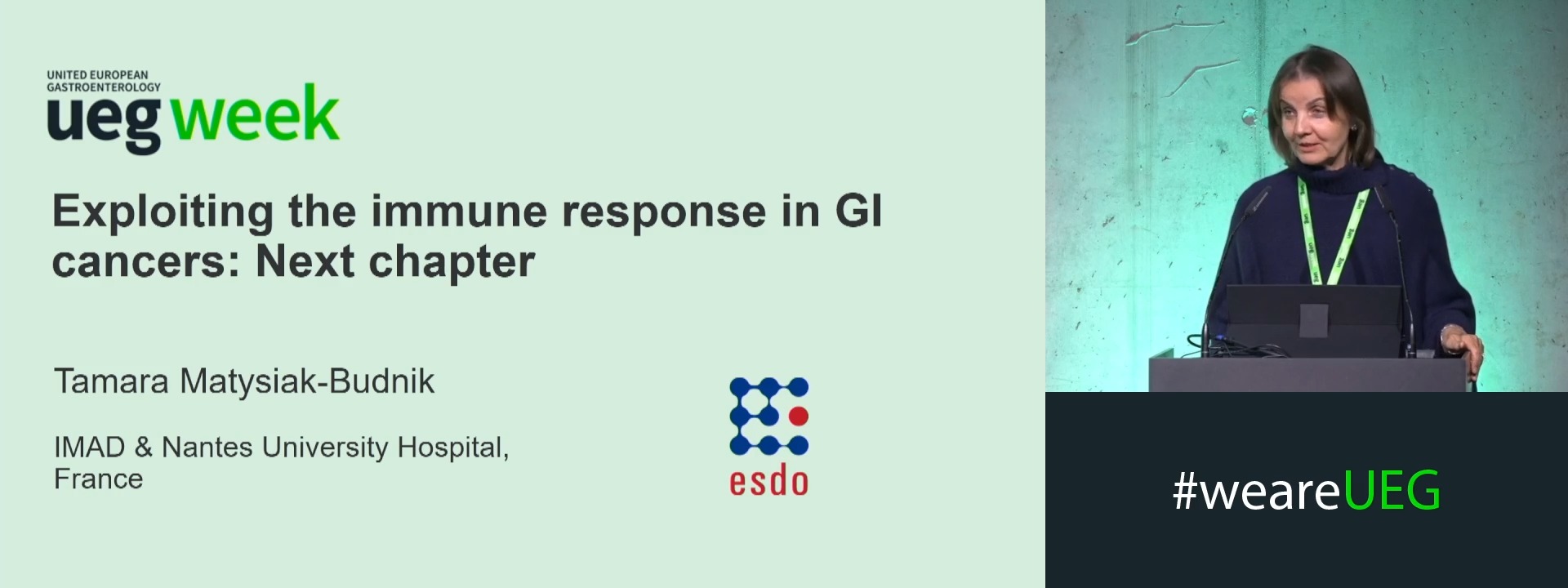
Exploiting the immune response in GI cancer: Next chapter
1 CHU de Nantes IMAD, Nantes, France
Event
Topics