UEG's educational platform for gastroenterology education bringing recordings, courses, guidelines, and more together in one place.
Most popular content
Rate for better recommendations!
Your feedback helps us show you more of what you like and less of what you dislike!
Log in to access this content.
Free for all myUEG account holders. Your access level is set automatically based on your occupation. Medical professionals get full access to all content. If you are a non-medical user, you can only access UEG Week content from congresses you attended.
Not sure what you can access? Learn more about account types.

MANAGEMENT OF BILE ACID MALABSORPTION: INSIGHTS INTO TREATMENT AND PATIENT OUTCOMES
1 Scunthorpe General Hospital, Scunthorpe, United Kingdom
Conference
Topics
Submission format
Session
Citation
Published
Log in to access this content.
Free for all myUEG account holders. Your access level is set automatically based on your occupation. Medical professionals get full access to all content. If you are a non-medical user, you can only access UEG Week content from congresses you attended.
Not sure what you can access? Learn more about account types.
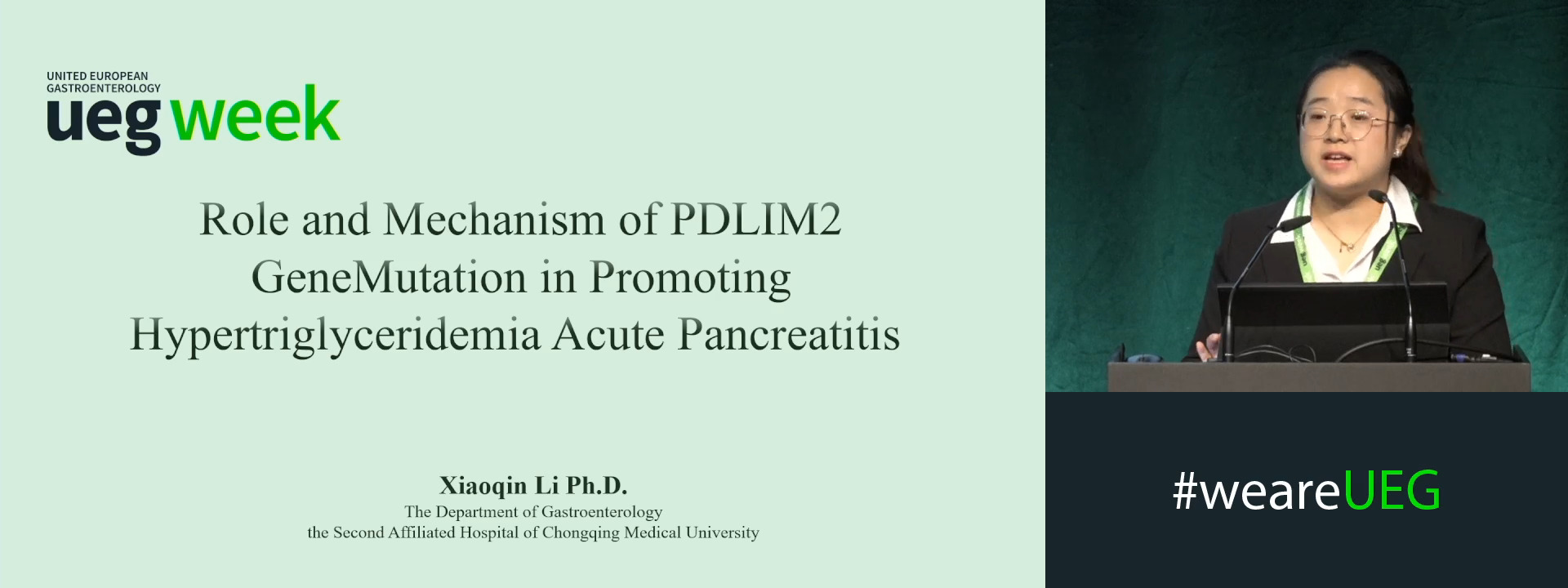
ROLE AND MECHANISM OF PDLIM2 GENE MUTATION IN PROMOTING HYPERTRIGLYCERIDEMIA ACUTE PANCREATITIS
1 The Second Affiliated Hospital of Chongqing Medical University, Chongqing, China
Event
Submission format
Citation
Published
Log in to access this content.
Free for all myUEG account holders. Your access level is set automatically based on your occupation. Medical professionals get full access to all content. If you are a non-medical user, you can only access UEG Week content from congresses you attended.
Not sure what you can access? Learn more about account types.
EXPLORING THE ROLE OF GENETIC VARIATION IN THE NICOTINAMIDE ADENINE DINUCLEOTIDE PHOSPHATE (NADPH) OXIDASE COMPLEXES IN FISTULATING CROHN’S DISEASE
Franci van Rhyn 1, Fernando Vazquez Lopez 1, Lynn Win 1, Alex Kadhim 1, Guo Cheng 1, Zachary Green 2, R Mark Beattie 3, Sarah Ennis 1, James Ashton 2
1 University of Southampton, Southampton, United Kingdom
2 University of Southampton, Southampton, United Kingdom|||Southampton Children's Hospital, Southampton, United Kingdom
3 Southampton Children's Hospital, Southampton, United Kingdom
Conference
Topics
Submission format
Citation
Published
Log in to access this content.
Free for all myUEG account holders. Your access level is set automatically based on your occupation. Medical professionals get full access to all content. If you are a non-medical user, you can only access UEG Week content from congresses you attended.
Not sure what you can access? Learn more about account types.
MECHANISM BY WHICH MBD2 INHIBITORS SUPPRESS COLORECTAL CANCER PROGRESSION VIA EPIGENETIC REPRESSION OF ONCOGENIC WNT16 ACTIVATION
1 The Seventh Affiliated Hospital, Sun Yat-sen University, Shenzhen, China
Conference
Topics
Submission format
Citation
Published
Log in to access this content.
Free for all myUEG account holders. Your access level is set automatically based on your occupation. Medical professionals get full access to all content. If you are a non-medical user, you can only access UEG Week content from congresses you attended.
Not sure what you can access? Learn more about account types.
NAVIGATING SELF-EXPANDABLE METALLIC STENT PLACEMENT IN INOPERABLE ESOPHAGEAL MALIGNANCIES: A LANDMARK-BASED TECHNIQUE USING VERTEBRAL COLUMN AND DIAPHRAGM
1 SIAG, Karachi, Pakistan
Conference
Topics
Submission format
Citation
Published
Log in to access this content.
Free for all myUEG account holders. Your access level is set automatically based on your occupation. Medical professionals get full access to all content. If you are a non-medical user, you can only access UEG Week content from congresses you attended.
Not sure what you can access? Learn more about account types.
ANTRAL PRESERVATION VS. ANTRAL RESECTION IN SLEEVE GASTRECTOMY: A SYSTEMATIC REVIEW AND META-ANALYSIS OF WEIGHT LOSS, METABOLIC OUTCOMES, AND COMORBIDITY RESOLUTION
Muhammad Abdullah Masood 1, Muhammad Abdul Muqtadir Qureshi 1, Hafiz Shahbaz Zahoor 1, Muhammad Bilal Akram 1, Muhammad Aoun Abbas Khan 1, Laiba Masood 2, Adina Arshad 1, Muhammad Moin ud Din Arshad 1, Areej Sarfraz 3
1 Quaid-e-Azam Medical College, Bahawalpur, Pakistan
2 Shahida Islam Medical and Dental, College, Lodhran, Pakistan
3 Fatima Jinnah Medical University, Lahore, Pakistan
Conference
Topics
Submission format
Citation
Published
Log in to access this content.
Free for all myUEG account holders. Your access level is set automatically based on your occupation. Medical professionals get full access to all content. If you are a non-medical user, you can only access UEG Week content from congresses you attended.
Not sure what you can access? Learn more about account types.
BRIDGING ENDOCRINE AND GUT AUTOIMMUNITY: FROM POPULATION TO PROTEOME IN GRAVES’ DISEASE–ULCERATIVE COLITIS COMORBIDITY
1 The First Hospital of Jilin University, Changchun, China
Conference
Topics
Submission format
Session