UEG's educational platform for gastroenterology education bringing recordings, courses, guidelines, and more together in one place.
Most popular content
Rate for better recommendations!
Your feedback helps us show you more of what you like and less of what you dislike!
Log in to access this content.
Free for all myUEG account holders. Your access level is set automatically based on your occupation. Medical professionals get full access to all content. If you are a non-medical user, you can only access UEG Week content from congresses you attended.
Not sure what you can access? Learn more about account types.

RELEVANCE OF RANDOM BIOPSY OF THE INCISURA ANGULARIS IN THE EVALUATION OF PREMALIGNANT GASTRIC CONDITIONS
Margarida Cristiano 1, Carlos Borges Chaves 1, Pedro Rocha 1, Diogo Feijó 1, Filipa Vidal Lima 1, Hugo Ribeiro 1, Rita Regatia 2, Nuno Peres Almeida 3, Pedro Narra Figueiredo 3
1 Unidade Local de Saúde de Coimbra, Coimbra, Portugal
2 Instituto Português de Oncologia de Coimbra Francisco Gentil, Coimbra, Portugal
3 Unidade Local de Saúde de Coimbra, Coimbra, Portugal|||Faculdade de Medicina da Universidade de Coimbra, Coimbra, Portugal
Conference
Topics
Submission format
Citation
Published
Log in to access this content.
Free for all myUEG account holders. Your access level is set automatically based on your occupation. Medical professionals get full access to all content. If you are a non-medical user, you can only access UEG Week content from congresses you attended.
Not sure what you can access? Learn more about account types.
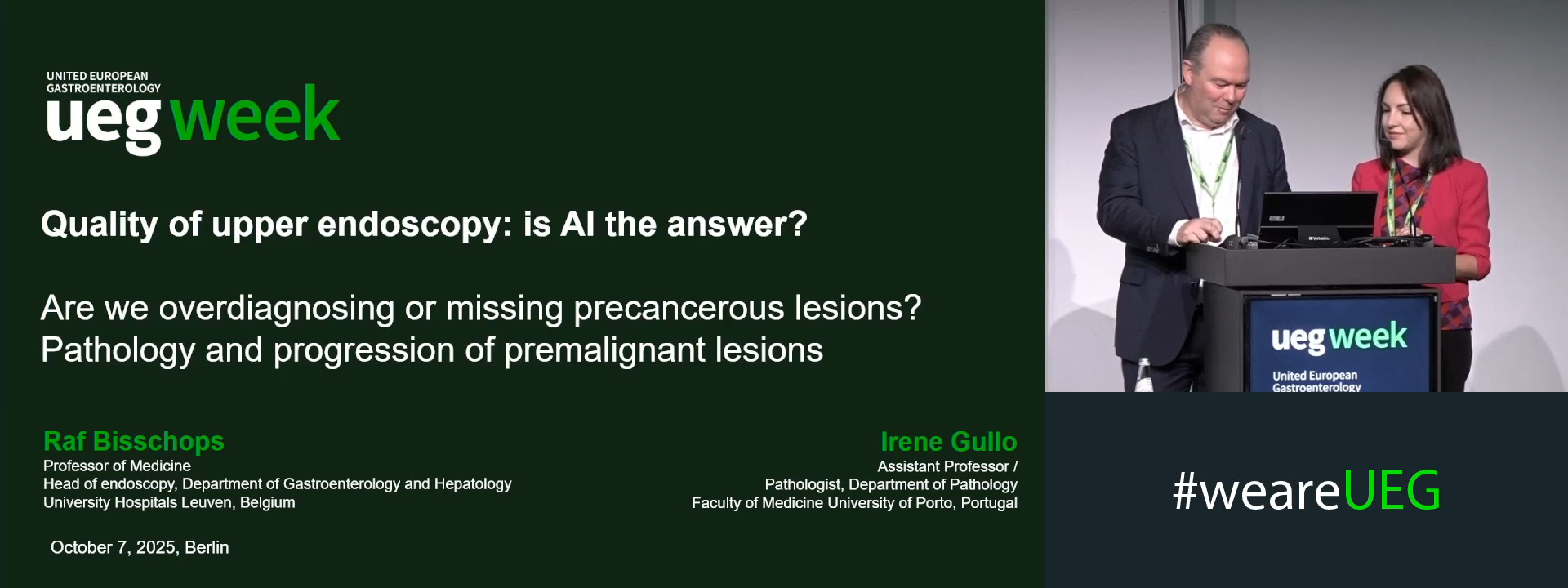
Premalignant gastric lesions: Pathology, progressions, and challenges in diagnosis
1 Katholieke Universiteit Leuven, Leuven, Belgium
2 Faculty of Medicine of the University of Porto, Porto, Portugal
Event
Citation
Published
Log in to access this content.
Free for all myUEG account holders. Your access level is set automatically based on your occupation. Medical professionals get full access to all content. If you are a non-medical user, you can only access UEG Week content from congresses you attended.
Not sure what you can access? Learn more about account types.
VALIDATION OF A PREDICTIVE SCORE FOR CLINICALLY SIGNIFICANT FINDINGS IN ENDOSCOPIC ULTRASOUND EVALUATION OF INCIDENTAL COMMON BILE DUCT DILATION
Pedro Rocha 1, Filipa Vidal Lima 1, Hugo Ribeiro 1, Mafalda João 1, Margarida Ferreira 1, Nuno Peres Almeida 2, Clotilde De Jesus Lopes Lérias 1, Pedro Narra Figueiredo 2
1 Coimbra University Hospital, Local Health Unit of Coimbra, Coimbra, Portugal
2 Coimbra University Hospital, Local Health Unit of Coimbra, Coimbra, Portugal|||Faculty of Medicine, University of Coimbra, Coimbra, Portugal
Conference
Topics
Submission format
Session
Citation
Published
Log in to access this content.
Free for all myUEG account holders. Your access level is set automatically based on your occupation. Medical professionals get full access to all content. If you are a non-medical user, you can only access UEG Week content from congresses you attended.
Not sure what you can access? Learn more about account types.
COMBINING BEDSIDE INDEX OF SEVERITY IN ACUTE PANCREATITIS (BISAP) AND CHARLSON COMORBIDITY INDEX IMPROVES EARLY RISK STRATIFICATION IN BILIARY ACUTE PANCREATITIS
Julian Prosenz 1, Moira Birkl 1, Tobias Hadrigan 2, Larissa Brandl 3, Anna Wittmann 4, Florian Koutny 1, Andreas Maieron 1
1 Karl Landsteiner University of Health Sciences, Krems, Austria|||University Hospital St. Pölten, St. Pölten, Austria
2 Karl Landsteiner University of Health Sciences, Krems, Austria|||University Hospital Tulln, Tulln an der Donau, Austria
3 Karl Landsteiner University of Health Sciences, Krems, Austria
4 Karl Landsteiner University of Health Sciences, Krems, Austria|||Hospital Mistelbach, Mistelbach, Austria
Conference
Topics
Submission format
Session
Citation
Published
Log in to access this content.
Free for all myUEG account holders. Your access level is set automatically based on your occupation. Medical professionals get full access to all content. If you are a non-medical user, you can only access UEG Week content from congresses you attended.
Not sure what you can access? Learn more about account types.
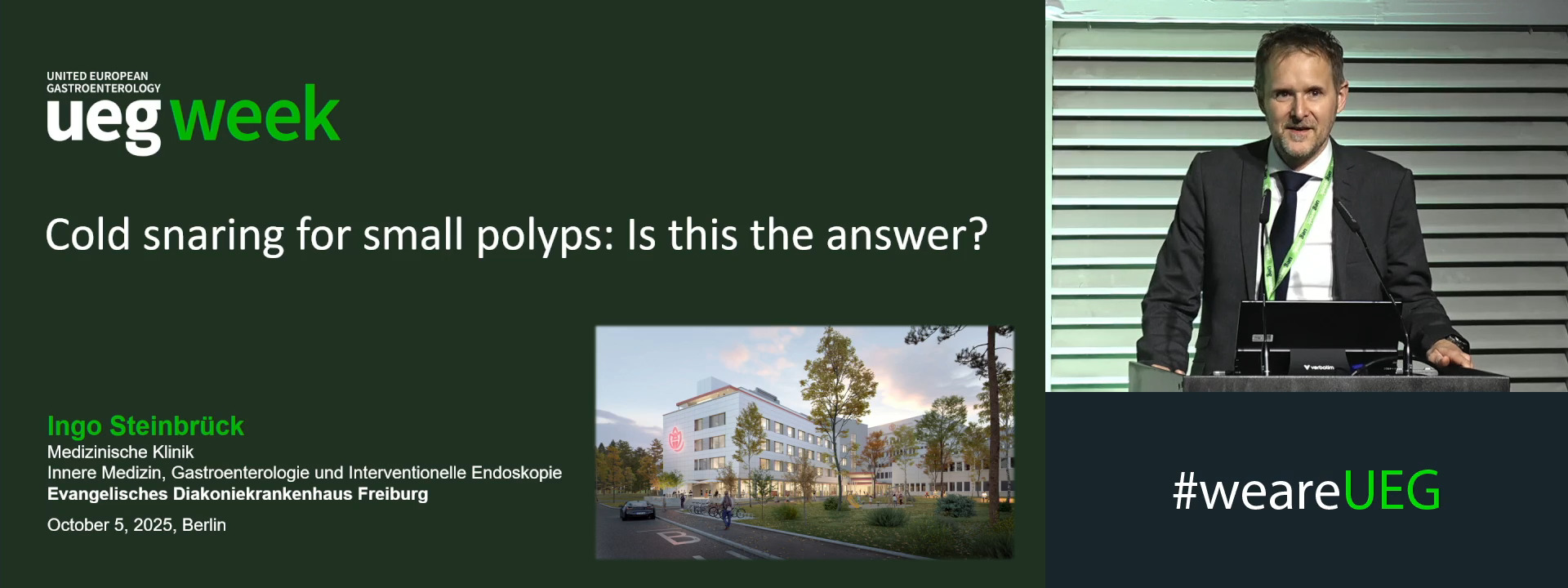
Cold snaring for small polyps or serrated polyps: Is this the answer?
1 AMC, Amsterdam, Netherlands
2 Evangelisches Diakoniekrankenhaus Freiburg, Freiburg, Germany
Event
Session
Citation
Published
Log in to access this content.
Free for all myUEG account holders. Your access level is set automatically based on your occupation. Medical professionals get full access to all content. If you are a non-medical user, you can only access UEG Week content from congresses you attended.
Not sure what you can access? Learn more about account types.
HISTOPATHOLOGICAL CORRELATIONS OF TISSUE SOUND SPEED IN HEPATOCELLULAR CARCINOMA: A QUANTITATIVE ASSESSMENT USING ACOUSTIC MICROSCOPY
1 Graduate School of Medicine, Tohoku University, Sendai, Japan|||Saitama Cooperative Hospital, Kawaguchi, Japan
2 Graduate School of Medicine, Tohoku University, Sendai, Japan
3 Honda Electronics, Co., Ltd., Toyohashi, Japan
4 Saitama Cooperative Hospital, Kawaguchi, Japan
Conference
Topics
Submission format
Session
Citation
Published
Log in to access this content.
Free for all myUEG account holders. Your access level is set automatically based on your occupation. Medical professionals get full access to all content. If you are a non-medical user, you can only access UEG Week content from congresses you attended.
Not sure what you can access? Learn more about account types.
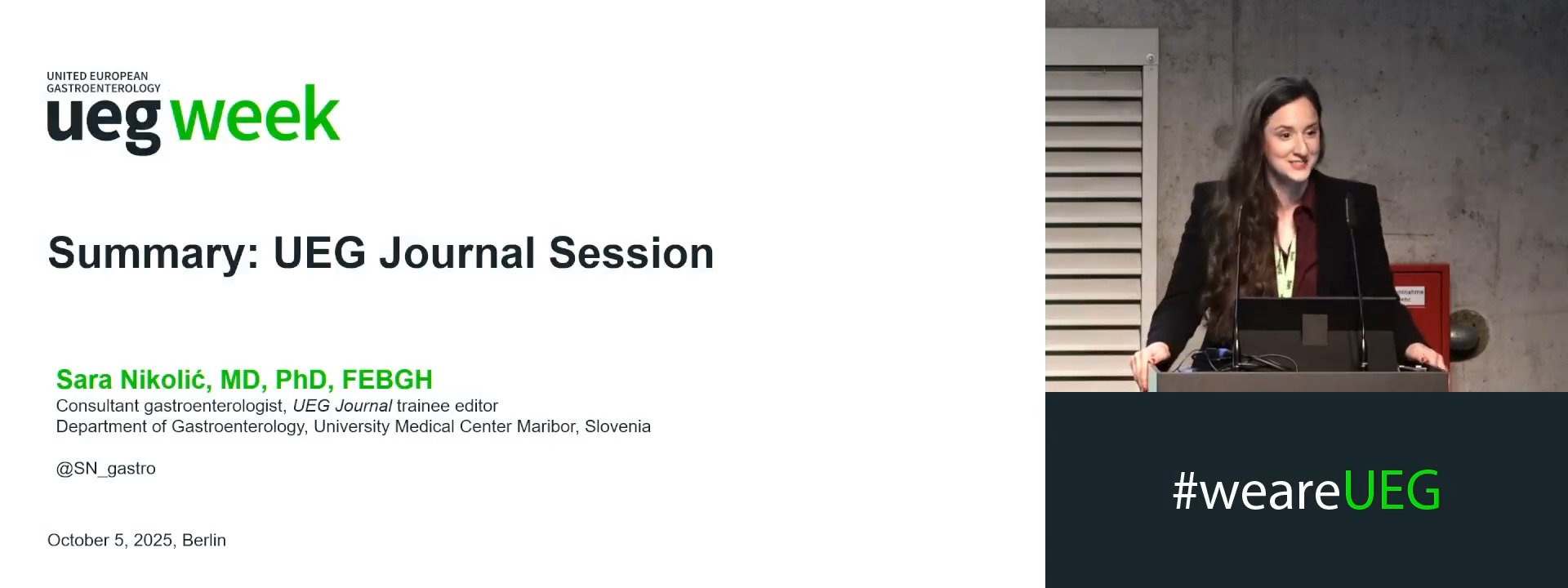
Summary: UEG Journal Session
1 University Medical Center Maribor, Maribor, Slovenia
Event
Topics