UEG's content platform for gastroenterology education bringing recordings, courses, guidelines, and more together in one place.
Trending on Gutflix
Rate for better recommendations!
Your feedback helps us show you more of what you like and less of what you dislike!
Log in to continue.
This content is part of Gutflix. Log in with your myUEG account, or create one free, to watch it.
Not sure what you can access? Learn more about account types.
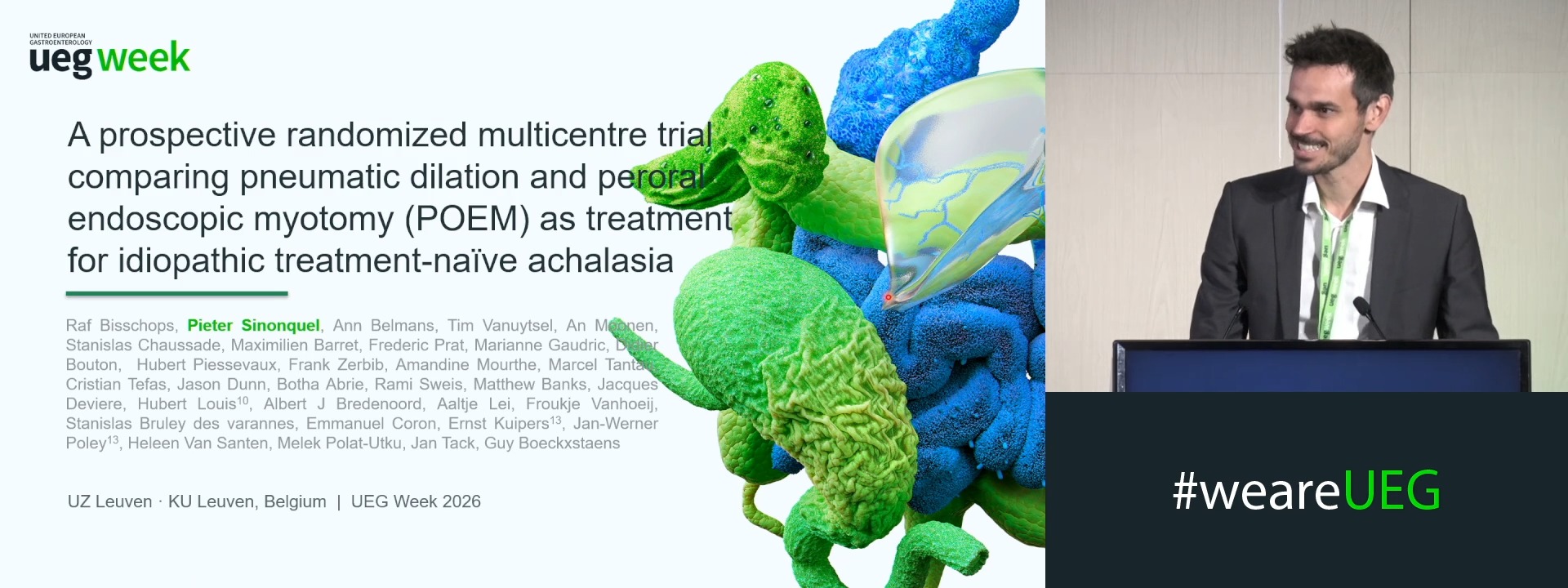
A PROSPECTIVE RANDOMIZED MULTICENTRE TRIAL COMPARING PNEUMATIC DILATION AND PERORAL ENDOSCOPIC MYOTOMY (POEM) AS TREATMENT FOR IDIOPATHIC TREATMENT-NAÏVE ACHALASIA
Raf Bisschops 1, Pieter Sinonquel 1, Ann Belmans 2, Stanislas Chaussade 3, Maximilien Barret 3, Frédéric Prat 3, Marianne Gaudric 3, Didier Bouton 3, Hubert Piessevaux 4, Frank Zerbib 5, Amandine Mourthe 5, Marcel Vasile Tantau 6, Cristian Tefas 7, Jason M. Dunn 8, Abrie Botha 8, Rami Sweis 9, Matthew Banks 10, Jacques Deviere 11, Hubert Louis 12, Albert J. Bredenoord 13, Aaltje Lei 13, Froukje van Hoeij 13, Stanislas Bruley Des Varannes 14, Emmanuel Coron 14, Ernst J. Kuipers 15, Jan Werner Poley 16, Heleen Van Santen 15, Melek Polat-Utku 15, Jan Tack 1, Guy E. Boeckxstaens 1
Affiliations
1 KU Leuven/UZ Leuven, Leuven, Belgium
2 KU Leuven, Leuven, Belgium
3 Cochin Hospital, Paris, France
4 Cliniques universitaires Saint-Luc, Brussels, Belgium
5 CHU de Bordeaux - Hôpital Haut Leveque, Pessac, France
6 Hepatology Institute Hepatology and Gastroenterology, Cluj, Romania
7 IRGH Prof. Dr. Octavian Fodor Cluj-Napoca, Cluj-Napoca, Romania
8 St Thomas' Hospital, London, United Kingdom
9 University College London Hospital, Orpington, United Kingdom
10 University College London Hospital NHS Trust (UCLH), London, United Kingdom
11 Erasme University Hospital, Bruxelles, Belgium
12 Erasme Hospital, Brussels, Belgium
13 Amsterdam UMC, Amsterdam, Netherlands
14 Hopital Hotel Dieu, Nantes, France
15 Erasmus MC University Medical Center, Rotterdam, Netherlands
16 Maastricht University Medical Center, Maastricht, Netherlands
Log in to continue.
This content is part of Gutflix. Log in with your myUEG account, or create one free, to watch it.
Not sure what you can access? Learn more about account types.
ESGE live endoscopy III (Complete Session)
Log in to continue.
This content is part of Gutflix. Log in with your myUEG account, or create one free, to watch it.
Not sure what you can access? Learn more about account types.
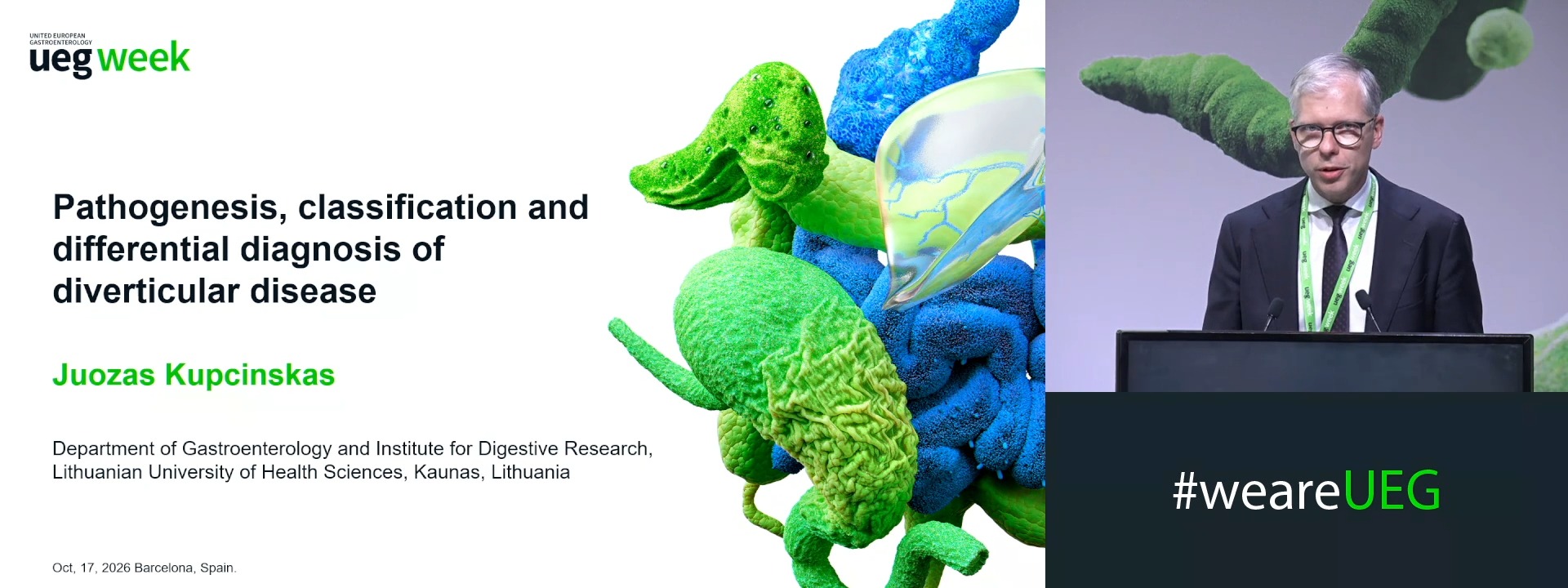
Pathogenesis, Classification, and Differential Diagnosis
Affiliations
1 Lithuanian University of Health Sciences, Kaunas, Lithuania
Log in to continue.
This content is part of Gutflix. Log in with your myUEG account, or create one free, to watch it.
Not sure what you can access? Learn more about account types.
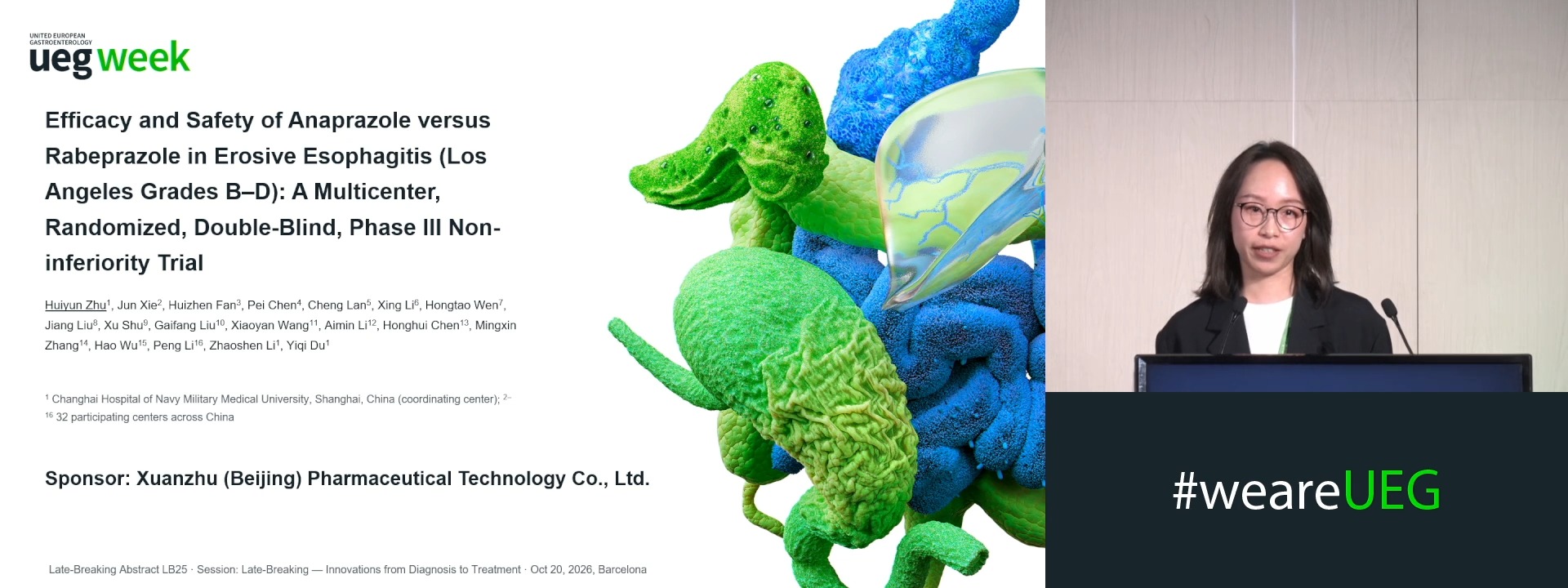
EFFICACY AND SAFETY OF ANAPRAZOLE VERSUS RABEPRAZOLE IN EROSIVE ESOPHAGITIS (LOS ANGELES GRADES B-D): A MULTICENTER, RANDOMIZED, DOUBLE-BLIND, PHASE III NON-INFERIORITY TRIAL
Huiyun Zhu 1, Jun Xie 2, Huizhen Fan 3, Pei Chen 4, Cheng Lan 5, Xing Li 6, Hongtao Wen 7, Jiang Liu 8, Shu Xu 9, Gaifang Liu 10, Xiaoyan Wang 11, Aimin Li 12, Honghui Chen 13, Mingxin Zhang 14, Hao Wu 15, Peng Li 16, Zhaoshen Li 1, Yiqi Du 1
Affiliations
1 Changhai Hospital of Navy Military Medical University, Shanghai, China
2 The First Affiliated Hospital of Gannan Medical University, Ganzhou, China
3 Yichun People's Hospital, Yichun, China
4 Zhengzhou First People's Hospital, Zhengzhou, China
5 Hainan Provincial People's Hospital, Haikou, China
6 Pingxiang People's Hospital, Pingxiang, China
7 The First Affiliated Hospital of Zhengzhou University, Zhengzhou, China
8 Huzhou Central Hospital, Huzhou, China
9 The First Affiliated Hospital of Nanchang University, Nanchang, China
10 Hebei Provincial People's Hospital, Shijiazhuang, China
11 Xiangya Third Hospital of Central South University, Changsha, China
12 Southern Medical University Nanfang Hospital, Guangzhou, China
13 The Second Affiliated Hospital of Nanhua University, Hengyang, China
14 The First Affiliated Hospital of Xi'an Medical University, Xi'an, China
15 Zhongshan Hospital Affiliated with Fudan University, Shanghai, China
16 Beijing Friendship Hospital Affiliated with Capital Medical University, Beijing, China
Log in to continue.
This content is part of Gutflix. Log in with your myUEG account, or create one free, to watch it.
Not sure what you can access? Learn more about account types.
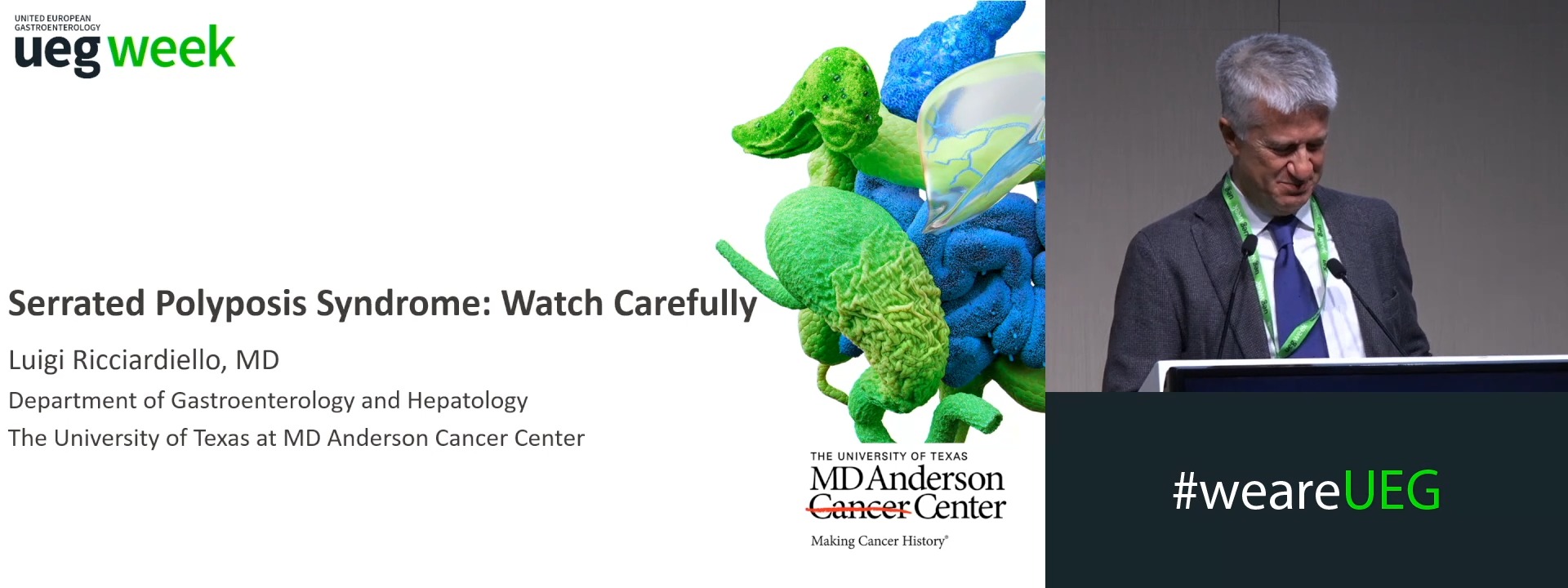
Serrated polyposis syndrome: Watch carefully
Affiliations
1 MD Anderson Cancer Center, Houston, United States of America