UEG's educational platform for gastroenterology education bringing recordings, courses, guidelines, and more together in one place.
Most popular content
Rate for better recommendations!
Your feedback helps us show you more of what you like and less of what you dislike!
Log in to access this content.
Free for all myUEG account holders. Your access level is set automatically based on your occupation. Medical professionals get full access to all content. If you are a non-medical user, you can only access UEG Week content from congresses you attended.
Not sure what you can access? Learn more about account types.
IMPACT OF USING THE ESGE GUIDELINE RISK-PROFILES FOR SURVEILLANCE AS OUTCOME PARAMETER IN A FIT-BASED COLORECTAL CANCER SCREENING PROGRAM
Elyse Emmelie Catharina Rijnders 1, Esther Toes-Zoutendijk 2, Sybrand De Boer 3, Ruud Schauwen 4, Marco Oudkerk Pool 5, Claudia Verveer 6, Evelien Dekker 7, Monique van leerdam 8, Iris Nagtegaal 9, Manon C.W. Spaander 10
1 Erasmus MC University Medical Center, Rotterdam, Netherlands
2 University Medical Center Rotterdam, Rotterdam, Netherlands
3 Slingeland Hospital, Doetinchem, Netherlands
4 Bernhoven hospital, Uden, Netherlands
5 Wilhelmina hospital, Assen, Netherlands
6 Ikazia Ziekenhuis, Rotterdam, Netherlands
7 AMC, Amsterdam, Netherlands
8 Netherlands Cancer Institute, Amstelveen, Netherlands
9 Radboud University Nijmegen Medical Center Dept. of Pathology, Nijmegen, Netherlands
10 Erasmus Medical Center Rotterdam, Rotterdam, Netherlands
Event
Submission format
Session
Citation
Published
Log in to access this content.
Free for all myUEG account holders. Your access level is set automatically based on your occupation. Medical professionals get full access to all content. If you are a non-medical user, you can only access UEG Week content from congresses you attended.
Not sure what you can access? Learn more about account types.
How far do we need to investigate?
1 Rouen University Hospital, INSERM U1073, CIC-CRB-1404, Rouen, France
Event
Topics
Session
Citation
Published
Log in to access this content.
Free for all myUEG account holders. Your access level is set automatically based on your occupation. Medical professionals get full access to all content. If you are a non-medical user, you can only access UEG Week content from congresses you attended.
Not sure what you can access? Learn more about account types.
PREVALENCE OF RED FLAGS IN THE GLOBAL GENERAL POPULATION AND IN DISORDERS OF GUT-BRAIN INTERACTION- RESULTS FROM THE ROME FOUNDATION GLOBAL EPIDEMIOLOGY STUDY
Jessica Sjölund 1, Jóhann Hreinsson 1, Brian Lacy 2, Hans Törnblom 1, Magnus Simrén 3, Shrikant I. Bangdiwala 4, Olafur S. Palsson 5, Ami D. Sperber 6
1 University of Gothenburg, Sahlgrenska Academy, Institute of Medicine, Gothenburg, Sweden
2 Mayo Clinic, Jacksonville, United States
3 University of Gothenburg, Sahlgrenska Academy, Institute of Medicine, Gothenburg, Sweden|||University of North Carolina-Chapel Hill, Chapel Hill, United States
4 McMaster University, Hamilton, Canada
5 University of North Carolina-Chapel Hill, Chapel Hill, United States
6 Ben-Gurion University of the Negev, Farod, Israel
Event
Submission format
Citation
Published
Log in to access this content.
Free for all myUEG account holders. Your access level is set automatically based on your occupation. Medical professionals get full access to all content. If you are a non-medical user, you can only access UEG Week content from congresses you attended.
Not sure what you can access? Learn more about account types.

GLUCAGON-LIKE PEPTIDE-1 RECEPTOR AGONIST AND ALCOHOL CONSUMPTION: A SYSTEMATIC REVIEW
Reza Eshraghi 1, Pouya Ebrahimi 2, Raheel Ahmed 3, Delaram Jafarzadeh Ghadimi 4, Kaveh Hosseini 5, Sara Montazeri Namin 6, Ashkan Bahrami 7, Yash Kachela 8, Mohsan Subhani 9, Ali Moradi 10, Farhan Shahid 11
1 Isfahan University of Medical Sciences, Isfahan, Iran, Islamic Republic of
2 Queen Elizabeth Hospital Birmingham, Birmingham, United Kingdom
3 Imperial College London, London, United Kingdom
4 Shahid Beheshti University of Medical Sciences, Tehran, Iran, Islamic Republic of
5 Tehran University of Medical Sciences, Tehran, Iran, Islamic Republic of
6 Iran University of Medical Sciences, Tehran, Iran, Islamic Republic of
7 Kashan University of Medical Sciences, Isfahan, Iran, Islamic Republic of
8 Aston University, Birmingham, United Kingdom
9 University Hospitals Nottingham and University of Nottingham, Nottingham, United Kingdom
10 University of South Florida, Florida, United States
11 Queen Elizabeth Hospital, London, United Kingdom
Conference
Topics
Submission format
Session
Citation
Published
Log in to access this content.
Free for all myUEG account holders. Your access level is set automatically based on your occupation. Medical professionals get full access to all content. If you are a non-medical user, you can only access UEG Week content from congresses you attended.
Not sure what you can access? Learn more about account types.
CHRONIC INTESTINAL PSEUDO-OBSTRUCTION IN A PATIENT WITH ANTI-EJ ANTISYNTHETASE SYNDROME
Pablo Pastor 1, Carolina Malagelada 2, Albert Gil 1, Ernesto Trallero-Araguás 1, Albert Selva-O'Callaghan 1, Luis Gerardo Alcala Gonzalez 1
1 Vall d'Hebron University Hospital, Barcelona, Spain
2 Instituto Carlos III, Madrid, Spain|||Vall d'Hebron University Hospital, Barcelona, Spain
Conference
Topics
Submission format
Session
Published
Log in to access this content.
Free for all myUEG account holders. Your access level is set automatically based on your occupation. Medical professionals get full access to all content. If you are a non-medical user, you can only access UEG Week content from congresses you attended.
Not sure what you can access? Learn more about account types.
EXPLORING DYNAMIC TRIGGERS OF ABDOMINAL PAIN IN IRRITABLE BOWEL SYNDROME USING THE EXPERIENCE SAMPLING METHOD - PRELIMINARY RESULTS FROM THE MULTICENTER DISCOVERIE STUDY
Michelle Bosman 1, Lisa Vork 1, Maaike Van Den Houte 2, Irina Midenfjord 3, Silvia Muñoz 4, Maria Raffaella Barbaro 5, Dan Lucian Dumitrascu 6, Daisy Mae Jonkers 1, Daniel Keszthelyi 1
1 Department of Gastroenterology-Hepatology, NUTRIM School of Nutrition and Translational Research in Metabolism, Maastricht University Medical Center, Maastricht, Netherlands
2 Laboratory for Brain-Gut Axis Studies, Translational Research in Gastrointestinal Disorders (TARGID), Department of Chronic Diseases & Metabolism, KU Leuven, Leuven, Belgium
3 Department of Internal Medicine, Institute of Medicine, Sahlgrenska Academy, University of Gothenburg, Gothenburg, Sweden
4 Psychiatry, Mental Health and Addictions Research Group, Vall d’Hebron Institute of Research (VHIR), Barcelona, Spain
5 IRCCS Azienda Ospedaliero-Universitaria di Bologna, Bologna, Italy, Bologna, Italy
6 Second Department of Internal Medicine, Iuliu Hatieganu University of Medicine and Pharmacy Cluj-Napoca, Cluj-Napoca, Romania
Event
Submission format
Citation
Published
Log in to access this content.
Free for all myUEG account holders. Your access level is set automatically based on your occupation. Medical professionals get full access to all content. If you are a non-medical user, you can only access UEG Week content from congresses you attended.
Not sure what you can access? Learn more about account types.
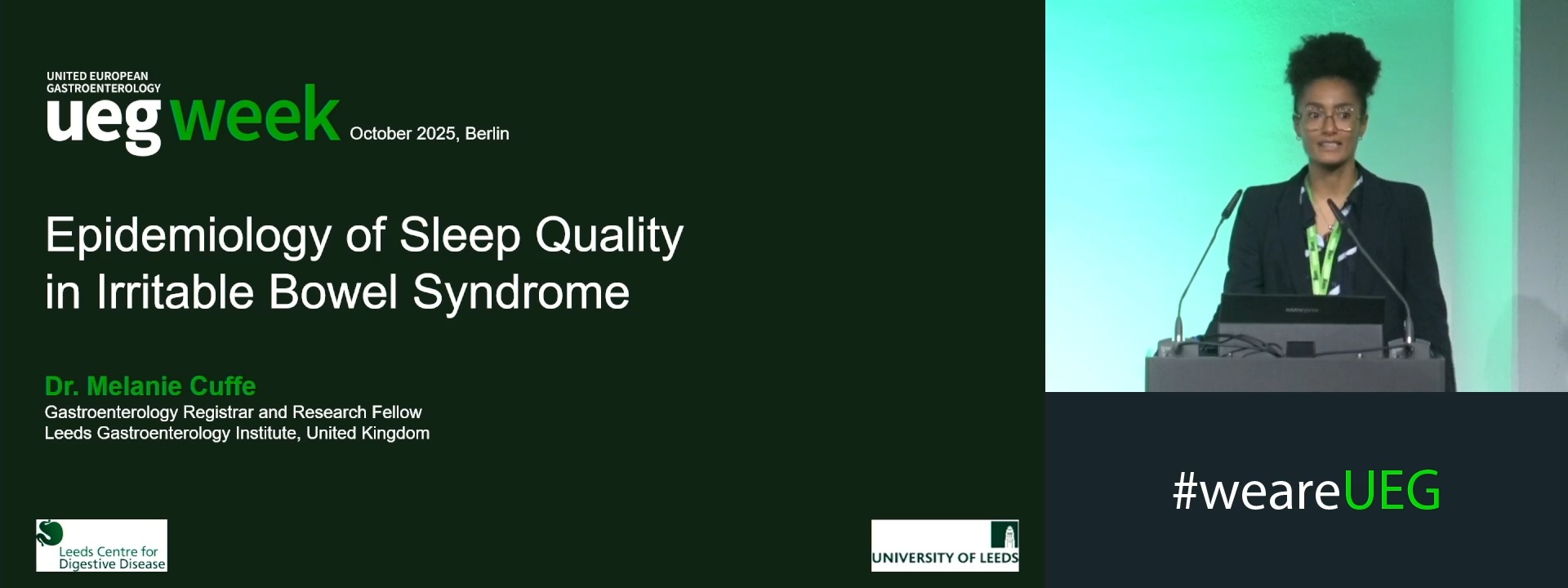
EPIDEMIOLOGY OF SLEEP QUALITY IN ROME IV IRRITABLE BOWEL SYNDROME (IBS)
1 Leeds Gastroenterology Institute, Leeds, United Kingdom
2 County Durham and Darlington NHS Foundation Trust, Darlington, United Kingdom
3 Leeds Gastroenterology Institute, Leeds, United Kingdom|||Leeds Institute of Medical Research, Leeds, United Kingdom
Event
Submission format
Session