UEG's educational platform for gastroenterology education bringing recordings, courses, guidelines, and more together in one place.
Most popular content
Rate for better recommendations!
Your feedback helps us show you more of what you like and less of what you dislike!
Log in to access this content.
Free for all myUEG account holders. Your access level is set automatically based on your occupation. Medical professionals get full access to all content. If you are a non-medical user, you can only access UEG Week content from congresses you attended.
Not sure what you can access? Learn more about account types.

EFFICACY AND SAFETY OF A NEW STENT IN MANAGING FISTULAS AND STRICTURES AFTER BARIATRIC AND ONCOLOGIC SURGERY
Francisco Capinha 1, Carlos Noronha 1, Juliana Serrazina 1, Carolina Simões 1, Patrícia Santos 1, Daniela Reis 1, Miguel Moura 1, João Carlos Paiva Sarreira Lopes 1, Filipe Damião 1, Luis Carlos Rodrigues Freitas 1, Olavo Gomes 2, Filipa Nogueira 2, Luis Manuel Branco Gomes Jasmins 3, Vítor Magno Pereira 4, Nuno Ladeira 5, Nicodemos Fernandes 6, Patrícia Sousa 7, Nadia Gonçalves 8, Luis Carrilho Ribeiro 1, Rui Tato Marinho 1, Luis Correia 1
1 Serviço de Gastrenterologia e Hepatologia, Hospital de Santa Maria, Centro Hospitalar Universitário Lisboa Norte, Lisboa, Portugal
2 Serviço de Cirurgia Geral, Hospital de Santa Maria, Centro Hospitalar Universitário Lisboa Norte, Lisboa, Portugal
3 CH Funchal - Nelio Mendonca, Lisboa, Portugal
4 Hospital Central do Funchal, Funchal, Portugal
5 Serviço de Gastrenterologia, Hospital Dr. Nélio Mendonça, SESARAM, Funchal, Funchal, Portugal
6 Serviço de Cirurgia Geral, Hospital Dr. Nélio Mendonça, SESARAM, Funchal, Funchal, Portugal
7 Hospital de Vila Franca de Xira, Loures, Portugal
8 Serviço de Cirurgia Geral, Hospital de Vila Franca de Xira, Lisboa, Portugal
Conference
Topics
Submission format
Citation
Published
Log in to access this content.
Free for all myUEG account holders. Your access level is set automatically based on your occupation. Medical professionals get full access to all content. If you are a non-medical user, you can only access UEG Week content from congresses you attended.
Not sure what you can access? Learn more about account types.
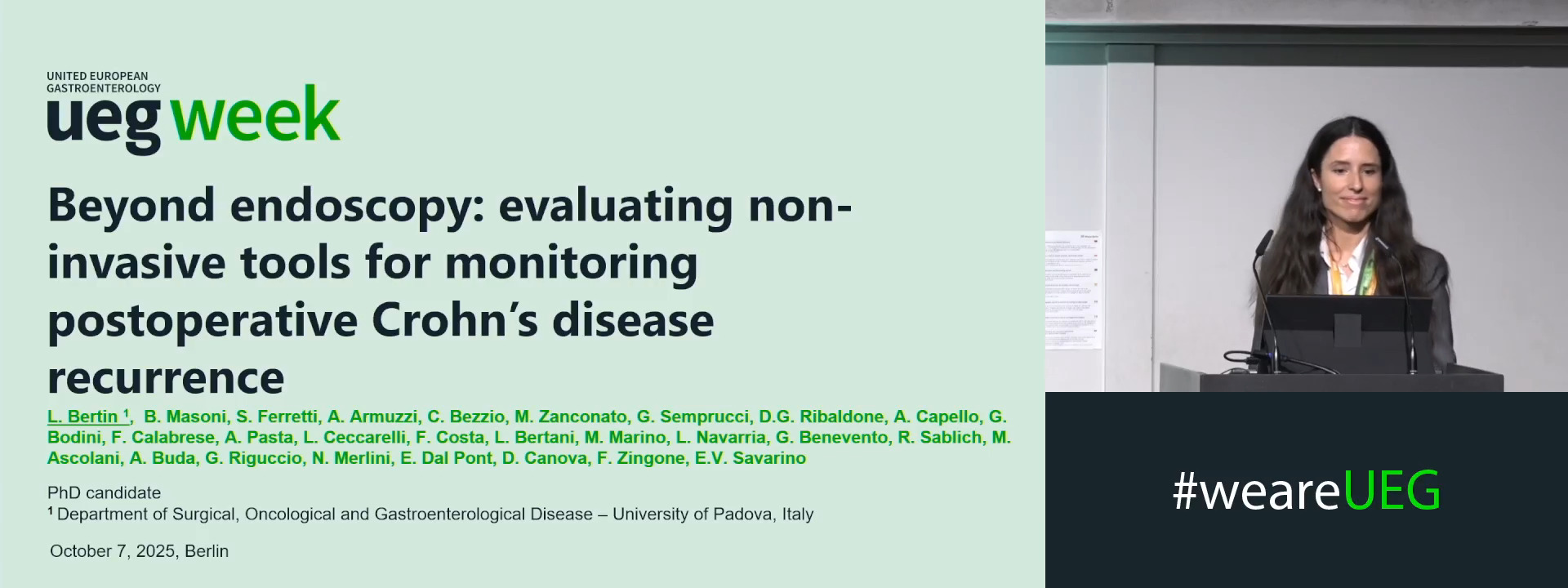
BEYOND ENDOSCOPY: EVALUATING NON-INVASIVE TOOLS FOR MONITORING POSTOPERATIVE CROHN'S DISEASE RECURRENCE
Luisa Bertin 1, Benedetta Masoni 2, Silvia Ferretti 2, Alessandro Armuzzi 2, Cristina Bezzio 2, Miriana Zanconato 1, Gianluca Semprucci 1, Davide Giuseppe Ribaldone 3, Adele Capello 3, Giorgia Bodini 4, Francesco Calabrese 4, ANDREA PASTA 4, Linda Ceccarelli 5, Francesco Costa 5, Lorenzo Bertani 6, Marco Marino 7, Luca Navarria 7, Gianluca Benevento 8, Renato Sablich 8, Marta Ascolani 9, Michele Campigotto 9, Andrea Buda 10, Gaia Riguccio 10, Nicoletta Merlini 11, Elisabetta Dal Pont 12, Daniele Canova 13, Fabiana Zingone 1, Edoardo Vincenzo Savarino 1
1 University of Padova, Padova, Italy
2 IBD Center, IRCCS Humanitas Research Hospital, Rozzano, Milan, Italy
3 University of Turin, Turin, Italy
4 Policlinico San Martino, Genova, Italy
5 AOU Pisa, Pisa, Italy
6 University of Pisa, Pisa, Italy
7 Azienda Sanitaria Universitaria Friuli Centrale, Udine, Italy
8 Ospedale S.Maria degli Angeli, Pordenone, Italy
9 Ospedale Ca'Foncello, Treviso, Italy
10 Ospedale di Santa Maria del Prato di Feltre, Feltre, Italy
11 Ospedale Vittorio Emanuele III, Montecchio, Italy
12 Ospedale San Martino di Belluno, Belluno, Italy
13 San Bortolo Hospital, Vicenza, Italy
Event
Topics
Submission format
Citation
Published
Log in to access this content.
Free for all myUEG account holders. Your access level is set automatically based on your occupation. Medical professionals get full access to all content. If you are a non-medical user, you can only access UEG Week content from congresses you attended.
Not sure what you can access? Learn more about account types.
PREDICTIVE FACTORS OF SEXUAL DYSFUNCTION IN CIRRHOTIC PATIENTS
Mensi Asma 1, TOUNSI Oumayma 1, Emna Belhadj Mabrouk 1, Ayadi Shema 1, Leila Mouelhi 1, Yosra Said 1, Dabbeche Radhouane 1
1 Charles Nicolle Hospital, Tunis, Tunisia
Conference
Topics
Submission format
Session
Citation
Published
Log in to access this content.
Free for all myUEG account holders. Your access level is set automatically based on your occupation. Medical professionals get full access to all content. If you are a non-medical user, you can only access UEG Week content from congresses you attended.
Not sure what you can access? Learn more about account types.
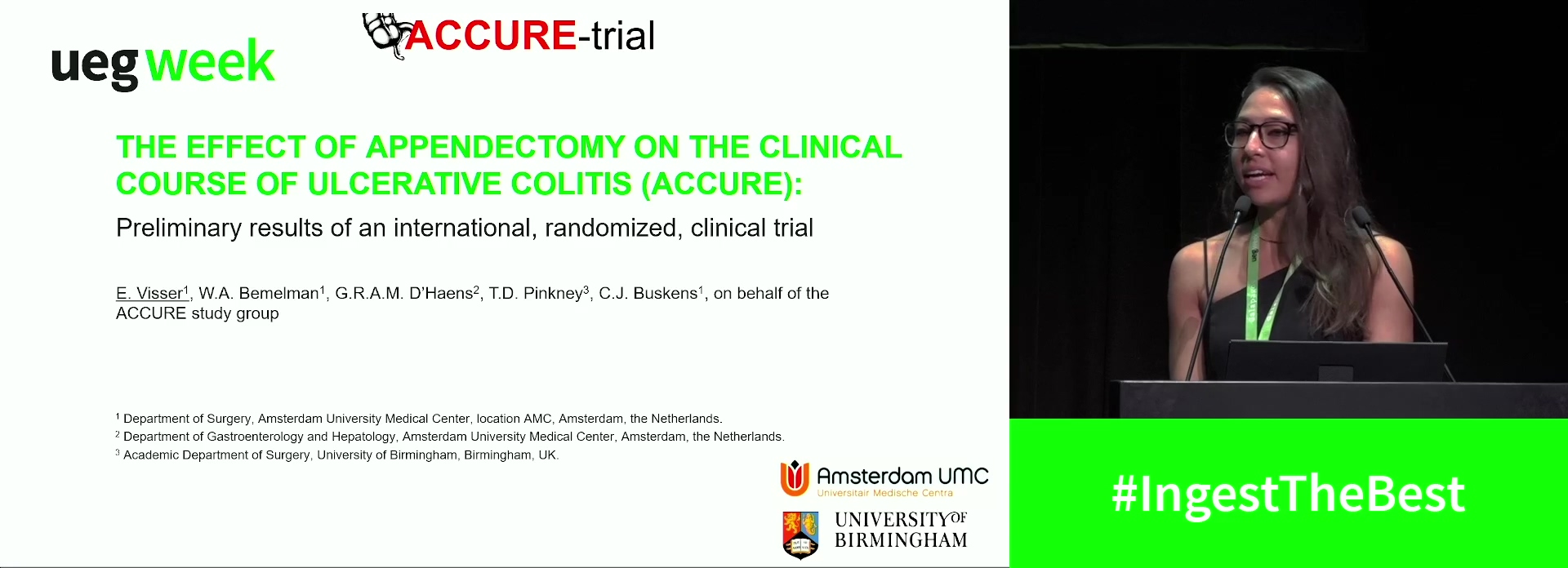
THE EFFECT OF APPENDECTOMY ON THE CLINICAL COURSE OF ULCERATIVE COLITIS (ACCURE): PRELIMINARY RESULTS OF AN INTERNATIONAL, RANDOMIZED, CLINICAL TRIAL
Eva Visser 1, Lianne Heuthorst 1, Shri Pathmakanthan 2, Manon E. Wildenberg 3, Geert R. D'Haens 4, Marcel G. W. Dijkgraaf 3, Wilhelmus A. Bemelman 1, Thomas D. Pinkney 5, Christianne Johanna Buskens 1
1 Amsterdam University Medical center, location AMC, Amsterdam, Netherlands
2 Queen Elizabeth University Hospital Birmingham, Birmingham, United Kingdom
3 Amsterdam University Medical Center, Amsterdam, Netherlands
4 Amsterdam University Medical Center - Inflammatory Bowel Disease Centre, Amsterdam, Netherlands
5 University of Birmingham, Birmingham, United Kingdom
Event
Topics
Submission format
Citation
Published
Log in to access this content.
Free for all myUEG account holders. Your access level is set automatically based on your occupation. Medical professionals get full access to all content. If you are a non-medical user, you can only access UEG Week content from congresses you attended.
Not sure what you can access? Learn more about account types.
ENDOSCOPIC CHARACTERISTICS OF LOCAL TUMOR REGROWTH IN PATIENTS UNDERGOING WATCH-AND-WAIT AFTER NEOADJUVANT THERAPY FOR RECTAL CANCER
Sylwester Szczegielniak 1, Peter Thelin Schmidt 2, Patrik Lundström 1, Charlotte Höög 1, Per J. Nilsson 1, Anna Martling 3, Stephan L. Haas 4
1 Karolinska University Hospital, Stockholm, Sweden
2 Uppsala University Hospital, Uppsala, Sweden
3 Karolinska Institutet, Stockholm, Sweden
4 Karolinska University Hospital and Department of Medicine, Karolinska Institutet, Stockholm, Sweden
Conference
Topics
Submission format
Session
Citation
Published
Log in to access this content.
Free for all myUEG account holders. Your access level is set automatically based on your occupation. Medical professionals get full access to all content. If you are a non-medical user, you can only access UEG Week content from congresses you attended.
Not sure what you can access? Learn more about account types.
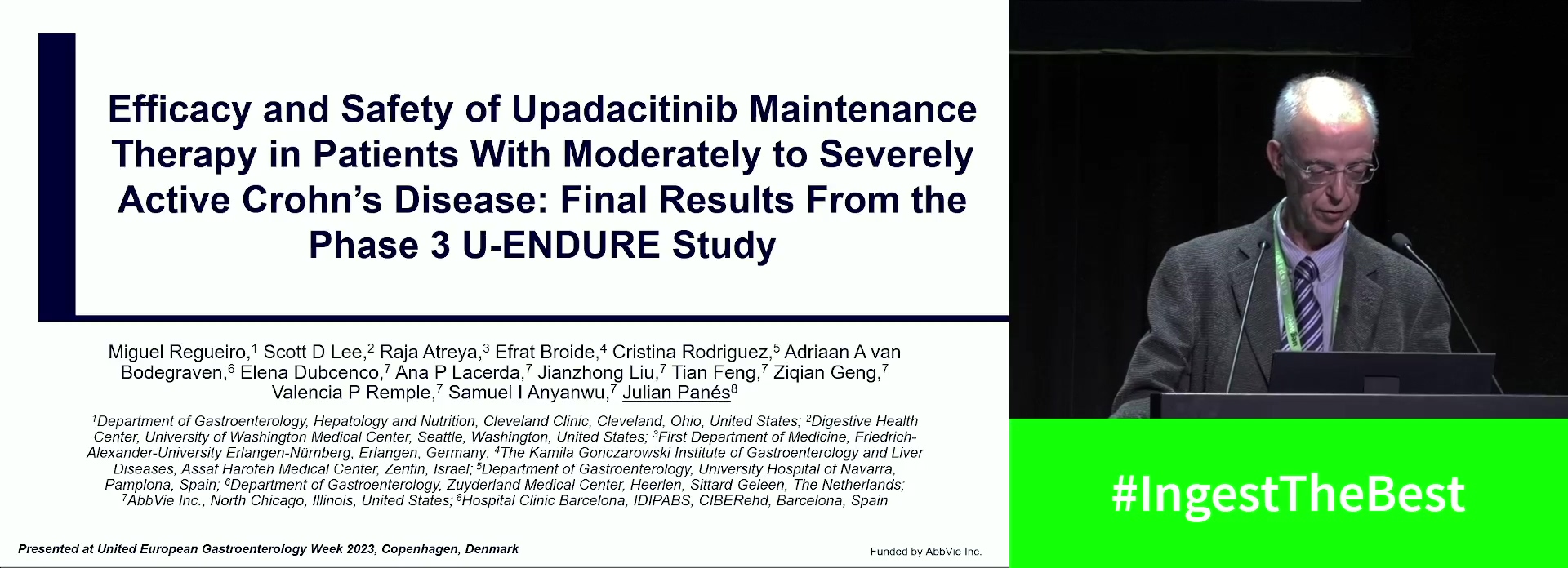
EFFICACY AND SAFETY OF UPADACITINIB MAINTENANCE THERAPY IN PATIENTS WITH MODERATELY TO SEVERELY ACTIVE CROHN’S DISEASE: FINAL RESULTS FROM THE PHASE 3 U-ENDURE STUDY
Miguel Regueiro 1, Scott Lee 2, Raja Atreya 3, Efrat Broide 4, Cristina Rodríguez Gutiérrez 5, Adriaan A. Van Bodegraven 6, Elena Dubcenco 7, Ana Paula Machado De Lacerda 7, Jianzhong Liu 7, Tian Feng 7, Ziqian Geng 7, Valencia Remple 7, Samuel Anyanwu 7, Julian Panés 8
1 Cleveland Clinic, Cleveland, United States
2 University of Washington Medical Center, Seattle, United States
3 Friedrich-Alexander-University Erlangen-Nürnberg, Erlangen, Germany
4 The Kamila Gonczarowski Institute of Gastroenterology and Liver Diseases, Assaf Harofeh Medical Center, Zerifin, Israel
5 University Hospital of Navarra, Pamplona, Spain
6 Zuyderland Medical Center, Herleen, Sittard-Geleen, Netherlands
7 AbbVie Inc., North Chicago, United States
8 Hospital Clinic Barcelona, IDIPABS, CIBERehd, Barcelona, Spain
Event
Topics
Submission format
Session
Citation
Published
Log in to access this content.
Free for all myUEG account holders. Your access level is set automatically based on your occupation. Medical professionals get full access to all content. If you are a non-medical user, you can only access UEG Week content from congresses you attended.
Not sure what you can access? Learn more about account types.
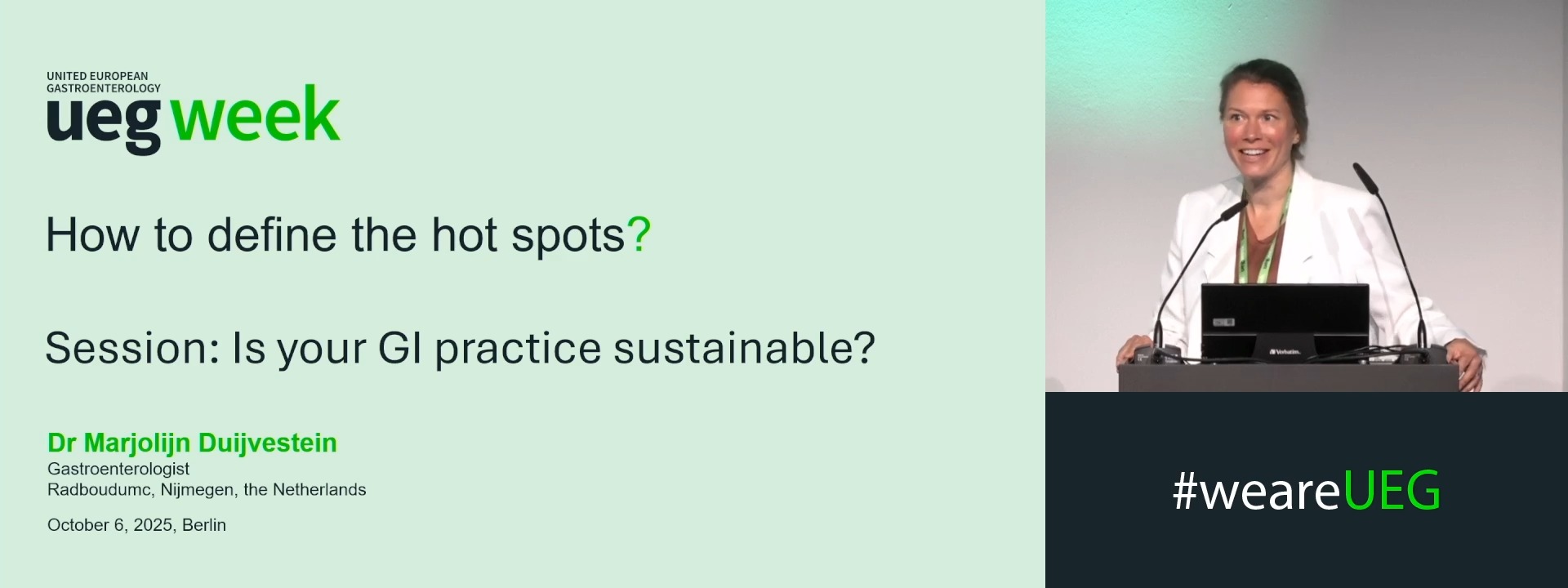
How to define the hot spots?
1 Radboudumc, Nijmegen, Netherlands
Event
Session