UEG's educational platform for gastroenterology education bringing recordings, courses, guidelines, and more together in one place.
Most popular content
Rate for better recommendations!
Your feedback helps us show you more of what you like and less of what you dislike!
Log in to access this content.
Free for all myUEG account holders. Your access level is set automatically based on your occupation. Medical professionals get full access to all content. If you are a non-medical user, you can only access UEG Week content from congresses you attended.
Not sure what you can access? Learn more about account types.

E-CIGARETTES AND HEAT-NOT-BURN TOBACCO INCREASE POSTOPERATIVE RECURRENCE OF CROHN’S DISEASE: A MULTICENTER EUROPEAN STUDY
Tommaso Lorenzo Parigi 1, Olga Maria Nardone 2, Maria Lisa 3, Luca Massimino 3, Roberto Gabbiadini 4, Tommaso Innocenti 5, Lorenzo Bertani 6, Angelo Del Gaudio 7, Pablo Flórez-Díez 8, Luisa Bertin 9, Brigida Barberio 10, Marianne Hupé 11, Loris Riccardo Lopetuso 12, Mariangela Allocca 13, Ferdinando D'Amico 13, Federica Furfaro 13, Alessandra Zilli 13, Gionata Fiorino 14, Federica Ungaro 13, Fabiana Castiglione 2, Edoardo Vincenzo Savarino 9, Gabriele Dragoni 5, Franco Scaldaferri 12, Alessandro Armuzzi 4, Laurent Peyrin-Biroulet 15, Vipul Jairath 16, Theresa Torres Pizarro 17, Silvio Danese 1
1 Vita-Salute San Raffaele University - IRCCS San Raffaele Hospital, Milan, Italy
2 University of Naples Federico II, Naples, Italy
3 Università Vita-Salute San Raffaele, Milan, Italy
4 IRCCS Humanitas Research Hospital, Milan, Italy
5 University of Florence - Careggi University Hospital, Florence, Italy
6 University of Pisa, Pontedera, Italy
7 Policlinico Gemelli, Rome, Italy
8 Hospital Universitario Central de Asturias, Oviedo, Spain
9 University of Padova, Padova, Italy
10 Azienda Ospedaliera Di Padova, Padova, Italy
11 CHU Grenoble Alpes, Grenoble, France
12 Fondazione Policlinico Universitario "A. Gemelli" IRCCS - Università Cattolica di Roma, Rome, Italy
13 IRCCS San Raffaele Hospital, Milan, Italy
14 ASL San Camillo Forlanini, Rome, Italy
15 Nancy University Hospital, Vandoeuvre-les-Nancy, France
16 Western University, London, Canada
17 Case Western Reserve University School of Medicine, Cleveland, United States
Conference
Topics
Submission format
Citation
Published
Log in to access this content.
Free for all myUEG account holders. Your access level is set automatically based on your occupation. Medical professionals get full access to all content. If you are a non-medical user, you can only access UEG Week content from congresses you attended.
Not sure what you can access? Learn more about account types.
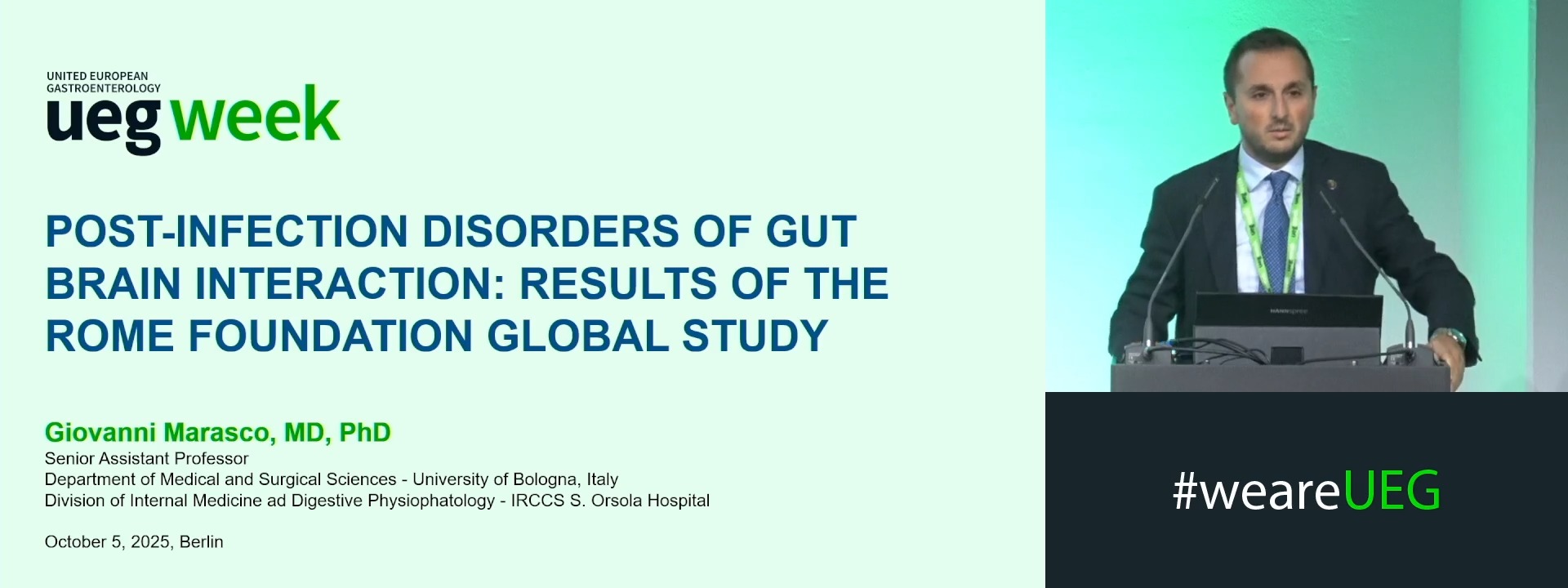
POST-INFECTION DISORDERS OF GUT BRAIN INTERACTION: RESULTS OF THE ROME FOUNDATION GLOBAL STUDY
Giovanni Marasco 1, Max Julio Schmulson Wasserman 2, Uday C. Ghoshal 3, Rutaba Khatun 4, Shrikant I. Bangdiwala 5, Olafur S. Palsson 6, Ami D. Sperber 7, Giovanni Barbara 1
1 University of Bologna, Bologna, Italy
2 Universidad Nacional Autónoma de México (UNAM), Mexico City, Mexico
3 Sanjay Gandhi Postgraduate Institute of Medical Sciences, Lucknow, India
4 McMaster University, Hamilton, Canada|||McMaster University, Hamilton, Canada
5 McMaster University, Hamilton, Canada
6 University of North Carolina, Chapel Hill, Chapel Hill, NC, United States
7 Ben-Gurion University of the Negev, Farod, Israel
Event
Submission format
Session
Citation
Published
Log in to access this content.
Free for all myUEG account holders. Your access level is set automatically based on your occupation. Medical professionals get full access to all content. If you are a non-medical user, you can only access UEG Week content from congresses you attended.
Not sure what you can access? Learn more about account types.
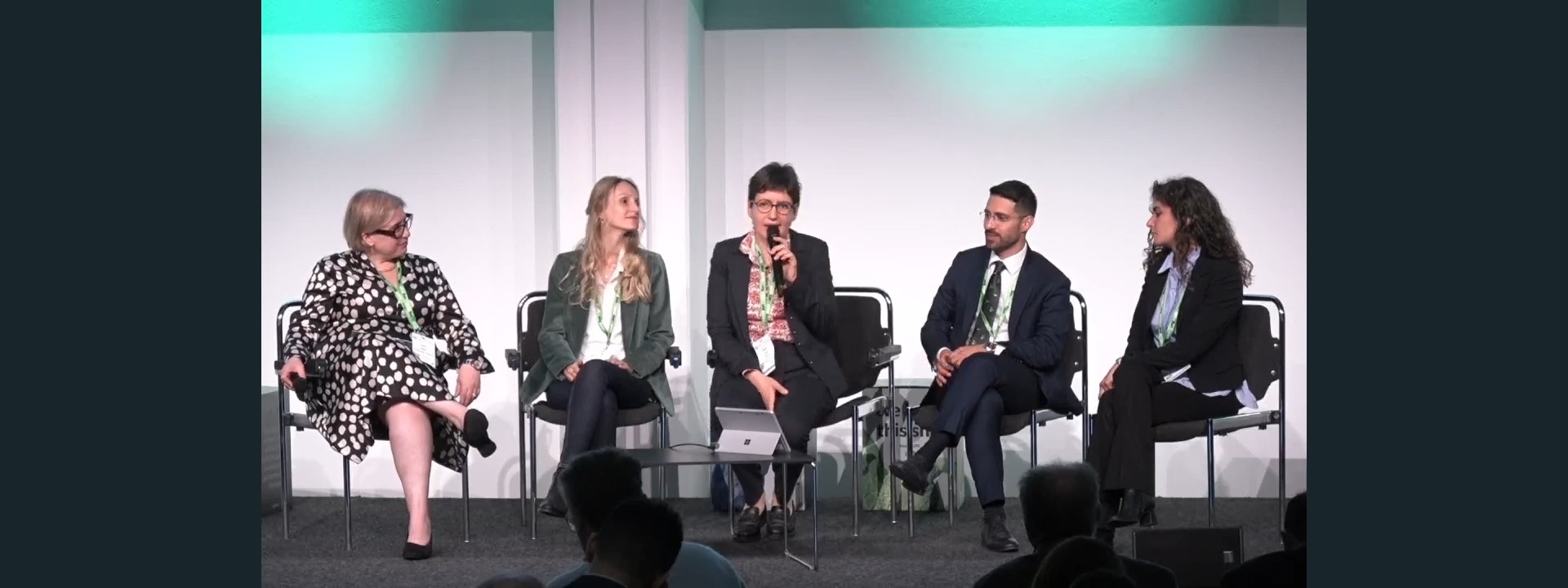
Panel discussion: Non-cardiac chest pain - The tale of a sore oesophagus
Event
Topics
Citation
Published
Log in to access this content.
Free for all myUEG account holders. Your access level is set automatically based on your occupation. Medical professionals get full access to all content. If you are a non-medical user, you can only access UEG Week content from congresses you attended.
Not sure what you can access? Learn more about account types.
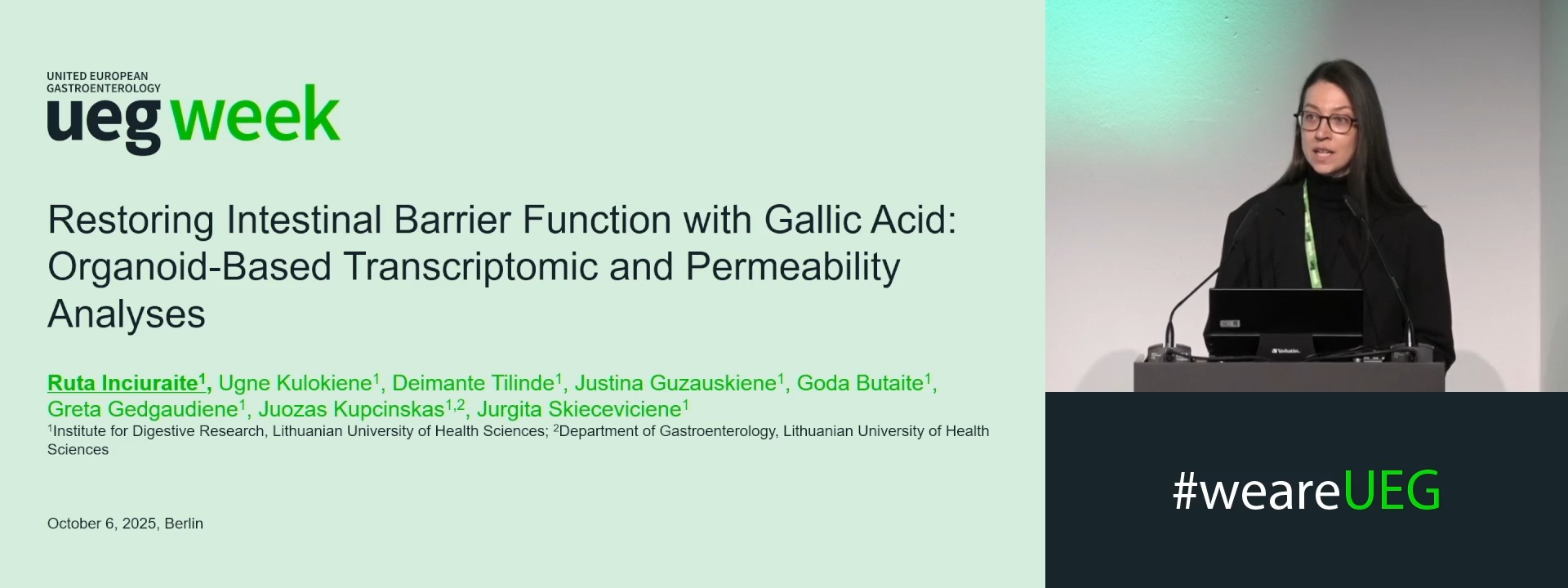
RESTORING INTESTINAL BARRIER FUNCTION WITH GALLIC ACID: ORGANOID-BASED TRANSCRIPTOMIC AND PERMEABILITY ANALYSES
Ruta Inciuraite 1, Ugne Kulokiene 1, Deimantė Tilindė 1, Justina Guzauskiene 1, Goda Butaite 1, Greta Gedgaudiene 1, Juozas Kupcinskas 2, Jurgita Skieceviciene 1
1 Lithuanian University of Health Sciences, Kaunas, Lithuania
2 Lithuanian University of Health Sciences, Kaunas, Lithuania|||Lithuanian University of Health Sciences, Kaunas, Lithuania
Event
Submission format
Citation
Published
Log in to access this content.
Free for all myUEG account holders. Your access level is set automatically based on your occupation. Medical professionals get full access to all content. If you are a non-medical user, you can only access UEG Week content from congresses you attended.
Not sure what you can access? Learn more about account types.
THE CAUSES OF POST ENDOSCOPY UPPER GASTROINTESTINAL CANCER DURING DIAGNOSTIC ENDOSCOPY: RESULTS FROM THE ENGLISH NATIONAL ROOT CAUSE ANALYSIS PROJECT
Amar Srinivasa 1, Rebeca Fiadeiro 2, Karen Clements 2, Tameera Rahman 2, Shilpi Goel 2, Tim Gentry 2, Nicholas E Burr 3, Matthew Banks 4, Anjan Dhar 5, Chris Healey 6, Mimi McCord 7, Dipankar Mukherjee 8, warren chapman 9, Roland Valori 10, Nigel Trudgill 11
1 Sandwell and West Birmingham NHS Trust, Birmingham, United Kingdom
2 Health Data Insight CIC, Cambridge, United Kingdom
3 Leeds Institute for Biomedical and Clinical Sciences, Leeds, United Kingdom
4 University College London Hospital NHS Trust (UCLH), London, United Kingdom
5 Darlington Memorial & Bishop Auckland Hospitals, Darlington, United Kingdom
6 Airedale Nhs foundation trust, Airdale, United Kingdom
7 Heartburn Cancer UK, Basingstoke, United Kingdom
8 Barking, Havering And Redbridge University Hospitals NHS Trust, Romford, United Kingdom
9 University Hospitals NHS Foundation Trust, Birmingham, United Kingdom
10 Gloucestershire NHS Foundation Trust - Medicine, Gloucestershire NHS Foundation Trust; Cheltenham/GB, Cheltenham, United Kingdom
11 Sandwell & West Birmingham Hospitals NHS Trust, West Bromwich, United Kingdom
Conference
Topics
Submission format
Citation
Published
Log in to access this content.
Free for all myUEG account holders. Your access level is set automatically based on your occupation. Medical professionals get full access to all content. If you are a non-medical user, you can only access UEG Week content from congresses you attended.
Not sure what you can access? Learn more about account types.
SARS-COV-2, THE SILENT KILLER: LARGE BOWEL PERFORATION IN A PATIENT WITH CROHN’S DISEASE
1 Carol Davila University of Medicine and Pharmacy/Universitary Emergency Hospital, Bucharest, Romania
Conference
Submission format
Session
Published
Log in to access this content.
Free for all myUEG account holders. Your access level is set automatically based on your occupation. Medical professionals get full access to all content. If you are a non-medical user, you can only access UEG Week content from congresses you attended.
Not sure what you can access? Learn more about account types.
ALBI OUTPERFORMS MELD AND CHILD-PUGH IN PREDICTING SHORT-TERM MORTALITY IN CIRRHOTIC PATIENTS WITH GASTROINTESTINAL HEMORRHAGE
José Luis López Chacón 1, Abel Sanchez 1, Dania Campos 1, Kevin Molina 1, José Roberto Aguirre Ayala 1, Vivian Karina Linares Leal 1
1 Hospital Roosevelt, Guatemala, Guatemala
Conference
Topics
Submission format
Session