Introduction
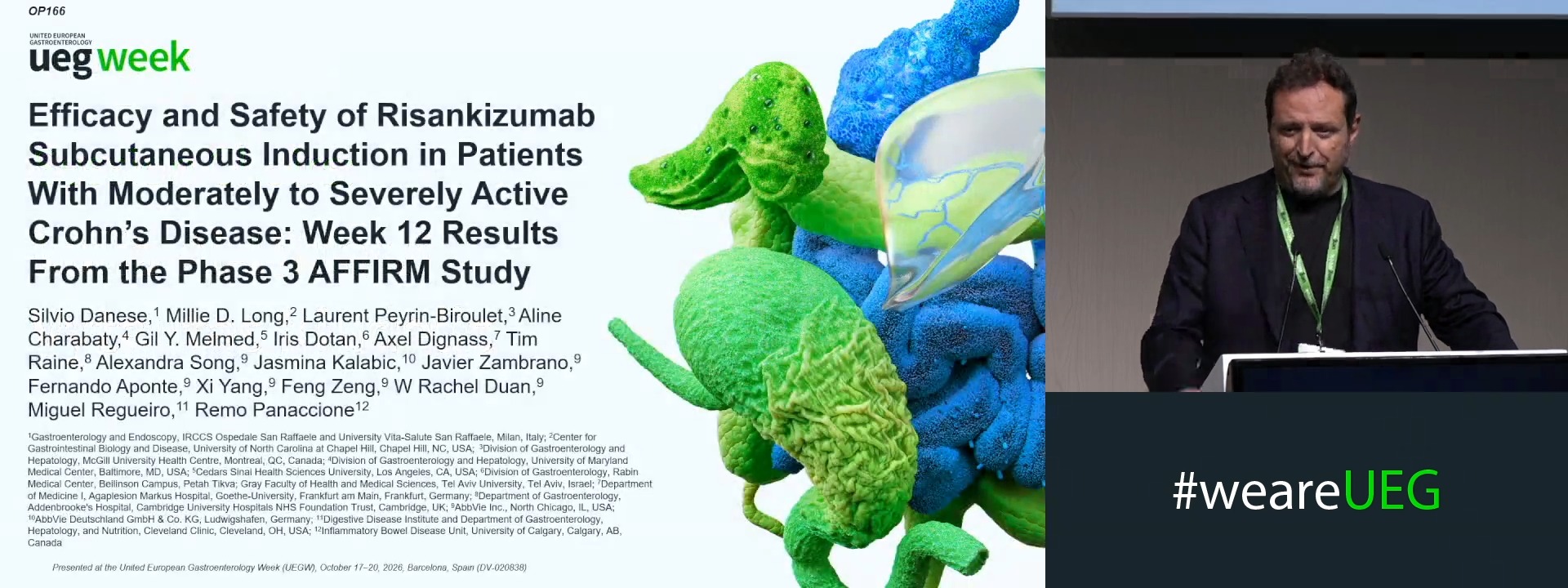
Risankizumab (RZB) is an interleukin-23 p19 subunit inhibitor currently approved as intravenous induction followed by subcutaneous (SC) maintenance therapy in patients with moderately to severely active Crohn’s disease (CD).1-4 Here we report 12-week results from the AFFIRM study that evaluated the efficacy and safety of RZB SC induction therapy in patients with moderately to severely active CD.
Aims & Methods
AFFIRM (NCT06063967) is a phase 3, randomised, placebo (PBO)-controlled, double-blind study that enrolled adult patients (≥ 18 years) with a confirmed CD diagnosis ≥ 3 months prior to baseline (BL), a BL CD Activity Index (CDAI) of 220–450, a BL Simple Endoscopic Score for CD (excluding the presence of narrowing component) of ≥ 6 (or ≥ 4 for isolated ileal disease), and prior intolerance/inadequate response (IR) to conventional and/or advanced therapies (ATs; ie biologics and Janus kinase [JAK] inhibitors). Enrolment of patients who were ustekinumab (UST)-IR or ≥ 3 AT-IR were each capped at 20%. Patients were randomised 2:1 to receive either SC RZB 720 mg or matching PBO at BL and weeks 2, 4, and 8 of the induction period. Co-primary endpoints were CDAI clinical remission and endoscopic response at week 12. All co-primary and secondary efficacy endpoints were multiplicity controlled for overall type-I error rate at a two-sided significance level of 0.05. Treatment-emergent adverse events (TEAEs) were assessed through week 12.
Results
This analysis included 289 patients (RZB, N = 191; PBO, N = 98). Patient demographics and BL characteristics were similar between treatment arms; 64.9% and 66.3% were AT-IR in RZB and PBO arms, respectively. At week 12, significantly greater proportions of the overall population treated with RZB vs PBO achieved CDAI clinical remission (55.0% vs 29.6%; P < .0001) and endoscopic response (44.0% vs 14.3%; P < .0001) (Table). For these endpoints, numerically higher rates were achieved at week 12 with RZB vs PBO in the AT-naïve subpopulation, with the RZB arm reaching 73.1% (vs 27.3% for PBO) for CDAI clinical remission and 61.2% (vs 15.2% for PBO) for endoscopic response. Numerically higher rates were also achieved at week 12 in the AT-IR subpopulation with RZB vs PBO for CDAI clinical remission (45.2% vs 30.8%) and endoscopic response (34.7% vs 13.8%). TEAEs were reported in 81 (42.4%) and 58 (59.2%) patients in the RZB and PBO arms, respectively (Table). No deaths were reported.
| PBO
(N = 98)
| RZB SC
(N = 191)
| Treatment difference vs PBO
|
CDAI clinical remission,a % [95% CI]
Overall
AT-naïve
AT-IR
Endoscopic response,b % [95% CI]
Overall
AT-naïve
AT-IR
TEAEs (safety analysis population), n (%)
Severe AE
Serious AE
AE with reasonable possibility of being drug relatedc
AE leading to discontinuation of study drug
Deaths
AESIs (safety analysis population), n (%)e
Serious infections
Adjudicated MACE
Malignant tumours
Malignancies excluding NMSC
Adjudicated anaphylactic reaction
Hepatic events
Injection site reaction
|
29.6 [20.55, 38.63]
27.3 [12.08, 42.47]
30.8 [19.55, 41.99]
14.3 [7.36, 21.21]
15.2 [2.92, 27.38]
13.8 [5.45, 22.24]
58 (59.2)
5 (5.1)
3 (3.1)
21 (21.4)
1 (1.0)
0
0
0
0
0
0
5 (5.1)
1 (1.0)
|
55.0 [47.92, 62.03]
73.1 [62.52, 83.75]
45.2 [36.40, 53.92]
44.0 [36.94, 51.02]
61.2 [49.53, 72.86]
34.7 [26.30, 43.05]
81 (42.4)
5 (2.6)
1 (0.5)d
21 (11.0)
0
0
0
0
0
0
0
1 (0.5)
4 (2.1)
|
26.6 [15.57, 37.60], P < .0001
45.9 [27.33, 64.40]
14.4 [0.16, 28.63]
29.4 [19.94, 38.92], P < .0001
46.0 [29.14, 62.95]
20.8 [8.97, 32.69]
NA
NA
|
Table. Summary of coprimary endpoints, TEAEs, and AESIs during the 12-week induction period
AE, adverse event; AESI, adverse event of special interest; AT, advanced therapy; BL, baseline; CDAI, Crohn’s Disease Activity Index; IR, inadequate response; MACE, major adverse cardiovascular events; NMSC, nonmelanoma skin cancer; NRI-MI, nonresponder imputation while incorporating multiple imputation; PBO, placebo; RZB, risankizumab; SC, subcutaneous; TEAE, treatment-emergent adverse event.
Overall population included all patients who were randomised and received ≥ 1 dose of study drug during the 12-week induction period. Randomisation was stratified by number of prior ATs failed (0, 1, > 1), prior ustekinumab failed (yes, no), and BL steroid use (yes, no).
AT-naïve patients included those without prior AT failure.
AT-IR patients included those with prior failure to ≥ 1 AT for CD.
The safety analysis population included all patients who received ≥ 1 dose of study drug during the 12-week induction period.
Statistically significant difference between RZB vs PBO for the coprimary endpoints was determined using a fixed-sequence multiple testing procedure at significance level of 0.05 (two-sided). Handling of missing data was based on NRI-MI for binary endpoints. 95% CIs were calculated using Student's t-distribution if there were missing data that can be reasonably assumed to be missing at random or normal approximation to the binomial distribution if there were no missing data that are missing at random. Treatment differences were based on Mantel-Haenszel estimation for binary endpoints. Statistical testing was not performed for the AT-naïve/AT-IR subgroup analyses; thus, no P values are provided herein.
aCDAI < 150.
bDecrease in SES-CD > 50% from baseline (or for patients with isolated ileal disease and a baseline SES-CD of 4, at least a 2-point reduction from baseline), as scored by central reviewer.
cAs assessed by investigator.
dWorsening of Crohn’s disease.
eThere were no reports of active tuberculosis, opportunistic infections, or herpes zoster. |
Conclusion
In the overall AFFIRM population, patients with moderately to severely active CD treated with 12-weeks of RZB SC induction therapy achieved the coprimary endpoints of CDAI clinical remission and endoscopic response at significantly higher rates than those receiving PBO. Approximately three quarters of AT-naïve patients achieved clinical remission at this early timepoint. Both AT-naïve and AT-IR (which included UST-IR, and JAK-IR) achieved high rates of efficacy at numerically higher rates with RZB SC induction than PBO. Safety results of SC induction were consistent with the known safety profile of RZB.
References
- Singh S, et al. mAbs. 2015;7(4):778–91.
- SKYRIZI® (risankizumab-rzaa) prescribing information. https://www.rxabbvie.com/pdf/skyrizi_pi.pdf
- D’Haens G, et al. Lancet. 2022;399(10340):2015–30.
- Ferrante M, et al. Lancet. 2022;399(10340):2034–46.
Funding
AbbVie funded this study and participated in the study design, research, analysis, data collection, interpretation of data, reviewing, and approval of the publication. All authors had access to relevant data and participated in the drafting, review, and approval of this publication. No honoraria or payments were made for authorship.
Acknowledgements
Mahesh Chemudupati, PhD, and Jeanie K. Meckes, PhD, of AbbVie, provided medical writing support. Angela T. Hadsell, of AbbVie, provided editorial support.
Disclosure
SD has received consultancy fees from AbbVie, Alimentiv, Allergan, Amgen, AstraZeneca, Athos Therapeutics, Biogen, Boehringer Ingelheim, Celgene, Celltrion, Eli Lilly, Enthera, Ferring Pharmaceuticals, Gilead, Hospira, Inotrem, Janssen, Johnson & Johnson, MSD, Mundipharma, Mylan, Pfizer, Roche, Sandoz, Sublimity Therapeutics, Takeda, TiGenix, UCB, and Vifor; and reports lecture fees from AbbVie, Amgen, Dr Falk Pharma, Ferring Pharmaceuticals, Gilead, Janssen, Mylan, Pfizer, and Takeda.
MDL has served as a consultant for AbbVie, Takeda, Pfizer, Janssen, UCB, Target PharmaSolutions, Salix, Valeant, and Prometheus.
LPB has received consulting fees from AbbVie, Abivax, Adacyte, Alimentiv, Alfasigma, Amgen, Apini, Banook, BMS, Celltrion, Enthera, Ferring, Fresenius Kabi, Galapagos, Genentech, Gilead, GSK, Hemay, Iterative Health, Janssen, Eli Lilly, LifeMine, Medac, Mirador, Morphic, MSD, Nordic Pharma, Novartis, Oddifact, Oncodesign Precision Medicine, Onco3R, ONO Pharma, OSE Immunotherapeuthics, Palisade Bio, Par' Immune, Pfizer, Prometheus, Roche, Roivant, Samsung, Sandoz, Sanofi, Sorriso, Spyre, Takeda, Teva, ThirtyfiveBio, Tillots, Vectivbio, Vedanta, Ventyx; stock options from Iterative Health, Oragen, Pharmanest, Thetis; and lecture fees from AbbVie, Alfasigma, Amgen, Biogen, Celltrion, Ferring, Fresenius Kabi, Galapagos, Genentech, Gilead, Iterative Health, Janssen, Eli Lilly, Medac, MSD, Nordic Pharma, Novartis, Pfizer, Roche, Sandoz, Takeda, and Tillots.
AC has received advisory board and/or consulting fees from AbbVie, Celltrion, Eli Lilly, Janssen, Pfizer, and Sanofi.
GYM has served as a consultant and/or on advisory Board for AbbVie, Arena Biopharmaceuticals, Boehringer-Ingelheim, Bristol-Meyers Squibb / Celgene, Cristcot, Diasorin, Dieta, Entasis, Fresenius Kabi, Ferring, Genentech, Janssen Immunology, Lilly, Medtronic, Merck, Oshi Health, Pfizer, Prometheus Labs, Samsung Bioepis, Shionogi, Gilead, Takeda, Techlab, Viatris; received speaking fees from AbbVie and Janssen; and has stock options in Harp Diagnostics and Oshi Health.
ID has received consultation fees, research grants, or honoraria from AbbVie, Altman, Arena Pharmaceuticals, AstraZeneca, Athos, Celgene/Bristol Myers Squibb, Celltrion, Dr Falk Pharma, Ferring, Galapagos, Genentech, Gilead, Iterative Scopes, H5MD, Friedevents AG, Janssen, Lilly, Materia Prima, Mirador, Pfizer, Prometheus, Sandoz, Sangamo, Spyre, Sublimity, Takeda. She is a shareholder in Gutreat and Harp Diagnostics.
AD reports fees for participation in clinical trials, review activities such as data monitoring boards, statistical analysis and end point committees from AbbVie, Abivax, Falk, Galapagos, Gilead, J&J, Pfizer and Takeda; consultancy fees from AbbVie, Alfasigma, Amgen, Biogen, Boehringer Hexal, J&J, Lilly, MSD, Pfizer, Pharmacosmos, Roche, Sandoz, Stada, Takeda, and Vifor Pharma; payment from lectures including service on speakers bureaus from AbbVie, Alfasigma, Biogen, CED Service GmbH, Celltrion, Falk, Fresenius Kabi, Ferring, Galapagos, Gilead, Hexal, High5MD, J&J, Materia Prima, MedToday, MSD, Pfizer, Sandoz, Streamed-Up, Takeda, and Vifor Pharma; payment for manuscript preparation from AbbVie, Falk, J & J, Takeda, Thieme, and UniMed Verlag.
TR has received research/educational grants and/or speaker/consultation fees from AbbVie, Alfasigma, Arena, Aslan, AstraZeneca, Boehringer-Ingelheim, BMS, Domain Therapeutics, Eli Lilly, Ferring, Galapagos, Gilead, GSK, Heptares, LabGenius, MonteRosa, Novartis, Numab, Janssen, Pfizer, Roche, Scientia, Takeda, UCB, and XAP therapeutics.
AS, JK, JZ, FA, XY, FZ, and WRD are full-time employees of AbbVie and may hold AbbVie stock and/or stock options.
MR served as an advisory board member and consultant (both) for AbbVie, Johnson and Johnson, UCB, Takeda, Pfizer, BMS, Organon, Amgen, Genentech, Gilead, Salix, Prometheus, Lilly, Celgene, Boehringer Ingelheim Pharmaceuticals Inc. (BIPI), Celltrion, Roche, Merck, Sanofi, Biocon, and Abivax.
RP has received consulting fees, speaker fees, and research support from Abbott, AbbVie, Abivax, Alimentiv, Amgen, AnaptysBio, AstraZeneca, Biogen, Boehringer Ingelheim, Bristol Myers Squibb, Celgene Corporation, Celltrion, Cosmos Pharmaceuticals, Eisai, Elan, Eli Lilly, Ferring, Fresenius Kabi, Galapagos, Genentech, Gilead Sciences, GlaxoSmithKline, JAMP Bio, Janssen, Merck, Mylan, Novartis, Oppilan Pharma, Organon, Pandion Pharma, Pendopharm, Pfizer, Progenity, Prometheus Biosciences, Protagonist Therapeutics, Roche, Sandoz, Sanofi, Satisfai Health, Sublimity Therapeutics, Takeda, Theravance Biopharma, Trellus, Viatris, UCB, and Ventyx.