Introduction
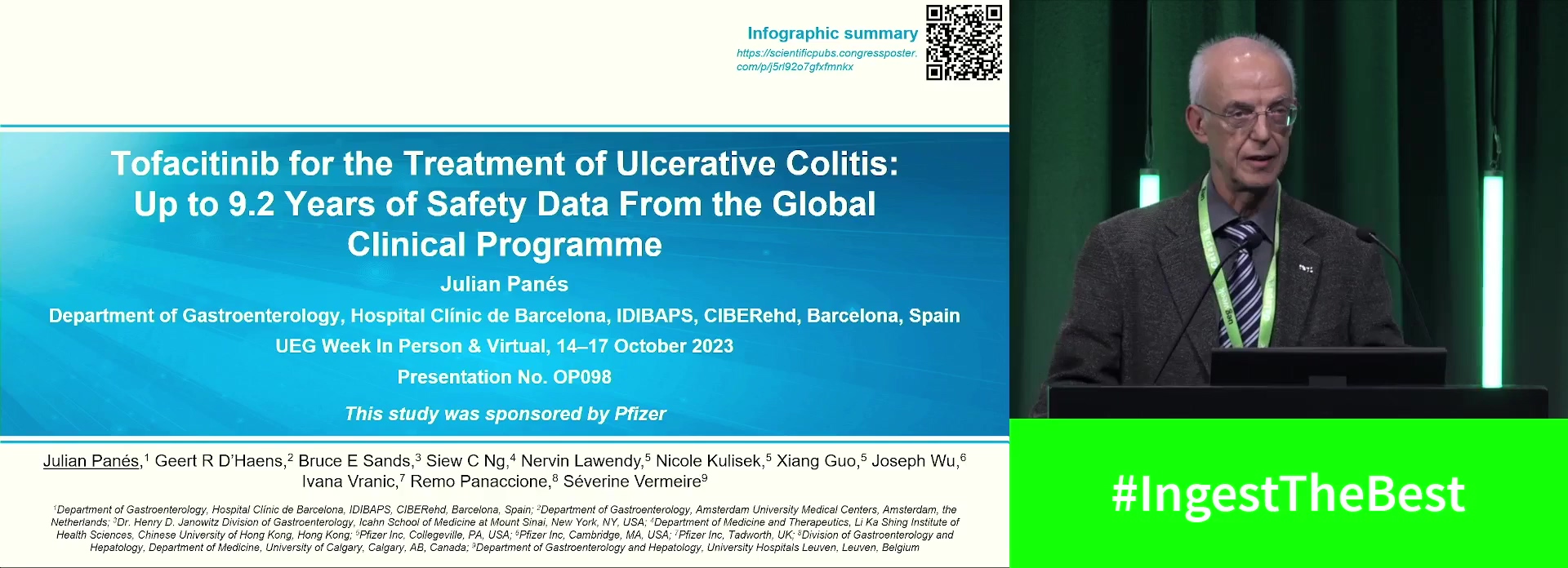
Tofacitinib is an oral small molecule Janus kinase inhibitor for the treatment of ulcerative colitis (UC). The safety of tofacitinib was evaluated in the Overall Cohort, which consisted of 6 studies: 4 randomised, placebo-controlled Phase (P)2/3 studies (NCT00787202; NCT01465763; NCT01458951; NCT01458574), an open-label, long‑term extension study (NCT01470612) and a randomised P3b/4 study (NCT03281304). We report final safety analyses from the tofacitinib UC clinical programme of ≤9.2 years of tofacitinib exposure (cut off date: 18 April 2022).
Aims & Methods
This analysis included 1157 patients (pts) receiving tofacitinib 5 or 10 mg twice daily (BID; predominant dose [PD]) in the Overall Cohort and a previously reported 52-week Maintenance Cohort.1,2 Proportions and incidence rates (IRs; unique pts with events/100 pt-years of exposure) were evaluated for deaths and adverse events of special interest (AESI): serious infections; herpes zoster (HZ); opportunistic infections (OIs); malignancies (excluding non‑melanoma skin cancer [NMSC]); NMSC; major adverse cardiovascular events (MACE); deep vein thrombosis (DVT); pulmonary embolism (PE); and gastrointestinal (GI) perforations.
Results
In the Overall Cohort, 1157 pts received ≥1 dose of tofacitinib 5 or 10 mg BID; 938 (81.1%) received a PD of 10 mg BID; 552 (47.7%) pts had received tofacitinib for ≥2 years. Median treatment duration was 1.7 years (mean 2.8; range 0.0–9.2). IRs (95% CI) for all tofacitinib in the Overall Cohort (Table): deaths 0.24 (0.10, 0.48); serious infections 1.80 (1.37, 2.32); HZ (non-serious and serious) 3.24 (2.63, 3.94); serious HZ 0.24 (0.10, 0.48); OIs 0.96 (0.65, 1.36); malignancies (excluding NMSC) 0.88 (0.59, 1.26); NMSC 0.71 (0.45, 1.07); MACE 0.27 (0.12, 0.52); DVT 0.06 (0.01, 0.22); PE 0.18 (0.07, 0.40); and GI perforations 0.09 (0.02, 0.27).
Table. Baseline demographics and disease characteristics, and IRs (unique pts with events/100 PY of exposure) for AESI in the tofacitinib UC clinical programme, by cohort
|
|---|
| Maintenance Cohort1,2 (52 weeks)
| Overall Cohort (≤9.2 years)
|
Placebo
(N=198; 100.4 PY)
| Tofacitinib
5 mg BID
(N=198; 146.2 PY)
| Tofacitinib
10 mg BID
(N=196; 154.3 PY)
| Tofacitinib all
(N=394; 300.5 PY)
| PD tofacitinib
5 mg BID
(N=219; 902.3 PY)
| PD tofacitinib
10 mg BID
(N=938; 2299.7 PY)
| Tofacitinib all
(N=1157; 3202.0 PY)
|
Baseline demographics and clinical characteristics
Age (yrs), mean (SD)a
TMS, mean (SD)b,c
Disease duration (yrs), mean (SD)b
Prior TNFi failure, n (%)d
CS use at baseline, n (%)b
AEs
Pts with AEs, n (%)
Pts with serious AEs, n (%)
Deaths, n (%), IR [95% CI]e
|
43.4 (14.0)
3.3 (1.8)
8.8 (7.5)
89 (44.9)
100 (50.5)
149 (75.3)
13 (6.6)
0 (0.0),
0.00 [0.00, 3.57]
|
41.9 (13.7)
3.3 (1.8)
8.3 (7.2)
83 (41.9)
101 (51.0)
143 (72.2)
10 (5.1)
0 (0.0),
0.00 [0.00, 2.48]
|
43.0 (14.4)
3.4 (1.8)
8.7 (7.0)
92 (46.9)
86 (43.9)
156 (79.6)
11 (5.6)
0 (0.0),
0.00 [0.00, 2.35]
|
42.5 (14.0)
3.4 (1.8)
8.5 (7.1)
175 (44.4)
187 (47.5)
299 (75.9)
21 (5.3)
0 (0.0),
0.00 [0.00, 1.21]
|
44.0 (14.4)
7.9 (2.4)
8.3 (6.6)
93 (42.5)
89 (40.6)
205 (93.6)
46 (21.0)
0 (0.0),
0.00 [0.00, 0.40]
|
40.6 (13.7)
8.8 (1.8)
8.2 (7.1)
490 (54.1)
434 (46.3)
789 (84.1)
208 (22.2)
8 (0.9),
0.34 [0.14, 0.66]
|
41.3 (13.9)
8.6 (2.0)
8.2 (7.0)
583 (51.9)
523 (45.2)
994 (85.9)
254 (22.0)
8 (0.7),f
0.24 [0.10, 0.48]
|
Infections, n (%), IR [95% CI]g
SIsh
All HZ (non-serious and serious)
Serious HZ
OIsd,j,k
HZ OIsj
|
2 (1.0),
1.94 [0.23, 7.00]
1 (0.5),
0.97 [0.02, 5.42]
0 (0.0),
0.00 [0.00, 3.57]
1 (0.5),
0.97 [0.02, 5.42]
1 (0.5),
0.97 [0.02, 5.42]
|
2 (1.0),
1.35 [0.16, 4.87]
3 (1.5),i
2.05 [0.42, 6.00]
0 (0.0),
0.00 [0.00, 2.48]
2 (1.0),
1.36 [0.16, 4.92]
2 (1.0),
1.36 [0.16, 4.92]
|
1 (0.5),
0.64 [0.02, 3.54]
10 (5.1),i
6.64 [3.19, 12.22]
0 (0.0),
0.00 [0.00, 2.35]
4 (2.0),
2.60 [0.71, 6.65]
4 (2.0),
2.60 [0.71, 6.65]
|
3 (0.8),
0.98 [0.20, 2.87]
13 (3.3),i
4.38 [2.33, 7.50]
0 (0.0),
0.00 [0.00, 1.21]
6 (1.5),
1.99 [0.73, 4.34]
6 (1.5),
1.99 [0.73, 4.34]
|
10 (4.6),
1.08 [0.52, 1.99]
23 (10.5),
2.71 [1.72, 4.06]
1 (0.5),
0.11 [0.00, 0.60]
8 (3.7),
0.89 [0.39, 1.76]
7 (3.2),
0.78 [0.31, 1.61]
|
49 (5.2),
2.07 [1.53, 2.74]
76 (8.1),
3.44 [2.71, 4.31]
7 (0.7),
0.29 [0.12, 0.61]
23 (2.5),
0.99 [0.63, 1.48]
19 (2.1),
0.81 [0.49, 1.27]
|
59 (5.1),
1.80 [1.37, 2.32]
99 (8.6),
3.24 [2.63, 3.94]
8 (0.7),
0.24 [0.10, 0.48]
31 (2.8),
0.96 [0.65, 1.36]
26 (2.3),
0.80 [0.53, 1.18]
|
Malignancies, n (%), IR [95% CI]d,e,j
Malignancies (excl. NMSC)
NMSC
|
1 (0.5),l
0.97 [0.02, 5.39]
1 (0.5),
0.97 [0.02, 5.40]
|
0 (0.0),
0.00 [0.00, 2.48]
0 (0.0),
0.00 [0.00, 2.48]
|
0 (0.0),
0.00 [0.00, 2.35]
3 (1.5),
1.91 [0.39, 5.59]
|
0 (0.0),
0.00 [0.00, 1.21]
3 (0.8),
0.98 [0.20, 2.87]
|
5 (2.3),
0.54 [0.18, 1.26]
6 (2.7),
0.66 [0.24, 1.43]
|
24 (2.7),
1.01 [0.65, 1.51]
17 (1.9),
0.73 [0.43, 1.17]
|
29 (2.6),m
0.88 [0.59, 1.26]
23 (2.0),
0.71 [0.45, 1.07]
|
MACE, n (%), IR [95% CI]d,e,j
| 0 (0.0),
0.00 [0.00, 3.57]
| 1 (0.5),n
0.68 [0.02, 3.77]
| 1 (0.5),o
0.64 [0.02, 3.54]
| 2 (0.5),
0.66 [0.08, 2.37]
| 4 (1.8),
0.44 [0.12, 1.12]
| 5 (0.6),
0.21 [0.07, 0.49]
| 9 (0.8),p
0.27 [0.12, 0.52]
|
VTE, n (%), IR [95% CI]g,j
DVT
PE
|
1 (0.5),
0.97 [0.02, 5.39]
1 (0.5),
0.98 [0.02, 5.44]
|
0 (0.0),
0.00 [0.00, 2.48]
0 (0.0),
0.00 [0.00, 2.48]
|
0 (0.0),
0.00 [0.00, 2.35]
0 (0.0),
0.00 [0.00, 2.35]
|
0 (0.0),
0.00 [0.00, 1.21]
0 (0.0),
0.00 [0.00, 1.21]
|
0 (0.0),
0.00 [0.00, 0.40]
0 (0.0),
0.00 [0.00, 0.40] |
2 (0.2),
0.08 [0.01, 0.30]
6 (0.6),
0.25 [0.09, 0.55]
|
2 (0.2),q
0.06 [0.01, 0.22]
6 (0.5),r
0.18 [0.07, 0.40]
|
GI perforations, n (%), IR [95% CI]d,g,j,s
|
1 (0.5),
0.97 [0.02, 5.39]
|
0 (0.0),
0.00 [0.00, 2.48]
|
0 (0.0),
0.00 [0.00, 2.35]
|
0 (0.0),
0.00 [0.00, 1.21]
|
1 (0.5),
0.11 [0.00, 0.60]
|
2 (0.2),
0.08 [0.01, 0.30]
|
3 (0.3),
0.09 [0.02, 0.27]
|
The Maintenance Cohort has been reported previously1,2 and includes pts receiving placebo, tofacitinib 5 mg BID or tofacitinib 10 mg BID in the 52-week maintenance study (OCTAVE Sustain; NCT01458574); the Overall Cohort includes final data from the open-label, long‑term extension study (OCTAVE Open; NCT01470612) and P3b/4 data as of 18 April 2022; in the Overall Cohort, PD tofacitinib 5 mg BID was defined as an average total daily dose of tofacitinib <15 mg and PD tofacitinib 10 mg BID was defined as an average total daily dose of tofacitinib ≥15 mg
aData are from screening of P3 induction studies (OCTAVE Induction 1&2; NCT01465763 and NCT01458951, respectively) for the Maintenance Cohort, and from Day 1 (start of active treatment in the tofacitinib UC clinical programme) for the Overall Cohort; bData are from baseline of the P3 maintenance study (OCTAVE Sustain) for the Maintenance Cohort, and from Day 1 (start of active treatment in the tofacitinib UC clinical programme) for the Overall Cohort; cFor the Overall Cohort, N=936 and N=1155 for the PD tofacitinib 10 mg BID and tofacitinib all groups, respectively; dData are from baseline of OCTAVE Induction 1&2; for the Overall Cohort, N=905 and N=1124 for the PD tofacitinib 10 mg BID and tofacitinib all groups, respectively (excludes P2; NCT00787202); eFor the Maintenance Cohort, and generally for the Overall Cohort, events that occurred >28 days after the last dose of study drug were excluded; for the Overall Cohort, deaths, malignancies and MACE outside the 28‑day risk period were included; fDeaths (number of events): aortic dissection (1), cardiac arrest (1), PE (1), hepatic angiosarcoma (1), acute myeloid leukaemia (1), malignant melanoma (1), metastatic adenocarcinoma (1), COVID-19 pneumonia/respiratory failure (1); gEvents that occurred >28 days after the last dose of study drug were excluded; hDefined as any infection AE that required hospitalisation or parenteral antimicrobials, or met other criteria that required the infection to be classified as a serious AE; iIRs of HZ in the Maintenance Cohort were numerically higher with tofacitinib 5 mg BID vs placebo and all tofacitinib vs placebo, and statistically higher with tofacitinib 10 mg BID vs placebo; jAdjudicated events; kExcludes tuberculosis and HZ with two adjacent dermatomes; lInvasive ductal breast carcinoma; mMalignancy (number of events): acute myeloid leukaemia (1), breast cancer (3), Bowen’s disease (1), cervical dysplasia (2), cholangiocarcinoma (2), colorectal cancer (5), diffuse large B-cell lymphoma (2), Epstein-Barr virus associated lymphoma (1), essential thrombocythaemia (1), hepatic angiosarcoma (1), leiomyosarcoma (1), lung cancer (2), malignant melanoma (2), oesophageal adenocarcinoma (1), penile dysplasia (1), renal cell carcinoma (1), vulvar cancer (1), prostate cancer (1); nMyocardial infarction; oHaemorrhagic stroke; pMACE (number of events): acute coronary syndrome (1), acute myocardial infarction (1), aortic dissection (1), cardiac arrest (1), cerebellar haemorrhage (1), cerebrovascular accident (2), haemorrhagic stroke (1), myocardial infarction (1); qPt with DVT was diagnosed following a long-haul flight and management of an infected leg wound sustained in a recent motorbike accident; the second DVT event was assessed as related to the study drug by the investigator; rPts with PE had the following notable medical history: one with prior DVT and PE, one with phlebothrombosis and stroke, one was receiving oral contraceptives for dysfunctional uterine bleeding and one had cholangiocarcinoma and metastases to the peritoneum, and PE was the cause of death. Two pts had a medical history with no prior risk factors for PE; sGI perforation excludes Preferred Terms of pilonidal cyst, perirectal abscess, rectal abscess, anal abscess, perineal abscess and any Preferred Terms containing the term fistula
AE, adverse event; AESI, AEs of special interest; BID, twice daily; CI, confidence interval; CS, corticosteroid; DVT, deep vein thrombosis; GI, gastrointestinal; HZ, herpes zoster; IR, incidence rate (unique pts with events/100 PY of exposure); MACE, major adverse cardiovascular events; N, number of pts treated in the treatment group; n, number of unique pts with a particular AE; NMSC, non‑melanoma skin cancer; OI, opportunistic infection; P, Phase; PD, predominant dose; PE, pulmonary embolism; PY, pt-years; pt, patient; SD, standard deviation; SI, serious infection; TMS, total Mayo score; TNFi, tumour necrosis factor inhibitor; UC, ulcerative colitis; VTE, venous thromboembolic events; yrs, years
|
Conclusion
IRs for AESI remained stable over an extended period of time (≤9.2 years) with the inclusion of the P3b/4 final data and were consistent with prior Overall Cohort analyses (≤7.8 years).1,2 The safety profile of tofacitinib in the UC clinical programme was consistent with that observed in other indications.3,4
References
1. Sandborn WJ et al. Clin Gastroenterol Hepatol 2019;17:1541–50.
2. Sandborn WJ et al. J Crohns Colitis 2023;17:338–51.
3. Cohen SB et al. RMD Open 2020;6:e001395.
4. Burmester GR et al. Drug Saf 2020;43:379–92.
Disclosure
Julian Panés has received grants and/or research support from AbbVie and Pfizer Inc, is a member of the speakers’ bureau for Abbott, Ferring, Janssen, Pfizer Inc and Takeda, has been an advisory board member for AbbVie, Arena, Athos, Atomwise, Boehringer Ingelheim, Celgene, Celsius, Celltrion, Ferring, Galapagos, Genentech/Roche, GlaxoSmithKline, Janssen, Mirum, Morphic, Nestlé, Origo, Pandion, Pfizer Inc, Progenity, Prometheus, Protagonist, Revolo, Robarts, Sanofi, Takeda, Theravance and Wasserman, and has developed educational presentations for AbbVie, Janssen, Pfizer Inc, Roche and Takeda. Geert R. D’Haens has received speaker fees from AbbVie, Boehringer Ingelheim, Celltrion, Johnson & Johnson, Pfizer Inc, Takeda and Tillotts, and has been an advisory board member for AbbVie, Alimentiv, AstraZeneca, Boehringer Ingelheim, Bristol Myers Squibb, Celltrion, Cosmo, Eli Lilly, Galapagos, GlaxoSmithKline, Johnson & Johnson, Takeda, Pfizer Inc, Polpharma, Prometheus, Tillotts and Ventyx. Bruce E. Sands has acted as a consultant for, or received speaker fees from, AbbVie, Abivax, Adiso Therapeutics, Alimentiv, Amgen, Arena, Artizan Biosciences, Artugen Therapeutics, AstraZeneca, Bacainn Therapeutics, Biora Therapeutics, Boehringer Ingelheim, Boston Pharmaceuticals, Bristol Myers Squibb, Calibr, Celltrion, ClostraBio, Connect Biopharm, Cytoki Pharma, Eli Lilly, Entera, Evommune, Ferring, Fresenius Kabi, Galapagos, Gilead Sciences, Genentech, GlaxoSmithKline, Gossamer Bio, HMP Acquisition, Imhotex, Immunic, InDex Pharmaceuticals, Innovation Pharmaceuticals, Inotrem, Ironwood Pharmaceuticals, Janssen, Johnson & Johnson, Kaleido, Kallyope, Merck, MiroBio, Morphic, MRM Health, OSE Immunotherapeutics, Pfizer Inc, Progenity, Prometheus, Protagonist, Q32 Bio, RedHill Biopharma, Sun Pharma Global, Surrozen, Synlogic Operating Company, Takeda, Target RWE, Theravance, TLL Pharmaceutical, USWM Enterprises, Ventyx and Viela Bio, and is a shareholder of Ventyx. Siew C. Ng has received grants and/or research support from AbbVie, Ferring, Janssen and Olympus, has received speaker fees from AbbVie, Ferring, Janssen, Menarini, Pfizer Inc, Takeda and Tillotts, has been an advisory board member for AbbVie, Ferring, Janssen and Pfizer Inc, holds a Directorship with Microbiota I Center, and is the scientific co-founder and a shareholder of GenieBiome Limited. Nervin Lawendy is an employee and shareholder of Pfizer Inc. Nicole Kulisek is an employee and shareholder of Pfizer Inc. Xiang Guo is an employee and shareholder of Pfizer Inc. Joseph Wu is an employee and shareholder of Pfizer Inc. Ivana Vranic is an employee and shareholder of Pfizer Inc. Remo Panaccione has received grants and/or research support from AbbVie, Janssen, Pfizer Inc, and Takeda, and has acted as a consultant for and/or received speaker fees from Abbott, AbbVie, Alimentiv, Amgen, Arena, AstraZeneca, Biogen, Boehringer Ingelheim, Bristol Myers Squibb, Celgene, Celltrion, Cosmos, Eisai, Elan, Eli Lily, Ferring, Galapagos, Fresenius Kabi, Genentech, Gilead Sciences, GlaxoSmithKline, JAMP Bio, Janssen, Merck, Mylan, Novartis, Oppilan Pharma, Organon, Pandion, Pendopharm, Pfizer Inc, Progenity, Prometheus, Protagonist, Roche, Sandoz, Satisfai Health, Shire, Sublimity, Takeda, Theravance, Trellus, Viatris and Ventyx. Séverine Vermeire has received grants from AbbVie, Galapagos, MSD, Pfizer Inc, and Takeda, has acted as a consultant for AbbVie, AbolerIS Pharma, Alimentiv, Arena, AstraZeneca, Avaxia, Boehringer Ingelheim, Bristol Myers Squibb, Celgene, CVasThera, Dr Falk Pharma, Eli Lilly, Ferring, Galapagos, Genentech/Roche, Gilead Sciences, Hospira, IMIdomics, Janssen, Johnson & Johnson, Materia Prima, MiroBio, Morphic, MRM Health, MSD, Mundipharma, Pfizer Inc, ProDigest, Progenity, Prometheus, Robarts, Second Genome, Shire, Surrozen, Takeda, Theravance, Tillotts and Zealand, and has received speaker fees from AbbVie, Dr Falk Pharma, Ferring, Hospira, MSD, Takeda and Tillotts.