UEG's educational platform for gastroenterology education bringing recordings, courses, guidelines, and more together in one place.
Most popular content
Rate for better recommendations!
Your feedback helps us show you more of what you like and less of what you dislike!
Log in to access this content.
Free for all myUEG account holders. Your access level is set automatically based on your occupation. Medical professionals get full access to all content. If you are a non-medical user, you can only access UEG Week content from congresses you attended.
Not sure what you can access? Learn more about account types.

EFFICACY OF BUDESONIDE ORODISPERSIBLE TABLETS ON ESOPAGHEAL STENOSIS IN PATIENTS WITH EOSINOPHILIC ESOPHAGITIS: A SINGLE CENTRE EXPERIENCE
Irene Spinelli 1, Francesca Fianchi 1, William Fusco 1, Arianna Aruanno 1, David Longhino 1, Federica Castri 2, Cristiano Caruso 1, Francesca Romana Ponziani 1, Maria Elena Riccioni 3, Antonio Gasbarrini 1, Gianluca Ianiro 1
1 Fondazione Policlinico Universitario Agostino Gemelli IRCCS, Rome, Italy
2 Fondazione Policlinico Universitario A. Gemelli IRCCS, Rome, Italy
3 Policlinico Gemelli, Roma, Italy
Conference
Topics
Submission format
Session
Citation
Published
Log in to access this content.
Free for all myUEG account holders. Your access level is set automatically based on your occupation. Medical professionals get full access to all content. If you are a non-medical user, you can only access UEG Week content from congresses you attended.
Not sure what you can access? Learn more about account types.
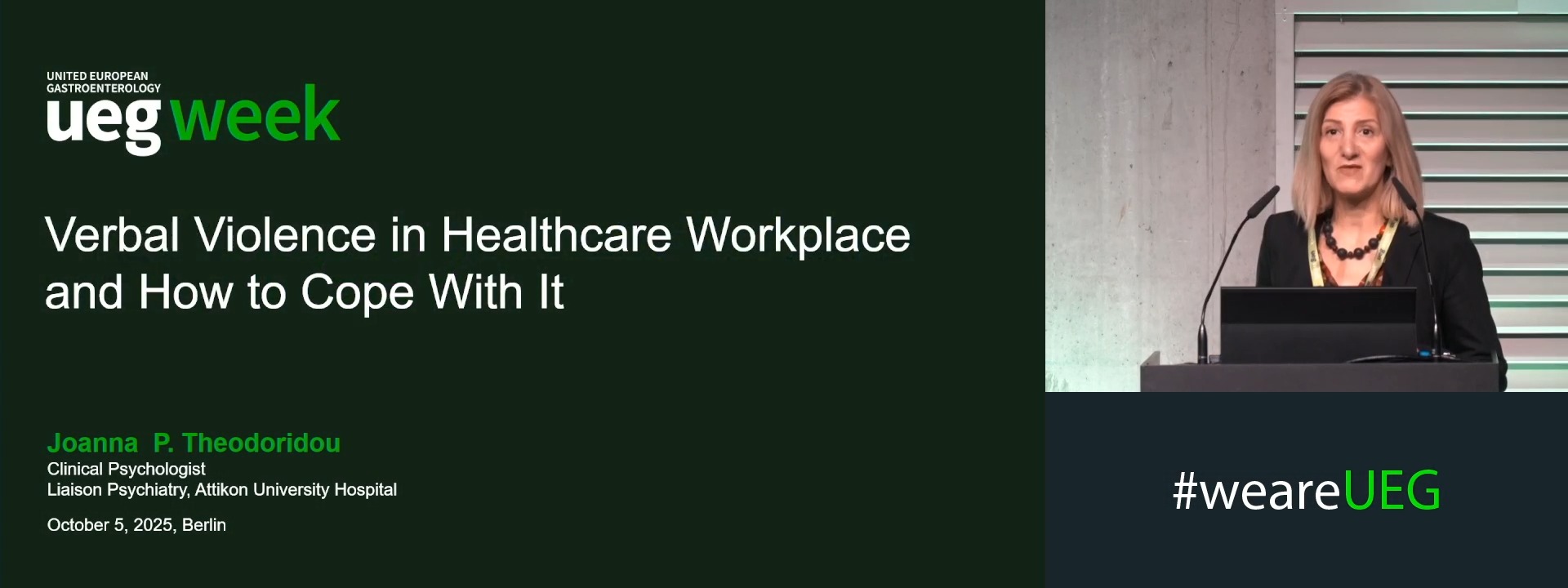
Verbal violence in the healthcare workplace and how to cope with it
1 None, None, Greece
Event
Topics
Session
Citation
Published

Log in to access this content.
Free for all myUEG account holders. Your access level is set automatically based on your occupation. Medical professionals get full access to all content. If you are a non-medical user, you can only access UEG Week content from congresses you attended.
Not sure what you can access? Learn more about account types.
GUT MICROBIOTA COMPOSITION AND ARTERIAL HYPERTENSION IN METABOLIC SYNDROME: THE ROLE OF ENTEROCLOSTER AND MICROBIALLY CONJUGATED BILE ACIDS
Raffaella Gadaleta 1, LUCILLA CRUDELE 1, Marica Cariello 1, Carlo De Matteis 1, Marilidia Piglionica 1, Maria Arconzo 1, Silvia Cultrera 1, Marilina Florio 1, Angela Fulvia Tricase 1, Antonio Moschetta 2
1 University Of Bari "Aldo Moro", Bari, Italy
2 University of Bari "Aldo Moro", Bari, Italy
Event
Topics
Submission format
Citation
Published
Log in to access this content.
Free for all myUEG account holders. Your access level is set automatically based on your occupation. Medical professionals get full access to all content. If you are a non-medical user, you can only access UEG Week content from congresses you attended.
Not sure what you can access? Learn more about account types.
PRE-PROCEDURAL SCREENING FOR MULTIDRUG-RESISTANT ORGANISMS IN ENDOSCOPIC RETROGRADE CHOLANGIOPANCREATOGRAPHY: A MULTICENTER INTERNATIONAL STUDY TO GUIDE PREVENTIVE PROTOCOLS SK
Koen van der Ploeg 1, Margreet C. Vos 2, Hardik Rughwani 3, Juliëtte A. Severin 2, D. Nageshwar Reddy 3, Sadhana Yelamanchili Veturi 3, Mitnala Sasikala 3, Sana Fathima Memon 3, Alessandro Repici 4, Marco Spadaccini 5, Matteo Colombo 4, Marta Andreozzi 4, Bryan A. Stevens 6, Rohit Das 6, Adam Slivka 6, Bibi C.G.C. Mason-Slingerland 2, Marco J. Bruno 2
1 Eramus University Medical Centre, Rotterdam, Netherlands|||Eramus University Medical Centre, Rotterdam, Netherlands
2 Eramus University Medical Centre, Rotterdam, Netherlands
3 Aig Hospitals, Hyderabad, India
4 Ist. Clinico Humanitas Rozzano Dept. of Gastroenterology, Milano, Italy
5 Humanitas University, Rozzano, Italy
6 University of Pittsburgh Medical Center, Pittsburgh, United States
Conference
Topics
Submission format
Citation
Published
Log in to access this content.
Free for all myUEG account holders. Your access level is set automatically based on your occupation. Medical professionals get full access to all content. If you are a non-medical user, you can only access UEG Week content from congresses you attended.
Not sure what you can access? Learn more about account types.
PREDICTIVE VALUE OF RECTAL AND THROAT-NOSE SCREENING FOR THE PRESENCE OF MULTIDRUG-RESISTANT ORGANISMS IN DUODENAL FLUID AS A RISK OF DUODENOSCOPE CONTAMINATION: A MULTICENTER STUDY
Koen van der Ploeg 1, Saskia H.J. Renkens 2, Margreet C. Vos 2, Bibi C.G.C. Mason-Slingerland 2, Corné H.W. Klaassen 2, Hardik Rughwani 3, D. Nageshwar Reddy 3, Sadhana Yelamanchili Veturi 3, Mitnala Sasikala 3, Sana Fathima Memon 3, Marco J. Bruno 2, Juliëtte A. Severin 2
1 Eramus University Medical Centre, Rotterdam, Netherlands|||Eramus University Medical Centre, Rotterdam, Netherlands
2 Eramus University Medical Centre, Rotterdam, Netherlands
3 Aig Hospitals, Hyderabad, India
Conference
Topics
Submission format
Citation
Published
Log in to access this content.
Free for all myUEG account holders. Your access level is set automatically based on your occupation. Medical professionals get full access to all content. If you are a non-medical user, you can only access UEG Week content from congresses you attended.
Not sure what you can access? Learn more about account types.
EFFECTIVENESS OF VONOPRAZAN ON SYMPTOM RELIEF IN CHINESE PATIENTS WITH GASTROESOPHAGEAL REFLUX DISEASE: POST HOC ANALYSIS OF THE VIEW STUDY
1 The First Affiliated Hospital, Sun Yat-Sen University, Guangzhou, China
2 Lanzhou University Second Hospital, Lanzhou, China
3 Jiangxi Provincial People's Hospital, Nanchang, China
4 Takeda Pharmaceutical Company, Shanghai, China
Conference
Topics
Submission format
Citation
Published
Log in to access this content.
Free for all myUEG account holders. Your access level is set automatically based on your occupation. Medical professionals get full access to all content. If you are a non-medical user, you can only access UEG Week content from congresses you attended.
Not sure what you can access? Learn more about account types.
BRIDGING ENDOCRINE AND GUT AUTOIMMUNITY: FROM POPULATION TO PROTEOME IN GRAVES’ DISEASE–ULCERATIVE COLITIS COMORBIDITY
1 The First Hospital of Jilin University, Changchun, China
Conference
Topics
Submission format
Session