Introduction
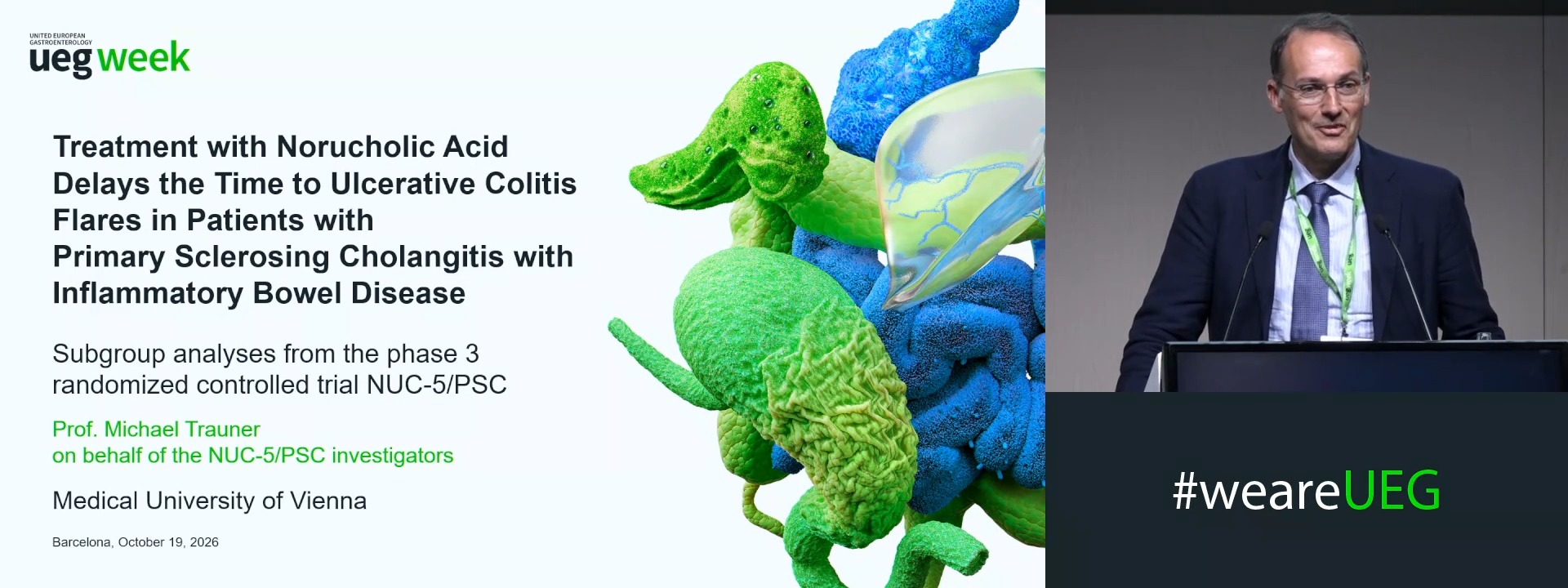
Primary sclerosing cholangitis (PSC) is strongly associated with inflammatory bowel disease (IBD). The phase 3 NUC-5/PSC trial in PSC demonstrated superiority of the semi-synthetic bile acid norucholic acid (NCA) over placebo in stabilization of liver histology and reduction in alkaline phosphatase (ALP). In preclinical models, potentially beneficial effects of NCA have also been observed on IBD activity. Here, we report the efficacy of NCA on the IBD component of PSC.
Aims & Methods
NUC-5/PSC was a randomized, placebo-controlled trial enrolling adults with large-duct PSC (NCT03872921). Treatment duration was 192 weeks, with the primary analysis at week 96. Patients with IBD were eligible to enroll, provided that Crohn’s disease (CD) was in remission (defined by a CD Activity Index [CDAI] <150), or that ulcerative colitis (UC) activity was mild or in remission (Clinical Activity Index [CAI] <8). IBD medications other than 5-aminosalicylates or probiotics were prohibited during the trial. The combined primary endpoint was no worsening in Ludwig histologic stage with reduction in ALP to <1.5x upper limit of normal at week 96. IBD activity was recorded every 3 months by colitis-related adverse events (acute flares, captured using the MeDRA Preferred Terms of “colitis”, “colitis ulcerative”, and “acute haemorrhagic ulcerative colitis") as well as by CAI or CDAI scores.
Results
A total of 205 patients were randomized to treatment with NCA and 96 to placebo. Overall, 66.8% of NCA patients and 58.3% of placebo patients in the trial had concomitant IBD. UC patients comprised 59.5% (NCA) and 52.1% (placebo) of the total population, with (mildly) active disease in 32.7% of all NCA patients and 26.0% of all placebo patients at baseline. Mesalazine was taken by 48.8% of NCA patients and 50.0% of placebo patients at trial entry. Mean baseline CAI scores were 1.5 and 1.2 among NCA and placebo patients with UC, while mean baseline CDAI scores were 59.3 and 56.6, respectively.
Among patients with UC, 13.9% of NCA patients and 30.0% of placebo patients experienced at least one colitis-related event by week 96. The time to first colitis event was significantly longer for patients receiving NCA than placebo (hazard ratio 0.35, p=0.004). There were no meaningful changes in CAI or CDAI in either treatment arm from baseline to week 96. Among patients with IBD at baseline, 13.9% receiving NCA versus 7.1% receiving placebo achieved the primary endpoint compared with 17.6% versus 0% among patients without IBD. No worsening in Ludwig histologic stage was observed in 54.0% of NCA patients versus 37.5% of placebo patients with IBD (p=0.021), compared with 60.3% versus 32.5% of patients without IBD, respectively (p=0.091). Fewer than 5% of patients in either arm received biologics for IBD during the course of the trial. There was one case (0.5%) of proctocolectomy in the NCA arm, and one (1.0%) patient in the placebo arm discontinued the trial due to exacerbation in IBD activity.
Conclusion
NCA delayed the time to first colitis event in PSC patients. A lower proportions of patients receiving NCA than placebo experienced flares of IBD despite a higher baseline rate of mildly active UC in the NCA arm. Rates of IBD progression and treatment escalation in both treatment arms were low. Similar proportions of NCA patients with and without IBD achieved the primary endpoint, thereby confirming the results of the primary analysis.
Disclosure
PT has received lecture fees from Advanz/Intercept, Albireo/Ipsen, Dr. Falk Pharma, Perspectum Ltd. and Zambon; consulting fees from Advanz/Intercept, Albireo/Ipsen, Chemomab, Cymabay/Gilead, Dr. Falk Pharma, GSK, Kowa, Mirum, and Pliant; and grant support from Bristol Myers Squibb, Core (Guts UK), EASL, Gilead Sciences, GSK, Intercept, Ipsen, LifeArc, Medical Research Foundation (UK), Mirum, NIHR, PSC Support, Regeneron and The Wellcome Trust. GD has received speaking fees from AbbVie, Advanz, Alfasigma, Falk Foundation, Gilead, Intercept, Ipsen, Novartis, Orphalan, consulting fees from Advanz, Alexion, Böhringer, Intercept, Ipsen, Novartis, Orphalan, Univar. MiD has received speaking fees from Roche, travel support from AstraZeneca, Falk Foundation, and has participated in data safety boards for AstraZeneca, Eisai. KKJ has recieved speaking fees from Norgine and BMS, consulting fees from Falk and NovoNordisk, travel grants from CSL Vifor and Celltrion, and has provided expert testimony for IPSEN. MüD has received speaking or consulting fees from Boehringer, Gilead, Opella, GSK, Ipsen, Echosens, Abbvie, Advanz, Ipsen, Falk, Merz, AstraZeneca, Madrigal, Novo Nordisk. CS has received grant support from Moonlake, Galapagos, consulting fees from Agomab, Amgen, Chemomab, Moonlake, Pliant, Mirum, speaking fees from Falk, Gilead. AEK is an advisor for AbbVie, Alentis, Alfasigma, Astellas, AstraZeneca, Attovia, Avior Bio, Bristol Myers Squibb, Böhringer-Ingelheim, Curatis, Dr. Falk Pharma, Gilead Sciences, GSK, Guidepoint, Ipsen, Mirum, Merck Sharp & Dohme, Novo Nordisk, Roche, and Takeda. UB has received speaking or consulting fees from Abacus, Amgen, Behring, GSK, Ipsen, Mirum, Ono. EH has received speaking or consulting fees from IPSEN, Intercept, Dr. Falk Pharma, Gilead. MP, GC, and MS are employees of Dr. Falk Pharma GmbH. PS has received consulting fees and research grants from Dr. Falk Pharma GmbH. MT has received grant support from Albireo, Alnylam, Cymabay, Falk, Genentech, Gilead, Intercept, MSD, Takeda and UltraGenyx, consulting fees from AbbVie, Albireo, Agomab, Boehringer Ingelheim, BiomX, Chemomab, Dexoligo Therapeutics, Falk, Genfit, Gilead, GSK, Hightide, Intercept, Ipsen, Janssen, Mirum; MSD, Novartis, Phenex, Pliant, ProQR Therapeutics, Regulus, Siemens and Shire, speaking fees from Albireo, Boehringer Ingelheim, Bristol-Myers Squibb, Falk, Gilead, Ipsen, Intercept, MSD and Madrigal, and travel support from AbbVie, Falk, Gilead, Janssen and Intercept, Ipsen and Janssen. He is also co-inventor of patents (service invention) on the medical use of 24-norursodeoxycholic acid filed by the Medical University of Graz. The remaining authors disclose no conflicts of interest.