UEG's educational platform for gastroenterology education bringing recordings, courses, guidelines, and more together in one place.
Most popular content
Rate for better recommendations!
Your feedback helps us show you more of what you like and less of what you dislike!
Log in to access this content.
Free for all myUEG account holders. Your access level is set automatically based on your occupation. Medical professionals get full access to all content. If you are a non-medical user, you can only access UEG Week content from congresses you attended.
Not sure what you can access? Learn more about account types.

SAFETY OF FILGOTINIB IN CROHN’S DISEASE COMPARED WITH ULCERATIVE COLITIS: DATA FROM THE PHASE 3 DIVERSITY1 AND PHASE 2B/3 SELECTION STUDIES
Stefan Schreiber 1, Severine Vermeire 2, David T. Rubin 3, Silvio Danese 4, Rajiv Mehta 5, Xavier Roblin 6, Paul Kwon 7, Paul Van Hoek 8, Tomasz Masior 9, Rahul Barron 9, Franck-Olivier Le Brun 9, Mamoru Watanabe 10
1 University Hospital Schleswig-Holstein, Kiel, Germany
2 UZ Leuven, Leuven, Belgium
3 University of Chicago Medicine, Chicago, United States
4 IRCCS Hospital San Raffaele, Milan, Italy|||Vita-Salute San Raffaele University, Milan, Italy
5 Surat Institute of Digestive Sciences Hospital, Surat, India
6 University Hospital of Saint-Étienne, Saint-Étienne, France
7 Gilead Sciences Inc., Foster City, United States
8 Galapagos NV, Mechelen, Belgium
9 Galapagos GmbH, Basel, Switzerland
10 Tokyo Medical and Dental University, Tokyo, Japan
Conference
Topics
Submission format
Citation
Published
Log in to access this content.
Free for all myUEG account holders. Your access level is set automatically based on your occupation. Medical professionals get full access to all content. If you are a non-medical user, you can only access UEG Week content from congresses you attended.
Not sure what you can access? Learn more about account types.
Log in to access this content.
Free for all myUEG account holders. Your access level is set automatically based on your occupation. Medical professionals get full access to all content. If you are a non-medical user, you can only access UEG Week content from congresses you attended.
Not sure what you can access? Learn more about account types.
Best practises for caring for LGBTQ+ people in GI with Alexander Goldowsky (rewind)
Published
Log in to access this content.
Free for all myUEG account holders. Your access level is set automatically based on your occupation. Medical professionals get full access to all content. If you are a non-medical user, you can only access UEG Week content from congresses you attended.
Not sure what you can access? Learn more about account types.
Transitional care with Patrizia Burra & Jorge Amil Dias
Topics
Published
Log in to access this content.
Free for all myUEG account holders. Your access level is set automatically based on your occupation. Medical professionals get full access to all content. If you are a non-medical user, you can only access UEG Week content from congresses you attended.
Not sure what you can access? Learn more about account types.
Best practises for caring for LGBTQ+ people in GI with Alexander Goldowsky
Published
Log in to access this content.
Free for all myUEG account holders. Your access level is set automatically based on your occupation. Medical professionals get full access to all content. If you are a non-medical user, you can only access UEG Week content from congresses you attended.
Not sure what you can access? Learn more about account types.
Introduction
Therapeutic management of acute biliary pancreatitis (ABP) includes endoscopic sphincterotomy and cholecystectomy. However, the optimal feeding strategy prior to cholecystectomy—early oral intake or exclusive enteral nutrition—remains debated, particularly given the risk of recurrent biliary events (BEs) before surgery, especially when surgery is delayed.
Aims & Methods
The primary objective was to evaluate the likehood of BEs (biliary colic/migration, stone impaction, cholangitis, recurrent acute pancreatitis, and acute cholecystitis) prior to cholecystectomy, comparing feeding methods: oral vs. exclusive enteral nutrition. The secondary objective was to evaluate cholecystectomy rates during the initial hospitalization and the reasons for non-performance. Data were collected during hospitalization, at 3 months, and at 6 months if surgery had not been performed by month 3. BEs and feeding modalities at those times were documented. Analyses included Cox models and Chi-square tests.
Results
From October 2022 to December 2023, 1,172 patients with ABP were prospectively enrolled by 60 French hospitals, with 1,167 included in the final analysis. Sixty patients (5%) were lost to follow-up, and 34 deaths (3%) were reported. Severe ABP was observed in 27.2% (n=317) of patients. After 48–72 hours, oral feeding was resumed in 62% (n=724), enteral feeding in 16% (n=192), and fasting/parenteral feeding in 21% (n=249). During follow-up, 236 BEs occurred in 172 patients, meaning 15.5% experienced at least one event, with a median onset time of 26 days (range: 9–57 days). Specifically, 6% had at least one episode of biliary colic/migration, 2.1% experienced stone impaction, 2.3% developed cholangitis, 6.1% had recurrent AP (9% of which were severe), and 1.6% developed acute cholecystitis.
Univariate analysis identified several factors associated with a higher risk of BE recurrence (p < 0.10): age ≥52 years (p=0.093), obesity (BMI ≥30, p=0.032), ASA score >2 (p=0.097), total bilirubin ≥60 µmol/L (p=0.010), CRP >150 mg/L, diagnostic delay ≥21 days (p=0.009), and prior sphincterotomy (p=0.136). No difference in BE incidence was observed between severe and non-severe ABP (p=0.497) when analyzing the first 172 BEs.
Over the full follow-up period, despite the 87 BEs analyzed and potential biases, there remained no significant association between nutrition type (oral vs. exclusive enteral nutrition ) and the likelihood of BE occurrence (p=0.447).
In patients with non-severe ABP, cholecystectomy was performed during the initial hospitalization in only 33% of cases. The main reasons for non-performance were structural (e.g., lack of availability or surgeon refusal), accounting for 45% of cases.
Conclusion
BEs are frequent and clinically relevant: 15.5% of patients experienced at least one before surgery, with 6% developing recurrent ABP (9% of which were severe). Cholecystectomy remains underutilized; only one-third of patients with non-severe ABP underwent it during their initial stay, often due to modifiable reasons. Neither ABP severity nor nutritional type-oral vs enteral nutrition (despite potential biases, missing data, and ongoing analysis)-appeared to be associated with the occurrence of BEs prior to surgery. Early cholecystectomy, when possible, remains the only reliable strategy for preventing BEs.
Disclosure
This study received a research grant from Fresenius Kabi.
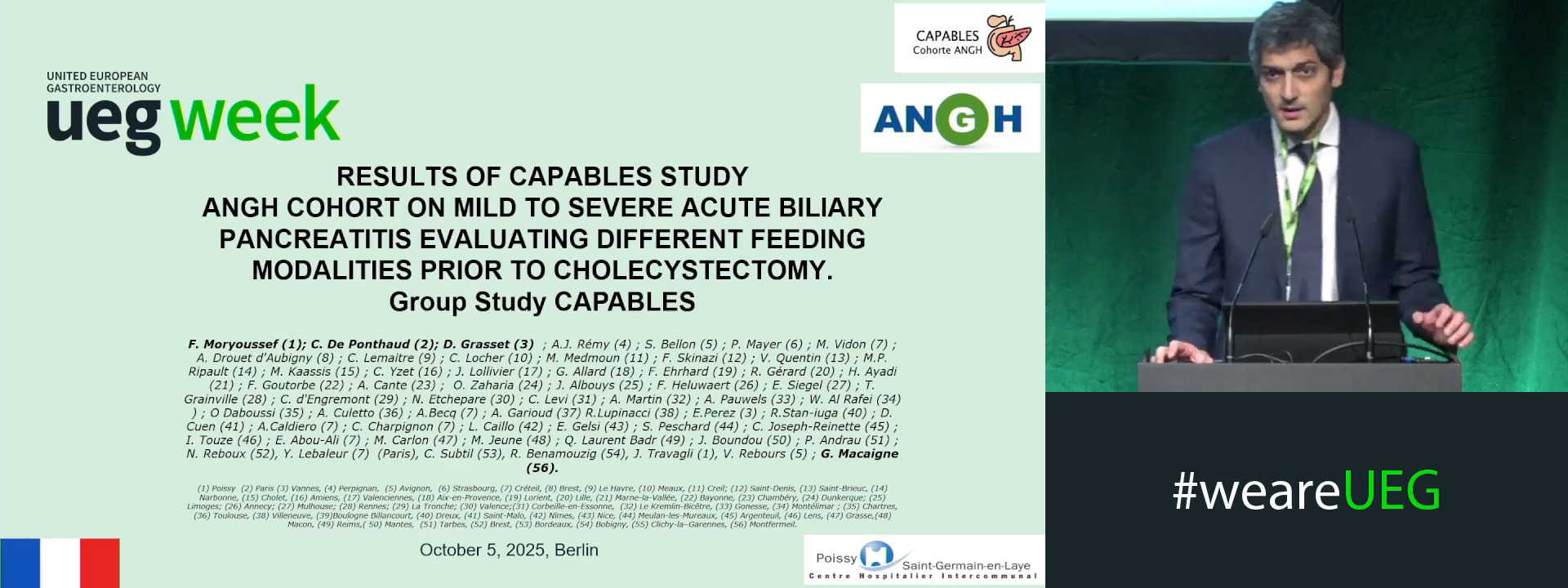
RESULTS OF THE ANGH COHORT ON MILD TO SEVERE ACUTE BILIARY PANCREATITIS (CAPABLES): EVALUATING DIFFERENT FEEDING MODALITIES PRIOR TO CHOLECYSTECTOMY
Frederick Moryoussef 1, Charles De Ponthaud 2, Denis Grasset 3, ANDRE JEAN REMY 4, Serge Bellon 5, Pierre Mayer 6, Mathias Vidon 7, Augustin Drouet D'Aubigny 8, Caroline Lemaitre 9, christophe locher 10, Mourad MEDMOUN 11, Florence Skinazi 12, vincent quentin 13, Marie-Pierre Ripault 14, Mehdi Kaassis 15, Clara Yzet 16, Julien Lollivier 17, Guillaume Allard 18, Florent Ehrard 19, Romain Gerard 20, Hend Ayadi 21, Félix GOUTORBE 22, Gaelle Boudoux d'Hautefeuille 23, Oana Maria Zaharia 24, Jeremie Albouys 25, Frédéric HELUWAERT 26, Emily Siegel 27, Thomas Grainville 28, Christelle d'Engremont 29, Nicolas Etchepare 30, Cristina Levi 31, Antoine Martin 32, Gabriela Chitic 33, Wasim Al Rafei 34, Oussama Daboussi 35, Adrian Culetto 36, Aymeric Becq 37, Armand Garioud 38, Renato Micelli Lupinacci 39, Enrique Perez 40, Roxana Stan Iuga 41, David Cuen 42, Anthony Caldiero 43, Claire Charpignon 44, Ludovic Caillo 45, Eve Gelsi 46, Sylvie Peschard 47, Julia Travagli 1, Vinciane Rebours 48, gilles macaigne 49
1 CH Poissy-Saint-Germain-En-Laye, Poissy, France
2 Pitie Salpétrière University Hospital, Paris, France
3 CHBA Service de Gastroentérologie, Vannes, France
4 CH Perpignan, Perpignan, France
5 Centre Hospitalier d'Avignon Henri Duffaut, Perpignan, France
6 Hepato-gastroenterology, Strasbourg, France
7 Centre Hospitalier Intercommunal de Creteil, Creteil, France
8 CH Cornouaille, Quimper, France
9 CH Le havre, Le Havre, France
10 CH Meaux, Meaux, France
11 CH Creil, Creil, France
12 CH Delafontaine, Saint Denis, France
13 Y Le Foll, Saint Brieuc, France
14 CH Narbonne, Narbonne, France
15 CH DE CHOLET, Cholet Cedex, France
16 Amiens univerisity hospital, Amiens, France
17 CH Valenciennes, Valenciennes, France
18 CH Aix-en-provence, Aix-en-provence, France
19 CH Lorient, Lorient, France
20 Inserm, Lille, France
21 CH Marne-la-vallée, Marne-la-vallée, France
22 CH Cote basque, Bayonne, France
23 CH Mteropole Savoie, Aix-les-bains, France
24 CH Dunkerque, Dunkerque, France
25 CHU Limoges / University of Limoges, Limoges, France
26 CH Annecy, Annecy, France
27 CH Mulhouse, Mulhouse, France
28 CHU Rennes, Rennes, France
29 Grenoble University Hospital, Grenoble, France
30 CH Valence, Valence, France
31 CH sud-francilien, Corbeilles-en-Essone, France
32 Kremlin Bicetre University Hospital, Kremlin Bicetre, France
33 CH Gonesse, Gonesse, France
34 CH Portes de Provencd, Montelimar, France
35 CH Chartres, Chartes, France
36 University Hospital Le Rangueuil, Toulouse, France
37 Mondor University Hospital, Creteil, France
38 CH Villeneuve-saint-georges, Villeneuve, France
39 Ambroise Paré University Hospital, Boulogne Billancourt, France
40 University Hospital Georges Pompidou, Paris, France
41 CH Dreux, Dreux, France
42 CH Saint-malo, Saint-malo, France
43 Tenon University Hospital, Paris, France
44 Montsouris Institute, Paris, France
45 CHU DE NIMES, Nîmes, France
46 Nice University Hospital, Nice, France
47 CH Meulan, Meulan-les-mureaux, France
48 Hopital Beaujon, Clichy, France
49 CH Montfermeil, Montfermeil, France
Event
Topics
Submission format
Citation
Published
Log in to access this content.
Free for all myUEG account holders. Your access level is set automatically based on your occupation. Medical professionals get full access to all content. If you are a non-medical user, you can only access UEG Week content from congresses you attended.
Not sure what you can access? Learn more about account types.
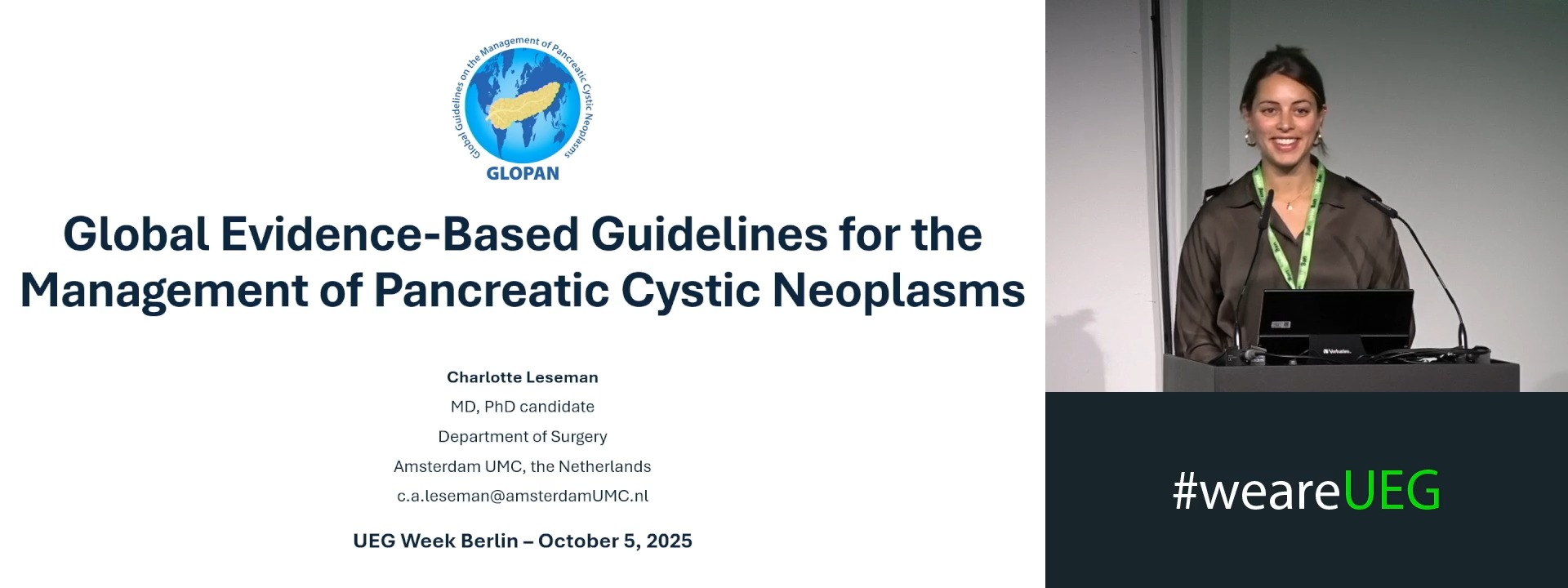
Breaking news in pancreatic care: The latest guidelines you can’t miss!
1 Amsterdam UMC, Amsterdam, Netherlands