UEG's content platform for gastroenterology education bringing recordings, courses, guidelines, and more together in one place.
Trending on Gutflix
Rate for better recommendations!
Your feedback helps us show you more of what you like and less of what you dislike!
Log in to continue.
This content is part of Gutflix. Log in with your myUEG account, or create one free, to watch it.
Not sure what you can access? Learn more about account types.
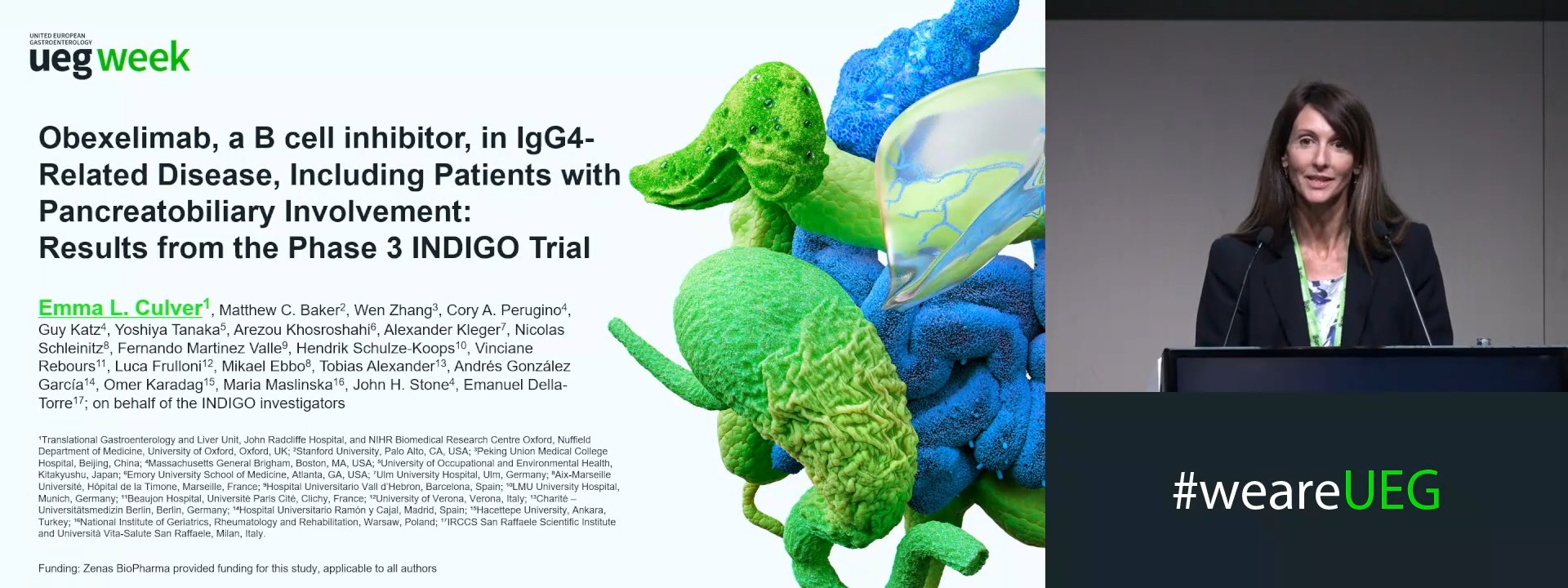
OBEXELIMAB, A B CELL INHIBITOR, IN IGG4-RELATED DISEASE, INCLUDING PATIENTS WITH PANCREATOBILIARY INVOLVEMENT: RESULTS FROM THE PHASE 3 INDIGO TRIAL
Emma Culver 1, Matthew C. Baker 2, Wen Zhang 3, Cory A. Perugino 4, Guy Katz 4, Yoshiya Tanaka 5, Arezou Khosroshahi 6, Alexander Kleger 7, nicolas schleinitz 8, Fernando Martinez-Valle 9, Hendrik Schulze-Koops 10, Shingo Nakayamada 11, Vinciane Rebours 12, Kazuichi Okazaki 13, Lingli Dong 14, Mollie Carruthers 15, Luke Y. C. Chen 16, Luca Frulloni 17, Alireza Meysami 18, Hiroki Takahashi 19, Mitsuhiro Kawano 20, Yanying Liu 21, Takako Saeki 22, Mikael Ebbo 8, Tobias Alexander 23, Andrés González-García 24, Omer Karadag 25, Maria Maslinska 26, Shauna Quinn 27, Allen Poma 27, Audrey Wells 27, Thomas J. Greene 27, John Stone 4, Emanuel della Torre 28
Affiliations
1 John Radcliffe Hospital, Oxford, Oxford, United Kingdom
2 Division of Immunology and Rheumatology, Department of Medicine, Stanford University, Palo Alto, CA, United States
3 Peking Union Medical College Hospital, Beijing, China
4 Division of Rheumatology, Inflammation, and Immunity, Massachusetts General Hospital, Boston, MA, United States
5 University of Occupational and Environmental Health, Miyagi, Japan
6 Emory University School of Medicine, Georgia, United States
7 Institute of Molecular Oncology and Stem Cell Biology, Ulm University Hospital, Ulm, Germany
8 Hôpital de La Timone, Internal Medicine Department, Marseille, France
9 Hospital Universitario Vall d’Hebron, Barcelona, Spain
10 Klinikum der Universität München, Munich, Germany
11 University of Occupational and Environmental Health, Kitakyushu, Japan
12 Hopital Beaujon, Clichy, France
13 Kansai Medical University Kori Hospital, Hirakata, Japan
14 Tongji Hospital, Tongji Medical College, Huazhong University of Science and Technology, Wuhan, China
15 Arthritis Research Canada, Vancouver, British Columbia, Canada
16 Dalhousie Medical School, Nova Scotia, Canada
17 Department of Medicine, the Pancreas Center, University of Verona, Verona, Italy
18 Henry Ford Health System, Michigan, USA; Wayne State University, Michigan, USA; Michigan State University, Michigan, United States
19 Sapporo Medical University, Sapporo, Japan
20 Kanazawa Medical University, Ishikawa, Japan
21 Beijing Friendship Hospital, Capital Medical University – PPDS, Beijing, China
22 Nagaoka Red Cross Hospital, Nagaoka, Japan
23 Charité – Universitätsmedizin Berlin, Department of Rheumatology and Clinical Immunology, German Rheumatism Research Center (DRFZ), Berlin, Germany
24 Hospital Universitario Ramón y Cajal, IRYCIS, Madrid, Spain
25 Hacettepe University, Department of Internal Medicine, Division of Rheumatology, Vasculitis Research Centre, Ankara, Türkiye
26 National Institute of Geriatrics, Rheumatology and Rehabilitation, Warsaw, Poland
27 Zenas BioPharma, Waltham, MA, United States
28 Università Vita-Salute San Raffaele, Milano, Italy
Log in to continue.
This content is part of Gutflix. Log in with your myUEG account, or create one free, to watch it.
Not sure what you can access? Learn more about account types.
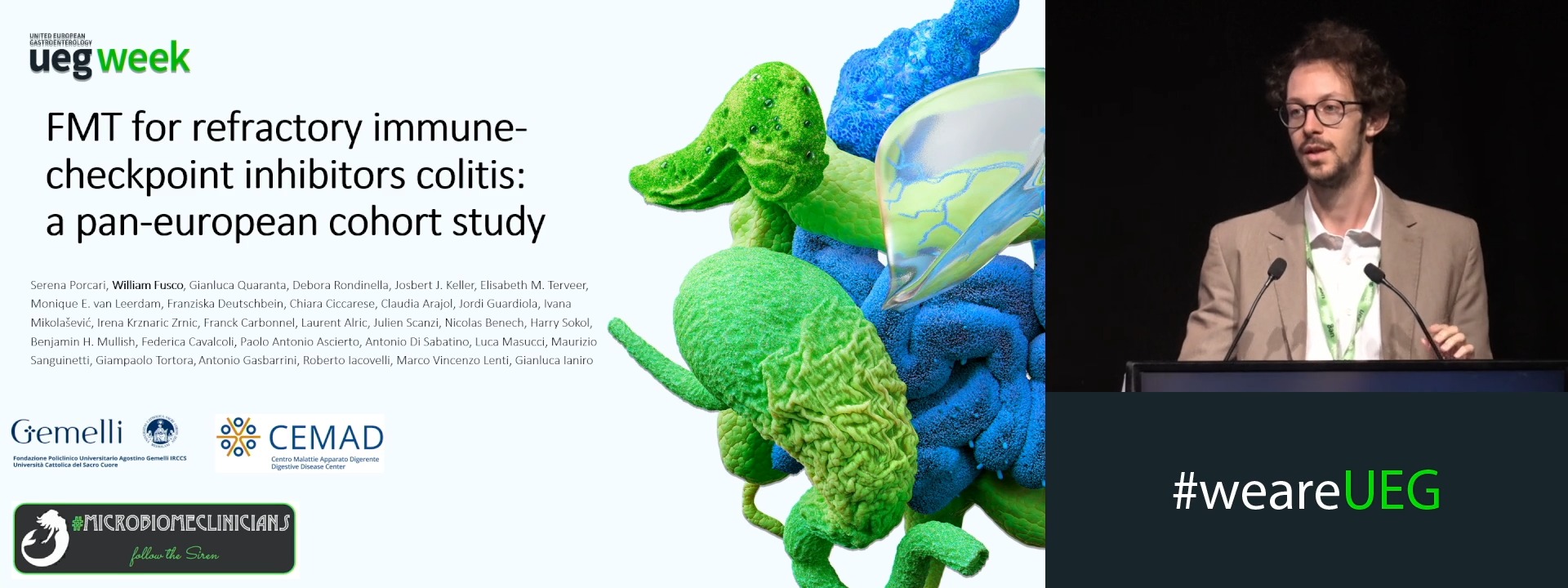
FECAL MICROBIOTA TRANSPLANTATION FOR REFRACTORY IMMUNE CHECKPOINT INHIBITOR-INDUCED COLITIS: A PAN-EUROPEAN COHORT STUDY
Serena Porcari 1, William Fusco 1, Gianluca Quaranta 1, Debora Rondinella 1, Josbert J. Keller 2, Liz Terveer 2, Monique van leerdam 2, Franziska Deutschbein 1, Chiara Ciccarese 1, Claudia Arajol 3, Jordi Guardiola 3, Ivana Mikolasevic 4, Irena Krznaric Zrnic 5, Franck Carbonnel 6, Laurent Alric 7, Julien Scanzi 8, Nicolas Benech 9, Harry Sokol 10, Bertrand Routy 11, Arielle Elkrief 11, Laurence Zitvogel 12, Benjamin H Mullish 13, Federica Cavalcoli 14, Paolo Antonio Ascierto 15, Antonio Di Sabatino 16, Luca Masucci 1, Maurizio Sanguinetti 1, Giampaolo Tortora 1, Antonio Gasbarrini 1, Roberto Iacovelli 1, Marco Vincenzo Lenti 16, Gianluca Ianiro 1
Affiliations
1 Università Cattolica del Sacro Cuore, Rome, Italy
2 Leiden University Medical Center, Leiden, Netherlands
3 Bellvitge University Hospital, Bellvitge, Spain
4 Clinical Hospital Centre Rijeka, Gastroenterology Department, Rijeka, Croatia
5 Clinical Hospital Centre Rijeka, Rijeka, Croatia
6 CHU Bicetre - Dept. de Hepato-Gastroenterologie, CHU Bicetre; Le Kremlin Bicetre/FR - Dept. de Hepat, Le Kremlin Bicetre, France
7 Rangueil Hospital, Toulouse, Toulouse, France
8 CHU de Clermont-Ferrand, Clermont-Ferrand, France
9 Hospices Civils de Lyon, Lyon, France
10 Saint-Antoine Hospital, Paris, France
11 Research Center of the Centre Hospitalier de l'Université de Montréal, Montréal, Canada
12 INSERM, U805, Villejuif, Paris, France
13 Imperial College London, London, United Kingdom
14 Fondazione IRCCS Istituto Nazionale dei Tumori, Milano, Italy
15 I.N.T. IRCCS Fondazione "G. Pascale", Naples, Italy
16 Fondazione IRCCS Policlinico San Matteo, University of Pavia, Pavia, Italy