UEG's educational platform for gastroenterology education bringing recordings, courses, guidelines, and more together in one place.
Most popular content
Rate for better recommendations!
Your feedback helps us show you more of what you like and less of what you dislike!
Log in to access this content.
Free for all myUEG account holders. Your access level is set automatically based on your occupation. Medical professionals get full access to all content. If you are a non-medical user, you can only access UEG Week content from congresses you attended.
Not sure what you can access? Learn more about account types.

EFFECTS OF SUBCUTANEOUS GUSELKUMAB INDUCTION AND MAINTENANCE ON HISTOLOGIC OUTCOMES IN PATIENTS WITH MODERATELY TO SEVERELY ACTIVE CROHN’S DISEASE IN GRAVITI, A PHASE 3 DOUBLE-BLIND, PLACEBO-CONTROLLED, TREAT-THROUGH STUDY
Geert R. D'Haens 1, Ailsa L Hart 2, Remo Panaccione 3, Flavio Steinwurz 4, Qian Cao 5, Mobolaji Olurinde 6, Leonardo Salese 6, Patrick Branigan 6, Wilbert van Duijnhoven 7, Natalie Terry 6, Silvio Danese 8, Tadakazu Hisamatsu 9, Bruce E. Sands 10
1 Amsterdam University Medical Centers, Amsterdam, Netherlands
2 London North-West University Healthcare NHS Trust, London, United Kingdom
3 University of Calgary, Calgary, Canada
4 Hospital Israelita Albert Einstein, São Paulo, Brazil
5 Sir Run Run Shaw Hospital Affiliated with School of Medicine, Zhejiang University, Hangzhou, China
6 Johnson & Johnson, Spring House, United States
7 Johnson & Johnson, Antwerp, Belgium
8 IRCCS Ospedale San Raffaele and University Vita-Salute San Raffaele, Milano, Italy
9 Kyorin University, Tokyo, Japan
10 Icahn School of Medicine at Mount Sinai, New York, United States
Conference
Topics
Submission format
Citation
Published
Log in to access this content.
Free for all myUEG account holders. Your access level is set automatically based on your occupation. Medical professionals get full access to all content. If you are a non-medical user, you can only access UEG Week content from congresses you attended.
Not sure what you can access? Learn more about account types.
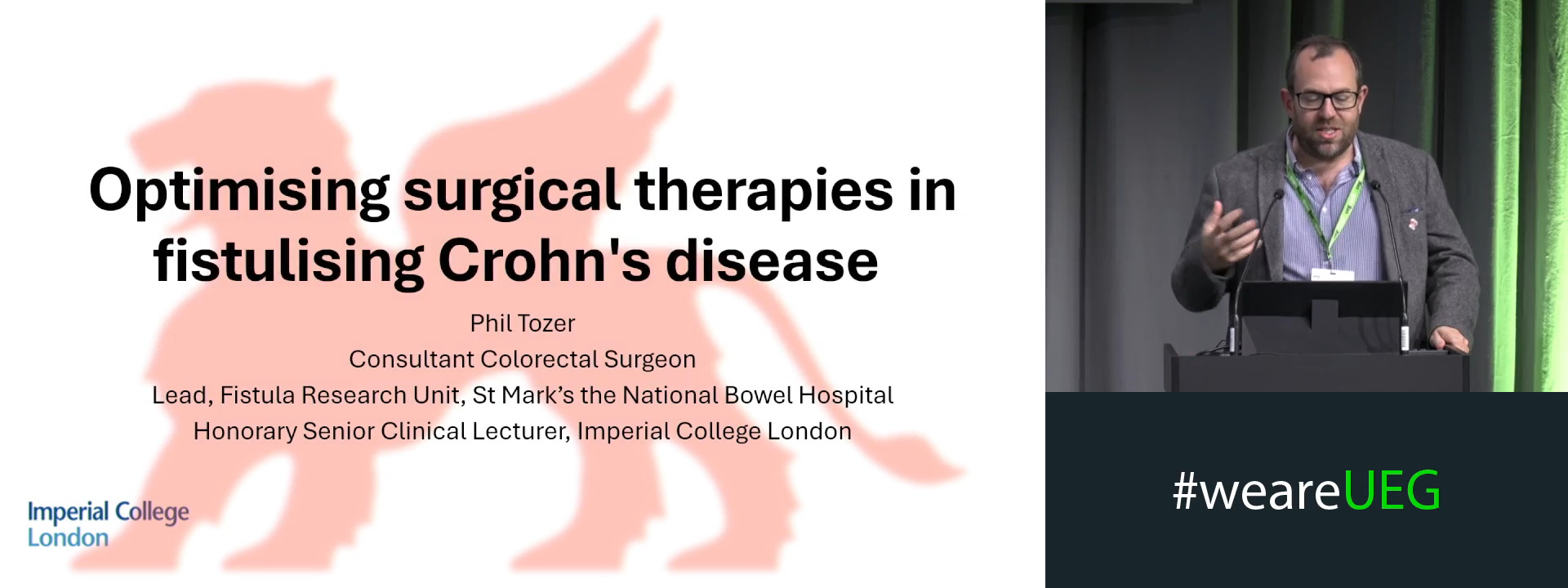
Optimising surgical therapies in fistulising Crohn's disease
1 St Marks Hospital, London, United Kingdom
Event
Citation
Published
Log in to access this content.
Free for all myUEG account holders. Your access level is set automatically based on your occupation. Medical professionals get full access to all content. If you are a non-medical user, you can only access UEG Week content from congresses you attended.
Not sure what you can access? Learn more about account types.
EFFICACY OF GUSELKUMAB IN MODERATELY TO SEVERELY ACTIVE ULCERATIVE COLITIS BY EXTENT OF DISEASE AND INFLAMMATORY BURDEN: SUBGROUP ANALYSIS OF THE PHASE 3 QUASAR MAINTENANCE STUDY
Jessica Allegretti 1, Tadakazu Hisamatsu 2, Brian Bressler 3, Laurent Peyrin-Biroulet 4, Matthew Germinaro 5, Shadi Yarandi 5, Nicole Shipitofsky 5, Ye Miao 5, Bruce E. Sands 6, David T. Rubin 7, Axel Dignass 8
1 Brigham and Women´s Hospital Crohn's and Colitis Center, Boston, United States
2 Kyorin University, Tokyo, Japan
3 University of British Columbia, Vancouver, Canada
4 Nancy University Hospital, Université de Lorraine, Nancy, France
5 Johnson & Johnson, Spring House, United States
6 Icahn School of Medicine at Mount Sinai, New York, United States
7 University of Chicago Medicine, Chicago, United States
8 Agaplesion Markus Hospital, Frankfurt, Germany
Conference
Topics
Submission format
Session
Citation
Published
Log in to access this content.
Free for all myUEG account holders. Your access level is set automatically based on your occupation. Medical professionals get full access to all content. If you are a non-medical user, you can only access UEG Week content from congresses you attended.
Not sure what you can access? Learn more about account types.
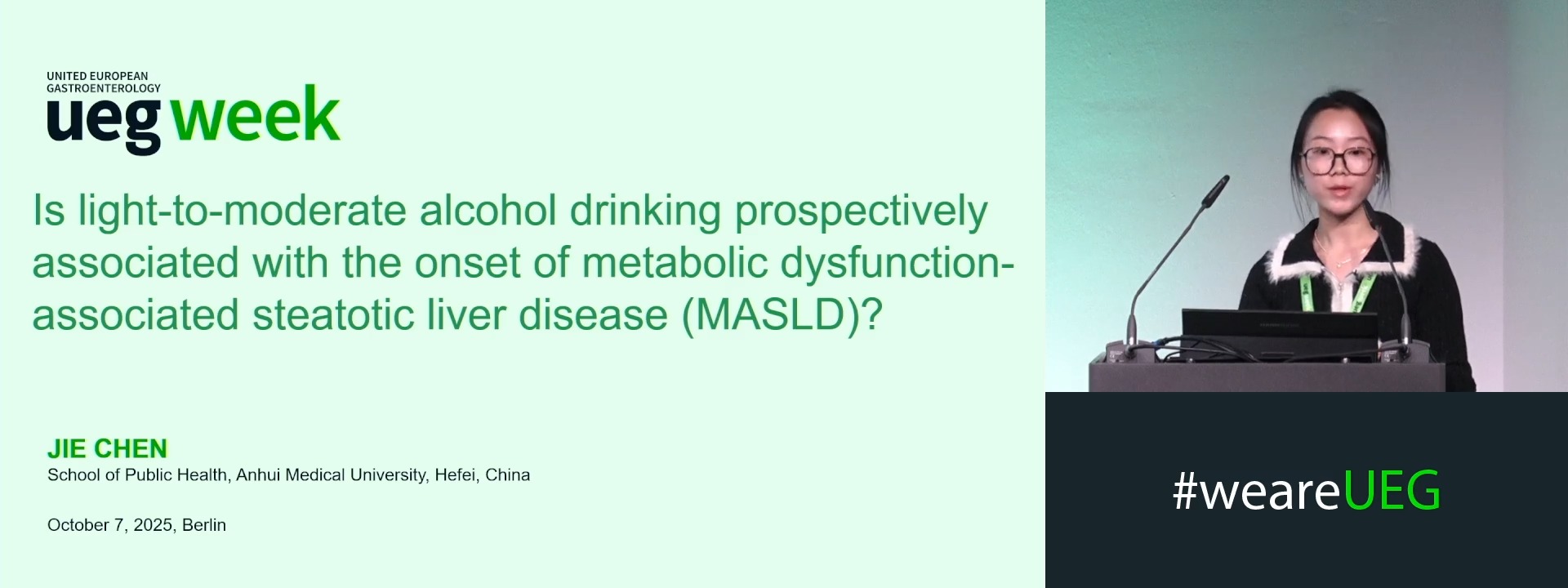
IS LIGHT TO MODERATE ALCOHOL DRINKING PROSPECTIVELY ASSOCIATED WITH THE ONSET OF METABOLIC DYSFUNCTION-ASSOCIATED STEATOTIC LIVER DISEASE?
Jie Chen 1, Yangxin Xu 1, Yu Chang 1, Qin Xinsheng 1, Hongjuan Cao 2, Zhuang Zhang 1, Wanshui Yang 1
1 Anhui Medical University, Hefei, China
2 Lu'an Municipal Center for Disease Control and Prevention, Lu'an, China
Event
Topics
Submission format
Citation
Published
Log in to access this content.
Free for all myUEG account holders. Your access level is set automatically based on your occupation. Medical professionals get full access to all content. If you are a non-medical user, you can only access UEG Week content from congresses you attended.
Not sure what you can access? Learn more about account types.
EVALUATION OF ENDOPLASMIC RETICULUM STRESS IN THE ILEAL POUCH MUCOSA OF PATIENTS WITH ULCERATIVE COLITIS COMPARED TO THE FAMILIAL ADENOMATOUS POLYPOSIS
Leandro Minatel Vidal de Negreiros 1, Lívia Bitencourt Pascoal 1, Lívia Moreira Genaro 1, Bruno Lima Rodrigues 1, Michel Gardere Camargo 1, Maria de Lourdes Setsuko Ayrizono 1, Raquel Franco Leal 1
1 University of Campinas (Unicamp), Campinas, Brazil
Conference
Topics
Submission format
Session
Citation
Published
Log in to access this content.
Free for all myUEG account holders. Your access level is set automatically based on your occupation. Medical professionals get full access to all content. If you are a non-medical user, you can only access UEG Week content from congresses you attended.
Not sure what you can access? Learn more about account types.
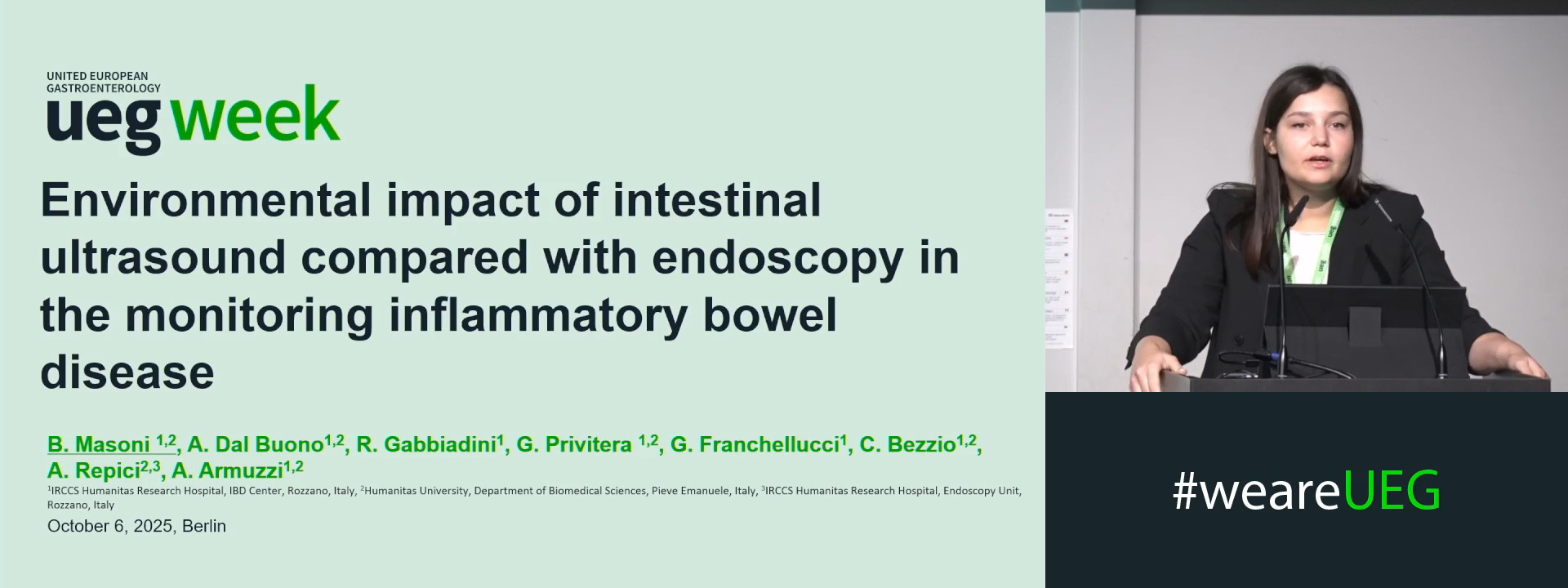
ENVIRONMENTAL IMPACT OF INTESTINAL ULTRASOUND COMPARED WITH ENDOSCOPY IN THE MONITORING OF INFLAMMATORY BOWEL DISEASE
Benedetta Masoni 1, Arianna Dal Buono 1, Roberto Gabbiadini 2, Giuseppe Privitera 1, gianluca franchellucci 2, Cristina Bezzio 1, Alessandro Repici 3, Alessandro Armuzzi 1
1 IRCCS Humanitas Research Hospital, Rozzano, Italy|||Humanitas University, Pieve Emanuele, Italy
2 IRCCS Humanitas Research Hospital, Rozzano, Italy
3 Humanitas University, Pieve Emanuele, Italy|||IRCCS Humanitas Research Hospital, Rozzano, Italy
Event
Topics
Submission format
Session
Citation
Published
Log in to access this content.
Free for all myUEG account holders. Your access level is set automatically based on your occupation. Medical professionals get full access to all content. If you are a non-medical user, you can only access UEG Week content from congresses you attended.
Not sure what you can access? Learn more about account types.
RELATIONSHIP BETWEEN CLINICAL AND HISTOLOGIC FINDINGS WITH TULISOKIBART INDUCTION AT WEEK 12 AND MAINTENANCE DOSING AT WEEK 50 IN THE PHASE 2 RANDOMIZED CONTROLLED ARTEMIS-UC STUDY IN PARTICIPANTS WITH ULCERATIVE COLITIS
Christopher Ma 1, Brigid S. Boland 2, Rupert Leong 3, Jaroslaw Leszczyszyn 4, Xavier Hebuterne 5, Zhi Jin Xu 6, Wen Zhou 6, Mark Yen 6
1 University of Caglary, Calgary, Canada
2 Altman Clinical Translational Research Institute, University of California, San Diego, United States
3 Macquarie University, Sydney, Australia
4 Melita Medical Center, Wroclaw, Poland
5 Hospital Archet 2, Nice, Nice, France
6 Merck & Co., Inc., Rahway, United States
Conference
Topics