UEG's content platform for gastroenterology education bringing recordings, courses, guidelines, and more together in one place.
Trending on Gutflix
Rate for better recommendations!
Your feedback helps us show you more of what you like and less of what you dislike!
Log in to continue.
This content is part of Gutflix. Log in with your myUEG account, or create one free, to watch it.
Not sure what you can access? Learn more about account types.
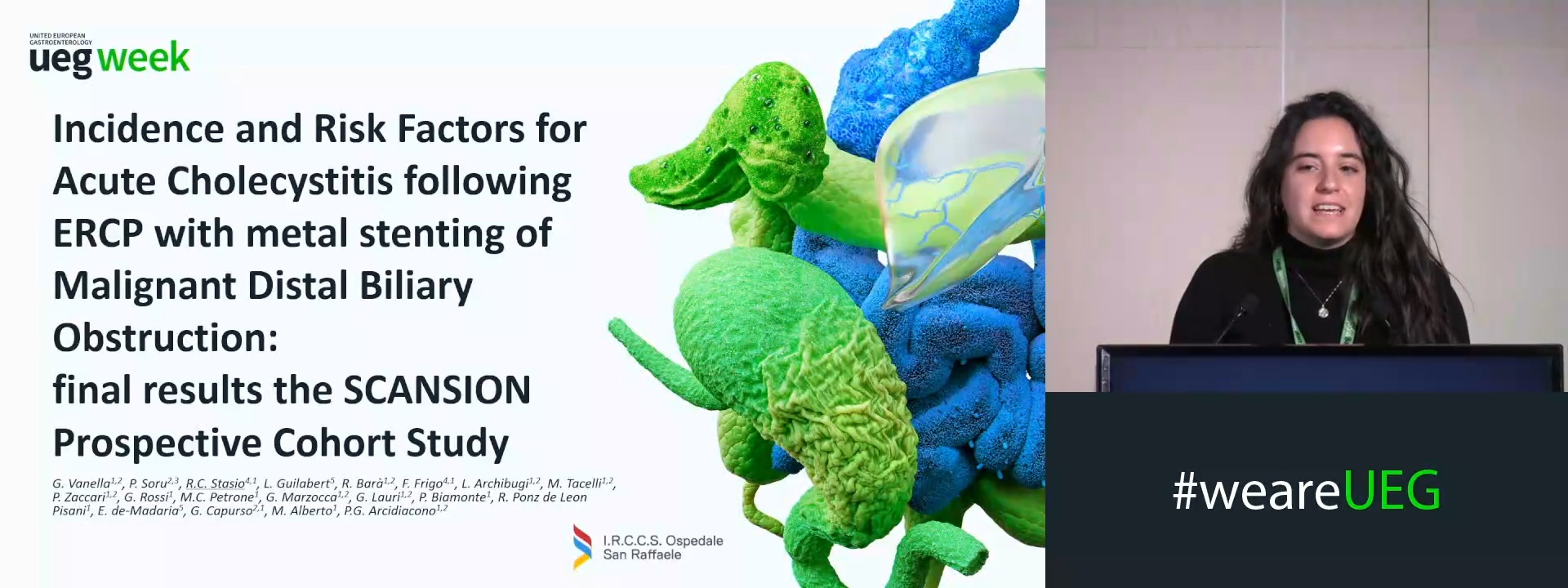
INCIDENCE AND RISK FACTORS FOR ACUTE CHOLECYSTITIS FOLLOWING ERCP WITH METAL STENTING OF MALIGNANT DISTAL BILIARY OBSTRUCTION: FINAL RESULTS THE SCANSION PROSPECTIVE COHORT STUDY
Giuseppe Vanella 1,2, Pietro Soru 2,3, Rosa Claudia Stasio 4,1, Lucía Guilabert 5, Rukaia Barà 1,2, Francesco Frigo 4,1, Livia Archibugi 1,2, Matteo Tacelli 1,2, Piera Zaccari 1,2, Gemma Rossi 1, Maria Chiara Petrone 1, Giuseppe Marzocca 1,2, Gaetano Lauri 1,2, Paolo Biamonte 1, Ruggero Ponz de Leon Pisani 1, Enrique de-Madaria 5, Gabriele Capurso 1,2, Mariani Alberto 1, Paolo Giorgio Arcidiacono 1,2
Affiliations
1 IRCCS San Raffaele Scientific Institute, Milan, Italy
2 Vita-Salute San Raffaele University, Milan, Italy
3 European Institute of Oncology, Milan, Italy
4 University of Turin, Turin, Italy
5 Dr. Balmis General University Hospital from Alicante, Alicante, Spain
Log in to continue.
This content is part of Gutflix. Log in with your myUEG account, or create one free, to watch it.
Not sure what you can access? Learn more about account types.
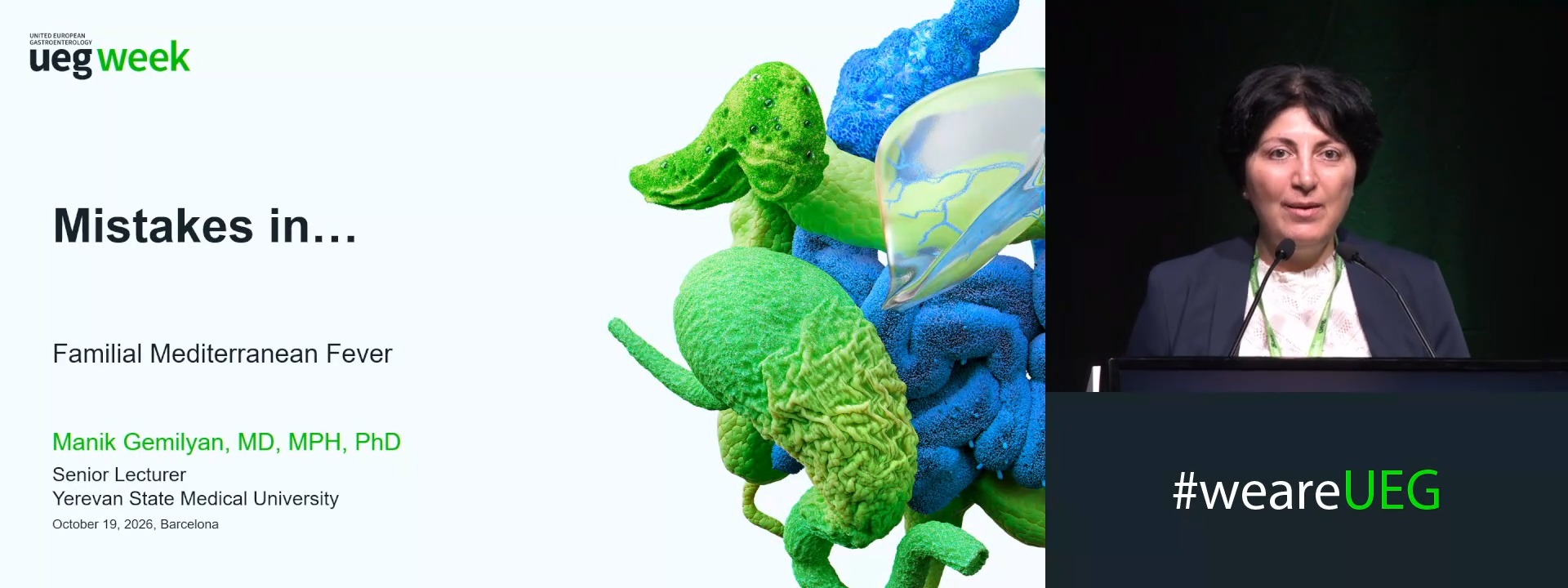
Familial Mediterranean fever
Affiliations
1 Yerevan State Medical University, Yerevan, Armenia
Log in to continue.
This content is part of Gutflix. Log in with your myUEG account, or create one free, to watch it.
Not sure what you can access? Learn more about account types.
Panel discussion: A 360° multidisciplinary approach to obesity and metabolic health