UEG's educational platform for gastroenterology education bringing recordings, courses, guidelines, and more together in one place.
Most popular content
Rate for better recommendations!
Your feedback helps us show you more of what you like and less of what you dislike!
Log in to access this content.
Free for all myUEG account holders. Your access level is set automatically based on your occupation. Medical professionals get full access to all content. If you are a non-medical user, you can only access UEG Week content from congresses you attended.
Not sure what you can access? Learn more about account types.
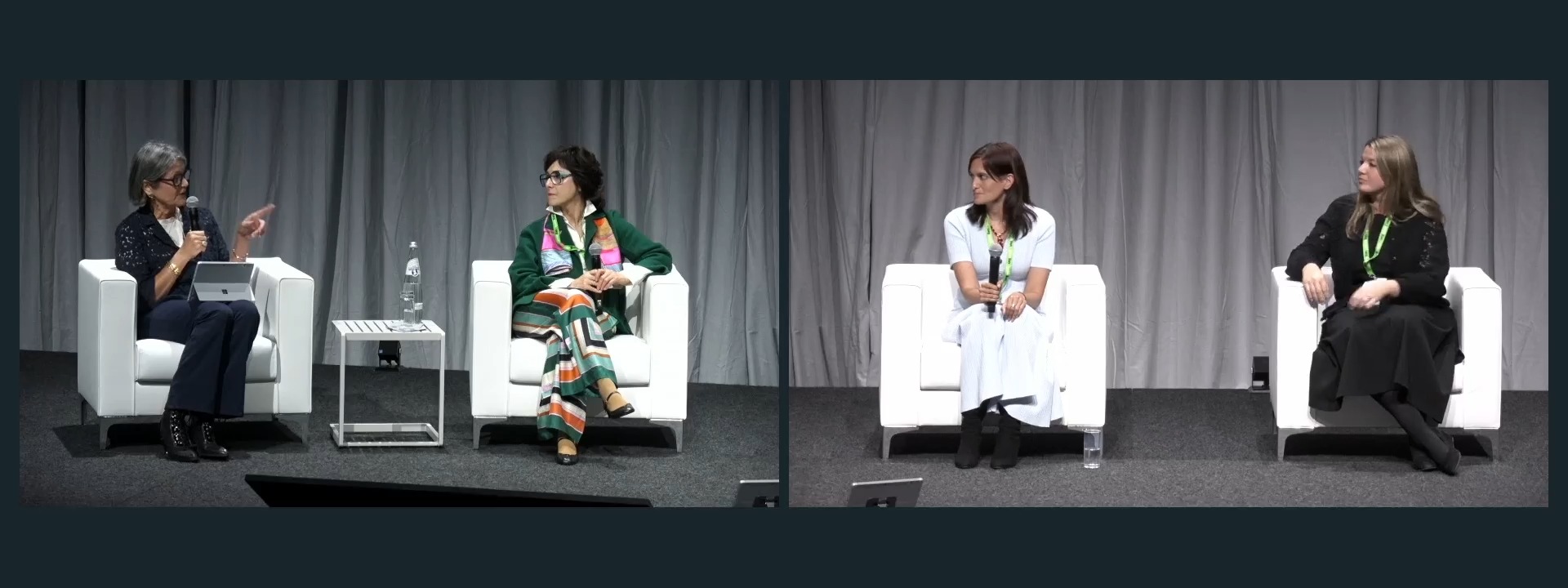
Panel discussion: Cancer and IBD - Mitigating risk among uncertainty
Event
Topics
Citation
Published
Log in to access this content.
Free for all myUEG account holders. Your access level is set automatically based on your occupation. Medical professionals get full access to all content. If you are a non-medical user, you can only access UEG Week content from congresses you attended.
Not sure what you can access? Learn more about account types.
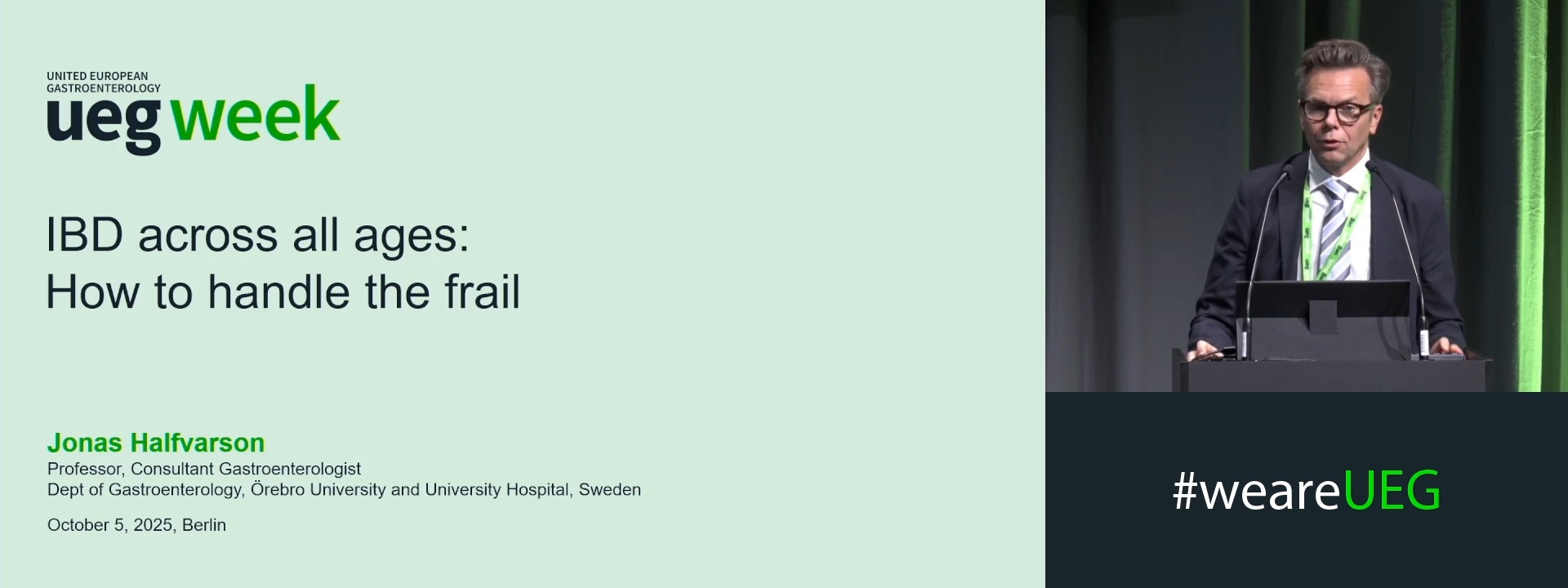
How to handle the frail
1 Örebro University, Örebro, Sweden
Event
Topics
Session
Citation
Published
Log in to access this content.
Free for all myUEG account holders. Your access level is set automatically based on your occupation. Medical professionals get full access to all content. If you are a non-medical user, you can only access UEG Week content from congresses you attended.
Not sure what you can access? Learn more about account types.
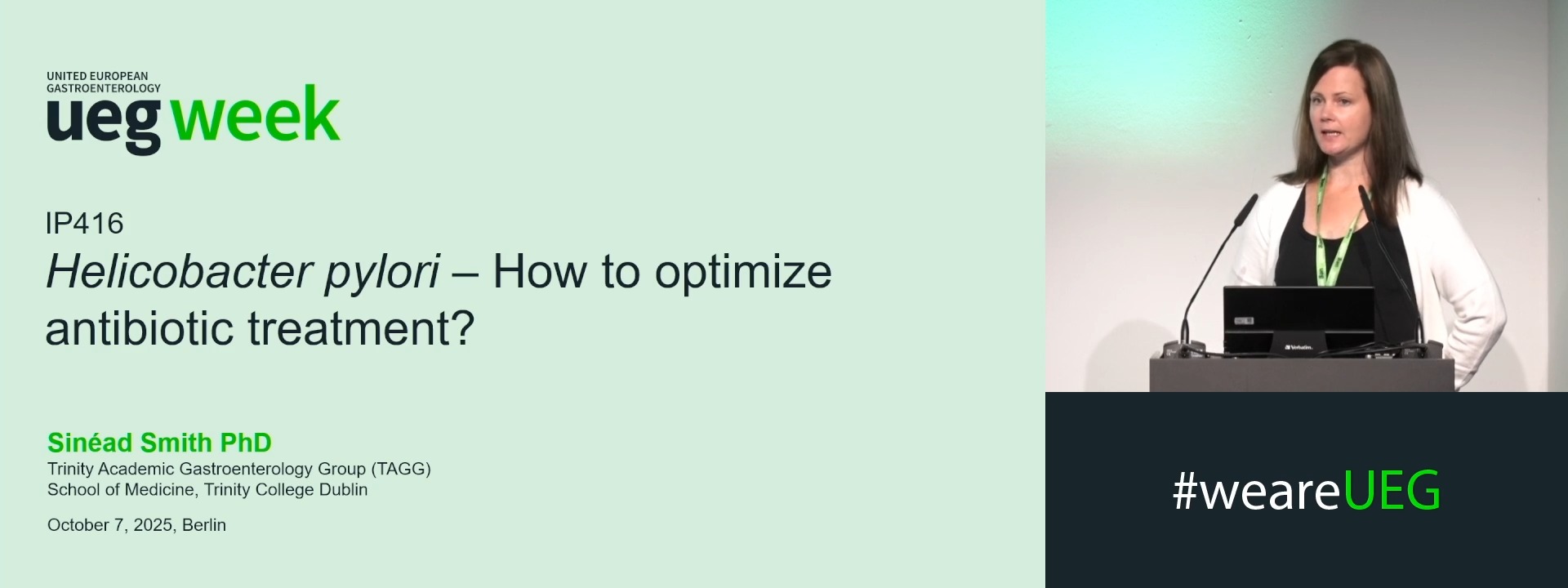
From H. pylori to cancer:Optimising current antibiotic therapy and exploring future targeted treatments
1 Trinity College Dublin, Dublin, Ireland
2 UZ Leuven, Leuven, Belgium
Event
Citation
Published
Log in to access this content.
Free for all myUEG account holders. Your access level is set automatically based on your occupation. Medical professionals get full access to all content. If you are a non-medical user, you can only access UEG Week content from congresses you attended.
Not sure what you can access? Learn more about account types.
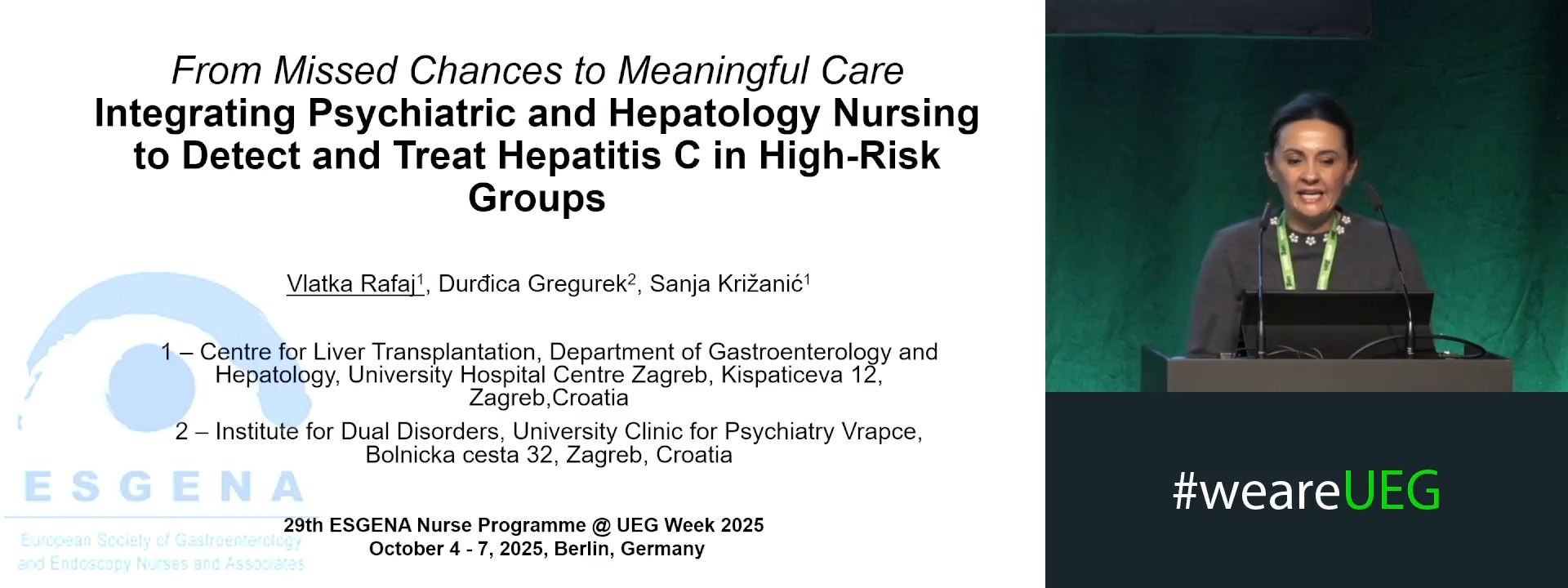
FROM MISSED CHANCES TO MEANINGFUL CARE: INTEGRATING PSYCHIATRIC AND HEPATOLOGY NURSING TO DETECT AND TREAT HEPATITIS C IN HIGH-RISK GROUPS
1 University Hospital Center Zagreb, Zagreb, Croatia
2 University Psychiatric Hospital Vrapce, Zagreb, Croatia
Event
Topics
Submission format
Citation
Published
Log in to access this content.
Free for all myUEG account holders. Your access level is set automatically based on your occupation. Medical professionals get full access to all content. If you are a non-medical user, you can only access UEG Week content from congresses you attended.
Not sure what you can access? Learn more about account types.
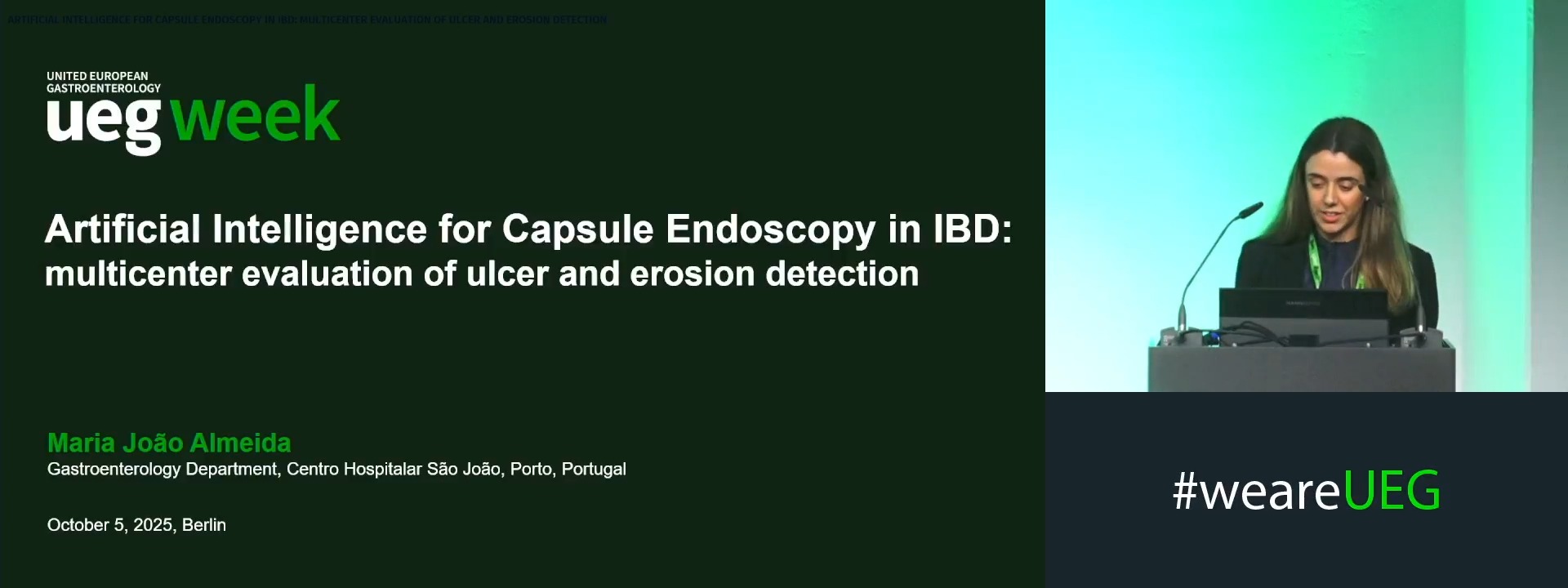
ARTIFICIAL INTELLIGENCE FOR CAPSULE ENDOSCOPY IN IBD: MULTICENTER EVALUATION OF ULCER AND EROSION DETECTION
Maria Almeida 1, Miguel Mascarenhas-Saraiva 1, Joana Mota 1, Miguel Martins 1, Francisco Mendes 1, Pedro Cardoso 2, Tiago Ribeiro 3, João Afonso 1, Tiago Cúrdia Gonçalves 4, Pedro Campelo 5, Cláudia Macedo 5, António Miguel Martins Pinto da Costa 6, CECILIO SANTANDER VAQUERO 7, William Preston Sonnier 8, Jack Di Palma 8, João Ferreira 9, José Berkeley Cotter 5, Guilherme Macedo 1
1 Centro Hospitalar São João, Porto, Portugal
2 Department of Gastroenterology, University Hospital Center of São João, Porto, Portugal
3 Centro Hospitalar Universitário de São João, Lordelo - Paredes, Portugal
4 Hospital da Senhora da Oliveira - Guimarães, Guimarães, Portugal
5 Hospital da Senhora da Oliveira, Guimarães, Portugal
6 Hospital Universitario Puerta de Hierro Majadahonda (Madrid), Madrid, Spain
7 Hosp. Universitario De La Princesa, Madrid, Spain
8 University of South Alabama, Alabama, United States
9 Faculdade de Engenharia da Universidade do Porto, Porto, Portugal
Event
Topics
Submission format
Citation
Published
Log in to access this content.
Free for all myUEG account holders. Your access level is set automatically based on your occupation. Medical professionals get full access to all content. If you are a non-medical user, you can only access UEG Week content from congresses you attended.
Not sure what you can access? Learn more about account types.
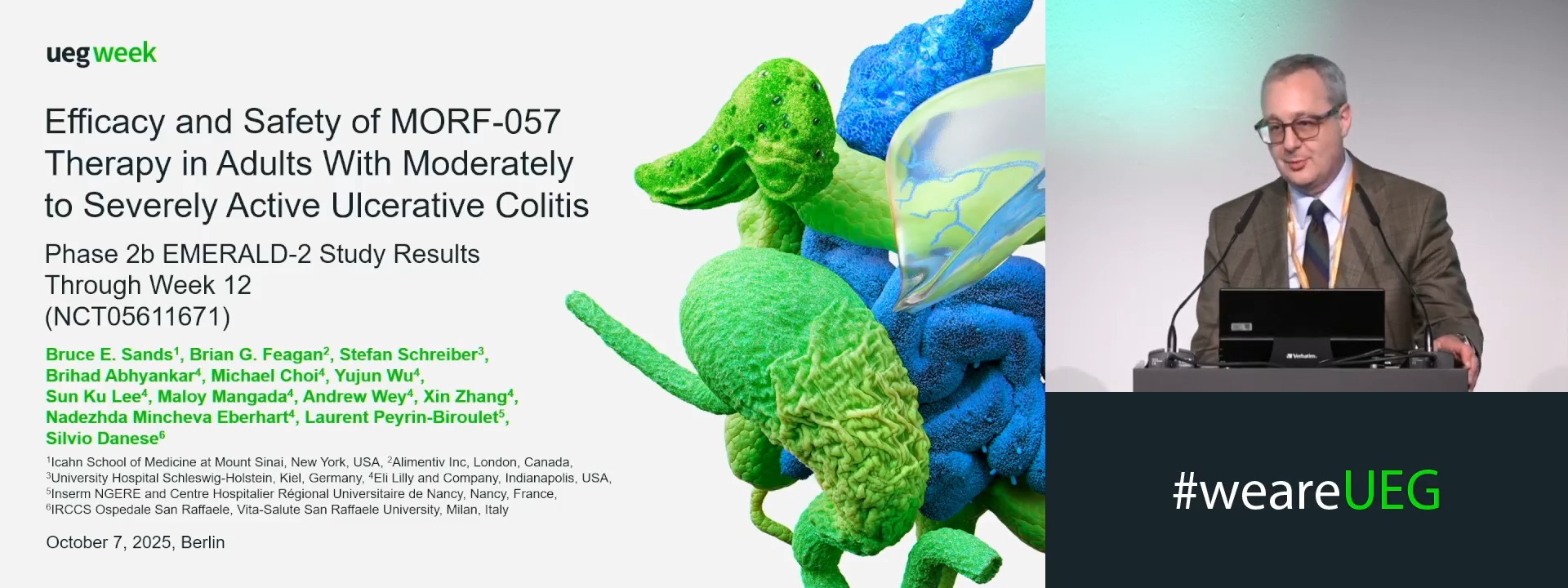
EFFICACY AND SAFETY OF MORF-057 THERAPY IN ADULTS WITH MODERATELY TO SEVERELY ACTIVE ULCERATIVE COLITIS: PHASE 2B EMERALD-2 STUDY RESULTS THROUGH WEEK 12
Bruce E. Sands 1, Brian G. Feagan 2, Stefan Schreiber 3, Brihad Abhyankar 4, Michael Choi 5, Yujun Wu 5, Sun Ku Lee 5, Maloy Mangada 5, Andrew Wey 5, Xin Zhang 5, Nadezhda Mincheva Eberhart 5, Laurent Peyrin-Biroulet 6, Silvio Danese 7
1 Icahn School of Medicine at Mount Sinai, New York, United States
2 Alimentiv Inc., London, Canada
3 University Hospital Schleswig-Holstein, Kiel, Germany
4 Eli Lilly and Company Limited, Basingstoke, United Kingdom
5 Eli Lilly and Company, Indianapolis, United States
6 Centre Hospitalier Régional Universitaire de Nancy, Nancy, France
7 Vita-Salute San Raffaele University - IRCCS Ospedale San Raffaele, Milan, Italy
Event
Submission format
Citation
Published
Log in to access this content.
Free for all myUEG account holders. Your access level is set automatically based on your occupation. Medical professionals get full access to all content. If you are a non-medical user, you can only access UEG Week content from congresses you attended.
Not sure what you can access? Learn more about account types.
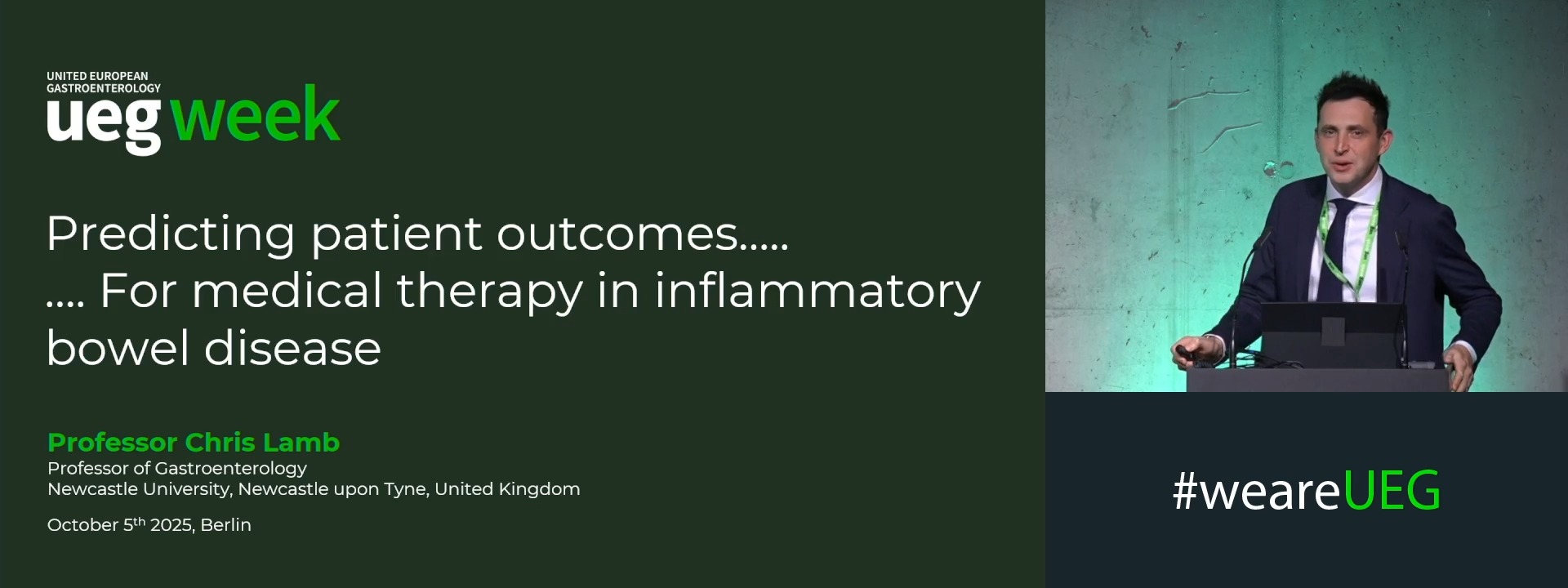
... for medical therapy in inflammatory bowel diseases
1 Newcastle Hospitals NHS Foundation Trust, Newcastle, United Kingdom
Event
Topics
Session