Introduction
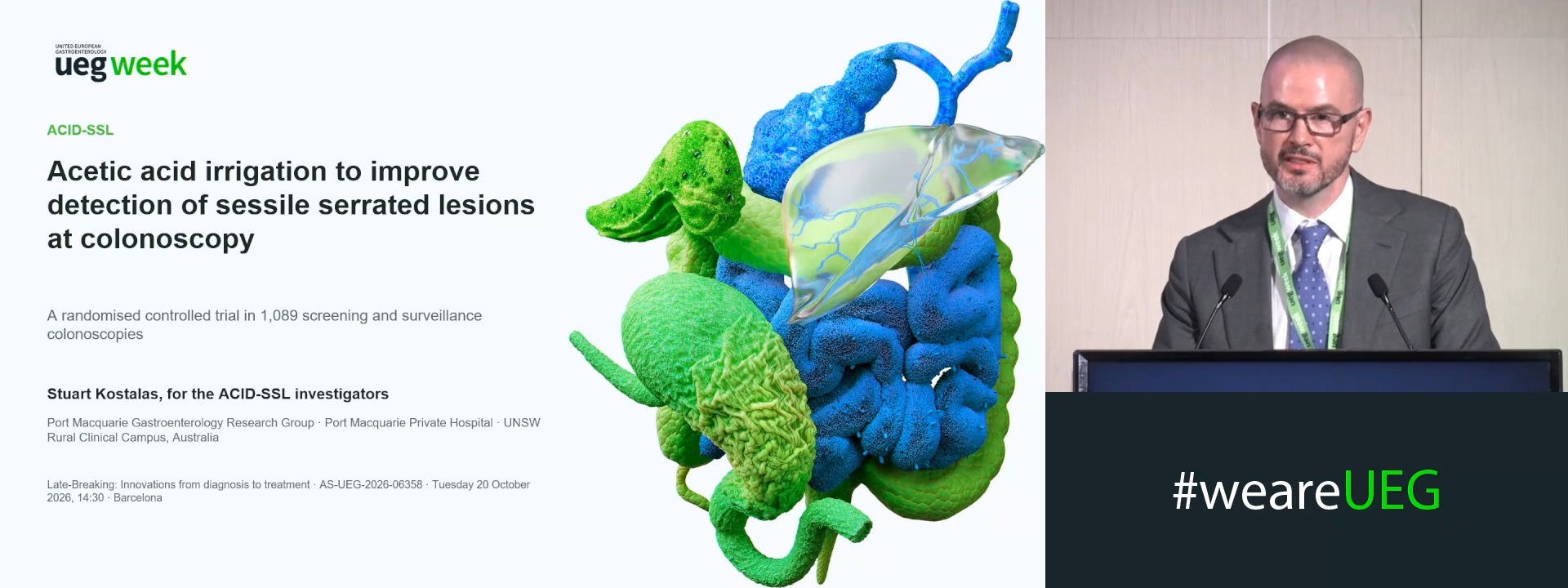
Sessile serrated lesions (SSLs) are important precursors of colorectal cancer and are frequently missed at colonoscopy because they are pale and flat, with an adherent mucus cap. Dilute acetic acid may improve their visualisation through mucolysis and transient aceto-whitening.
Aims & Methods
To determine whether acetic acid irrigation, compared with control irrigation (normal saline or water), improves detection of sessile serrated lesions during colonoscopy in an average-risk screening and surveillance population.
In this prospective, parallel-group randomised controlled trial (prospectively registered), average-risk adults aged 50 to 75 years undergoing screening or surveillance colonoscopy by a single experienced endoscopist were randomised 1:1 to 0.5% acetic acid or control irrigation, applied to each colonic segment during withdrawal. Patients and the reporting pathologist were blinded; the endoscopist could not be. The primary outcome was the SSL detection rate (SSL-DR): the proportion of colonoscopies detecting at least one histologically confirmed SSL (World Health Organization 2019 criteria). Analysis was by intention to treat using the chi-square test, with a logistic model adjusting for prognostic covariates. Confidence intervals (CI) are 95%.
Results
1,089 patients were randomised (544 acetic acid, 545 control) with balanced baseline characteristics. The SSL detection rate was significantly higher with acetic acid (36.2% vs 29.0%; absolute difference 7.2%, CI 1.7 to 12.8; p=0.011; relative risk 1.25; number needed to treat 14; Table). Acetic acid remained independently associated with detection after adjustment (odds ratio 1.40, CI 1.08 to 1.81; p=0.010). The gain was serrated-specific: adenoma detection was unchanged. Additional yield was concentrated in the proximal colon and included lesions at least 10 mm. Procedure time was similar (19.7 vs 19.3 min) and no serious adverse events occurred.
Table. Primary and key secondary outcomes (intention-to-treat).
| Outcome | Acetic acid (n=544) | Control (n=545) | Difference (95% CI) | p |
| SSL detection rate, n (%) | 197 (36.2) | 158 (29.0) | +7.2 (1.7 to 12.8) | 0.011 |
| Proximal SSL detection, n (%) | 171 (31.4) | 130 (23.9) | +7.6 (2.3 to 12.9) | 0.005 |
| SSL at least 10 mm, n (%) | 78 (14.3) | 50 (9.2) | +5.2 (1.3 to 9.0) | 0.008 |
| Adenoma detection rate, n (%) | 320 (58.8) | 322 (59.1) | -0.3 (-6.1 to 5.6) | 0.931 |
| Mean SSLs per patient | 1.03 | 0.85 | +0.18 (-0.03 to 0.38) | 0.027 |
| Serious adverse events, n | 0 | 0 | - | - |
SSL, sessile serrated lesion; CI, confidence interval. Differences for detection rates are in percentage points; p from chi-square test (proportions) or Mann-Whitney U test (mean count).
Conclusion
In average-risk screening, acetic acid chromoendoscopy significantly improved detection of sessile serrated lesions compared with control irrigation, with a serrated-specific, proximally concentrated effect achieved at negligible added time and with an excellent safety profile. Because the endoscopist could not be blinded, the observed effect may be an upper bound; confirmation in a blinded, multi-operator trial is warranted.
References
1. Tribonias G, Theodoropoulou A, Stylianou K, et al. Irrigating acetic acid solution during colonoscopy for the detection of sessile serrated neoplasia: a randomized controlled trial. Dig Dis Sci 2022;67:282-292. doi:10.1007/s10620-021-06858-x.
2. Desai M, Anderson JC, Kaminski M, et al. Sessile serrated lesion detection rates during average-risk screening colonoscopy: a systematic review and meta-analysis. Endosc Int Open 2021;9:E610. doi:10.1055/a-1352-4095.