UEG's educational platform for gastroenterology education bringing recordings, courses, guidelines, and more together in one place.
Most popular content
Rate for better recommendations!
Your feedback helps us show you more of what you like and less of what you dislike!
Log in to access this content.
Free for all myUEG account holders. Your access level is set automatically based on your occupation. Medical professionals get full access to all content. If you are a non-medical user, you can only access UEG Week content from congresses you attended.
Not sure what you can access? Learn more about account types.
Summary: The ultimate guide to colorectal cancer staging surgery adjuvant treatment
1 Erasme University Hospital, Brussels, Belgium
Event
Topics
Citation
Published
Log in to access this content.
Free for all myUEG account holders. Your access level is set automatically based on your occupation. Medical professionals get full access to all content. If you are a non-medical user, you can only access UEG Week content from congresses you attended.
Not sure what you can access? Learn more about account types.
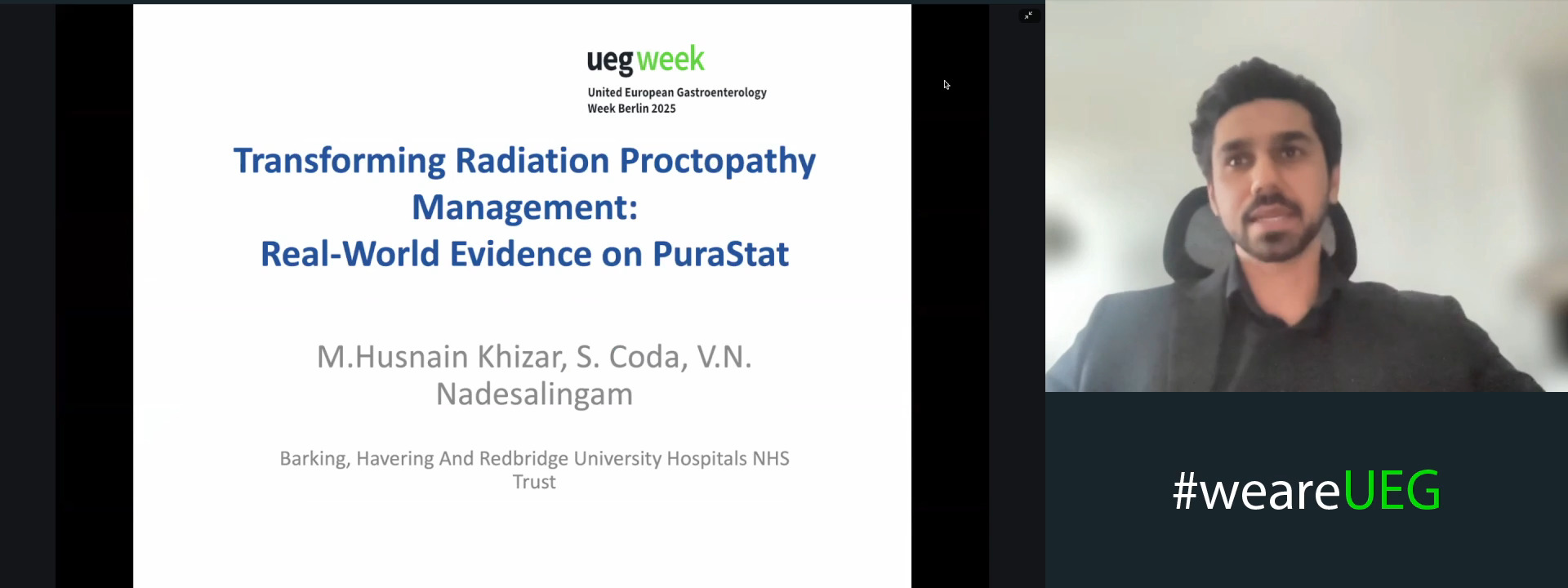
TRANSFORMING RADIATION PROCTOPATHY MANAGEMENT: REAL-WORLD EVIDENCE ON PURASTAT FROM A UK TEACHING HOSPITAL
1 Barking, Havering And Redbridge University Hospitals NHS Trust, London, United Kingdom
Event
Submission format
Session
Citation
Published
Log in to access this content.
Free for all myUEG account holders. Your access level is set automatically based on your occupation. Medical professionals get full access to all content. If you are a non-medical user, you can only access UEG Week content from congresses you attended.
Not sure what you can access? Learn more about account types.
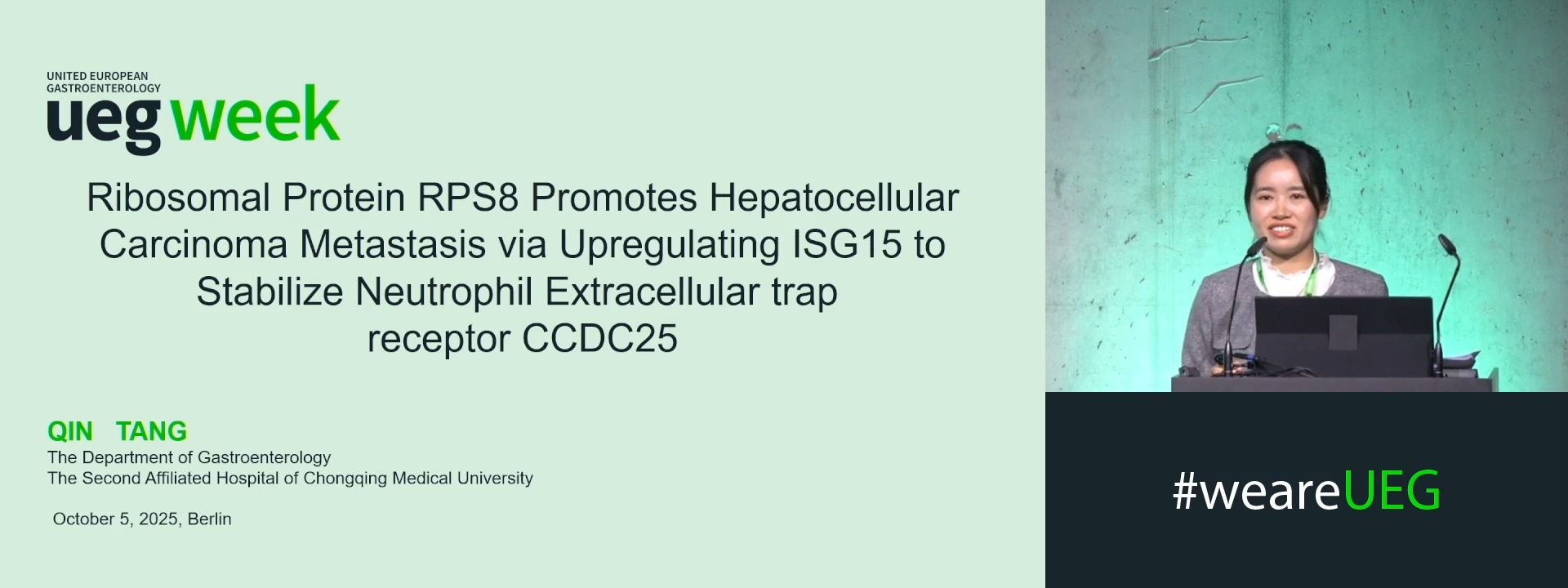
RIBOSOMAL PROTEIN RPS8 PROMOTES HEPATOCELLULAR CARCINOMA METASTASIS VIA UPREGULATING ISG15 TO STABILIZE NEUTROPHIL EXTRACELLULAR TRAP RECEPTOR CCDC25
1 The Second Affiliated Hospital of Chongqing Medical University, Chongqing, China
Event
Submission format
Citation
Published
Log in to access this content.
Free for all myUEG account holders. Your access level is set automatically based on your occupation. Medical professionals get full access to all content. If you are a non-medical user, you can only access UEG Week content from congresses you attended.
Not sure what you can access? Learn more about account types.
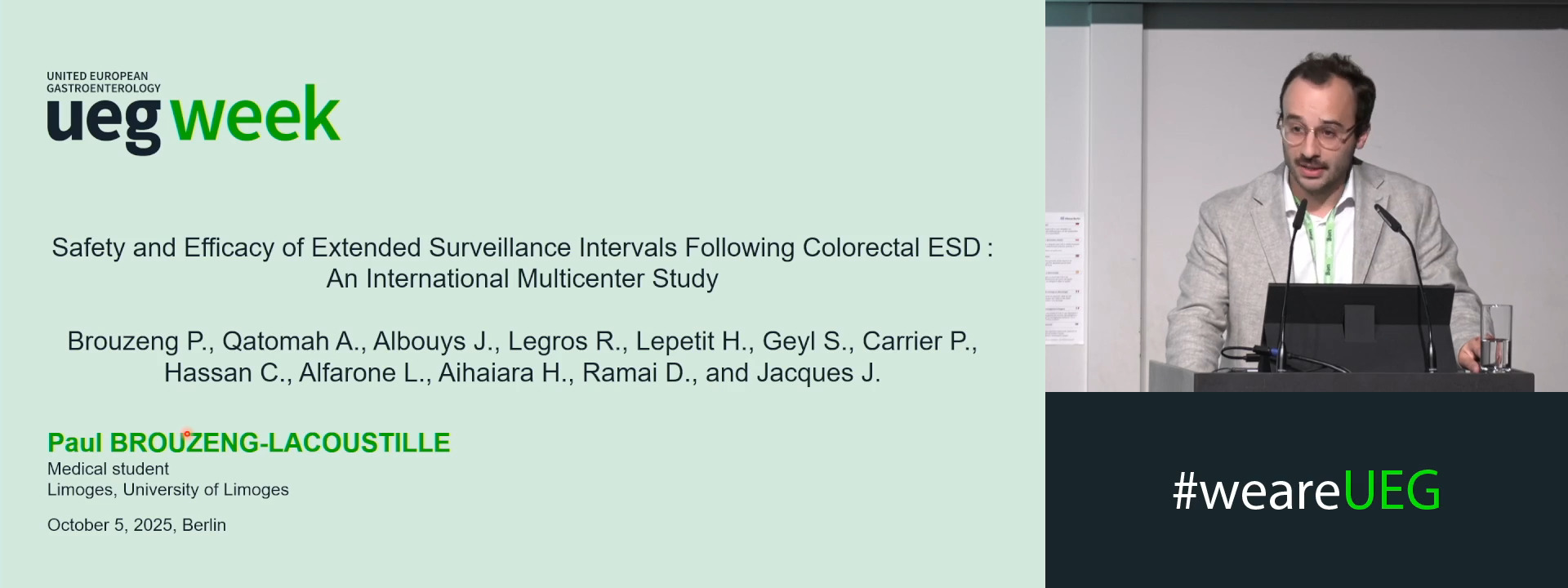
SAFETY AND EFFICACY OF EXTENDED SURVEILLANCE INTERVALS FOLLOWING COLORECTAL ESD: AN INTERNATIONAL MULTICENTER STUDY
Paul Brouzeng 1, Jérémie Jacques 2, Jeremie Albouys 3, Paul Carrier 2, Romain Legros 1, Hugo Lepetit 4, Sophie GEYL 1, Ludovico Alfarone 5, Abdulraman Qatomah 6, Cesare Hassan 7, Daryl Ramai 6, Hiroyki Aihaiara 6
1 CHU Limoges, Limoges, France
2 CHU Limoges - Hepato-Gastro-Enterology, CHU Limoges; Limoges/FR, Limoges, France
3 CHU Limoges / University of Limoges, Limoges, France
4 CHU Limoges France, Limoges, France
5 Milan, Milan, Italy
6 Brigham and Women's Hospital, Boston, United States
7 Humanitas University, Pieve Emanuele MI, Italy
Event
Submission format
Session
Citation
Published
Log in to access this content.
Free for all myUEG account holders. Your access level is set automatically based on your occupation. Medical professionals get full access to all content. If you are a non-medical user, you can only access UEG Week content from congresses you attended.
Not sure what you can access? Learn more about account types.
Rheumatic diseases affecting the liver
1 San Raffaele University, San Raffaele, Italy
Event
Topics
Citation
Published
Log in to access this content.
Free for all myUEG account holders. Your access level is set automatically based on your occupation. Medical professionals get full access to all content. If you are a non-medical user, you can only access UEG Week content from congresses you attended.
Not sure what you can access? Learn more about account types.
Integrative care of gastric cancer: From endoscopic therapies to surgery and chemo/raditherapy
1 University College London Hospital, London, United Kingdom
2 Erasmus MC Rotterdam Dept. of Surgery, Rotterdam, Netherlands
Event
Citation
Published
Log in to access this content.
Free for all myUEG account holders. Your access level is set automatically based on your occupation. Medical professionals get full access to all content. If you are a non-medical user, you can only access UEG Week content from congresses you attended.
Not sure what you can access? Learn more about account types.
A PROSPECTIVE STUDY COMPARING ULTRA-LOW VOLUME BOWEL PREPARATIONS FOR CAPSULE COLONOSCOPY AND PAN-INTESTINAL CAPSULE ENDOSCOPY: EFFICACY OF 1L POLYETHYLENE GLYCOL PLUS ASCORBIC ACID VS. SODIUM PICOSSULFATE WITH MAGNESIUM CITRATE
Joao Carlos Goncalves 1, Ines Marques 1, Mariana Souto 1, Ana Isabel Ferreira 1, Joana Lúcia Teixeira Magalhães Magalhães 1, Bruno Rosa 1, José Berkeley Cotter 1
1 Unidade Local de Saúde do Alto Ave, Guimarães, Portugal|||Life and Health Sciences Research Institute (ICVS), School of Medicine, University of Minho, Braga, Portugal