UEG's content platform for gastroenterology education bringing recordings, courses, guidelines, and more together in one place.
Trending on Gutflix
Rate for better recommendations!
Your feedback helps us show you more of what you like and less of what you dislike!
Log in to continue.
This content is part of Gutflix. Log in with your myUEG account, or create one free, to watch it.
Not sure what you can access? Learn more about account types.
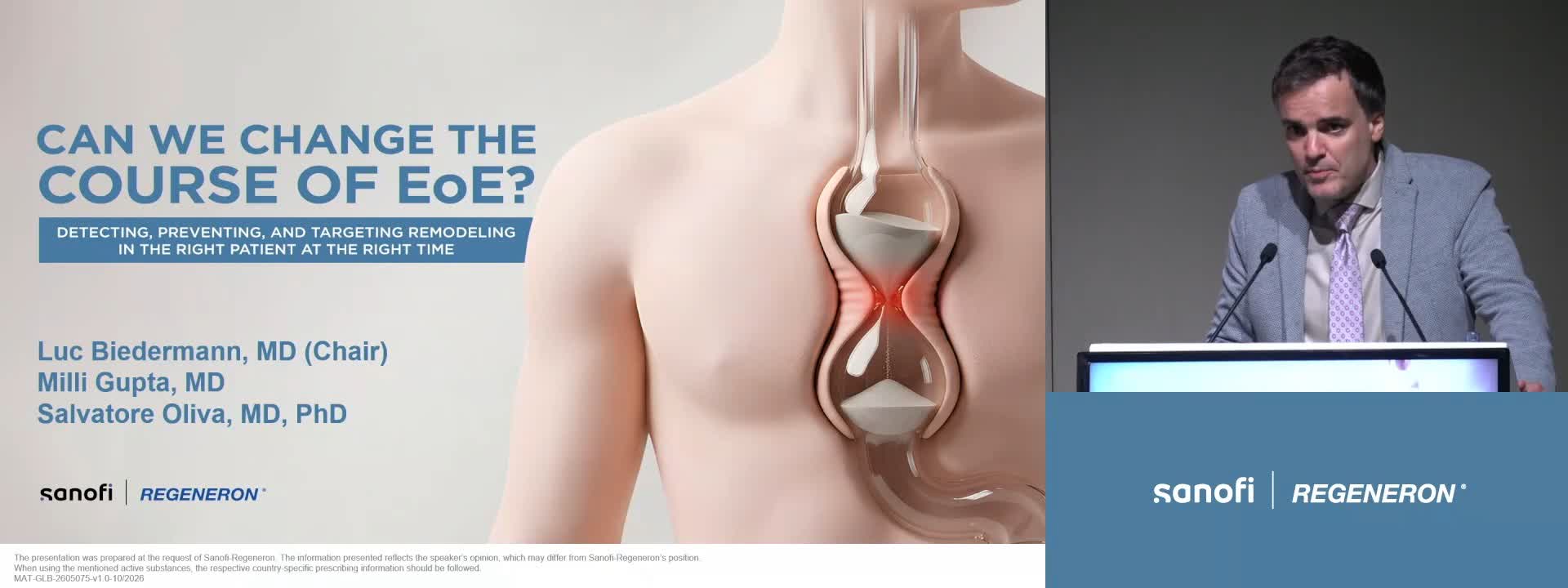
Can We Change the Course of EoE? Detecting, Preventing, and Targeting Remodeling in the Right Patient, at the Right Time (Sanofi Regeneron) (Complete Session)
Affiliations
1 USZ Zürich, Zurich, Switzerland
2 University Hospital Umberto, Sapienza University of Rome, Rome, Italy
3 Associate Clinical Professor of Medicine Division of Gastroenterology and Hepatology, Department of Medicine University of Calgary, None, Canada
Log in to continue.
This content is part of Gutflix. Log in with your myUEG account, or create one free, to watch it.
Not sure what you can access? Learn more about account types.
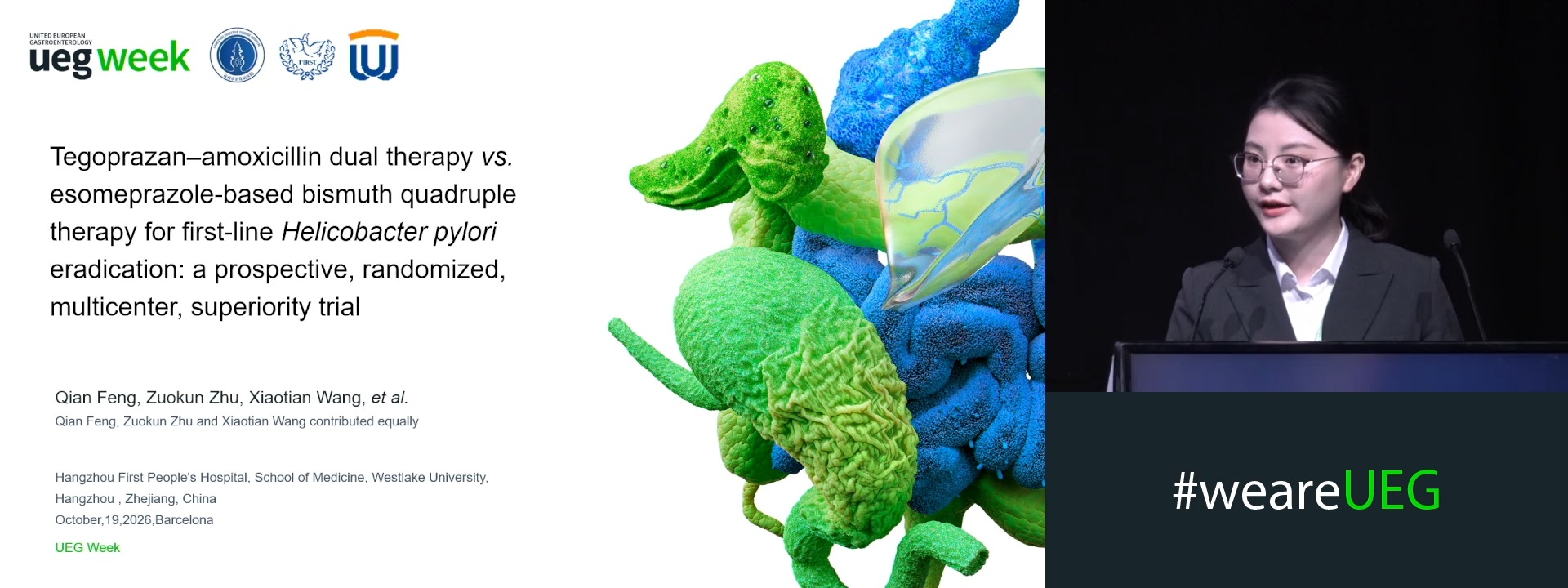
TEGOPRAZAN-AMOXICILLIN DUAL THERAPY VERSUS ESOMEPRAZOLE-BASED BISMUTH QUADRUPLE THERAPY FOR FIRST-LINE HELICOBACTER PYLORI ERADICATION: A PROSPECTIVE, RANDOMIZED, MULTICENTER, SUPERIORITY TRIAL
Qian Feng 1,2, Zuokun Zhu 3, Xiaotian Wang 3, Yubo Xu 4, Qianhong Tao 5, Xiaofeng Zhang 1, Haitao Huang 6, Hongzhang Shen 1,7
Affiliations
1 Hangzhou First People's Hospital, Hangzhou, China
2 Hangzhou Geriatric Hospital, Hangzhou, China
3 The Fourth Clinical Medical College, Zhejiang Chinese Medical University, Hangzhou, China
4 Anchang Branch, Shaoxing Central Hospital, Shaoxing, China
5 Affiliated Hangzhou Cancer Hospital, Zhejiang University School of Medicine, Hangzhou, China
6 The First People's Hospital of Tonglu County, Tonglu, China
7 School of Medicine, Westlake University, Hangzhou, China