UEG's educational platform for gastroenterology education bringing recordings, courses, guidelines, and more together in one place.
Most popular content
Rate for better recommendations!
Your feedback helps us show you more of what you like and less of what you dislike!
Log in to access this content.
Free for all myUEG account holders. Your access level is set automatically based on your occupation. Medical professionals get full access to all content. If you are a non-medical user, you can only access UEG Week content from congresses you attended.
Not sure what you can access? Learn more about account types.

ARE RECTAL OR RECTOSIGMOID ENDOSCOPY SUFFICIENT TO ASSESS COMPLETE ENDOSCOPIC OR HISTOLOGICAL HEALING IN ULCERATIVE COLITIS: A CROSS-SECTIONAL STUDY
Clara Yzet 1, Capucine Moreau 1, Erica Meudjo 1, Camille Robert 1, Franck Brazier 1, Audrey Michaud 1, Mathurin Fumery 1
1 Amiens University Hospital, Amiens, France
Conference
Topics
Submission format
Session
Citation
Published
Log in to access this content.
Free for all myUEG account holders. Your access level is set automatically based on your occupation. Medical professionals get full access to all content. If you are a non-medical user, you can only access UEG Week content from congresses you attended.
Not sure what you can access? Learn more about account types.
Log in to access this content.
Free for all myUEG account holders. Your access level is set automatically based on your occupation. Medical professionals get full access to all content. If you are a non-medical user, you can only access UEG Week content from congresses you attended.
Not sure what you can access? Learn more about account types.
Log in to access this content.
Free for all myUEG account holders. Your access level is set automatically based on your occupation. Medical professionals get full access to all content. If you are a non-medical user, you can only access UEG Week content from congresses you attended.
Not sure what you can access? Learn more about account types.
Log in to access this content.
Free for all myUEG account holders. Your access level is set automatically based on your occupation. Medical professionals get full access to all content. If you are a non-medical user, you can only access UEG Week content from congresses you attended.
Not sure what you can access? Learn more about account types.
THE FRENCH CONSENSUS ON IDIOPATHIC GASTROPARESIS IN ADULTS AND CHILDREN
Heithem Soliman 1, Fabien Wuestenberghs 2, Madeleine Aumar 3, Charlène Brochard 4, Marion Chambaz 4, Benoit Coffin 5, Charlotte Desprez 6, Pauline Jouet 2, Hélène Lengliné 7, gilles macaigne 8, Chloé Melchior 9, Francois Mion 10, Sabine Roman 11, Alberto Zalar 12, Frank Zerbib 13, Nicolas Caron 14, Guillaume Gourcerol 15
1 Hôpital Louis Mourier - AP-HP, Colombes, France
2 APHP, Avicenne Hospital, Sorbonne Paris Nord University, Bobigny, France
3 CHU Lille, Lille, France
4 CHU Rennes, Rennes, France
5 Hopital Louis Mourier, Colombes, France
6 Rouen University Hospital, Rouen, France
7 AP-HP, Robert Debré Hospital, Paris, France
8 GHI Le Raincy Montfermeil, Montfermeil, France
9 Rouen University Hospital, INSERM U1073, CIC-CRB-1404, Rouen, France
10 Hospices Civils de Lyon, Lyon, France
11 Hôpital Edouard Herriot, Lyon, France
12 Cabinet Medical, Rouen, France
13 CHU de Bordeaux - Hôpital Haut Leveque, Pessac, France
14 CHU Lyon, Hospices Civils de Lyon, Lyon, France
15 CHU Rouen Hopital C. Nicolle, Rouen Cedex, France
Conference
Topics
Submission format
Citation
Published
Log in to access this content.
Free for all myUEG account holders. Your access level is set automatically based on your occupation. Medical professionals get full access to all content. If you are a non-medical user, you can only access UEG Week content from congresses you attended.
Not sure what you can access? Learn more about account types.
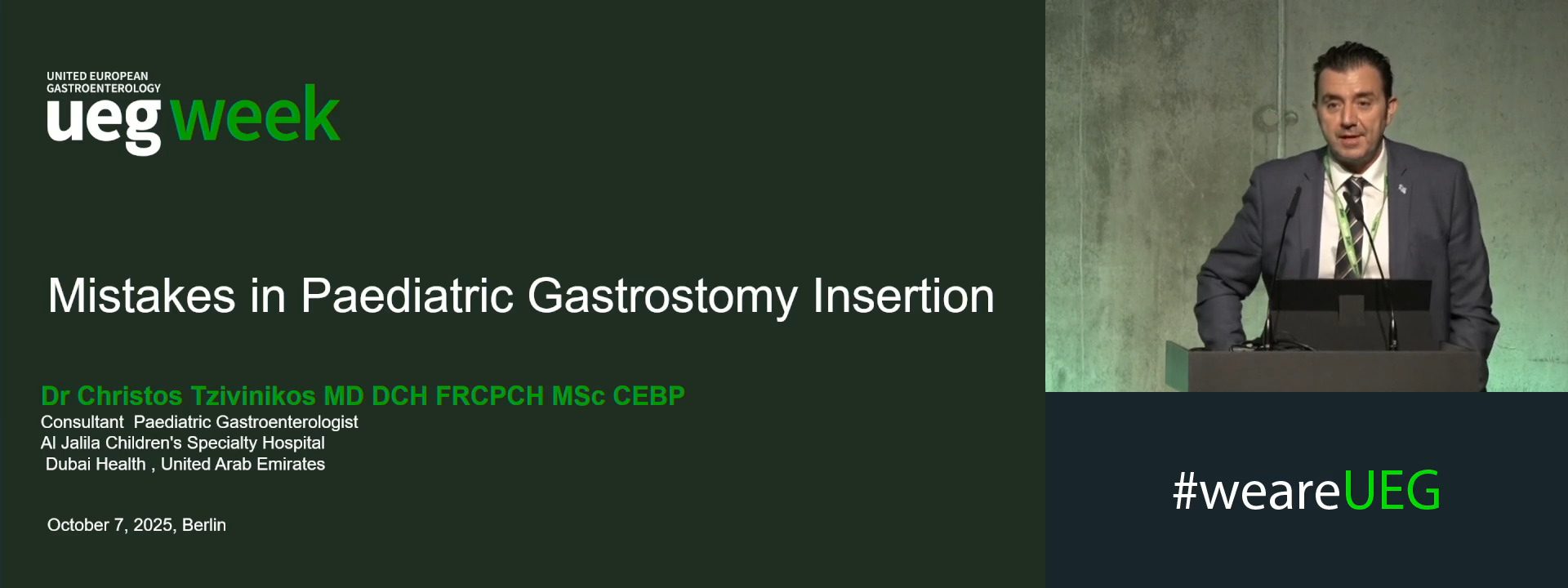
Paediatric gastrostomy insertion
1 Al Jalila Children's Specialty Hospital, DUBAI, United Arab Emirates
Event
Session
Citation
Published
Log in to access this content.
Free for all myUEG account holders. Your access level is set automatically based on your occupation. Medical professionals get full access to all content. If you are a non-medical user, you can only access UEG Week content from congresses you attended.
Not sure what you can access? Learn more about account types.
CLINICAL OUTCOMES OF RADIOFREQUENCY ABLATION FOR BARRETT’S ESOPHAGUS IN BELGIUM BEFORE AND AFTER REIMBURSEMENT: A MULTICENTER REGISTRY STUDY
Philippe Leclercq 1, Olivier Plomteux 2, Dominiek De Wulf 3, Arnaud Lemmers 4, David James Tate 5, Michiel Bronswijk 6, Maxime Poncin 7, Abdenor Badaoui 8, Pierre Eisendrath 9, Hilde Willekens 10, Chelsea Camps 10, Raf Bisschops 11
1 CHC-Mont LEGIA, 4000, Belgium|||Katholieke Universiteit Leuven, Leuven, Belgium
2 CHC-Mont LEGIA, 4000, Belgium
3 H. Hartziekenhuis, Roeselare, Belgium
4 Hôpital Univ. Erasme (Gastro), Bruxelles, Belgium
5 University Hospital Ghent, Gent, Belgium
6 Imelda Hospital Bonheiden, Keerbergen, Belgium
7 CHU Sart-Tilman, Liège, Belgium
8 Mont-Godinne University Hospital, 5530, Yvoir, Yvoir, Belgium
9 CHU Saint-Pierre, Brussels, Belgium
10 UZ Gasthuisberg Gastro-enterologie, B-3000 Leuven, Belgium
11 Katholieke Universiteit Leuven, Leuven, Belgium
Conference
Topics