UEG's content platform for gastroenterology education bringing recordings, courses, guidelines, and more together in one place.
Trending on Gutflix
Rate for better recommendations!
Your feedback helps us show you more of what you like and less of what you dislike!

Log in to continue.
This content is part of Gutflix. Log in with your myUEG account, or create one free, to watch it.
Not sure what you can access? Learn more about account types.
OUTCOMES OF ENDOSCOPIC MANAGEMENT OF SIGMOID VOLVULUS: COHORT OF 404 PATIENTS – VOLVOR STUDY
Karine Louvion 1, Hadrien Alric 2, Charles Houdeville 1, Marie Goudot 1, Aïmene KHIARI 1, Salome Ouazana 1, Nelson Lourenço 3, Maximilien Barret 4, Sara Lemoinne 5, Aymeric Becq 6, Nils Steuer 7, Jean Charles Nault 8, Antoine Guilloux 1, Xavier Dray 1, Marine Camus 1
Affiliations
1 Sorbonne University, Saint Antoine Hospital, Paris, France
2 Hôpital Européen Georges-pompidou, Paris, France
3 Université Paris Cité, Paris, France
4 Cochin Hospital, Paris, France
5 INSERM, UMRS 938, Université Pierre et Marie Curie, Paris, France
6 Henri Mondor Hospital, Créteil, France
7 Montfermeil, Montfermeil, France
8 Inserm U, Paris, France

Log in to continue.
This content is part of Gutflix. Log in with your myUEG account, or create one free, to watch it.
Not sure what you can access? Learn more about account types.
RISANKIZUMAB, BUT NOT USTEKINUMAB OR VEDOLIZUMAB, DOWNREGULATES IL-23-INDUCED MUCOSAL PATHOGENIC TH17 CELLS IN PATIENTS WITH CROHN’S DISEASE
Daniele Noviello 1, Irene Dusetti 1, Valerie Pivorunas 2, Ambra Eleonora Lovati 3, Clorinda Ciafardini 3, Chiara Amoroso 3, Francesco Conforti 3, Nicole Piazza O Sed 3, Maurizio Vecchi 1, Federica Facciotti 4, Moira Paroni 1, Flavio Caprioli 1
Affiliations
1 University of Milan, Milano, Italy
2 AbbVie, Chicago, United States
3 Foundation IRCCS Ca’ Granda Ospedale Maggiore Policlinico, Milan, Italy
4 University Of Milano Bicocca, Milan, Italy

Log in to continue.
This content is part of Gutflix. Log in with your myUEG account, or create one free, to watch it.
Not sure what you can access? Learn more about account types.
SAFETY AND TOLERABILITY OF MH002, A LIVE BIOTHERAPEUTIC PRODUCT, IN INFLAMMATORY BOWEL DISEASE: SUMMARY OF DATA FROM TWO PHASE 2 CLINICAL TRIALS
Severine Vermeire 1, Silvio Danese 2, Fernando Magro 3, Sam Possemiers 4, Selin Bolca 4, Ludo Haazen 4
Affiliations
1 University Hospital Leuven, Leuven, Belgium
2 Vita-Salute San Raffaele University - IRCCS San Raffaele Scientific Institute, Milan, Italy
3 Faculty of Medicine of the University of Porto, Porto, Portugal
4 MRM Health, Ghent, Belgium
Log in to continue.
This content is part of Gutflix. Log in with your myUEG account, or create one free, to watch it.
Not sure what you can access? Learn more about account types.
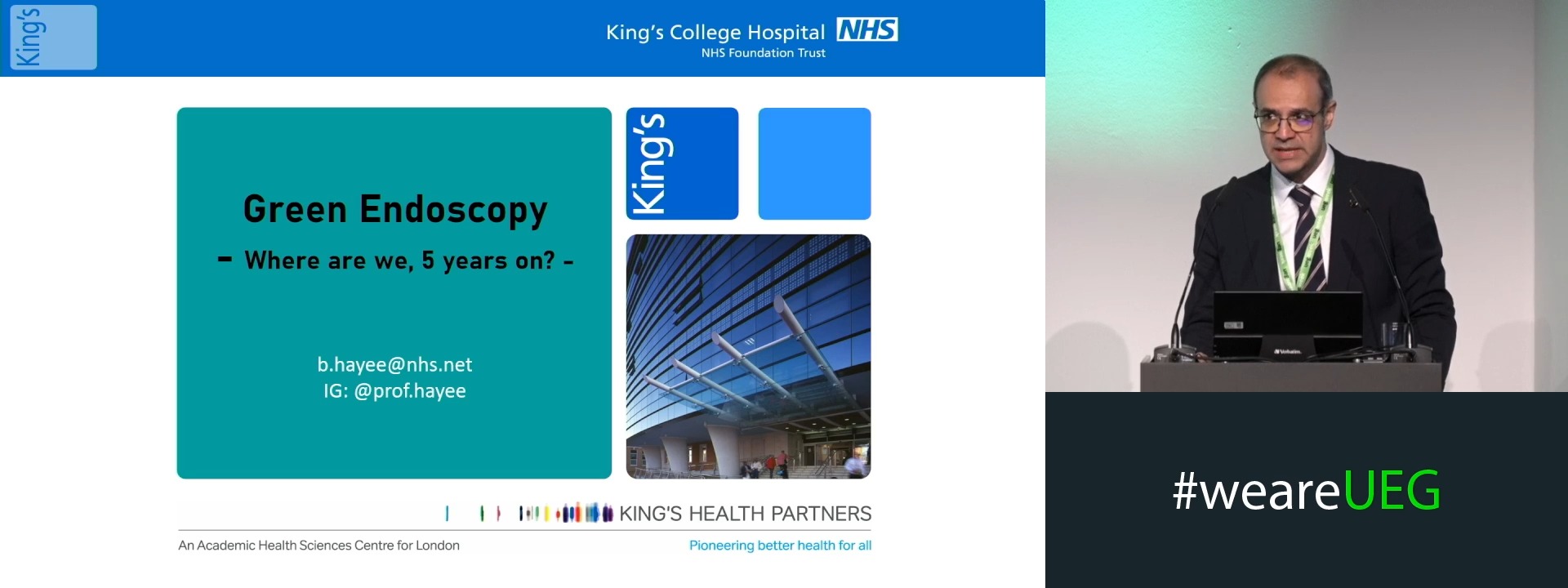
The carbon footprint of endoscopy
Affiliations
1 Kings College Hospital, London, United Kingdom

Log in to continue.
This content is part of Gutflix. Log in with your myUEG account, or create one free, to watch it.
Not sure what you can access? Learn more about account types.
USTEKINUMAB FOR FISTULIZING PERIANAL CROHN’S DISEASE: WEEK-12 RESULTS FROM THE USTAP RANDOMIZED PLACEBO CONTROLLED GETAID TRIAL
pauline wils 1, Stephane NANCEY 2, Elodie Messmer 3, Arnaud Bourreille 4, Anthony Buisson 5, Ludovic Caillo 6, Lucine Vuitton 7, Romain Altwegg 8, Xavier Hebuterne 9, Olivier Ernst 1, Paul Meunier 10, Valérie Laurent 11, David Laharie 12, Eric Vicaut 13, Laurent Peyrin-Biroulet 14
Affiliations
1 Lille university hospital, Lille, France
2 Lyon hospital, Pierre Benite, France
3 Roubaix Hospital, Roubaix, France
4 Hopital Hotel Dieu Et Hme - Hge Aile Sud, Nantes Cedex 1, France
5 CHU Estaing Clermont-Ferrand, Clermont-ferrand, France
6 CHU DE NIMES, Nîmes, France
7 Besançon university hospital, Courbevoie, France
8 Hopital Saint Eloi Hepatologie Gastro Enterologie, Montpellier cedex 5, France
9 Hospital Archet 2, Nice, Nice, France
10 Liege hospital, Liege, Belgium
11 Nancy hospital, Nancy, France
12 CHU de Bordeaux Hopital Haut-Leveque Dept. de Gastroenterologie, Pessac cedex, France
13 Hôpital Lariboisière, APHP, Paris, France
14 Inserm U1256, Nancy University Hospital, Vandoeuvre-les-Nancy, France

Log in to continue.
This content is part of Gutflix. Log in with your myUEG account, or create one free, to watch it.
Not sure what you can access? Learn more about account types.
Is IBS a gut-specific disease or a multisystemic disorder?
Affiliations
1 Icahn School of Medicine, New York, United States of America
2 Sahlgrenska University Hospital - Dept of Internal Medicine, Sahlgrenska University Hospital ; Gothe, Gothenburg, Sweden