UEG's educational platform for gastroenterology education bringing recordings, courses, guidelines, and more together in one place.
Most popular content
Rate for better recommendations!
Your feedback helps us show you more of what you like and less of what you dislike!
Log in to access this content.
Free for all myUEG account holders. Your access level is set automatically based on your occupation. Medical professionals get full access to all content. If you are a non-medical user, you can only access UEG Week content from congresses you attended.
Not sure what you can access? Learn more about account types.

FIVE-YEAR PERSISTENCE OF VEDOLIZUMAB IN CROHN’S DISEASE: A REAL-WORLD MONOCENTRIC RETROSPECTIVE STUDY
1 CHU Saint-Pierre, Brxuelles, Belgium
Conference
Topics
Submission format
Session
Citation
Published
Log in to access this content.
Free for all myUEG account holders. Your access level is set automatically based on your occupation. Medical professionals get full access to all content. If you are a non-medical user, you can only access UEG Week content from congresses you attended.
Not sure what you can access? Learn more about account types.
PREVALENCE OF NON-ADVANCED AND ADVANCED COLONIC NEOPLASIA IN YOUNG ADULTS
Georgios Kokkotis 1, VASILIKI KITSOU 1, Konstantina Chalakatevaki 1, Michalis Gizis 1, Effrosyni Laoudi 1, Georgios Kounadis 1, Ioannis Koutsounas 1, Giorgos Bamias 1
1 3rd Department of Internal Medicine, University of Athens, Athens, Greece
Conference
Topics
Submission format
Session
Citation
Published
Log in to access this content.
Free for all myUEG account holders. Your access level is set automatically based on your occupation. Medical professionals get full access to all content. If you are a non-medical user, you can only access UEG Week content from congresses you attended.
Not sure what you can access? Learn more about account types.
EVALUATION OF CHARACTERISTICS OF BOWEL URGENCY IN PATIENTS WITH ULCERATIVE COLITIS
Emese Ivány 1, Péter Bacsur 1, Tamás Resál 2, Barbara Horvát 1, Patrícia Sarlós 3, Karoly Palatka 4, Lorant Gonczi 5, Ákos Iliás 5, Bernadett Farkas 1, Anita Balint 1, Anna Fabian 1, Zsofia Bosze 1, Klaudia Farkas 1, Szepes Zoltán 1, Tamás Molnár 1
1 University of Szeged, Albert Szent-Györgyi Medical Center, Szeged, Hungary
2 Military Hospital, Central Hospital of Northern Pest, Szeged, Hungary
3 University of Pécs, Pécs, Hungary
4 University of Debrecen, Medical and Health Science Center, Div Gasztroenterology, Debrecen, Hungary
5 Semmelweis University, Budapest, Hungary
Conference
Topics
Submission format
Session
Citation
Published
Log in to access this content.
Free for all myUEG account holders. Your access level is set automatically based on your occupation. Medical professionals get full access to all content. If you are a non-medical user, you can only access UEG Week content from congresses you attended.
Not sure what you can access? Learn more about account types.
USTEKINUMAB TROUGH LEVELS ARE NOT ASSOCIATED WITH CLINICAL OUTCOMES IN CROHN’S DISEASE: PK-PD RESULTS OF THE RESCUE STUDY
Peter Bossuyt 1, Jean François Rahier 2, Filip Baert 3, Edouard Louis 4, Elisabeth Macken 5, Triana Lobaton Ortega 6, Julie Busschaert 7, Harald Peeters 8, Pieter Dewint 9, Denis Franchimont 10, joris dutre 11, Barbara Willandt 12, Christophe Claessens 13, Olivier Dewit 14, Marc Ferrante 15, Severine Vermeire 16
1 Imelda General Hospital, Bonheiden, Belgium
2 CHU UCL Mont-Godinne, Wavre, Belgium
3 Az Delta, Roeselare, Belgium
4 CHU Liège and Liège University, Liège, Belgium
5 uza, Edegem, Belgium
6 Ghent University Hospital, Gent, Belgium
7 AZ Sint-Lucas, Brugge, Belgium
8 AZ Sint-Lucas, Gent, Belgium
9 AZ Maria Middelares, Gent, Belgium
10 FGCC, Brussels, Belgium
11 ZNA Jan Palfijn, Merksem, Belgium
12 AZ St. Jan Brugge, Brugge, Belgium
13 AZ Turnhout, Turnhout, Belgium
14 UCL Saint Luc, Brussels, Belgium
15 University Hospitals Leuven, Leuven, Belgium
16 University Hospital Leuven, Leuven, Belgium
Conference
Topics
Submission format
Session
Citation
Published
Log in to access this content.
Free for all myUEG account holders. Your access level is set automatically based on your occupation. Medical professionals get full access to all content. If you are a non-medical user, you can only access UEG Week content from congresses you attended.
Not sure what you can access? Learn more about account types.
TRANSCRIPTOMIC SIGNATURES ASSOCIATED WITH ANTI-TNF DISCONTINUATION OUTCOMES IN ULCERATIVE COLITIS
Emma Rapp 1, Ingrid Prytz Berset 2, Sinan U. Umu 1, Espen Sønderaal Bækkevold 3, Karen Sivertsen Utheim 4, Dag Arne Lihaug Hoff 5, Knut E.A. Lundin 6, Frode Jahnsen 1, Diana Domanska 7
1 Institute of Clinical Medicine, University of Oslo, Oslo, Norway|||Oslo University Hospital, Oslo, Norway
2 Gastroenterology Aalesund, Alesund, Norway
3 Oslo University Hospital, Oslo, Norway|||Institute of Oral Biology, University of Oslo, Oslo, Norway
4 Institute of Clinical Medicine, University of Oslo, Oslo, Norway
5 Møre & Romsdal Hospital Trust, Ålesund, Norway|||Norwegian University of Science and Technology, Ålesund, Norway
6 Oslo University Hospital, Oslo, Norway|||Norwegian Coeliac Disease Research Centre, University of Oslo and Oslo University Hospital, Oslo, Norway
7 Oslo University Hospital, Oslo, Norway|||University of Oslo, Oslo, Norway|||University of Warmia and Mazury in Olsztyn, Olsztyn, Poland
Conference
Topics
Submission format
Session
Citation
Published
Log in to access this content.
Free for all myUEG account holders. Your access level is set automatically based on your occupation. Medical professionals get full access to all content. If you are a non-medical user, you can only access UEG Week content from congresses you attended.
Not sure what you can access? Learn more about account types.
FIBROBLAST ACTIVATION PROTEIN (FAP)-CLEAVED TYPE III COLLAGEN [C3F] IS A POTENTIAL MARKER FOR INTESTINAL FIBROSIS IN PATIENTS WITH CROHN’S DISEASE
Thomai Tsapanou-Katranara 1, Anja Poulsen 2, Marta Sorokina Alexdóttir 3, Lene Buhl Riis 4, Martin Pehrsson 3, Julie Rasmussen 5, Ismail Gögenur 5, Johan Burisch 6, Morten Asser Karsdal 3, Anne-Christine Bay-Jensen 3, Jakob Benedict Seidelin 2, Joachim Høg Mortensen 3
1 University of Southern Denmark, Odense, Denmark|||Nordic Bioscience, Herlev, Denmark
2 Copenhagen University Hospital - Rigshospitalet, Copenhagen, Denmark
3 Nordic Bioscience, Herlev, Denmark
4 Copenhagen University Hospital - Herlev and Gentofte, Herlev, Denmark
5 Zealand University Hospital, Køge, Denmark
6 Copenhagen University Hospital - Amager and Hvidovre, Hvidovre, Denmark
Conference
Topics
Submission format
Citation
Published
Log in to access this content.
Free for all myUEG account holders. Your access level is set automatically based on your occupation. Medical professionals get full access to all content. If you are a non-medical user, you can only access UEG Week content from congresses you attended.
Not sure what you can access? Learn more about account types.
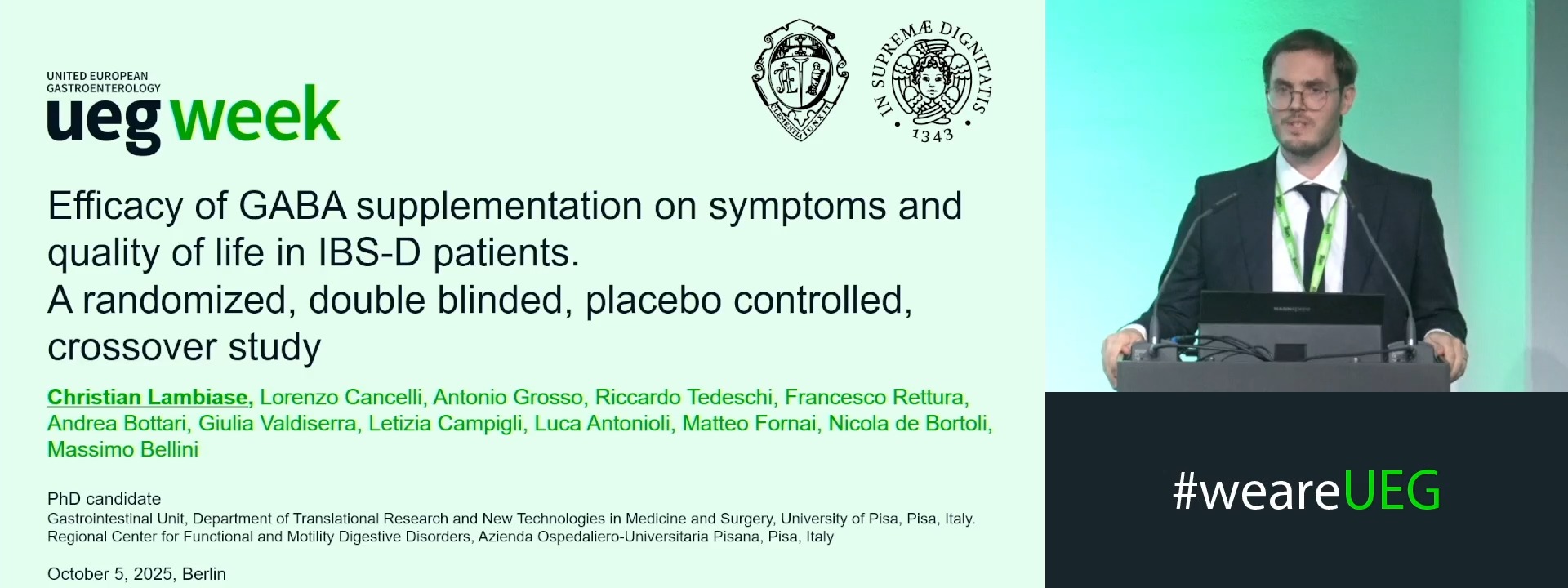
EFFECTS OF GAMMA-AMINOBUTYRIC ACID SUPPLEMENTATION ON SYMPTOMS AND QUALITY OF LIFE IN IBS-D PATIENTS. PRELIMINARY RESULTS FROM A RANDOMIZED, DOUBLE BLINDED, PLACEBO CONTROLLED, CROSSOVER STUDY
Christian Lambiase 1, Lorenzo Cancelli 1, Antonio Grosso 1, Riccardo Tedeschi 1, Francesco Rettura 1, Andrea Bottari 1, Giulia Valdiserra 2, Letizia Campigli 2, Luca Antonioli 2, Matteo Fornai 2, Nicola de Bortoli 1, Massimo Bellini 1
1 University of Pisa, Pisa, Italy|||Azienda Ospedaliero-Universitaria Pisana, Pisa, Italy
2 University of Pisa, Pisa, Italy
Event
Topics
Submission format
Session