UEG's educational platform for gastroenterology education bringing recordings, courses, guidelines, and more together in one place.
Most popular content
Rate for better recommendations!
Your feedback helps us show you more of what you like and less of what you dislike!
Log in to access this content.
Free for all myUEG account holders. Your access level is set automatically based on your occupation. Medical professionals get full access to all content. If you are a non-medical user, you can only access UEG Week content from congresses you attended.
Not sure what you can access? Learn more about account types.
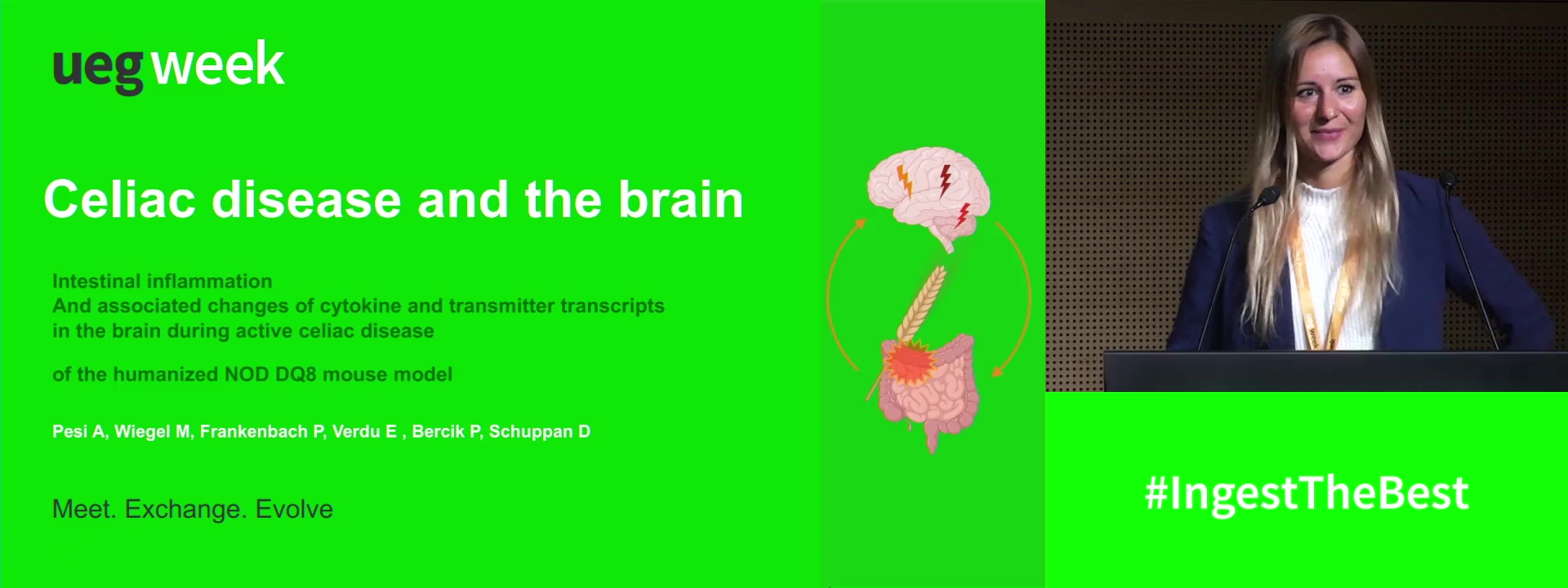
INTESTINAL INFLAMMATION AND ASSOCIATED CHANGES OF CYTOKINE AND TRANSMITTER TRANSCRIPTS IN THE BRAIN DURING ACTIVE CELIAC DISEASE IN THE HUMANIZED NOD DQ8 MOUSE MODEL
Aline Pesi 1, Michelle Wiegel 1, Paul Frankenbach 1, Elena Verdu 2, Premysl Bercik 2, Detlef Schuppan 3
1 Medical University Mainz - Institute of Translational Immunology, Medical University Mainz ; Mainz/D, Mainz, Germany
2 McMaster University, Hamilton, Canada
3 Medical University Mainz - Institute of Translational Immunology, Medical University Mainz ; Mainz/D, Mainz, Germany|||Beth Israel Deaconess Medical Center, Boston, United States
Event
Submission format
Session
Citation
Published
Log in to access this content.
Free for all myUEG account holders. Your access level is set automatically based on your occupation. Medical professionals get full access to all content. If you are a non-medical user, you can only access UEG Week content from congresses you attended.
Not sure what you can access? Learn more about account types.
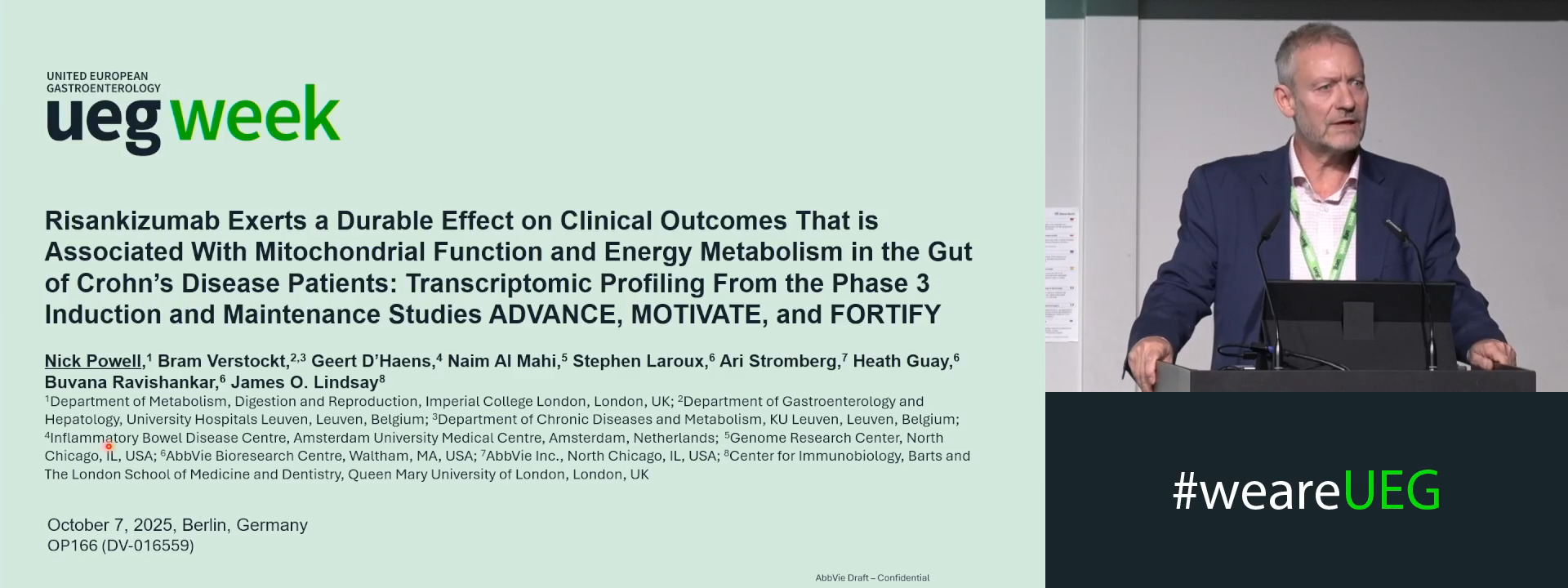
RISANKIZUMAB EXERTS A DURABLE EFFECT ON CLINICAL OUTCOMES THAT IS ASSOCIATED WITH MITOCHONDRIAL FUNCTION AND ENERGY METABOLISM IN THE GUT OF CROHN’S DISEASE PATIENTS: TRANSCRIPTOMIC PROFILING FROM THE PHASE 3 INDUCTION AND MAINTENANCE STUDIES ADVANCE, MOT
Nick Powell 1, Bram Verstockt 2, Geert R. D'Haens 3, Naim Al Mahi 4, Stephen Laroux 5, Ari Stromberg 6, Heath M. Guay 5, Buvana Ravishankar 5, James O. Lindsay 7
1 Imperial College London, London, United Kingdom
2 University Hospitals Leuven, Leuven, Belgium|||KU Leuven, Leuven, Belgium
3 Amsterdam University Medical Centre, Amsterdam, Netherlands
4 Genome research center, North Chicago, Illinois, United States
5 AbbVie Bioresearch Centre, Waltham, Massachusetts, United States
6 AbbVie Inc., Chicago, Illinois, United States
7 Barts and The London School of Medicine and Dentistry, Queen Mary University of London, London, United Kingdom
Event
Topics
Submission format
Citation
Published
Log in to access this content.
Free for all myUEG account holders. Your access level is set automatically based on your occupation. Medical professionals get full access to all content. If you are a non-medical user, you can only access UEG Week content from congresses you attended.
Not sure what you can access? Learn more about account types.

The Use of Jejunal Tube Feeding in Children
Publisher
Guideline
Citation
Published
Log in to access this content.
Free for all myUEG account holders. Your access level is set automatically based on your occupation. Medical professionals get full access to all content. If you are a non-medical user, you can only access UEG Week content from congresses you attended.
Not sure what you can access? Learn more about account types.
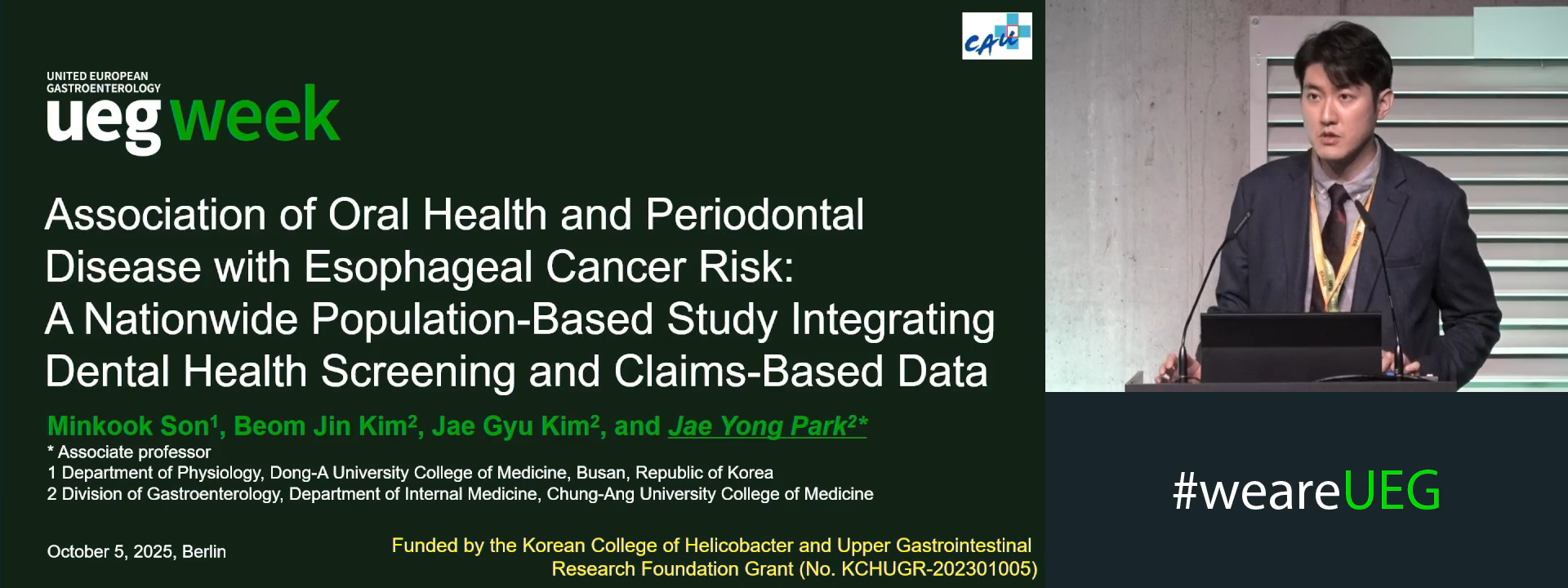
ASSOCIATION OF ORAL HEALTH AND PERIODONTAL DISEASE WITH ESOPHAGEAL CANCER RISK: A NATIONWIDE POPULATION-BASED STUDY INTEGRATING DENTAL HEALTH SCREENING AND CLAIMS-BASED DATA
1 Dong-A University College of Medicine, Busan, Korea, Republic of
2 Chung-Ang University College of Medicine, Seoul, Korea, Republic of
Event
Topics
Submission format
Citation
Published
Log in to access this content.
Free for all myUEG account holders. Your access level is set automatically based on your occupation. Medical professionals get full access to all content. If you are a non-medical user, you can only access UEG Week content from congresses you attended.
Not sure what you can access? Learn more about account types.
The Future of Faecal Microbiota Transplantation (FMT) with Maria Vehreschild
Topics
Published
Log in to access this content.
Free for all myUEG account holders. Your access level is set automatically based on your occupation. Medical professionals get full access to all content. If you are a non-medical user, you can only access UEG Week content from congresses you attended.
Not sure what you can access? Learn more about account types.
REAL-TIME COMPUTER-AIDED DETECTION OF GASTRIC NEOPLASMS: A NON-RANDOMIZED CONFIRMATORY TRIAL (G-CADE TRIAL)
Yuichiro Hirai 1, Seiichiro Abe 1, Naoto Iwai 2, Takashi Ueno 3, Hiroyuki Osawa 3, Yoshiyasu Kitagawa 4, Takuto Suzuki 4, Osamu Dohi 2
1 National Cancer Center Hospital, Tokyo, Japan
2 Kyoto Prefectural University of Medicine, Kyoto, Japan
3 Jichi Medical University, Shimotsuke, Japan
4 Chiba Cancer Center, Chiba, Japan
Conference
Topics
Submission format
Citation
Published
Log in to access this content.
Free for all myUEG account holders. Your access level is set automatically based on your occupation. Medical professionals get full access to all content. If you are a non-medical user, you can only access UEG Week content from congresses you attended.
Not sure what you can access? Learn more about account types.
Microbiome: Implications for clinicians - gut-liver and gut-pancreas axis
1 Universitätsklinikum Göttingen, Hamburg, Germany
2 Fondazione Policlinico Universitario 'A.Gemelli' - IRCCS, MONTEROTONDO - ROME, Italy