UEG's educational platform for gastroenterology education bringing recordings, courses, guidelines, and more together in one place.
Most popular content
Rate for better recommendations!
Your feedback helps us show you more of what you like and less of what you dislike!
Log in to access this content.
Free for all myUEG account holders. Your access level is set automatically based on your occupation. Medical professionals get full access to all content. If you are a non-medical user, you can only access UEG Week content from congresses you attended.
Not sure what you can access? Learn more about account types.
Why doesn’t your colleague know what an endoscopy nurse does?
1 Hospital universitario insular de Gran Canaria, None, Spain
Event
Topics
Session
Citation
Published
Log in to access this content.
Free for all myUEG account holders. Your access level is set automatically based on your occupation. Medical professionals get full access to all content. If you are a non-medical user, you can only access UEG Week content from congresses you attended.
Not sure what you can access? Learn more about account types.
Leadership training: Optimising team management
1 Leiden University Medical Center, Leiden, Netherlands
Event
Topics
Citation
Published
Log in to access this content.
Free for all myUEG account holders. Your access level is set automatically based on your occupation. Medical professionals get full access to all content. If you are a non-medical user, you can only access UEG Week content from congresses you attended.
Not sure what you can access? Learn more about account types.
NORMALISATION OF HEALTH-RELATED QUALITY OF LIFE OUTCOMES IN PATIENTS WITH MODERATELY TO SEVERELY ACTIVE ULCERATIVE COLITIS TREATED WITH UPADACITINIB: A POST-HOC ANALYSIS OF PHASE 3 U-ACHIEVE & U-ACCOMPLISH STUDIES
Joana Torres 1, Corey A. Siegel 2, Julian Panés 3, Edward V Loftus Jr 4, Remo Panaccione 5, Yuri Sanchez Gonzalez 6, Si Xuan 6, Justin Klaff 6, Cecile Holweg 6, Valencia Remple 6, Dolly Sharma 6, Gareth Parkes 7
1 Gastroenterology Division, Hospital Beatriz Angelo; Gastroenterology Division, Hospital da Luz, Lisbon, Portugal
2 Dartmouth Hitchcock Medical Center, Lebanon, United States
3 Hospital Clínic Barcelona, Barcelona, Spain
4 Mayo Clinic College of Medicine, Rochester, United States
5 University of Calgary, Calgary, Canada
6 AbbVie Inc., North Chicago, United States
7 Barts Health NHS Trust; Barts and the London School of Medicine and Dentistry, London, United Kingdom
Event
Topics
Submission format
Citation
Published
Log in to access this content.
Free for all myUEG account holders. Your access level is set automatically based on your occupation. Medical professionals get full access to all content. If you are a non-medical user, you can only access UEG Week content from congresses you attended.
Not sure what you can access? Learn more about account types.
ASSOCIATION OF NONSWITCHED MEMORY B-CELL (MBC) LEVELS WITH OZANIMOD (OZA) EFFICACY IN PATIENTS (PTS) WITH MODERATELY TO SEVERELY ACTIVE CROHN’S DISEASE (CD): RESULTS FROM THE PHASE 2 STEPSTONE STUDY
Sarah Harris 1, Brian G. Feagan 2, Steve Hanauer 3, Severine Vermeire 4, Subrata Ghosh 5, Jim Yan 6, Chun Wu 1, Yanhua Hu 1, Rachel Maddux 1, Douglas C. Wolf 7, Geert D’Haens 8
1 Bristol Myers Squibb, Princeton, United States
2 Robarts Research Institute, Western University, London, Ontario, Canada
3 Northwestern University Feinberg School of Medicine, Chicago, United States
4 University of Leuven, Leuven, Belgium
5 APC Microbiome Ireland, College of Medicine and Health, University College Cork, Cork, Ireland
6 Laboratory Corporation of America, Durham, United States
7 Center for Crohn’s Disease & Ulcerative Colitis, Atlanta Gastroenterology Associates, Atlanta, United States
8 Inflammatory Bowel Disease Center, Amsterdam University Medical Center, Amsterdam, Netherlands
Event
Topics
Submission format
Citation
Published
Log in to access this content.
Free for all myUEG account holders. Your access level is set automatically based on your occupation. Medical professionals get full access to all content. If you are a non-medical user, you can only access UEG Week content from congresses you attended.
Not sure what you can access? Learn more about account types.

REAPPRAISAL OF THE EOSINOPHILIC ESOPHAGITIS ENDOSCOPIC REFERENCE SCORE (EREFS): SUBSCORING INFLAMMATORY AND FIBROTIC FINDINGS IMPROVES THE ASSESSMENT OF DISEASE ACTIVITY
Pierfrancesco Visaggi 1, Irene Solinas 1, Gaia Pellegatta 2, Federico Testi 1, Gaia Cairoli 1, Mauro Mitilini 1, Isabella Dulmin 1, Valeria Poletti 2, Giacomo Marcozzi 2, Massimo Bellini 1, Emanuele Marciano 3, Stefano Siboni 4, Alessandro Repici 2, Edoardo Vincenzo Savarino 5, Nicola de Bortoli 1
1 University of Pisa, Pisa, Italy
2 Humanitas Research Hospital, Rozzano, Italy
3 Azienda Ospedaliero Universitaria Pisana, Pisa, Italy
4 Policlinico San Donato, San Donato Milanese, Italy
5 University of Padua, Padua, Italy
Conference
Topics
Submission format
Citation
Published
Log in to access this content.
Free for all myUEG account holders. Your access level is set automatically based on your occupation. Medical professionals get full access to all content. If you are a non-medical user, you can only access UEG Week content from congresses you attended.
Not sure what you can access? Learn more about account types.
UNDERWATER TECHNIQUE IN COMPLICATED DIVERTICULAR DISEASE: INITIAL EXPERIENCE
1 Azienda Sanitaria Locale di Benevento, Benevento, Italy
2 Azienda Sanitaria Locale di Benevento, Benevento, Italy|||Azienda Sanitaria Locale di Benevento, Benevento, Italy
Conference
Topics
Submission format
Citation
Published
Log in to access this content.
Free for all myUEG account holders. Your access level is set automatically based on your occupation. Medical professionals get full access to all content. If you are a non-medical user, you can only access UEG Week content from congresses you attended.
Not sure what you can access? Learn more about account types.
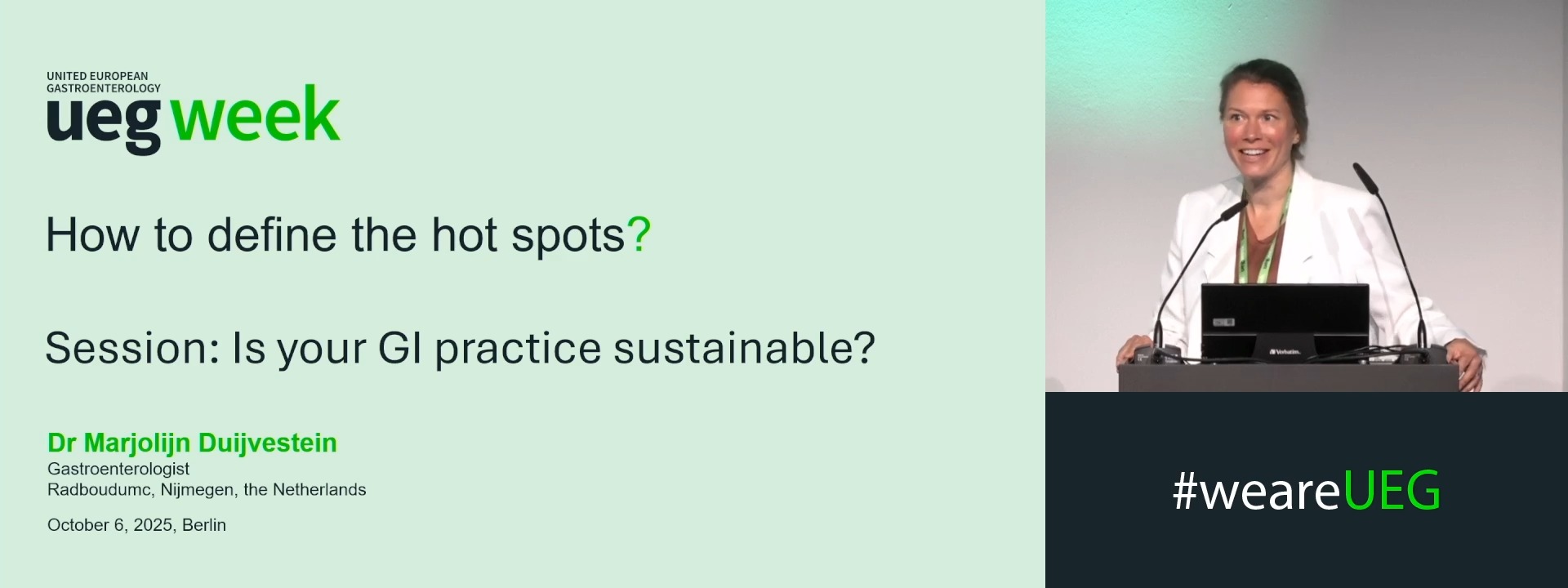
How to define the hot spots?
1 Radboudumc, Nijmegen, Netherlands
Event
Session