UEG's educational platform for gastroenterology education bringing recordings, courses, guidelines, and more together in one place.
Most popular content
Rate for better recommendations!
Your feedback helps us show you more of what you like and less of what you dislike!
Log in to access this content.
Free for all myUEG account holders. Your access level is set automatically based on your occupation. Medical professionals get full access to all content. If you are a non-medical user, you can only access UEG Week content from congresses you attended.
Not sure what you can access? Learn more about account types.

HIGH PREVALENCE OF STEATOTIC LIVER DISEASE AND FIBROSIS IN SCREENING COLONOSCOPY PATIENTS: A MISSED OPPORTUNITY FOR EARLY DETECTION?
1 Regional Hospital Liberec, Liberec, Czechia
2 4th Department of Internal Medicine, Prague, Czechia|||Regional Hospital Liberec, Liberec, Czechia
Conference
Topics
Submission format
Session
Citation
Published
Log in to access this content.
Free for all myUEG account holders. Your access level is set automatically based on your occupation. Medical professionals get full access to all content. If you are a non-medical user, you can only access UEG Week content from congresses you attended.
Not sure what you can access? Learn more about account types.
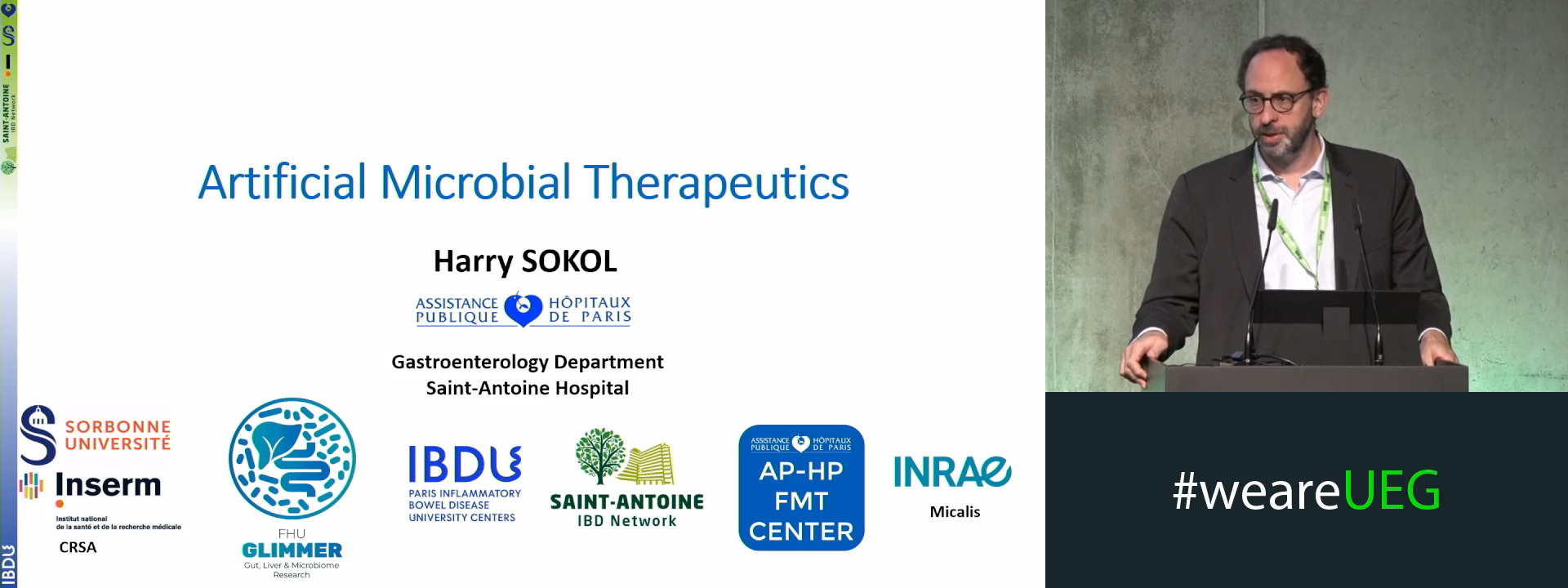
Artificial microbial therapeutics
1 Saint-Antoine Hospital, Paris, France
Event
Topics
Session
Citation
Published
Log in to access this content.
Free for all myUEG account holders. Your access level is set automatically based on your occupation. Medical professionals get full access to all content. If you are a non-medical user, you can only access UEG Week content from congresses you attended.
Not sure what you can access? Learn more about account types.
DEVELOPMENT AND VALIDATION OF AUTOMATIC UPPER GASTROINTESTINAL ENDOSCOPY REPORT GENERATION SYSTEM BASED ON MULTIMODAL LARGE LANGUAGE MODEL
Lingde Feng 1, Linna Luo 1, Bingzhong Jing 1, Huiling Wu 1, wencheng Tan 1, Xudong Hu 1, Yin Li 1, Li Jianjun 1, Longjun He 1
1 Sun Yat-sen University Cancer Center, Guangzhou, China
Conference
Topics
Submission format
Citation
Published
Log in to access this content.
Free for all myUEG account holders. Your access level is set automatically based on your occupation. Medical professionals get full access to all content. If you are a non-medical user, you can only access UEG Week content from congresses you attended.
Not sure what you can access? Learn more about account types.
ARTIFICIAL INTELLIGENCE IN THE MANAGEMENT OF UPPER GASTROINTESTINAL BLEEDING: A NEW DECISION-MAKING TOOL
Chaimae Haddad Hachimi 1, Amine Achemlal 2, Chaimae Hiji 2, sanaa berrag 2, Nejjari Fouad 2, Tarik ADIOUI 2, Mouna Tamzaourte 2
1 Mohamed V Military Training Hospital, Faculty of Medicine and Pharmacy of Rabat, Rabat, Morocco
2 Mohamed V Military Training Hospital, Rabat, Morocco
Conference
Topics
Submission format
Citation
Published
Log in to access this content.
Free for all myUEG account holders. Your access level is set automatically based on your occupation. Medical professionals get full access to all content. If you are a non-medical user, you can only access UEG Week content from congresses you attended.
Not sure what you can access? Learn more about account types.
APPROACH TO CASES OF FAILED PRE-CUT SPHINCTEROTOMY - SEEKING BILE DUCT WITH THE HYDROPHILIC GUIDE WIRE, COMPLETELY DEPENDENT ON FLUOROSCOPIC VIEW
1 Mitsui Memorial Hospital, Tokyo, Japan
Conference
Topics
Submission format
Citation
Published
Log in to access this content.
Free for all myUEG account holders. Your access level is set automatically based on your occupation. Medical professionals get full access to all content. If you are a non-medical user, you can only access UEG Week content from congresses you attended.
Not sure what you can access? Learn more about account types.
OBESITY AS A FACTOR IN ENDOSCOPIC RETROGRADE CHOLANGIOPANCREATOGRAPHY OUTCOMES: MYTH OR REALITY?
1 Hitit University, Çorum, Türkiye
Conference
Topics
Submission format
Citation
Published
Log in to access this content.
Free for all myUEG account holders. Your access level is set automatically based on your occupation. Medical professionals get full access to all content. If you are a non-medical user, you can only access UEG Week content from congresses you attended.
Not sure what you can access? Learn more about account types.
UNUSUAL PRESENTATION OF ACTINOMYCOSIS AS SOFT TISSUE MASS IN THE GASTROHEPATIC SPACE, IN THE POST LIVER TRANSPLANT SETTING
1 University Hospital Birmingham, Walsall, United Kingdom
2 Walsall Manor Hospital, Walsall, United Kingdom
3 Northern General Hospital, Sheffield, United Kingdom
4 Salisbury District Hospital, Salisbury, United Kingdom
Conference
Topics
Submission format
Session