UEG's educational platform for gastroenterology education bringing recordings, courses, guidelines, and more together in one place.
Most popular content
Rate for better recommendations!
Your feedback helps us show you more of what you like and less of what you dislike!
Log in to access this content.
Free for all myUEG account holders. Your access level is set automatically based on your occupation. Medical professionals get full access to all content. If you are a non-medical user, you can only access UEG Week content from congresses you attended.
Not sure what you can access? Learn more about account types.
ACUTE STROKE IN A PATIENT WITH ULCERATIVE COLITIS INITIATED ON UPADACITINIB: A CASE REPORT
1 McMaster University, Hamilton, Canada
2 Chatham-Kent Health Alliance, Chatham, Canada|||Western University, London, Canada
Conference
Topics
Submission format
Session
Published
Log in to access this content.
Free for all myUEG account holders. Your access level is set automatically based on your occupation. Medical professionals get full access to all content. If you are a non-medical user, you can only access UEG Week content from congresses you attended.
Not sure what you can access? Learn more about account types.
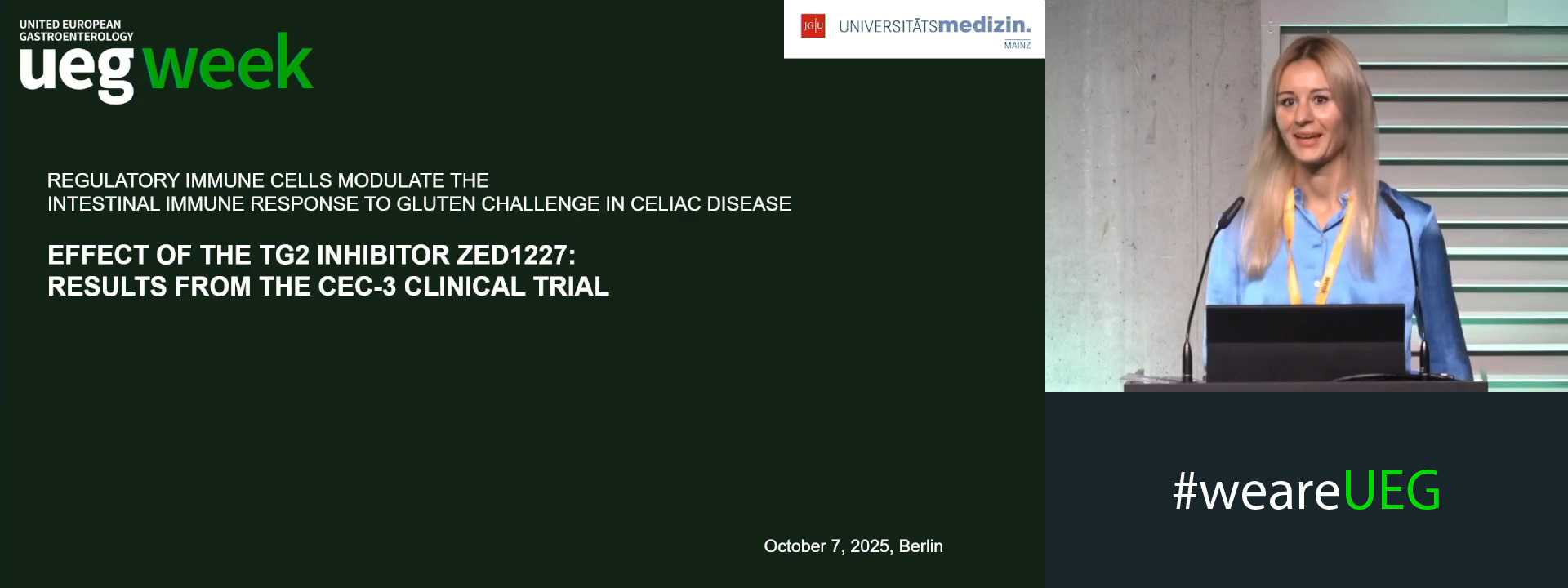
REGULATORY IMMUNE CELLS MODULATE THE INTESTINAL IMMUNE RESPONSE TO GLUTEN CHALLENGE IN CELIAC DISEASE – EFFECT OF THE TG2 INHIBITOR ZED1227: RESULTS FROM THE CEC-3 CLINICAL TRIAL
Aline Pesi 1, Valeriia Dotsenko 2, Jorma Isola 3, Ralf Mohrbacher 4, Bernhard Tewes 5, Martin Hils 6, Ralf Pasternack 6, Juha Taavela 7, Timo Zimmerman 4, Knut E.A. Lundin 8, Markku Mäki 9, Keijo Viiri 2, Detlef Schuppan 10
1 University Medicine Mainz, Mainz, Germany
2 Tampere University, Tampere, Finland
3 Tampere University, Tampere, Finland|||Jilab Inc, Tampere, Finland
4 Dr. Falk Pharma GmbH, Freiburg, Germany
5 Dr. Falk Pharma Gmbh, Freiburg, Germany
6 Zedira GmbH, Darmstadt, Germany
7 Tampere University Hospital, Tampere, Finland|||Celiac Disease Research Center, Tampere university and Tampere Univrsity Hospital, Tampere, Finland
8 Norwegian Coeliac Disease Research Centre, University of Oslo and Oslo University Hospital, Oslo, Norway|||Norwegian Coeliac Disease Research Centre, Oslo University Hospital Rikshospitalet, Oslo, Norway
9 Tampere university Faculty of Medicine and Health Technology, Tampere, Finland
10 Medical University Mainz - Institute of Translational Immunology, Medical University Mainz ; Mainz/D, Mainz, Germany|||Beth Israel Deaconess Medical Center, Harvard Medical School, Boston, United States
Event
Submission format
Citation
Published
Log in to access this content.
Free for all myUEG account holders. Your access level is set automatically based on your occupation. Medical professionals get full access to all content. If you are a non-medical user, you can only access UEG Week content from congresses you attended.
Not sure what you can access? Learn more about account types.
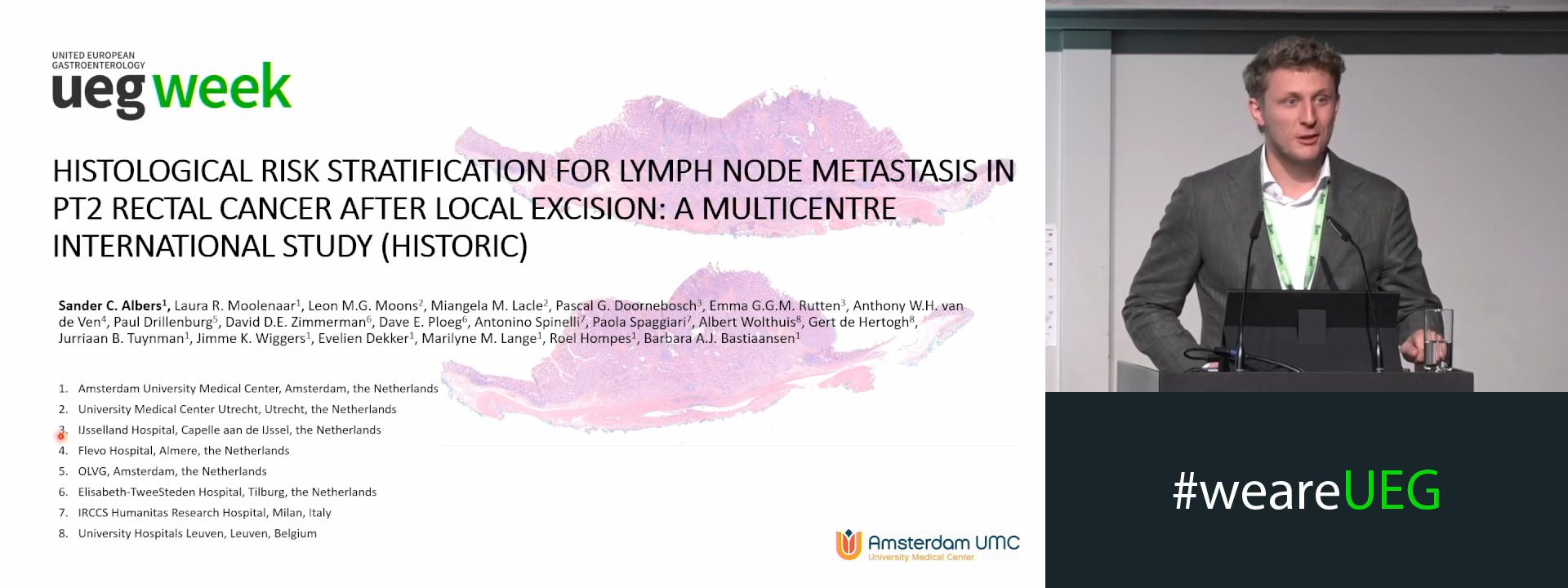
HISTOLOGICAL RISK STRATIFICATION FOR LYMPH NODE METASTASIS IN PT2 RECTAL CANCER AFTER LOCAL EXCISION: A MULTICENTRE INTERNATIONAL STUDY
Sander C. Albers 1, Laura Moolenaar 1, Leon M.G. Moons 2, Miangela M. Lacle 2, Pascal G. Doornebosch 3, Emma G.G.M. Rutten 3, Anthony W.H. van de Ven 4, Paul Drillenburg 5, David D.E. Zimmerman 6, Dave E. Ploeg 6, Antonino Spinelli 7, Paola Spaggiari 7, Albert Wolthuis 8, Gert De Hertogh 8, Jurriaan Tuynman 1, Jimme Wiggers 1, Evelien Dekker 1, Marilyne M. Lange 1, Roel Hompes 1, Barbara A.J. Bastiaansen 1
1 Amsterdam University Medical Center, Amsterdam, Netherlands
2 University Medical Center Utrecht, Utrecht, Netherlands
3 IJsselland Hospital, Capelle aan de IJssel, Netherlands
4 Flevo Hospital, Almere, Netherlands
5 OLVG, Amsterdam, Netherlands
6 Elisabeth-TweeSteden Hospital, Tilburg, Netherlands
7 IRCCS Humanitas Research Hospital, Milan, Italy
8 University Hospital Leuven, Leuven, Belgium
Event
Submission format
Session
Citation
Published
Log in to access this content.
Free for all myUEG account holders. Your access level is set automatically based on your occupation. Medical professionals get full access to all content. If you are a non-medical user, you can only access UEG Week content from congresses you attended.
Not sure what you can access? Learn more about account types.
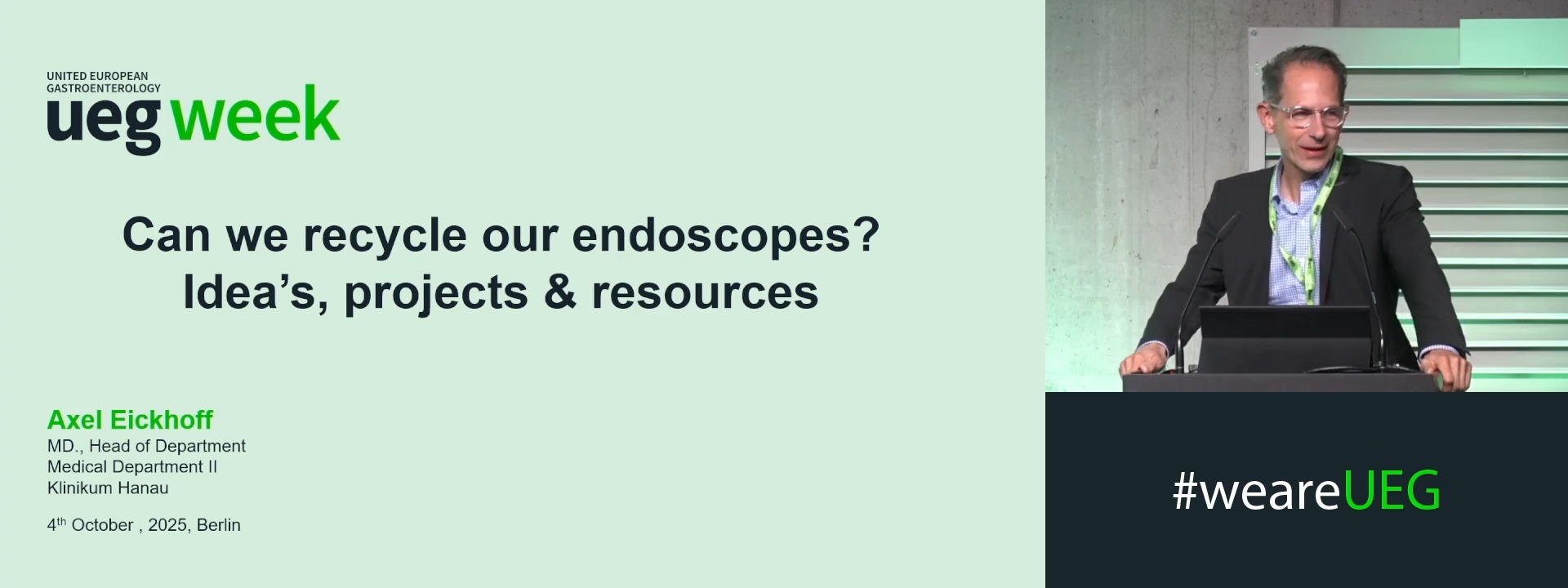
Can we recycle our endoscopes? Ideas, Projects and resources
1 Klinikum Hanau, None, Germany
Event
Topics
Citation
Published
Log in to access this content.
Free for all myUEG account holders. Your access level is set automatically based on your occupation. Medical professionals get full access to all content. If you are a non-medical user, you can only access UEG Week content from congresses you attended.
Not sure what you can access? Learn more about account types.
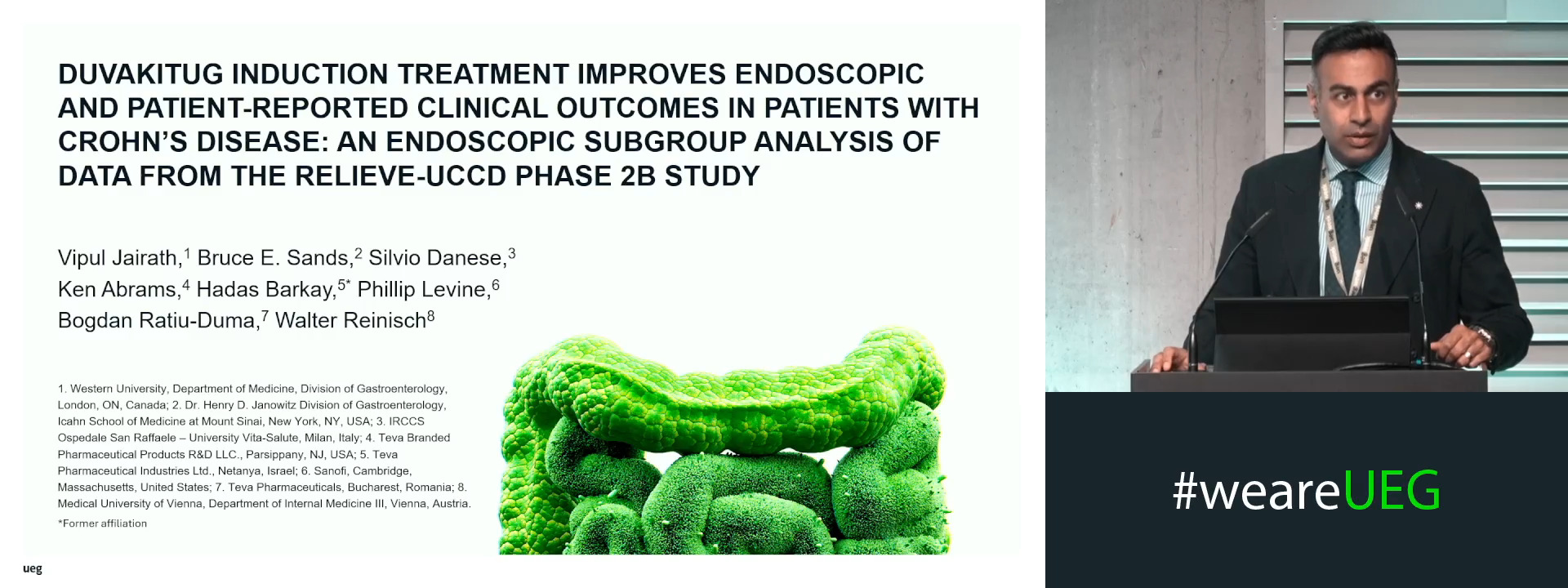
DUVAKITUG INDUCTION TREATMENT IMPROVES ENDOSCOPIC AND PATIENT-REPORTED CLINICAL OUTCOMES IN PATIENTS WITH CROHN’S DISEASE: AN ENDOSCOPIC SUBGROUP ANALYSIS OF DATA FROM THE RELIEVE-UCCD PHASE 2B STUDY
Vipul Jairath 1, Bruce E. Sands 2, Silvio Danese 3, Ken Abrams 4, Hadas Barkay 5, Phillip Levine 6, Bogdan Ratiu-Duma 7, Walter Reinisch 8
1 Western University, London, Canada
2 Icahn School of Medicine at Mount Sinai, New York, United States
3 Vita-Salute San Raffaele University - IRCCS San Raffaele Scientific Institute, Milan, Italy
4 Teva Branded Pharmaceutical Products R&D LLC, Parsippany, United States
5 Teva Pharmaceutical Industries Ltd, Netanya, Israel
6 Sanofi, Cambridge, United States
7 Teva Pharmaceuticals, Bucharest, Romania
8 Medical University of Vienna, Wien, Austria
Event
Submission format
Session
Citation
Published
Log in to access this content.
Free for all myUEG account holders. Your access level is set automatically based on your occupation. Medical professionals get full access to all content. If you are a non-medical user, you can only access UEG Week content from congresses you attended.
Not sure what you can access? Learn more about account types.
IMPACT OF CMV DETECTION IN COLONIC BIOPSIES ON CLINICAL OUTCOMES IN ACUTE SEVERE ULCERATIVE COLITIS
1 Royal North Shore Hospital, St Leonards, Australia
Conference
Topics
Submission format
Citation
Published
Log in to access this content.
Free for all myUEG account holders. Your access level is set automatically based on your occupation. Medical professionals get full access to all content. If you are a non-medical user, you can only access UEG Week content from congresses you attended.
Not sure what you can access? Learn more about account types.
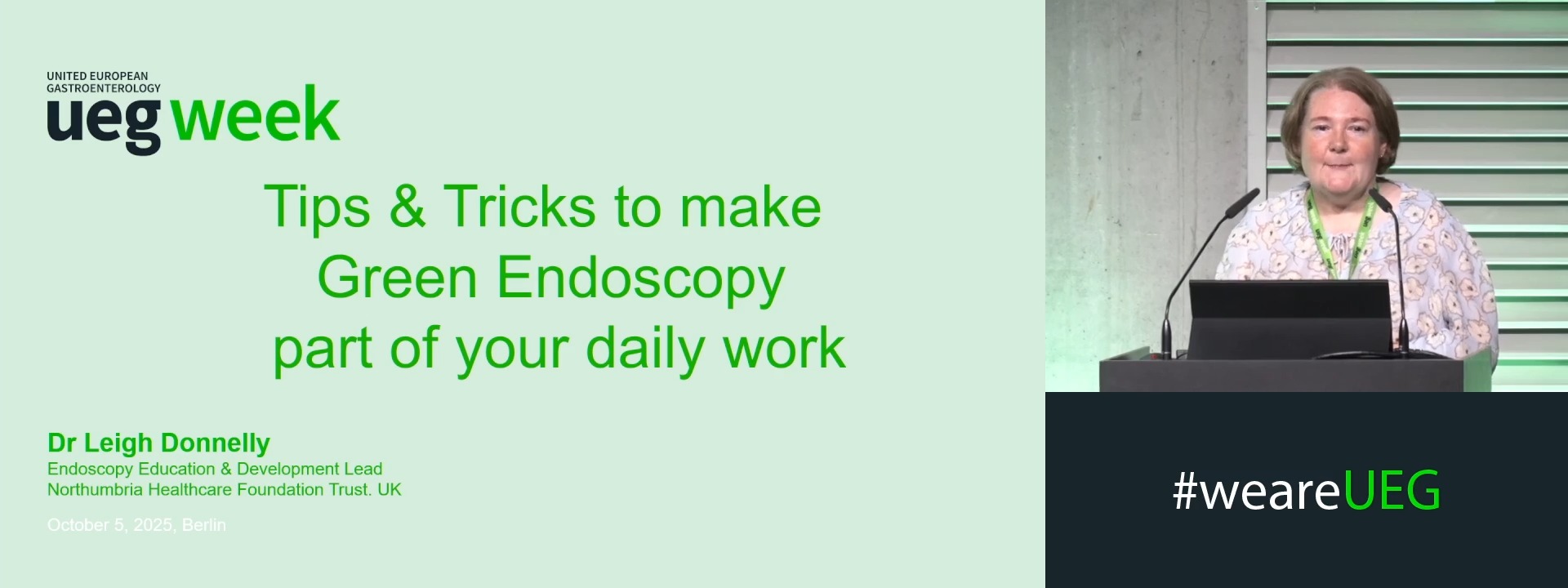
Tips and tricks to make green endoscopy part of your daily work
1 WANSBECK HOSPITAL, Ashington, United Kingdom
Event
Topics