UEG's content platform for gastroenterology education bringing recordings, courses, guidelines, and more together in one place.
Trending on Gutflix
Rate for better recommendations!
Your feedback helps us show you more of what you like and less of what you dislike!
Log in to continue.
This content is part of Gutflix. Log in with your myUEG account, or create one free, to watch it.
Not sure what you can access? Learn more about account types.
EUS-guided biliary drainage (Complete Session)
Log in to continue.
This content is part of Gutflix. Log in with your myUEG account, or create one free, to watch it.
Not sure what you can access? Learn more about account types.
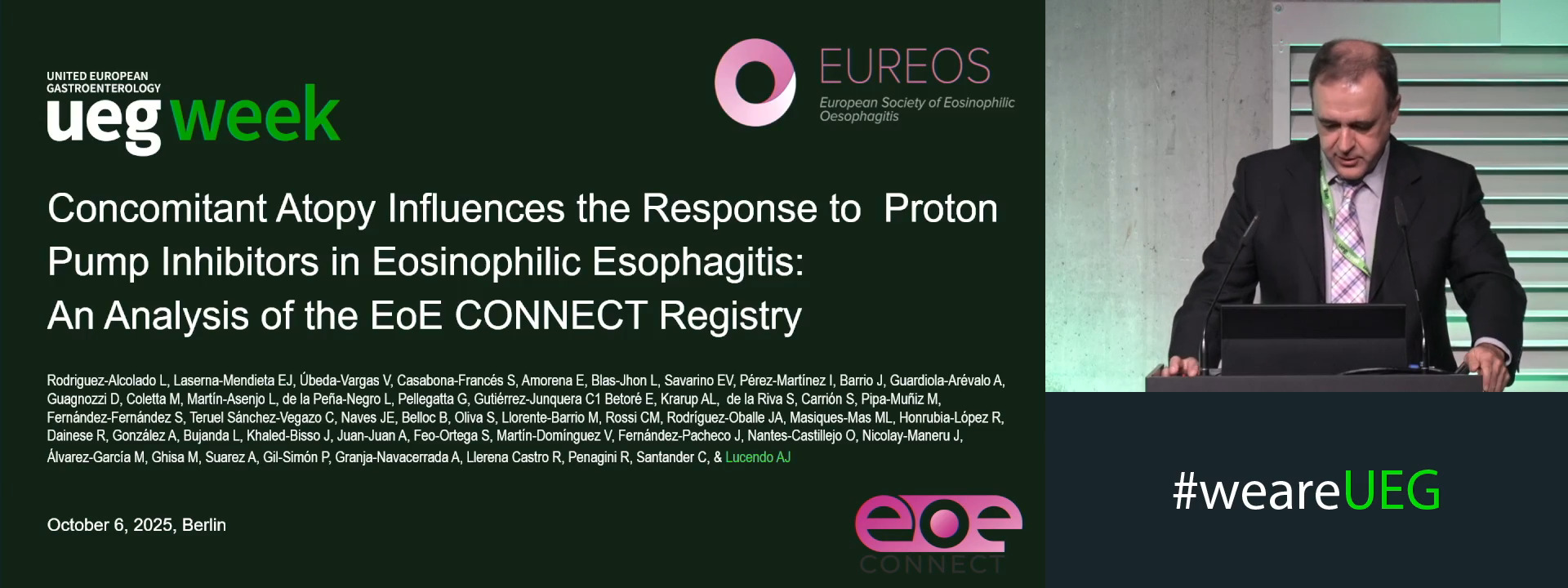
CONCOMITANT ATOPY INFLUENCES RESPONSE TO PROTON-PUMP INHIBITORS IN EOSINOPHILIC ESOPHAGITIS: AN ANALYSIS OF THE EOE CONNECT REGISTRY
Leticia Rodríguez-Alcolado 1,2, Emilio Jose Laserna-Mendieta 1,3, Victoria Úbeda Vargas 1, Sergio Casabona-Francés 4,5, Edurne Amorena Muro 6, Leonardo Blas 7, Edoardo Vincenzo Savarino 8, Isabel Pérez-Martínez 9,10, Jesús Barrio Andrés 11, Antonio Guardiola Arevalo 12, Danila Guagnozzi 13, Marina Coletta 14, Laura Martín Asenjo 15, Luisa de la Peña Negro 16, Gaia Pellegatta 17, Alejandro García-Díaz 18, Elena Betoré 19, Anne Lund Krarup 20, Susana de la Riva 21, Silvia Carrión Bolorino 3,22, María Pipa 23, Sonia Fernandez-Fernandez 24, Carlos Teruel Sanchez - Vegazo 25, Juan Naves 26, BLANCA BELLOC 27, Salvatore Oliva 28, Mónica Llorente-Barrio 29, Carlo Maria Rossi 30, Juan Armando Rodríguez Oballe 31, Maria Luisa Masiques-Mas 32, Raúl Honrubia-López 33, Raffaella Dainese Plichon 34, Alexis González Almeida 35, Luis Bujanda Fernández de Piérola 36, Juan Khaled Bisso Zein 37, Alba Juan-Juan 38, Sara Feo Ortega 1, Verónica Martín Domínguez 4,5, Jennifer Fernández-Pacheco 4,5, Oscar Nantes Castillejo 6, Julia Nicolay Maneru 6, Marta Álvarez-García 7, Matteo Ghisa 8, Carmen Díaz-Donado 9, Paula Gil Simón 11, Alicia Granja 12, Ronald Llerena Castro 13, Roberto Penagini 14, Cecilio Santander 4,5, Alfredo J. Lucendo 1,3
Affiliations
1 Hospital General de Tomelloso, Instituto de Investigación Sanitaria de Castilla-La Mancha (IDISCAM), Tomelloso, Spain
2 University of Alcalá, Alcalá de Henares, Spain
3 Centro de Investigación Biomédica en Red de Enfermedades Hepáticas y Digestivas (CIBERehd), Madrid, Spain
4 Hospital Universitario de La Princesa, Madrid, Spain
5 Instituto de Investigación Sanitaria La Princesa, Madrid, Spain
6 Hospital Universitario de Navarra. Instituto de Investigación Sanitaria de Navarra (IdiSNA), Pamplona, Spain
7 Fundacion Jiménez Díaz, Madrid, Spain
8 Azienda Ospedaliera Università di Padova, Padua, Italy
9 Hospital Universitario Central de Asturias, Oviedo, Spain
10 Instituto de Investigación Sanitaria del Principado de Asturias (ISPA), Oviedo, Spain
11 Hospital Universitario Rio Hortega, Valladolid, Spain
12 Hospital Universitario de Fuenlabrada, Fuenlabrada, Spain
13 Hospital Vall d'Hebrón, Barcelona, Spain
14 Fondazione IRCCS Cà Granda - Ospedale Maggiore Policlinico, Milan, Italy
15 Hospital Universitario de Álava, Vitoria, Spain
16 Hospital de Viladecans, Viladecans, Spain
17 Humanitas Research Hospital, Rozzano, Italy
18 Hospital Universitario Puerta de Hierro, Majadahonda, Spain
19 Hospital Universitario Miguel Servet, Zaragoza, Spain
20 The North Danish Regional Hospital, Hjørring, Denmark
21 Clínica Universidad de Navarra, Pamplona, Spain
22 Hospital de Mataró, Mataró, Spain
23 Hospital Universitario de Cabueñes, Gijón, Spain
24 Hospital Universitario Severo Ochoa, Leganés, Spain
25 Hospital Universitario Ramón y Cajal, Madrid, Spain
26 Hospital del Mar, Barcelona, Spain
27 Hospital General de la Defensa, Zaragoza, Spain
28 University Hospital Umberto I - Sapienza University of Rome, Roma, Italy
29 Hospital Santa Bárbara, Soria, Spain
30 Fondazione IRCCS Policlinico San Matteo, Pavia, Italy
31 Hospital Universitario Santa María, Lérida, Spain
32 Hospital de Granollers, Granollers, Spain
33 Hospital Universitario Infanta Sofía, San Sebastián de los Reyes, Spain
34 Centre Hospitalier d’Antibes Juan-les-Pins, Antibes, France
35 Complejo Hospitalario Universitario Insular Materno Infantil, Las Palmas de Gran Canaria, Spain
36 Hospital Universitario de Donostia-Instituto Biodonostia, San Sebastián, Spain
37 Hospital Universitario Costa del Sol, Marbella, Spain
38 Hospital Sant Joan Despí Moisès Broggi, Sant Joan Despí, Spain
Log in to continue.
This content is part of Gutflix. Log in with your myUEG account, or create one free, to watch it.
Not sure what you can access? Learn more about account types.
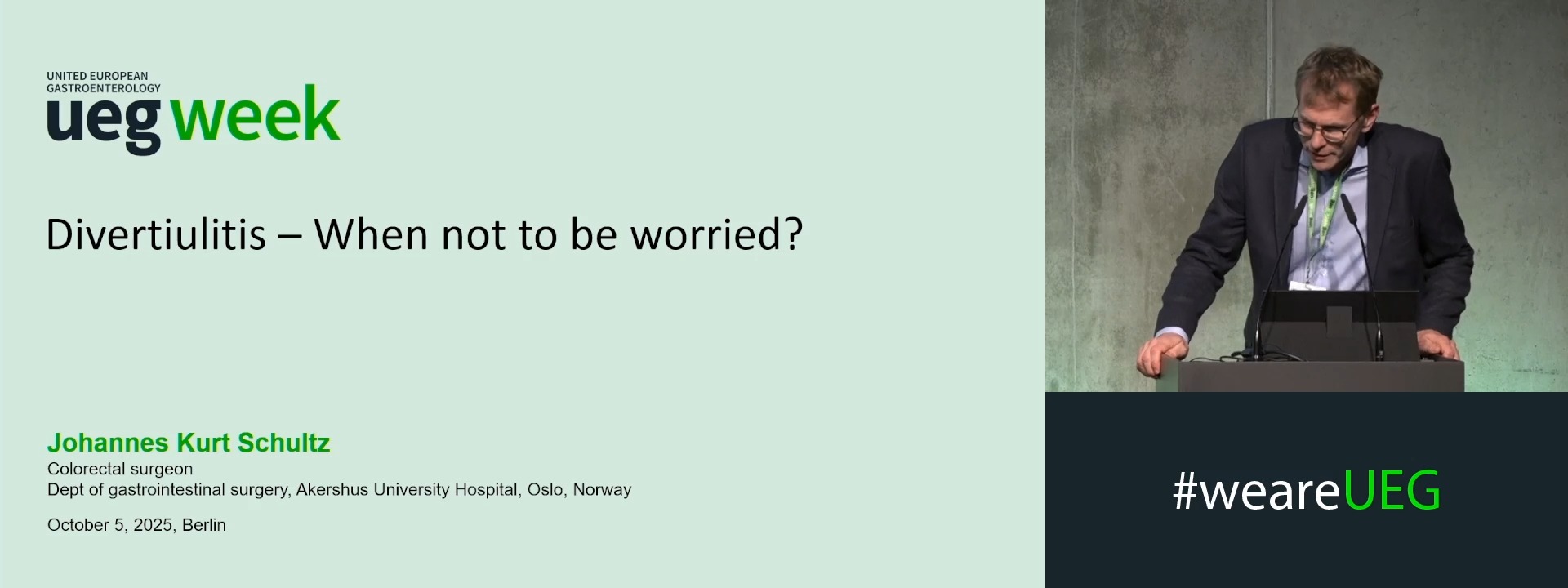
Diverticulitis: When not to be worried?
Affiliations
1 Univertsity of Oslo, Oslo, Norway
Log in to continue.
This content is part of Gutflix. Log in with your myUEG account, or create one free, to watch it.
Not sure what you can access? Learn more about account types.
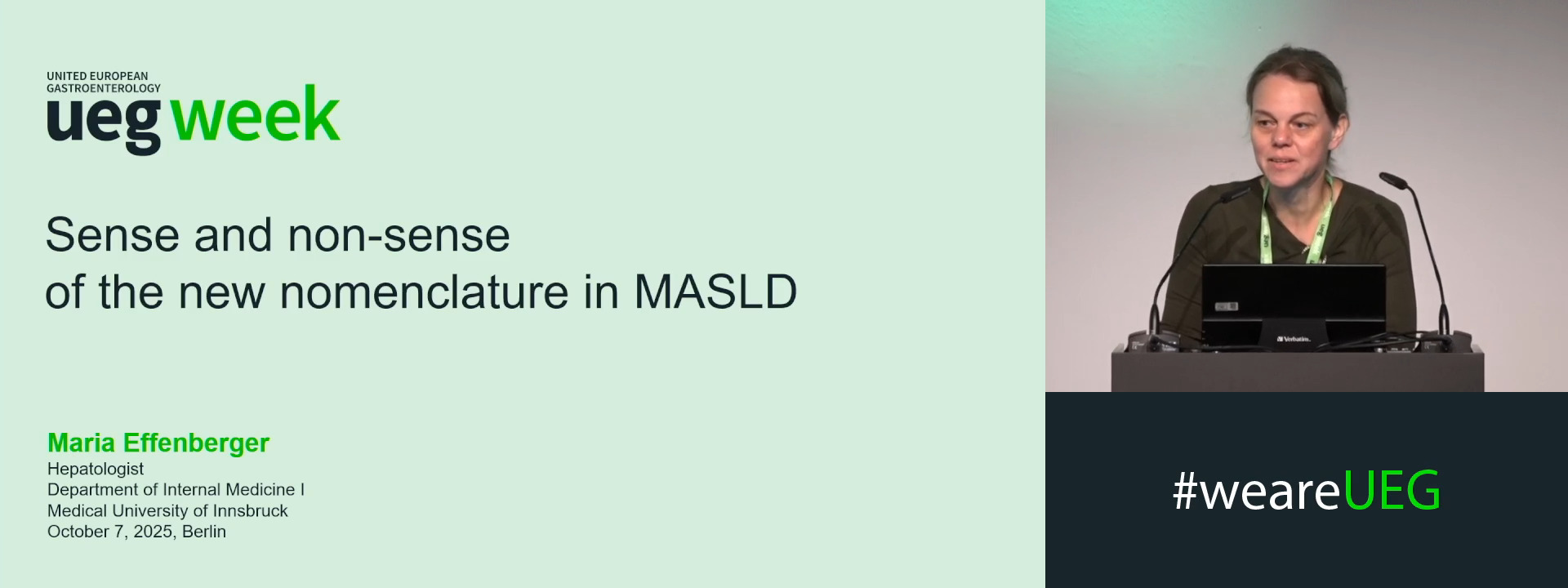
Sense and non-sense of the new nomenclature
Affiliations
1 Medical University of Innsbruck, Innsbruck, Austria