UEG Week Recordings UEG Week Posters Online courses Guidelines Mistakes in... Podcasts Webinars
new
Gut Guide online
Visit ueg.eu Create myUEG account Log In

Filters:

UEG Presentation
Share via Email Share on Facebook Share on X Share on LinkedIn Share on Bluesky
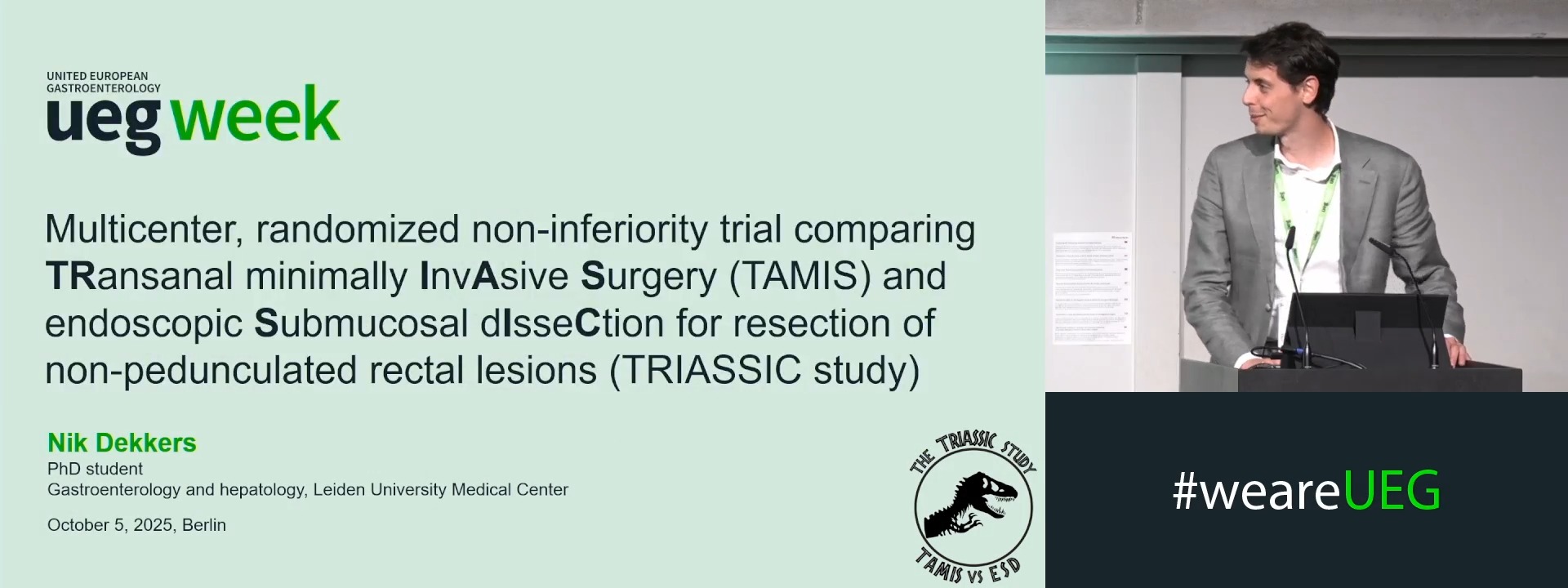
MULTICENTER, RANDOMIZED NON-INFERIORITY TRIAL COMPARING TRANSANAL MINIMAL INVASIVE SURGERY (TAMIS) AND ENDOSCOPIC SUBMUCOSAL DISSECTION (ESD) FOR RESECTION OF NON-PEDUNCULATED RECTAL LESIONS (TRIASSIC STUDY)

Log in to access this content.

Free for all myUEG account holders. Your access level is set automatically based on your occupation. Medical professionals get full access to all content. If you are a non-medical user, you can only access UEG Week content from congresses you attended.

Log In Create a free account

Not sure what you can access? Learn more about account types.

Introduction

​Transanal Minimally Invasive Surgery (TAMIS) and Endoscopic Submucosal Dissection (ESD) are minimally invasive techniques for en bloc resection of large non-pedunculated rectal lesions. While TAMIS has been widely adopted in the Netherlands, ESD uptake has been slower. No randomized trials have compared these methods, leaving the choice of technique dependent on local expertise rather than evidence.

Aims & Methods

This multicenter-randomized non-inferiority trial (NTR7281) aimed at comparing TAMIS and ESD regarding effectiveness, safety, patient burden, and costs. In total, 198 patients with non-pedunculated rectal lesions >2 cm, located ≤15 cm from the anal verge, were included. Patients were randomized in a 1:1 ratio to TAMIS or ESD, with stratification by polyp size (20–40 mm or >40 mm) and distance from the dentate line (<10 mm, 10–99 mm, 100–150 mm), after an expert panel had judged the lesions suitable for inclusion. Exclusion criteria included deep submucosal invasion on endoscopy or imaging (with endoscopy prioritized in case of discordant findings), prior endoscopic resection attempt, and an unfavorable risk-benefit ratio for local treatment (e.g., poor general condition or very short life expectancy). The primary endpoint was cumulative local recurrence at 12 months (non-inferiority margin: 6%). Secondary endpoints included radical (R0) resection rate, complications (AGREE classification), patient burden (COREFO, EQ-5D-5L, QLQ-CR29), and cost-effectiveness. Intention-to-treat analysis was performed.

Results

Of the 198 randomized patients (98 TAMIS, 100 ESD), 5 crossed over from TAMIS to ESD and 1 from ESD to TAMIS. One patient dropped out before treatment as result of non-related metastatic disease. Mean polyp size was 42.0 mm. Mean procedure time was 108.7 minutes for ESD and 78.1 minutes for TAMIS. In total, 156 benign and 41 malignant lesions (39 T1, 2 T2, and 1 T3) were resected. At 12 months, 6 recurrences occurred: 0 (0%) in the ESD group and 6 (6.4%) in the TAMIS group, all benign, with a 6.4% difference favoring ESD (95% CI: -11.8 to -1.5), confirming non-inferiority and also superiority. R0 resection rates were 83% for ESD and 71% for TAMIS (p = 0.047). Overall complication rates were similar (p = 0.33). Colorectal functional outcomes at 12 months were similar and comparable to baseline. Quality-adjusted life years were also similar (0.90 for ESD and 0.91 for TAMIS, p = 0.356). Despite a significant difference in the average initial procedure cost (€2.628 for ESD and €3365 for TAMIS, p < 0.001), the average total cost over 12 months was similar (€7.134 for ESD and €7216 for TAMIS, p = 0.934).

Conclusion

This trial is the first to show that ESD is non-inferior to TAMIS for local recurrence at 12 months in en bloc resection of large non-pedunculated rectal lesions. ESD showed superior radical resection rates and lower initial procedural costs, while both techniques had similar safety profiles, colorectal functional outcomes, quality-adjusted life years, and total 12-month costs.

Disclosure

The TRIASSIC study received funding by ZonMw and Applied medical.
A. Koch received consultancy fees from Microtech, Erbe and Fujifilm

MULTICENTER, RANDOMIZED NON-INFERIORITY TRIAL COMPARING TRANSANAL MINIMAL INVASIVE SURGERY (TAMIS) AND ENDOSCOPIC SUBMUCOSAL DISSECTION (ESD) FOR RESECTION OF NON-PEDUNCULATED RECTAL LESIONS (TRIASSIC STUDY)

Nik Dekkers 1, Daan Verhoeven 1, Jurjen J. Boonstra 1, Leon M.G. Moons 2, Roel Hompes 3, Barbara A.J. Bastiaansen 3, Jurriaan Tuynman 3, Arjun D. Koch 4, Bas L.A.M. Weusten 5, Alaa Alkhalaf 6, Eric J. T. Belt 7, Wilhelmus A. Bemelman 3, Esther C.J. Consten 8, Stijn Crobach 1, Richard Dang 1, Paul Didden 2, Brechtje Grotenhuis 9, Hakimullah Hekmat 10, Elmer Hoekstra 11, Wilbert B. van den Hout 1, Inge Huibregtse 9, Josbert J. Keller 12, jolein van der Kraan 1, Alexandra Langers 1, Monique van leerdam 13, Andreas W.K.S. Marinelli 12, Peter A. Neijenhuis 14, Jikke M.T. Omloo 15, Apollo Pronk 16, Robert Roomer 17, Mar Rodríguez–Girondo 1, Ruud W. M. Schrauwen 18, Matthijs P. Schwartz 8, Mareille Verseveld 17, Wouter De Vos Tot Nederveen Cappel 6, Bob J. van Wely 18, Marinke Westerterp 12, Erik Van Westreenen 6, Eelco J.R. de Graaf 10, Jonathan Y.L. Lai 12, Rogier ten Hove 14, Hans F.A. Vasen 1, Pascal G. Doornebosch 10, James Hardwick 1

1 Leiden University Medical Center, Leiden, Netherlands

2 University Medical Center Utrecht, Utrecht, Netherlands

3 Amsterdam UMC, Amsterdam, Netherlands

4 Erasmus MC Cancer Institute, Rotterdam, Netherlands

5 St Antonius Hospital, Nieuwegein, Netherlands

6 Isala Clinics, Zwolle, Netherlands

7 Albert Schweitzer Hospital, Dordrecht, Netherlands

8 Meander Medical Center, Amersfoort, Netherlands

9 Netherlands Cancer Institute, Amsterdam, Netherlands

10 IJsselland Hospital, Capelle aan den IJssel, Netherlands

11 Hagaziekenhuis, The Hague, Netherlands

12 Haaglanden Medical Center, The Hague, Netherlands

13 Netherlands Cancer Institute, Amsterdam, Netherlands|||Leiden University Medical Center, Leiden, Netherlands

14 Alrijne Hospital, Leiderdorp, Netherlands

15 Gelre Hospitals, Apeldoorn, Netherlands

16 Diakonessenhuis, Utrecht, Netherlands

17 Franciscus Gasthuis, Rotterdam, Netherlands

18 Bernhoven Hospital, Uden, Netherlands

Event

UEG Week Berlin 2025

Topics

Colorectal Endoscopy Surgery

Submission format

Abstract

Session

Improving decision-making in colorectal lesions

Citation

United European Gastroenterology Journal 2025; 13 (Supplement 8)

Published

2025
UEG Presentation
Share via Email Share on Facebook Share on X Share on LinkedIn Share on Bluesky
UEG Journal Best Paper Award

Log in to access this content.

Free for all myUEG account holders. Your access level is set automatically based on your occupation. Medical professionals get full access to all content. If you are a non-medical user, you can only access UEG Week content from congresses you attended.

Log In Create a free account

Not sure what you can access? Learn more about account types.

UEG Journal Best Paper Award

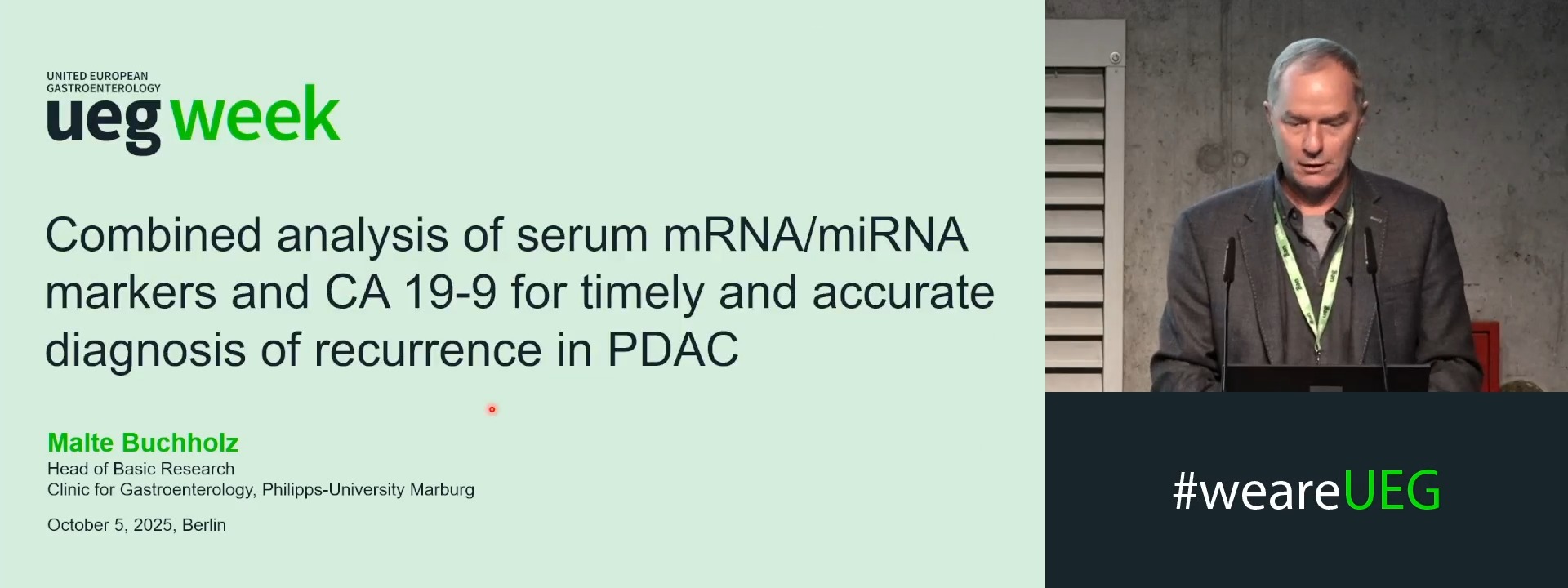
Malte Buchholz 1

1 Uni Marburg, Marburg, Germany

Event

UEG Week Berlin 2025

Topics

Nurses Pancreas Radiology & Imaging

Session

Hot topics in European gastroenterology

Citation

United European Gastroenterology Journal 2025; 13 (Supplement 8)

Published

2025
UEG Presentation
Share via Email Share on Facebook Share on X Share on LinkedIn Share on Bluesky
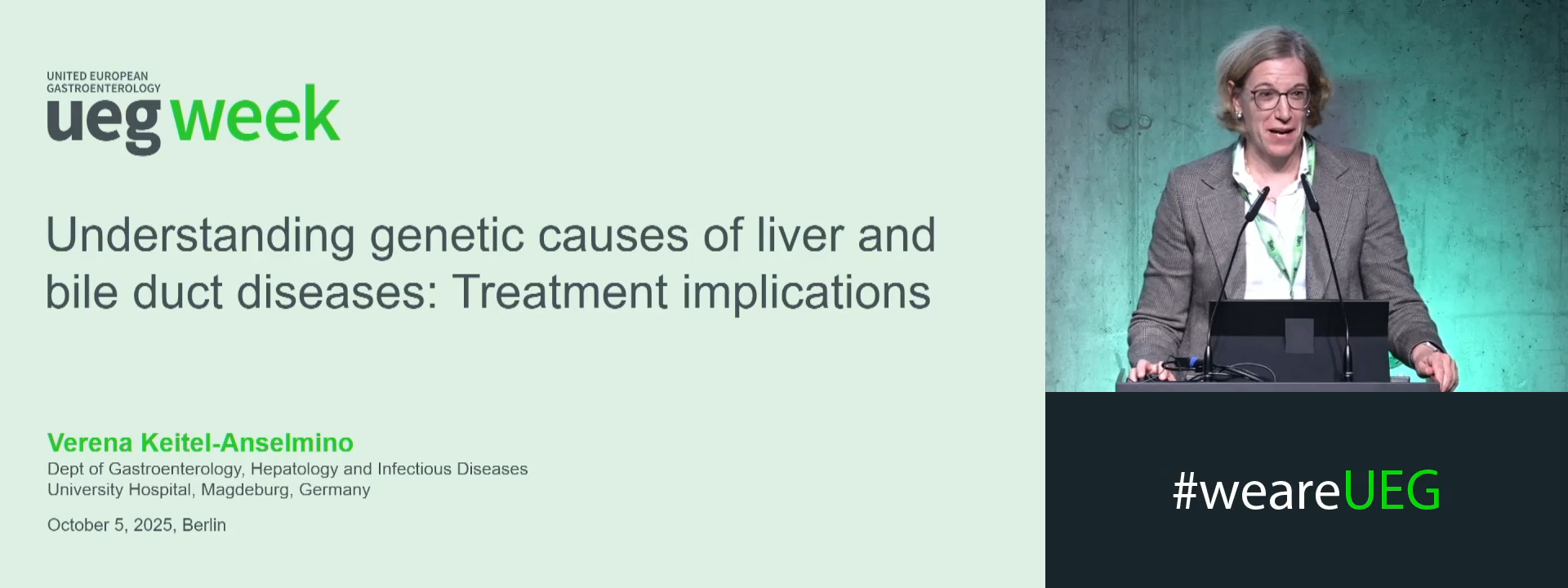
Undertstanding genetic causes of liver and bile duct diseases: Treatment implications

Log in to access this content.

Free for all myUEG account holders. Your access level is set automatically based on your occupation. Medical professionals get full access to all content. If you are a non-medical user, you can only access UEG Week content from congresses you attended.

Log In Create a free account

Not sure what you can access? Learn more about account types.

Undertstanding genetic causes of liver and bile duct diseases: Treatment implications

Verena Keitel-Anselmino 1

1 University Hospital Magdeburg, Magdeburg, Germany

Event

UEG Week Berlin 2025

Topics

Hepatobiliary Mechanisms & Personalised Medicine

Session

Infectious and rare hepatitis

Citation

United European Gastroenterology Journal 2025; 13 (Supplement 8)

Published

2025
UEG Presentation
Share via Email Share on Facebook Share on X Share on LinkedIn Share on Bluesky
Diverticulitis: When not to be worried?

Log in to access this content.

Free for all myUEG account holders. Your access level is set automatically based on your occupation. Medical professionals get full access to all content. If you are a non-medical user, you can only access UEG Week content from congresses you attended.

Log In Create a free account

Not sure what you can access? Learn more about account types.

Diverticulitis: When not to be worried?

Johannes Kurt Schultz 1

1 Univertsity of Oslo, Oslo, Norway

Event

UEG Week Berlin 2025

Topics

Colorectal Hepatobiliary Pancreas

Session

Predicting disease severity

Citation

United European Gastroenterology Journal 2025; 13 (Supplement 8)

Published

2025
UEG Presentation
Share via Email Share on Facebook Share on X Share on LinkedIn Share on Bluesky
ENDOSCOPIC ULTRASONOGRAPHY-GUIDED GASTROENTEROSTOMY VERSUS SURGICAL GASTROJEJUNOSTOMY FOR PALLIATION OF MALIGNANT GASTRIC OUTLET OBSTRUCTION (ENDURO)

Log in to access this content.

Free for all myUEG account holders. Your access level is set automatically based on your occupation. Medical professionals get full access to all content. If you are a non-medical user, you can only access UEG Week content from congresses you attended.

Log In Create a free account

Not sure what you can access? Learn more about account types.

Introduction

Gastric outlet obstruction is a common manifestation of advanced gastric, duodenal, and periampullary malignancies, severely affecting quality of life. Endoscopic ultrasonography-guided gastroenterostomy (EUS-GE) may be superior to surgical gastroenterostomy (SGJ) as palliative treatment for this condition, but randomised trials are currently lacking.

Aims & Methods

We performed a multicenter, randomized controlled trial involving palliative patients with a malignant obstruction localized between the pylorus and the distal duodenum, randomizing them 1:1 to either EUS-GE or SGJ. The first co-primary superiority end point was time to solid oral intake. The second co-primary non-inferiority end point was persistent or recurrent obstructive symptoms for which a reintervention was required within six months after treatment. The predefined non-inferiority margin was 20%.

Results

From February 2022 to February 2024, 250 patients were screened in 12 participating hospitals in the Netherlands. Of the 98 enrolled patients, 48 were assigned to EUS-GE and 50 were assigned to SGJ. Median age was 69 versus 70 years and the most prevalent etiology was pancreatic cancer in 58% versus 50% in the EUS-GE group and SGJ group, respectively. Median time to oral intake was significantly shorter in the EUS-GE group compared to the SGJ group: 1 day versus 3 days (hazard ratio, 2.21, 95% CI, 1.43 to 3.42, p=0.0003). In the endoscopic group, 5 patients (10%) experienced persistent or recurrent obstructive symptoms requiring reintervention, compared with 6 patients (12%) in the surgical group (risk difference, 1.6%, upper limit of 90% CI, 8.9%). Clinical success, defined as the ability to tolerate solid oral intake, was higher in the EUS-GE group (96% versus 80%, relative risk, 1.20, 95% CI, 1.03 to 1.39). Median length of hospital stay was shorter in the EUS-GE group (1 day versus 4 days, relative change, 0.46, 95% CI, 0.20 to 0.78). Serious adverse events, defined as Clavien-Dindo ≥3B, were observed in 8% of patients in the EUS-GE group and in 12% of patients in the SGJ group (relative risk, 0.69, 95% CI, 0.21 to 2.31). Median survival was 91 days after EUS-GE (95% CI, 74 to 140) and 74 days (95% CI, 46 to 110) after SGJ. Thirty-day mortality was 13% in the EUS-GE group and 26% in the SGJ group (relative risk, 0.48, 95% CI, 0.20 to 1.14). In the first three months following the procedure, quality of life was not different between the two treatments.

Conclusion

This trial showed that EUS-GE, compared to SGJ, is superior in terms of time to solid oral intake and non-inferior with regards to the rate of persistent or recurrent obstructive symptoms requiring reintervention. Based on these results, EUS-GE should be the preferred palliative treatment for malignant gastric outlet obstruction.

Disclosure

Yorick L. van de Pavert, Janine B. Kastelijn, Marc G. Besselink, Dieke C. Booij, Jurjen J. Boonstra, Judith Boot, Olivier R.C. Busch, Wouter J.M. Derksen, Bas Groot Koerkamp, Akin Inderson, Wim J. Lammers, Daan J. Lips, J. Sven D. Mieog, I. Quintus Molenaar, Alexander A.F.A. Veenhof, Niels G. Venneman, Robert C. Verdonk, Paco M.J. Welsing, Thomas R. de Wijkerslooth, and Hjalmar C. van Santvoort report no conflicts of interest.
Freek Daams is proctor for Intuitive, received educational grants from Medtronic, and received speaker’s fees from Johnson & Johnson and Medtronic.
Paul Fockens is consultant for Cook Endoscopy and Olympus.
Rogier P. Voermans reports research grants from Boston Scientific and Prion Medical, performed as a consultant for Boston Scientific and Cook Medical, and received speaker’s fees from Mylan and Zambon.
Roy L.J. van Wanrooij is a consultant for Boston Scientific.
Marco J. Bruno is a consultant for Boston Scientific, Cook Medical, and Pentax Medical; received support for industry-initiated studies from Boston Scientific and Cook Medical; and received support for investigator-initiated studies from Boston Scientific, Cook Medical, Pentax Medical, Mylan, Interscope, and ChiRhoStim.
Jeanin E. van Hooft received lecture fees from Cook Medical, Boston Scientific, Medtronic, and Abbvie, is an independent observer for Olympus, and is the current secretary general of the federation United European Gastroenterology (UEG).
Leon M.G. Moons is a consultant for Boston Scientific.
Frank P. Vleggaar is a consultant for Boston Scientific.

ENDOSCOPIC ULTRASONOGRAPHY-GUIDED GASTROENTEROSTOMY VERSUS SURGICAL GASTROJEJUNOSTOMY FOR PALLIATION OF MALIGNANT GASTRIC OUTLET OBSTRUCTION (ENDURO)

Yorick van de Pavert 1, Janine Kastelijn 1, Marc G. Besselink 2, Dieke C. Booij 3, Jurjen J. Boonstra 4, Judith Boot 1, Marco J. Bruno 3, Olivier R.C. Busch 2, Freek Daams 5, Wouter J.M. Derksen 6, Paul Fockens 7, Bas Groot Koerkamp 8, Jeroen Hagendoorn 9, Jeanin van Hooft 4, Akin Inderson 4, Willem Lammers 3, Daan J. Lips 10, Sven Mieog 4, I. Quintus Molenaar 9, Alexander A.F.A. Veenhof 11, Niels G. Venneman 10, Robert C. Verdonk 12, Rogier P. Voermans 2, Roy LJ van Wanrooij 13, Paco M.J. Welsing 1, Thomas de Wijkerslooth 11, Leon M.G. Moons 1, Hjalmar C. van Santvoort 14, Frank P. Vleggaar 1

1 UMC Utrecht, Utrecht, Netherlands

2 Amsterdam UMC, Location University of Amsterdam, Amsterdam, Netherlands|||Cancer Center Amsterdam, Amsterdam, Netherlands

3 Erasmus University Medical Center, Rotterdam, Netherlands

4 Leiden University Medical Center, Leiden, Netherlands

5 Amsterdam UMC, Location Vrije Universiteit, Amsterdam, Netherlands|||Cancer Center Amsterdam, Amsterdam, Netherlands

6 St. Antonius Hospital, Nieuwegein, Netherlands|||UMC Utrecht, Utrecht, Netherlands

7 Cancer Center Amsterdam, Amsterdam, Netherlands|||Amsterdam UMC, Location University of Amsterdam, Amsterdam, Netherlands

8 Erasmus University Medical Center Cancer Institute, Rotterdam, Netherlands

9 UMC Utrecht, Utrecht, Netherlands|||St. Antonius Hospital, Nieuwegein, Netherlands

10 Medisch Spectrum Twente, Enschede, Netherlands

11 Netherlands Cancer Institute, Amsterdam, Netherlands

12 St. Antonius Hospital, Nieuwegein, Netherlands

13 Cancer Center Amsterdam, Amsterdam, Netherlands|||Amsterdam UMC, Location Vrije Universiteit, Amsterdam, Netherlands

14 University Medical Center Utrecht, Utrecht, Netherlands|||St. Antonius Hospital, Nieuwegein, Netherlands

Event

UEG Week Berlin 2025

Topics

Immunology Oesophagus

Submission format

Abstract

Session

Opening Plenary

Citation

United European Gastroenterology Journal 2025; 13 (Supplement 8)

Published

2025
UEG Presentation
Share via Email Share on Facebook Share on X Share on LinkedIn Share on Bluesky
Early versus delayed endoscopic necrosectomy (Complete Session)

Log in to access this content.

Free for all myUEG account holders. Your access level is set automatically based on your occupation. Medical professionals get full access to all content. If you are a non-medical user, you can only access UEG Week content from congresses you attended.

Log In Create a free account

Not sure what you can access? Learn more about account types.

Early versus delayed endoscopic necrosectomy (Complete Session)

Event

UEG Week Berlin 2025

Topics

Endoscopy

Session

Early versus delayed endoscopic necrosectomy

Citation

United European Gastroenterology Journal 2025; 13 (Supplement 8)

Published

2025
UEG Presentation
Share via Email Share on Facebook Share on X Share on LinkedIn Share on Bluesky
Acute pancreatitis: When to reserve an ITU bed?

Log in to access this content.

Free for all myUEG account holders. Your access level is set automatically based on your occupation. Medical professionals get full access to all content. If you are a non-medical user, you can only access UEG Week content from congresses you attended.

Log In Create a free account

Not sure what you can access? Learn more about account types.

Acute pancreatitis: When to reserve an ITU bed?

Georg Beyer 1

1 University Hospital LMU Munich, München, Germany

Event

UEG Week Berlin 2025

Topics

Colorectal Hepatobiliary Pancreas

Session

Predicting disease severity

Citation

United European Gastroenterology Journal 2025; 13 (Supplement 8)

Published

2025

The global reference point for the digestive health community

Platform Publisher

United European Gastroenterology

Wickenburggasse 1 1080 Vienna, Austria

Contact us

support@ueg.eu

ueg.eu

T: +43 1 997 1639

Legal

Terms & Conditions

Imprint

Privacy Policy

Explore

My Bookmarks

My recommendations

My fields of interest

© 2026 United European Gastroenterology

Change fields of interest

These fields are selected based on the interests in your myUEG profile.
Click the item to unselect it. You can select multiple items.