UEG Week Recordings UEG Week Posters Online courses Guidelines Mistakes in... Podcasts Webinars
Visit ueg.eu Create myUEG account Log In

Filters:

UEG Presentation
Share via Email Share on Facebook Share on X Share on LinkedIn Share on Bluesky
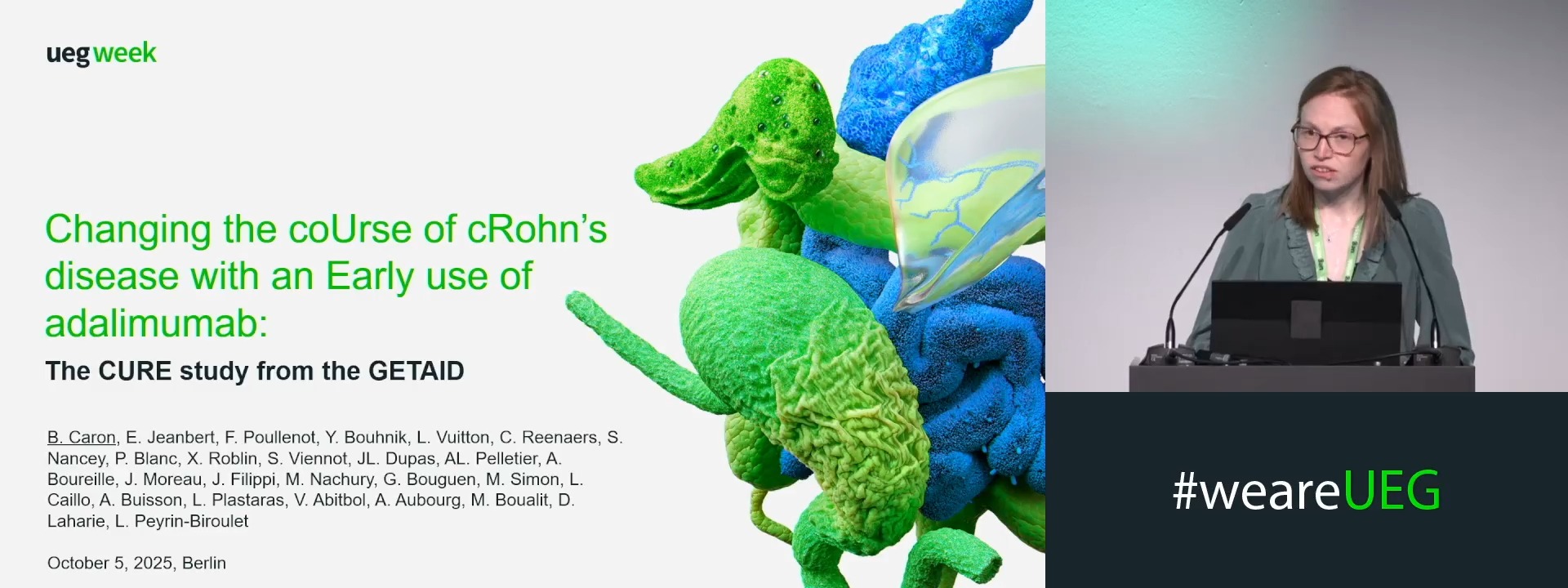
CHANGING THE COURSE OF CROHN’S DISEASE WITH AN EARLY USE OF ADALIMUMAB: THE CURE STUDY FROM THE GETAID

Log in to access this content.

Free for all myUEG account holders. Your access level is set automatically based on your occupation. Medical professionals get full access to all content. If you are a non-medical user, you can only access UEG Week content from congresses you attended.

Log In Create a free account

Not sure what you can access? Learn more about account types.

Introduction

Crohn's disease (CD) is a disabling and destructive disease. Early intervention associated with tight monitoring appear to the best way to achieve deep remission and to prevent disease progression. Whether anti-TNF (tumor necrosis factor) therapy can be interrupted in patients with early CD who have undergone a period of prolonged deep remission is unknown.

Aims & Methods

The primary objective was to evaluate the sustained deep remission rate one year after discontinuation of a 12-month course of adalimumab in adult patients with early CD who achieved deep remission at 12 months after treatment induction and who were already in clinical remission and biomarker remission at 6 months.
We carried out a multicentre prospective GETAID cohort study. All patients had early luminal CD less than 24 months since diagnosis, and were naïve to biologics. The primary study endpoint was percentage of patients with sustained deep remission one year after stopping a 12-months course of adalimumab (+/- 3 months) in adult patients with early-stage CD who achieved deep remission without therapeutic intervention (i.e. no surgery, no clinical flare-up, no introduction of CD-related treatment, no need for adalimumab optimization) AND who were already in clinical remission (CDAI < 150) and biomarker remission (CRP < 5 mg/L and fecal calprotectin < 250) at 6 months. A clinical flare-up was defined as a CDAI > 220 or an increase in CDAI between two subsequent visits > 70.

Results

A total of 171 patients received treatment with adalimumab between March 2015 and March 2019.
In this cohort, 39.2% (67/171) were active smokers. The median disease duration was 4 [2-9] months. CD location was ileal (42.7%, 73/171), colonic (12.3%, 21/171), and ileo colonic (44.4%, 76/171). Twenty-one patients (12.3%) had perianal disease. The majority of patients had an inflammatory phenotype (71.3%, 122/171). At inclusion, median CRP level was 9.0 [3.0-24.0] mg/L, and median fecal calprotectin was 440.5 [159.0-838.0] µg/g.
Overall, 38/171 (22.2%) of patients achieved deep remission after a 12-month course of adalimumab. From those who achieved deep remission, 7 patients did not discontinue adalimumab. In this study, 7/31 (22.6%) patients maintained their deep remission for one year after their treatment discontinuation (24 months from initiation of adalimumab). Among the whole cohort, only 4% (7/171) of patients were in deep remission off adalimumab at 2 years. Median time between adalimumab discontinuation and the first clinical relapse was 14 months. No predictive factor associated with loss of deep remission in the year following treatment discontinuation was identified. No serious adverse event was reported.

Conclusion

In this first prospective trial exploring withdrawal of advanced therapy in early CD, 22.6% achieved deep remission at one year with adalimumab; among them, about a quarter maintained deep remission at two years. These results demonstrate that anti-TNF therapy should not be discontinued, even in patients with early CD.

CHANGING THE COURSE OF CROHN’S DISEASE WITH AN EARLY USE OF ADALIMUMAB: THE CURE STUDY FROM THE GETAID

Bénédicte Caron 1, Elodie Jeanbert 1, Florian Poullenot 2, Yoram Bouhnik 3, Lucine Vuitton 4, Catherine Reenaers 5, Stephane NANCEY 6, pierre Blanc 7, Xavier Roblin 8, Stéphanie Viennot 9, Jean-Louis Dupas 10, Anne Laure Pelletier 11, Arnaud Bourreille 12, Jacques Moreau 13, Jerome Filippi 14, Maria Nachury 15, Guillaume Bouguen 16, Marion Simon 17, Ludovic Caillo 18, Anthony Buisson 19, Laurianne Plastaras 20, Vered Abitbol 21, Alexandre Aubourg 22, Médina Boualit 23, David Laharie 24, Laurent Peyrin-Biroulet 25

1 Nancy University Hospital, Vandoeuvre les Nancy, France

2 Bordeaux University Hospital, Bordeaux, France

3 CHU Beaujon Dept. of IBD and Nutrition, Clichy, France

4 Besançon university hospital gastroenterology, Courbevoie, France

5 Assistants en formation gastro, réseau Ulg - CHU Sart Tilman, Assistants en formation gastro, réseau, Lantremange, Belgium

6 Lyon University Hospital, Pierre Benite, France

7 Hopital Saint Eloi, Montpellier, France

8 University of St. Etienne Dept. de Gastroenterologie, Saint Etienne, France

9 CHRU de Caen HGE 19è étage, Caen Cedex, France

10 CHU Nord Amiens, Amiens, France

11 Hopital Beaujon, Paris, France

12 Hopital Hotel Dieu Et Hme - Hge Aile Sud, Nantes Cedex 1, France

13 Centre Hospitalier Universitaire de Toulouse, Hopital Rangueil, Toulouse, France

14 Hopital de lAchet Dept. de Gastroenterlogie Dept. de Nutrition Oncologie, Nice Cedex 3, France

15 CHRU Lille, Courbevoie Cedex, France

16 CHU Pontchaillou, Rennes, France

17 Institut Mutualiste Montsouris, Paris, France

18 CHU DE NIMES, Nîmes, France

19 CHU Estaing Clermont-Ferrand, Clermont-ferrand, France

20 Chu Colmar, Colmar, France

21 Hopital Cochin Gastroentérologie AP-HP, Paris Cedex 14, France

22 Cabinet Medical, Chambray Les Tours, France

23 Ch Valenciennes, Valenciennes Cedex, France

24 CHU de Bordeaux Hopital Haut-Leveque Dept. de Gastroenterologie, Pessac cedex, France

25 Inserm U1256, Nancy University Hospital, Vandoeuvre-les-Nancy, France
Event

UEG Week Berlin 2025

Topics

IBD Mechanisms & Personalised Medicine

Submission format

Abstract

Session

Clinical management of IBD

Citation

United European Gastroenterology Journal 2025; 13 (Supplement 8)

Published

2025
UEG Presentation
Share via Email Share on Facebook Share on X Share on LinkedIn Share on Bluesky
COMPARISON OF ATEZOLIZUMAB PLUS BEVACIZUMAB AND DURVALUMAB PLUS TREMELIMUMAB TREATMENTS FOR ADVANCED STAGE HEPATOCELLULAR CARCINOMA IN LIVER CIRRHOSIS PATIENTS WITH CHILD-PUGH CLASS B

Log in to access this content.

Free for all myUEG account holders. Your access level is set automatically based on your occupation. Medical professionals get full access to all content. If you are a non-medical user, you can only access UEG Week content from congresses you attended.

Log In Create a free account

Not sure what you can access? Learn more about account types.

Introduction

An important issue for unresectable advanced stage hepatocellular carcinoma (uHCC) patients with Child-Pugh class B liver cirrhosis (CP-B), is lack of safe treatment options that show therapeutic efficacy, thus it is considered to be an unmet need. Atezolizumab plus bevacizumab (At/Bv) and durvalumab plus tremelimumab (Dur/Tre) have each been used as first-line systemic immunotherapy for uHCC.

Aims & Methods

The present study aimed to elucidate clinical outcomes of uHCC patients with CP-B treated with those combination treatments. The records of 169 uHCC patients with CP-B in Japan, treated with At/Bv or Dur/Tre as first-line systemic therapy from 2020 to 2024 at participating institutions were examined (median age: 73 years, males: 143, Child-Pugh score 7:8:9 = 121:43:5, BCLC stage B:C = 65:104, At/Bv:Dur/Tre = 131:38). Each regimen was analyzed for therapeutic efficacy and safety, and the results compared, in a retrospective manner.

Results

Using RECIST, ver. 1.1, the objective response rate (ORR) was shown to be 25.9% in the At/Bv group, and 18.4% in the Dur/Tre group (p=0.08). Disease control rate (DCR) was significantly higher in the At/Bv group (64.9% vs. 39.5%, p=0.01). There were no significant differences between the groups for progression-free survival (PFS) [At/Bv vs. Dur/Tre=5.3 vs. 3.5 months (95% CI: 3.9–6.5 and 2.3–7.2, respectively), p=0.90], overall survival (OS) [10.5 vs. 12.5 months (95% CI: 9.1–13.3 and 7.9–NA, respectively), p=0.58], or post-progression survival (PPS) [4.9 vs. 7.5 months (95% CI: 3.7–7.5 and 2.2–NA, respectively), p=0.60]. The rate of incidence of immune-related adverse events (irAEs) of any grade was 11.5% in the At/Bv group and 23.7% in the Dur/Tre group (p=0.07), while irAEs of grade 3 or higher were noted in 3.1% and 15.8%, respectively (p=0.02) significantly greater in the Dur/Tre group).

Conclusion

The incidence rate of irAEs in each group was similar to that observed in clinical trials previously performed for these regimens. uHCC patients with CP-B, who received Dur/Tre had a greater rate of incidence of high-grade irAEs, while the At/Bv group had a better DCR, though there were no significant differences for PFS, OS, or PPS between the groups. Neither treatment was found to sufficiently improve the prognosis of uHCC patients with CP-B. Development of safe and effective treatment options for patients affected by uHCC, that can be administered even to those with CP-B remains necessary.

Disclosure

Atsushi Hiraoka: lecture fee Chugai, AstraZeneca, and Lilly.

COMPARISON OF ATEZOLIZUMAB PLUS BEVACIZUMAB AND DURVALUMAB PLUS TREMELIMUMAB TREATMENTS FOR ADVANCED STAGE HEPATOCELLULAR CARCINOMA IN LIVER CIRRHOSIS PATIENTS WITH CHILD-PUGH CLASS B

Yuka Kimura 1, Hideko Ohama 1, Atsushi Hiraoka 1, Fujimasa Tada 1, Takeshi Hatanaka 2, Toshifumi Tada 3, Satoru Kakizaki 4, Yoichi Hiasa 5, Takashi Kumada 6

1 Ehime Prefectural Central Hospital, Matsuyama, Japan

2 Gunma Saiseikai Maebashi Hospital, Maebashi, Japan

3 Kobe University, Kobe, Japan

4 NHO Takasaki General Medical Center, Takasaki, Japan

5 Ehime University Graduate School of Medicine, Toon, Japan

6 Gifu Kyoritsu University, Gifu, Japan

Event

UEG Week Berlin 2025

Topics

Hepatobiliary Immunology Mechanisms & Personalised Medicine

Submission format

Abstract

Session

Bench to bedside and beyond frontiers in HCC

Citation

United European Gastroenterology Journal 2025; 13 (Supplement 8)

Published

2025
UEG Presentation
Share via Email Share on Facebook Share on X Share on LinkedIn Share on Bluesky
How to boost your biology? Every day strategies to improve therapies and combinations

Log in to access this content.

Free for all myUEG account holders. Your access level is set automatically based on your occupation. Medical professionals get full access to all content. If you are a non-medical user, you can only access UEG Week content from congresses you attended.

Log In Create a free account

Not sure what you can access? Learn more about account types.

How to boost your biology? Every day strategies to improve therapies and combinations

Britta Siegmund 1

1 Charité - Universitätsmedizin Berlin, Berlin, Germany

Event

UEG Week Berlin 2025

Topics

IBD Mechanisms & Personalised Medicine Surgery

Session

How to optimise success in IBD treatment

Citation

United European Gastroenterology Journal 2025; 13 (Supplement 8)

Published

2025
UEG Presentation
Share via Email Share on Facebook Share on X Share on LinkedIn Share on Bluesky
When to call the surgeon?

Log in to access this content.

Free for all myUEG account holders. Your access level is set automatically based on your occupation. Medical professionals get full access to all content. If you are a non-medical user, you can only access UEG Week content from congresses you attended.

Log In Create a free account

Not sure what you can access? Learn more about account types.

When to call the surgeon?

Bas P.L. Wijnhoven 1

1 Erasmus MC Rotterdam Dept. of Surgery, Rotterdam, Netherlands

Event

UEG Week Berlin 2025

Topics

Endoscopy Nurses Paediatrics Surgery

Session

Crash course: Foreign bodies

Citation

United European Gastroenterology Journal 2025; 13 (Supplement 8)

Published

2025
UEG Presentation
Share via Email Share on Facebook Share on X Share on LinkedIn Share on Bluesky
Europe’s malabsorption game-changer: What every doctor must know!

Log in to access this content.

Free for all myUEG account holders. Your access level is set automatically based on your occupation. Medical professionals get full access to all content. If you are a non-medical user, you can only access UEG Week content from congresses you attended.

Log In Create a free account

Not sure what you can access? Learn more about account types.

Europe’s malabsorption game-changer: What every doctor must know!

Marco Vincenzo Lenti 1

1 Fondazione IRCCS Policlinico San Matteo, University of Pavia, Alessandria, Italy

Event

UEG Week Berlin 2025

Topics

Small Intestine & Nutrition Standards & Guidelines

Session

From guidelines to clinical practice: Bringing guidelines to life - Tackling malabsorption in clinical practice

Citation

United European Gastroenterology Journal 2025; 13 (Supplement 8)

Published

2025
UEG Presentation
Share via Email Share on Facebook Share on X Share on LinkedIn Share on Bluesky
IMPACT OF DIAPHRAGMATIC RELAXING INCISION ON RECURRENCE RATE AFTER PARAESOPHAGEAL HERNIA REPAIR; 1 YEAR RESULTS OF A DOUBLE-BLIND, RANDOMIZED CLINICAL TRIAL

Log in to access this content.

Free for all myUEG account holders. Your access level is set automatically based on your occupation. Medical professionals get full access to all content. If you are a non-medical user, you can only access UEG Week content from congresses you attended.

Log In Create a free account

Not sure what you can access? Learn more about account types.

Introduction

The optimal surgical approach to reduce recurrence rates after laparoscopic repair of paraesophageal hernia (PEH) is yet to be defined. The crural repair is challenged by both axial and transverse-lateral tension, which may compromise durability. The aim of this double-blind randomized clinical trial was to investigate whether a left-sided diaphragmatic relaxing incision in addition to standard crural repair and fundoplication reduces anatomical recurrence rates at one year postoperatively.

Aims & Methods

This study was conducted at two high-volume Swedish centers—Ersta Hospital (Stockholm) and Sahlgrenska University Hospital (Gothenburg)—between August 2019 and August 2023. Adult patients undergoing surgery for PEH were randomized 1:1 to either standard crural repair with total (360°) fundoplication (control) or the same procedure with the addition of a left-sided diaphragmatic relaxing incision covered by synthetic mesh (intervention). Patients with prior hiatal surgery, ASA class IV or above, type I hernia, major esophageal motility disorders, or any contraindication to fundoplication were excluded. Blinding for patients and assessors was maintained throughout follow-up. Pre- and postoperative assessments included computed tomography (CT), symptom questionnaires (Dakkak dysphagia score, Gastrointestinal Symptom Rating Scale [GSRS]), and quality of life (QoL, RAND-36). The primary outcome was radiologically confirmed PEH recurrence at 12 months.

Results

Of 103 patients screened, 76 were randomized (38 per group). Baseline characteristics were well balanced. CT was completed in 72 patients (95%) at 12 months. The recurrence rate was 66% in the control group and 54% in the intervention group (p=0.313). Three patients in the intervention group had asymptomatic CT verified herniation at the site of the diaphragmatic incision. There were no differences in recurrence size distribution (<4 cm vs >4 cm) between groups. Postoperative symptom assessment revealed significant improvements in dysphagia, reflux, indigestion, and abdominal pain in both groups, without intergroup differences. Physical QoL (PCS) improved significantlywhereas mental QoL (MCS) remained unchanged. Two deaths occurred within 90 days postoperatively (1 per group), yielding a 90-day mortality of 2.6%. Other complications included mediastinal abscess (n=1, intervention group) and need for postoperative endoscopic dilatation (n=5 in total). Operation time tended to be longer in the intervention group (150 vs 133 min; p=ns).

Crural repair alone Crural repair with relaxing diaphragmatic incision P value
Completed CT chest at 1 year35/3837/38
Radiological recurrence23 (66%)20 (54%).313
Recurrence<4cm12 (34%)11 (30%).522
Recurrence>4cm11 (31%)9 (24%).457

Table 1: Radiological recurrences 1 year after surgical repair of PEH

Conclusion

In this randomized, double-blind trial, the addition of a left-sided diaphragmatic relaxing incision to standard laparoscopic PEH repair did not improve anatomical recurrence rates, symptom relief or QoL at 12 months after surgery and should not be recommended for routine use. Alternative strategies to improve recurrence rates after PEH need to be explored in the future.

IMPACT OF DIAPHRAGMATIC RELAXING INCISION ON RECURRENCE RATE AFTER PARAESOPHAGEAL HERNIA REPAIR; 1 YEAR RESULTS OF A DOUBLE-BLIND, RANDOMIZED CLINICAL TRIAL

Alexandros Tsoposidis 1, Srdjan Kostic 1, Lars Lundell 2, Ville Wallenius 1, Hans Axelsson 1, Anders Thorell 3, Bengt Håkanson 3, Marcus Reuterwall Hansson 3

1 University of Gothenburg, Gothenburg, Sweden

2 Karolinska Institutet, Stockholm, Sweden

3 Karolinska Institutet, Stockholm, Sweden|||Ersta Hospital, Stockholm, Sweden

Event

UEG Week Berlin 2025

Topics

Neurogastroenterology & Motility Oesophagus

Submission format

Abstract

Session

Burning issues in GERD

Citation

United European Gastroenterology Journal 2025; 13 (Supplement 8)

Published

2025
UEG Presentation
Share via Email Share on Facebook Share on X Share on LinkedIn Share on Bluesky
EVALUATION OF SUBCUTANEOUS INFLIXIMAB FOR PERIANAL FISTULA HEALING IN CROHN’S DISEASE: PRELIMINARY RESULTS FROM THE REMSILAP MULTICENTER OBSERVATIONAL COHORT STUDY

Log in to access this content.

Free for all myUEG account holders. Your access level is set automatically based on your occupation. Medical professionals get full access to all content. If you are a non-medical user, you can only access UEG Week content from congresses you attended.

Log In Create a free account

Not sure what you can access? Learn more about account types.

Introduction

Management of perianal fistulas in Crohn’s disease (CD) is challenging and requires a multidisciplinary approach, combining surgical drainage and biologic therapies, such as infliximab (IFX). Higher IFX trough concentrations have been associated with improved fistula healing rates. The subcutaneous (SC) formulation of IFX achieves 2–3 times higher and more stable trough levels compared to intravenous (IV) formulation. This study hypothesizes that SC IFX could enhance perianal fistula healing rates in CD patients.

Aims & Methods

REMSILAP study is part of the 3TLAP cohort, a French prospective multicenter observational study evaluating optimal therapeutic strategies for achieving clinical and radiological remission of perianal fistulas in CD at 12 months post-surgical drainage. The REMSILAP substudy focuses specifically on patients receiving SC IFX. Patients who received SC IFX after or within six months prior to surgical drainage were included. Baseline was defined as the day of surgical drainage. The primary outcome was the proportion of patients achieving complete clinical remission defined as Perianal Disease Activity Index (PDAI) fistula drainage subscore = 0 associated with PDAI activity restriction subscore <3 and absence of seton, and radiological remission at 12 months. Here, we present preliminary findings from REMSILAP.

Results

Among the 353 patients enrolled in the 3TLAP cohort, 54 were included in REMSILAP. The cohort consisted of 61.1% male patients, with a median age of 36 years and a median disease duration of 4.5 years. Penetrating disease (B3 phenotype) was present in 40.7%, and 33.3% had a history of surgical resection. At baseline, 40.7% of patients had quiescent disease regarding Harvey-Bradshaw index, while 5.6% had severe disease activity. Biologic exposure prior to inclusion was noted in 42.6%. Surgical drainage, with seton placement, was performed in 74.1% of patients. Forty-eight patients (88%) initiated SC IFX treatment after surgical drainage. Of the patients receiving SC IFX, 50% transitioned to SC IFX after less than three IV infusions. Among those on IV IFX at baseline, 20.4% were receiving a 10 mg/kg dose. Forty-three patients (79.6%) received SC IFX in combination with immunomodulators (azathioprine, methotrexate, or 6-mercaptopurine). The median duration of SC IFX treatment was 13.1 months, with treatment maintained for 67.5% of the follow-up period (mean: 19.3 ± 11.3 months). Forty-three patients (79.6%) were treated with a stable dose of 120 mg/14 days and 6 patients (11.1%) had an intensification of SC IFX dosage to 120mg / 7 days. At 12 months, 42 patients were evaluable for clinical outcomes. Complete clinical healing at 12 months was achieved in 11 patients (27.5%) and association of PDAI restriction subscore <3 and drainage subscore = 0 was found in 18 patients (42.9%). Thirteen patients (34.2%) from the 25 patients who had received at least 6 months of SC IFX treatment showed clinical healing at 6 months. Out of the 26 patients treated with at least 12 months of SC IFX treatment, clinical healing was achieved in 16 patients (61.5%) at 12 months. Among the 11 patients with clinical healing at 12 months, 8 (72.2%) were treated with SC IFX treatment following more than three IFX IV infusions. None of the 11 patients with available MRI date showed radiological healing at 12 months.

Conclusion

Subcutaneous infliximab following surgical drainage of Crohn’s disease perianal fistula demonstrates high treatment persistence and promising rates of fistula healing.

Disclosure

This study was funded by Celltrion Healthcare France

EVALUATION OF SUBCUTANEOUS INFLIXIMAB FOR PERIANAL FISTULA HEALING IN CROHN’S DISEASE: PRELIMINARY RESULTS FROM THE REMSILAP MULTICENTER OBSERVATIONAL COHORT STUDY

Manon Haas 1, Laurent Abramowitz 2, Stephanie Hamonic 3, Amandine Landemaine 3, Guillaume Bouguen 3, Anne Laurain 2, Lucine Vuitton 4, Isabelle Etienney 5, Gauthier Pellet 6, Kristell Coat 3, Ronan Garlantezec 3, Laurent Siproudhis 3, Xavier Treton 1

1 Institut des MICI - Clinique Ambroise Paré Hartmann, Neuilly sur Seine, France

2 CHU Bichat, Paris, France

3 CHU Pontchaillou, Rennes, France

4 Besançon university hospital gastroenterology, Courbevoie, France

5 Diaconesses-Croix St Simon Hospital, Paris, France

6 CHU Bordeaux, Bordeaux, France

Event

UEG Week Berlin 2025

Topics

IBD

Submission format

Abstract

Session

Treatment of fistulas in Crohn's disease

Citation

United European Gastroenterology Journal 2025; 13 (Supplement 8)

Published

2025

The global reference point for the digestive health community

Platform Publisher

United European Gastroenterology

Wickenburggasse 1 1080 Vienna, Austria

Contact us

support@ueg.eu

ueg.eu

T: +43 1 997 1639

Legal

Terms & Conditions

Imprint

Privacy Policy

Explore

My Bookmarks

My recommendations

My fields of interest

© 2026 United European Gastroenterology

Change fields of interest

These fields are selected based on the interests in your myUEG profile.
Click the item to unselect it. You can select multiple items.