UEG Week Recordings UEG Week Posters Online courses Guidelines Mistakes in... Podcasts Webinars
new
Gut Guide online
Visit ueg.eu Create myUEG account Log In

Filters:

UEG Presentation
Share via Email Share on Facebook Share on X Share on LinkedIn Share on Bluesky
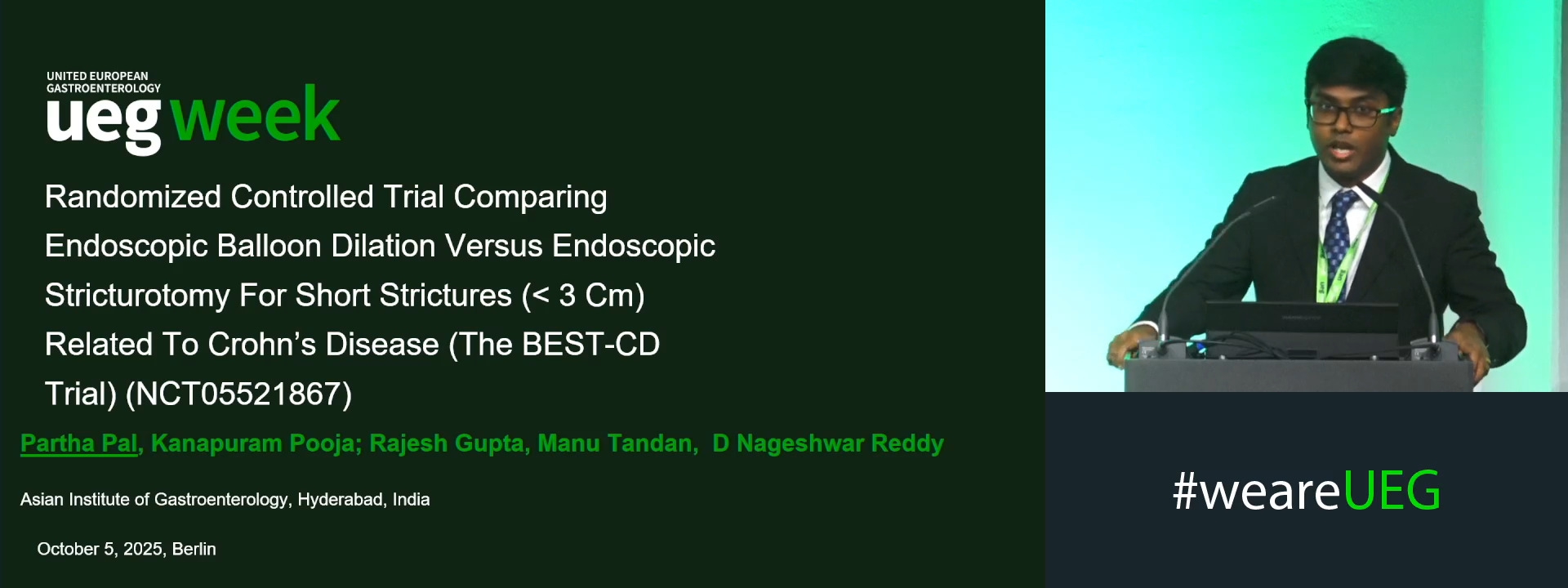
RANDOMIZED CONTROLLED TRIAL COMPARING ENDOSCOPIC BALLOON DILATION VERSUS ENDOSCOPIC STRICTUROTOMY FOR SHORT STRICTURES (< 3 CM) RELATED TO CROHN’S DISEASE (THE BEST-CD TRIAL) (NCT05521867)

Log in to access this content.

Free for all myUEG account holders. Your access level is set automatically based on your occupation. Medical professionals get full access to all content. If you are a non-medical user, you can only access UEG Week content from congresses you attended.

Log In Create a free account

Not sure what you can access? Learn more about account types.

Introduction

Although endoscopic balloon dilation (EBD) remains the standard intervention for Crohn’s disease (CD)-associated strictures, its efficacy is limited by high recurrence and surgery rates. Retrospective analyses suggest endoscopic stricturotomy (ES) may offer superior outcomes, particularly in anastomotic strictures. However, no randomized trials have directly compared EBD and ES for short CD-related strictures.

Aims & Methods

This single-center, randomized controlled trial (August 2022–March 2025) enrolled adult CD patients (18–65 years) with symptomatic, predominantly fibrotic or mixed, short strictures (<3 cm), including both de novo and anastomotic types, accessible via standard endoscopy. Patients with multiple (>2) strictures, strictures beyond endoscopic reach, or prior stricturotomy were excluded. Participants were randomized to undergo either EBD or ES. The primary outcome was clinical recurrence at 1 year. Secondary outcomes included re-intervention, surgery, emergency visits, hospitalization, technical success, and adverse events.

Results

Out of 70 randomized patients, 69 were analyzed (EBD: 35; ES: 34). Baseline characteristics were comparable between groups. Technical success was similar (EBD: 91.4%, ES: 94.1%). On time to event analysis, clinical recurrence was significantly lower in the ES group (OR=0.343, 95% CI: 0.134–0.881; p=0.026). Re-intervention rates favored ES (EBD: 25.7%, ES: 8.8%; OR=0.337, 95% CI: 0.131–0.870; p=0.025). Surgery rates were numerically lower with ES (EBD: 11.4%, ES: 5.9%) but not statistically significant (p=0.581). Hospitalization was significantly more frequent in the EBD arm (OR=0.276, 95% CI: 0.091–0.840; p=0.023). ED visits also trended lower with ES, though not statistically significant (p=0.062) (see table). Adverse events occurred in 25.7% of EBD patients (bleeding n=3 [1 hemoclip], pain with admission n=3, micro-perforation n=1, post-procedure pain n=2) and 14.7% of ES patients (bleeding n=3 [1 self-limited, 1 coagrasper, 1 hemoclip], none required transfusion, suspected perforation n=1, mild pain n=1).

Outcome
EBD (n=35)
ES (n=34)
p-value
Odds Ratio (95% CI)
Technical Success (%)
91.4% (32/35)
94.1% (32/34)
0.70
-
Clinical Recurrence (%)
48.6%
23.5%
0.026
0.343 (0.134–0.881)
Re-intervention Rate (%)
25.7%
8.8%
0.025
0.337 (0.131–0.870)
Surgery (%)
11.4%
5.9%
0.581
0.707 (0.207–2.422)
Stricture-related ED Visits (%)
20.0%
11.8%
0.062
0.404 (0.156–1.047)
Stricture-related Hospitalizations (%)
25.7%
8.8%
0.023
0.276 (0.091–0.840)
Any Adverse Event (%)
25.7% (9/35)
14.7% (5/34)
0.45
-

Conclusion

In this interim analysis, ES was associated with significantly lower clinical recurrence, re-intervention, and hospitalization compared to EBD for short CD-related strictures, with similar safety outcomes. These findings support ES as a potentially superior first-line endoscopic strategy over EBD in selected patients with Crohn’s disease strictures. (NCT05521867)

References

Lan N, Shen B. Endoscopic Stricturotomy Versus Balloon Dilation in the Treatment of Anastomotic Strictures in Crohn's Disease. Inflamm Bowel Dis. 2018 Mar 19;24(4):897-907. doi: 10.1093/ibd/izx085. PMID: 29546384.

RANDOMIZED CONTROLLED TRIAL COMPARING ENDOSCOPIC BALLOON DILATION VERSUS ENDOSCOPIC STRICTUROTOMY FOR SHORT STRICTURES (&LT; 3 CM) RELATED TO CROHN’S DISEASE (THE BEST-CD TRIAL) (NCT05521867)

Partha Pal 1, Kanapuram Pooja 1, Rajesh Gupta 1, Manu Tandan 1, D. Nageshwar Reddy 1

1 Asian Institute of Gastroenterology, Hyderabad, India
Event

UEG Week Berlin 2025

Topics

Endoscopy Radiology & Imaging IBD

Submission format

Abstract

Session

Advances in the investigation of the small bowel

Citation

United European Gastroenterology Journal 2025; 13 (Supplement 8)

Published

2025
UEG Presentation
Share via Email Share on Facebook Share on X Share on LinkedIn Share on Bluesky
Long-term outcome post-LTx in adults

Log in to access this content.

Free for all myUEG account holders. Your access level is set automatically based on your occupation. Medical professionals get full access to all content. If you are a non-medical user, you can only access UEG Week content from congresses you attended.

Log In Create a free account

Not sure what you can access? Learn more about account types.

Long-term outcome post-LTx in adults

Patrizia Burra 1

1 University of Padua-Multivisceral Transplant Unit- Gastroenterology, Padova, Italy

Event

UEG Week Berlin 2025

Topics

Hepatobiliary Surgery

Session

New developments in liver transplantation

Citation

United European Gastroenterology Journal 2025; 13 (Supplement 8)

Published

2025
UEG Presentation
Share via Email Share on Facebook Share on X Share on LinkedIn Share on Bluesky
Donor selection with liver disease

Log in to access this content.

Free for all myUEG account holders. Your access level is set automatically based on your occupation. Medical professionals get full access to all content. If you are a non-medical user, you can only access UEG Week content from congresses you attended.

Log In Create a free account

Not sure what you can access? Learn more about account types.

Donor selection with liver disease

Dieter Broering 1

1 King Faisal Specialist Hospital & Research Centre (KFSH&RC), Riyadh, Saudi Arabia

Event

UEG Week Berlin 2025

Topics

Hepatobiliary Surgery

Session

New developments in liver transplantation

Citation

United European Gastroenterology Journal 2025; 13 (Supplement 8)

Published

2025
UEG Presentation
Share via Email Share on Facebook Share on X Share on LinkedIn Share on Bluesky
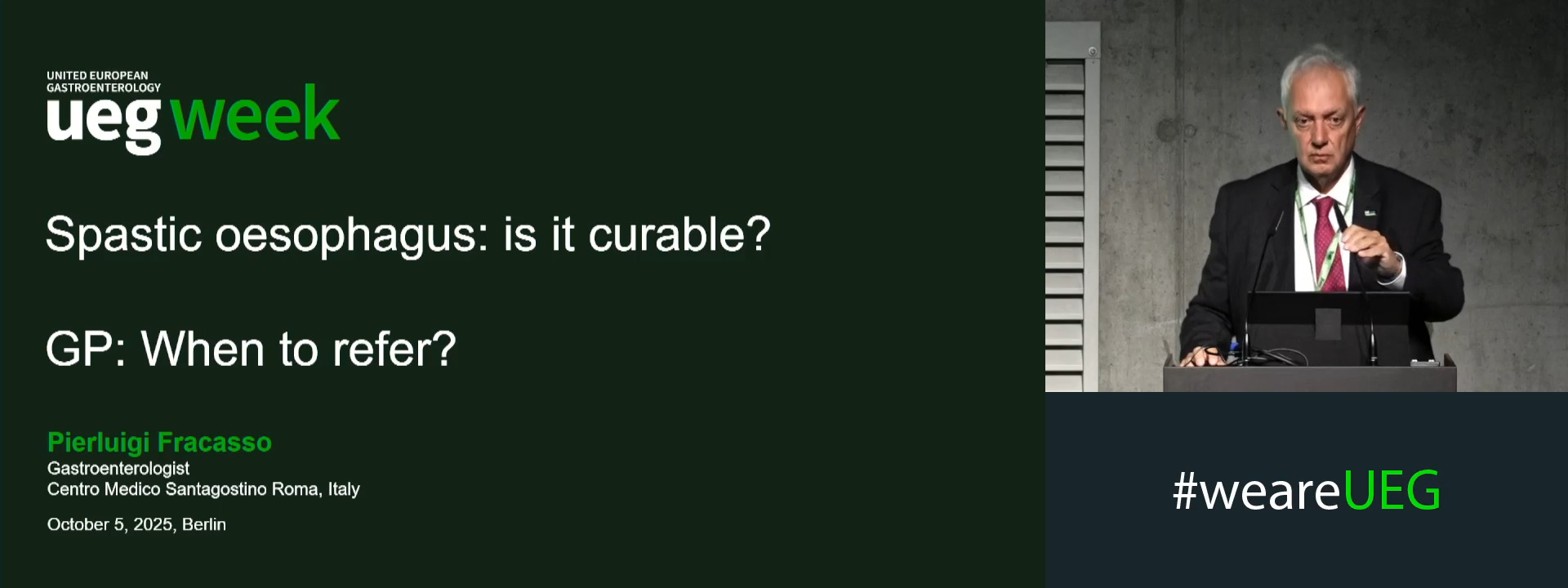
GP: When to refer?

Log in to access this content.

Free for all myUEG account holders. Your access level is set automatically based on your occupation. Medical professionals get full access to all content. If you are a non-medical user, you can only access UEG Week content from congresses you attended.

Log In Create a free account

Not sure what you can access? Learn more about account types.

GP: When to refer?

Pierluigi Fracasso 1

1 Ospedale Sandro Pertini, Roma, Roma, Italy
Event

UEG Week Berlin 2025

Topics

Oesophagus Primary Care

Session

Spastic oesophagus: Is it curable?

Citation

United European Gastroenterology Journal 2025; 13 (Supplement 8)

Published

2025
UEG Presentation
Share via Email Share on Facebook Share on X Share on LinkedIn Share on Bluesky
IL-23

Log in to access this content.

Free for all myUEG account holders. Your access level is set automatically based on your occupation. Medical professionals get full access to all content. If you are a non-medical user, you can only access UEG Week content from congresses you attended.

Log In Create a free account

Not sure what you can access? Learn more about account types.

IL-23

Laurent Peyrin-Biroulet 1

1 Inserm NGERE and University of Lorraine, Vandœuvre-lès-Nancy, France
Event

UEG Week Berlin 2025

Topics

IBD Mechanisms & Personalised Medicine

Session

What's new in advanced therapies for IBD in 2025?

Citation

United European Gastroenterology Journal 2025; 13 (Supplement 8)

Published

2025
UEG Presentation
Share via Email Share on Facebook Share on X Share on LinkedIn Share on Bluesky
ARTIFICIAL INTELLIGENCE FOR CAPSULE ENDOSCOPY IN IBD: MULTICENTER EVALUATION OF ULCER AND EROSION DETECTION

Log in to access this content.

Free for all myUEG account holders. Your access level is set automatically based on your occupation. Medical professionals get full access to all content. If you are a non-medical user, you can only access UEG Week content from congresses you attended.

Log In Create a free account

Not sure what you can access? Learn more about account types.

Introduction

Capsule endoscopy (CE) is a minimally invasive and essential tool for assessing small bowel disorders, especially Crohn’s disease. Accurate detection of ulcers and erosions is vital for evaluating disease activity, guiding treatment, and monitoring therapeutic response. Although CE has revolutionized lesion detection, its manual interpretation remains time-consuming and subject to interobserver variability. Recent advances in artificial intelligence (AI), particularly convolutional neural networks (CNNs), offer promising solutions by enhancing diagnostic accuracy, reducing variability, and improving workflow efficiency. This study aimed to develop and validate a robust AI model capable of detecting and distinguishing small bowel ulcers and erosions across multiple CE platforms and clinical centers.

Aims & Methods

In a prospective, multicenter study conducted between January 2021 and April 2024, data were collected from centers in Portugal, Spain, and the United States. Two CE devices—PillCamSB3 and Olympus EC-10—were used to analyze 137 anonymized exams. The AI-assisted readings generated by a deep learning model were compared to standard-of-care (SoC) interpretations, with an expert consensus panel serving as the reference standard. Performance metrics included sensitivity, specificity, positive and negative predictive values (PPV, NPV), and area under the receiver operating characteristic curve (AUROC).

Results

Expert consensus identified ulcers and erosions in 56 patients (40.9%). Compared to the reference standard, SoC readings achieved 60.7% sensitivity, 98.8% specificity, 97.1% PPV, 78.4% NPV, and 83.2% accuracy. In contrast, the AI-assisted model achieved 94.6% sensitivity, 80.2% specificity, 76.8% PPV, 95.6% NPV, and 86.1% accuracy. The AI model was found to be both non-inferior (p < 0.001) and statistically superior (p < 0.001) to SoC. Notably, it identified 68 lesions, nearly double those detected by SoC (35), and demonstrated consistent performance across devices and centers. The mean AI-assisted reading time was 239 seconds (SD 138 seconds) per exam.

Conclusion

The AI-assisted model significantly outperformed conventional SoC in the detection of small bowel ulcers and erosions, achieving higher sensitivity and overall accuracy while substantially reducing reading time. This is the first multicenter validation of an interoperable AI solution for CE, capable of high diagnostic performance across different devices and clinical environments. These findings highlight the potential of AI to transform endoscopic evaluation and management in inflammatory bowel disease.

ARTIFICIAL INTELLIGENCE FOR CAPSULE ENDOSCOPY IN IBD: MULTICENTER EVALUATION OF ULCER AND EROSION DETECTION

Maria Almeida 1, Miguel Mascarenhas-Saraiva 1, Joana Mota 1, Miguel Martins 1, Francisco Mendes 1, Pedro Cardoso 2, Tiago Ribeiro 3, João Afonso 1, Tiago Cúrdia Gonçalves 4, Pedro Campelo 5, Cláudia Macedo 5, António Miguel Martins Pinto da Costa 6, CECILIO SANTANDER VAQUERO 7, William Preston Sonnier 8, Jack Di Palma 8, João Ferreira 9, José Berkeley Cotter 5, Guilherme Macedo 1

1 Centro Hospitalar São João, Porto, Portugal

2 Department of Gastroenterology, University Hospital Center of São João, Porto, Portugal

3 Centro Hospitalar Universitário de São João, Lordelo - Paredes, Portugal

4 Hospital da Senhora da Oliveira - Guimarães, Guimarães, Portugal

5 Hospital da Senhora da Oliveira, Guimarães, Portugal

6 Hospital Universitario Puerta de Hierro Majadahonda (Madrid), Madrid, Spain

7 Hosp. Universitario De La Princesa, Madrid, Spain

8 University of South Alabama, Alabama, United States

9 Faculdade de Engenharia da Universidade do Porto, Porto, Portugal

Event

UEG Week Berlin 2025

Topics

Endoscopy Radiology & Imaging IBD

Submission format

Abstract

Session

Advances in the investigation of the small bowel

Citation

United European Gastroenterology Journal 2025; 13 (Supplement 8)

Published

2025
UEG Presentation
Share via Email Share on Facebook Share on X Share on LinkedIn Share on Bluesky
Portal vein thrombosis: Aetiologies and differential management

Log in to access this content.

Free for all myUEG account holders. Your access level is set automatically based on your occupation. Medical professionals get full access to all content. If you are a non-medical user, you can only access UEG Week content from congresses you attended.

Log In Create a free account

Not sure what you can access? Learn more about account types.

Portal vein thrombosis: Aetiologies and differential management

Verena Keitel-Anselmino 1

1 University Hospital Magdeburg, Magdeburg, Germany

Event

UEG Week Berlin 2025

Topics

Hepatobiliary

Session

What's new in complications in chronic liver disease in 2025?

Citation

United European Gastroenterology Journal 2025; 13 (Supplement 8)

Published

2025

The global reference point for the digestive health community

Platform Publisher

United European Gastroenterology

Wickenburggasse 1 1080 Vienna, Austria

Contact us

support@ueg.eu

ueg.eu

T: +43 1 997 1639

Legal

Terms & Conditions

Imprint

Privacy Policy

Explore

My Bookmarks

My recommendations

My fields of interest

© 2026 United European Gastroenterology

Change fields of interest

These fields are selected based on the interests in your myUEG profile.
Click the item to unselect it. You can select multiple items.