UEG's educational platform for gastroenterology education bringing recordings, courses, guidelines, and more together in one place.
Most popular content
Rate for better recommendations!
Your feedback helps us show you more of what you like and less of what you dislike!

Log in to access this content.
Free for all myUEG account holders. Your access level is set automatically based on your occupation. Medical professionals get full access to all content. If you are a non-medical user, you can only access UEG Week content from congresses you attended.
Not sure what you can access? Learn more about account types.
A NOVEL MULTI-EPITOPE BASED VACCINE AGAINST HELICOBACTER PYLORI
Behnam Kalali 1, Hassan Moeini 1, Amrollah Mostafazadeh 2, Abbas Yadegar 3, Volker Wedershoven 4, Christian Schulz 5, Peter Malfertheiner 5
1 Iguana Biotechnology, Munich, Germany|||Ludwig Maximilian University, Munich, Germany
2 Babol University of Medical Sciences, Babol, Iran, Islamic Republic of
3 Shahid Beheshti Medical University, Tehran, Iran, Islamic Republic of
4 Iguana Biotechnology, Munich, Germany
5 Ludwig Maximilian University, Munich, Germany
Event
Submission format
Session
Citation
Published

Log in to access this content.
Free for all myUEG account holders. Your access level is set automatically based on your occupation. Medical professionals get full access to all content. If you are a non-medical user, you can only access UEG Week content from congresses you attended.
Not sure what you can access? Learn more about account types.
PPIs under the microscope: The must-know European guidelines!
1 Vilnius university Santaros Klinikos, Vilnius, Lithuania
Event
Citation
Published

Log in to access this content.
Free for all myUEG account holders. Your access level is set automatically based on your occupation. Medical professionals get full access to all content. If you are a non-medical user, you can only access UEG Week content from congresses you attended.
Not sure what you can access? Learn more about account types.
Chronic constipation (Complete Session)
Event
Topics
Session
Citation
Published
Log in to access this content.
Free for all myUEG account holders. Your access level is set automatically based on your occupation. Medical professionals get full access to all content. If you are a non-medical user, you can only access UEG Week content from congresses you attended.
Not sure what you can access? Learn more about account types.
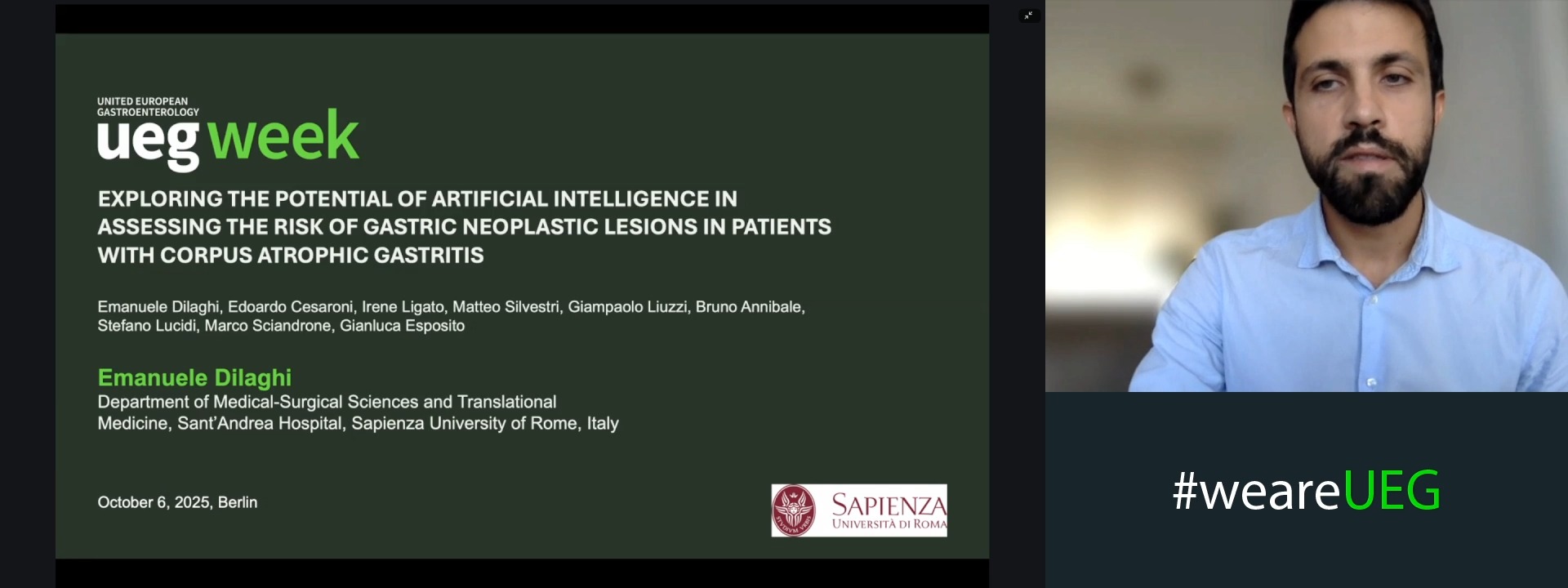
EXPLORING THE POTENTIAL OF ARTIFICIAL INTELLIGENCE IN ASSESSING THE RISK OF GASTRIC NEOPLASTIC LESIONS IN PATIENTS WITH CORPUS ATROPHIC GASTRITIS
Emanuele Dilaghi 1, Edoardo Cesaroni 2, Irene Ligato 1, Giampaolo Liuzzi 2, Bruno Annibale 1, Stefano Lucidi 2, Gianluca Esposito 1, Marco Sciandrone 2
1 Sapienza Univeristy of Rome, Department of Medical and Surgical Sciences and Translational Medicine, Rome, Italy
2 Department of Computer, Control, and Management Engineering “Antonio Ruberti” – Sapienza University of Rome, Italy, Rome, Italy
Event
Submission format
Citation
Published
Log in to access this content.
Free for all myUEG account holders. Your access level is set automatically based on your occupation. Medical professionals get full access to all content. If you are a non-medical user, you can only access UEG Week content from congresses you attended.
Not sure what you can access? Learn more about account types.
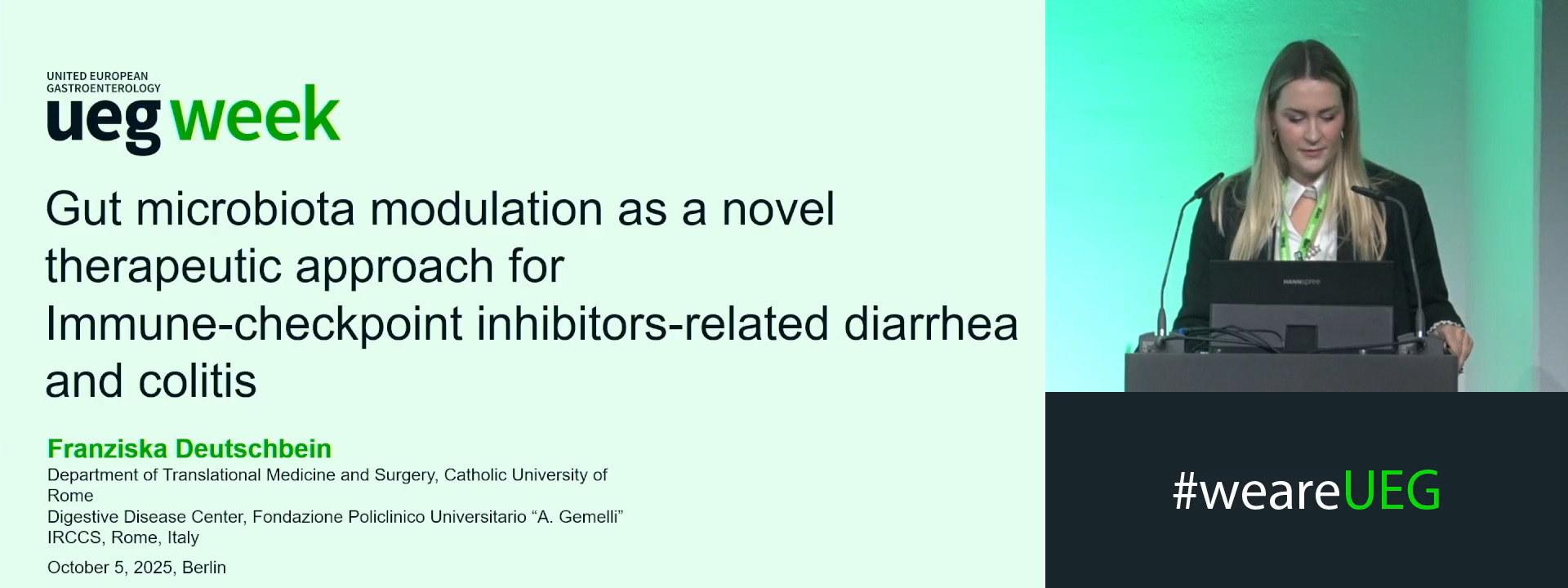
GUT MICROBIOTA MODULATION AS A NOVEL THERAPEUTIC APPROACH FOR IMMUNE-CHECKPOINT INHIBITORS-RELATED DIARRHEA AND COLITIS
Serena Porcari 1, Franziska Deutschbein 1, William Fusco 1, Andrea Severino 1, Debora Rondinella 1, Irene Venturini 1, Antonio Di Sabatino 2, Marco Vincenzo Lenti 2, Ettore D'Argento 1, Emilio Bria 1, Giovanni Schinzari 1, Eleonora Palluzzi 1, Olga Martelli 1, Mariagrazia Distefano 1, Carolina Maria Sassu 1, Serena Maria Boccia 1, Laura Vertechy 1, Ida Paris 1, Roberto Iacovelli 1, Chiara Ciccarese 1, Francesca Romana Ponziani 1, Claudia Marchetti 3, Giampaolo Tortora 1, Antonio Gasbarrini 1, Giovanni Cammarota 1, Gianluca Ianiro 1
1 Fondazione Policlinico Universitario 'A.Gemelli' - IRCCS, Roma, Italy
2 IRCCS Policlinico S. Matteo, Pavia, Italy
3 Fondazione Policlinico Universitario 'A.Gemelli' - IRCCS, Roma, Italy|||Università Cattolica del Sacro cuore, Roma, Italy
Event
Submission format
Session
Citation
Published
Log in to access this content.
Free for all myUEG account holders. Your access level is set automatically based on your occupation. Medical professionals get full access to all content. If you are a non-medical user, you can only access UEG Week content from congresses you attended.
Not sure what you can access? Learn more about account types.
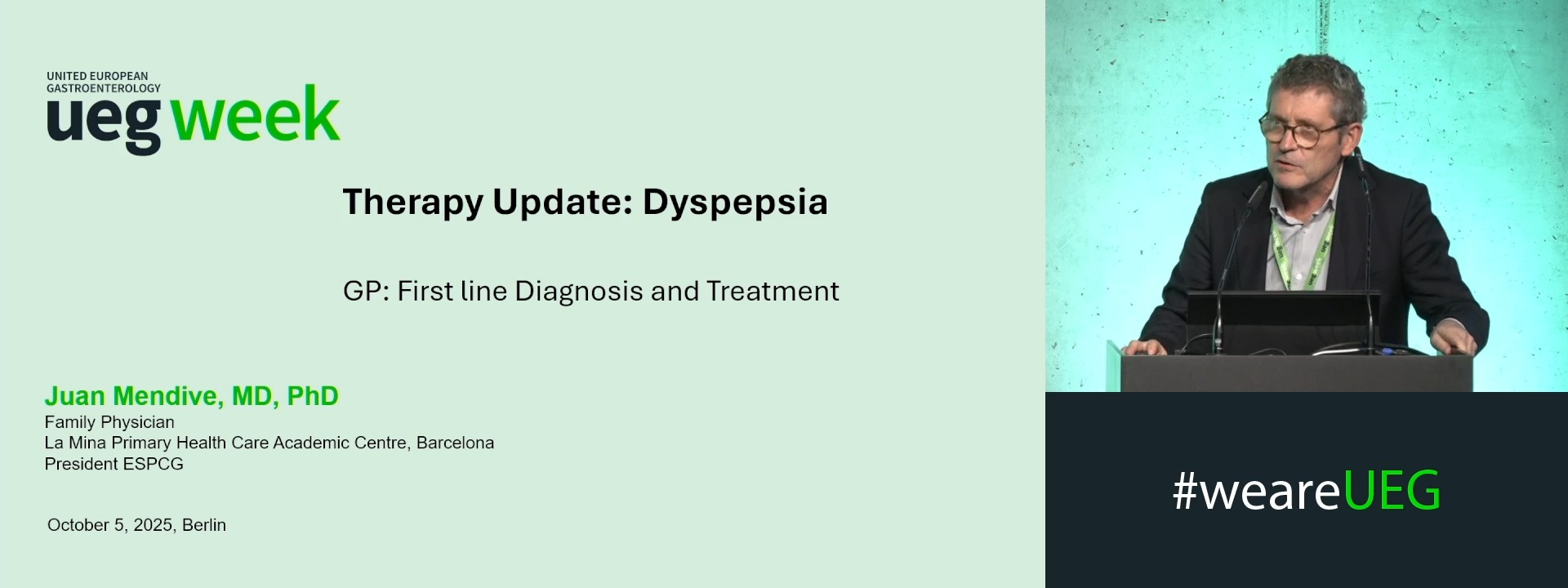
GP: First line diagnosis and treatment
1 European Society for Primary Care Gastroenterology (ESPCG), Sant Adrià de Besòs ( Barcelona), Spain
Event
Session
Citation
Published
Log in to access this content.
Free for all myUEG account holders. Your access level is set automatically based on your occupation. Medical professionals get full access to all content. If you are a non-medical user, you can only access UEG Week content from congresses you attended.
Not sure what you can access? Learn more about account types.
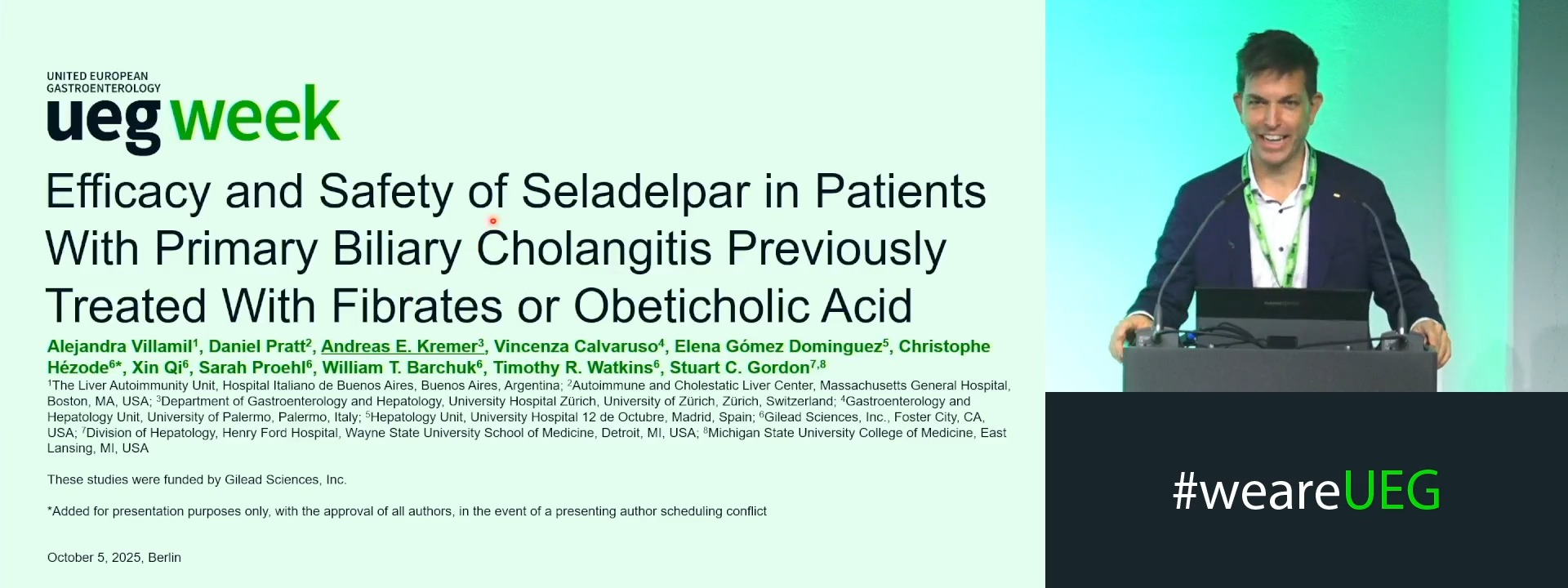
EFFICACY AND SAFETY OF SELADELPAR IN PATIENTS WITH PRIMARY BILIARY CHOLANGITIS PREVIOUSLY TREATED WITH FIBRATES OR OBETICHOLIC ACID
Alejandra Villamil 1, Daniel Pratt 2, Andreas E. Kremer 3, Vincenza Calvaruso 4, Elena Gómez Domínguez 5, Christophe Hezode 6, Xin Qi 6, Sarah Proehl 6, William T. Barchuk 6, Tim Watkins 6, Stuart C. Gordon 7
1 The Liver Autoimmunity Unit, Hospital Italiano de Buenos Aires, Buenos Aires, Argentina
2 Autoimmune and Cholestatic Liver Center, Massachusetts General Hospital, Boston, United States
3 Department of Gastroenterology and Hepatology, University Hospital Zürich, Zürich, Switzerland
4 Gastroenterology and Hepatology Unit, University of Palermo, Palermo, Italy
5 Hepatology Unit, University Hospital 12 de Octubre, Madrid, Spain
6 Gilead Sciences, Inc., Foster City, United States
7 Division of Hepatology, Henry Ford Hospital, Wayne State University School of Medicine, Detroit, United States|||Michigan State University College of Medicine, East Lansing, United States