Introduction
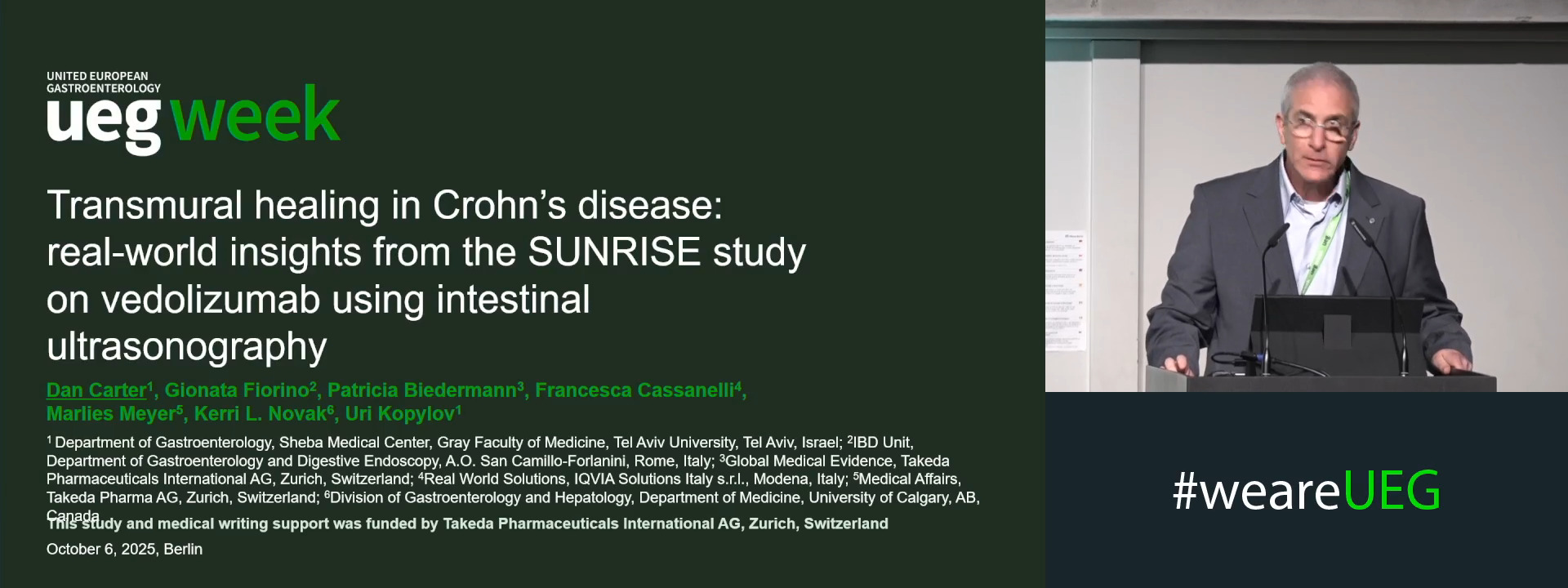
The use of patient-centric monitoring modalities for assessing therapies, such as vedolizumab (VDZ), are of growing interest to optimize disease outcomes in patients with Crohn’s disease (CD). Transmural healing is an emerging outcome assessed by intestinal ultrasonography (IUS), which allows frequent evaluation of CD.1,2 Real-world evidence on the effectiveness of current treatments for induction and maintenance of a transmural response to inform treatment decisions is limited.
Aims & Methods
The SUNRISE study aims to describe patients with CD treated with VDZ achieving a composite outcome of complete remission, and transmural response, utilizing IUS. SUNRISE is an ongoing observational, prospective study (NCT05192863) being conducted across 10 sites in Canada, Israel and Italy. Adults with moderately to severely active CD, with a bowel wall thickness of > 3 mm based on IUS, and who newly initiated intravenous VDZ are eligible. Complete remission (defined as a composite endpoint of clinically corticosteroid-free [Harvey–Bradshaw Index score of < 5 points and no concomitant corticosteroids], biochemical [C-reactive protein and faecal calprotectin normalization] and transmural remission [assessed by IUS]) and transmural response after VDZ treatment are reported after induction with VDZ (Weeks 10/14) and every 6 months until Month 18 or early discontinuation. In addition, health-related quality of life (as measured by the Short Inflammatory Bowel Disease Questionnaire), healthcare resource utilization and patient satisfaction with IUS are reported.
Results
This interim analysis included 70 patients; median (interquartile range [IQR]) age was 50.0 (39.0–67.0) years, time since CD diagnosis was 4.0 (0.9–17.2) years and treatment duration (n = 69) was 5.0 (3.2–6.1) months. At Month 6 after VDZ initiation, the proportion of patients achieving complete remission, and transmural remission and response were 3/11 (27.3%), 9/28 (32.1%) and 12/28 (42.9%) patients, respectively; data at Weeks 10/14 are shown in the Table. Median (IQR) Short Inflammatory Bowel Disease Questionnaire total score was 4.3 (3.7–5.6) at baseline, 4.5 (3.4–5.3) at Week 10, 4.7 (3.9–5.6) at Week 14 and 5.0 (4.4–6.1) at Month 6. At Month 6, 10/21 patients (47.6%) ranked IUS as their preferred test over colonoscopy, magnetic resonance elastography and computed tomography enterography. Of 40 patients with available data at Month 6, 6 (15.0%) discontinued treatment, 5 (12.5%) switched to subcutaneous VDZ and 1 (2.5%) skipped ≥ 1 dose of VDZ. During the observation period, 2/70 patients (2.9%) had a CD-related hospitalization, and 1/70 patient (1.4%) each had a CD-related emergency room visit or CD-related surgery (fistula removal).
Table
| n/N (%)a | Week 10 (± 1 week) | Week 14 (± 1 week) | Month 6 (± 4 weeks) |
Complete remission Corticosteroid-free clinical remission Biochemical remission Transmural remission | 0/2 (0) 14/25 (56.0) 1/3 (33.3) 2/16 (12.5) | 1/7 (14.3) 25/40 (62.5) 7/7 (100) 5/35 (14.3) | 3/11 (27.3) 14/23 (60.9) 8/12 (66.7) 9/28 (32.1) |
| Clinical response | 8/18 (44.4) | 15/30 (50.0) | 8/16 (50.0) |
| Transmural response | 5/16 (31.3) | 7/35 (20.0) | 12/28 (42.9) |
| aNumerator is the number of patients with remission/response; denominator is the number of patients with available data at the time points considered. |
Conclusion
The SUNRISE study provides real-world evidence for the use of VDZ to achieve transmural healing in patients with CD and supports patient preference for IUS over other monitoring modalities. Additional follow-up data are required to confirm these findings.
This abstract was previously presented at the European Crohn’s and Colitis Organisation (ECCO) 2025 congress. This study and medical writing support was funded by Takeda Pharmaceuticals International AG, Zurich, Switzerland.
References
1. Ilvemark J.F.K.F. et al. J Crohns Colitis 2022;16:554–80.
2. Turner D. et al. Gastroenterol 2021;160:1570–83.
Disclosure
D.C. has received speaker’s fees and/or research support from AbbVie, Janssen, Takeda and Taro, and consultancy fees from AbbVie, Takeda and Taro.
G.F. has received personal fees from AbbVie, Abivax, AlfaSigma, Celltrion, Ferring, Galapagos, Janssen, Lilly, Pfizer, Sandoz, STADA and Takeda.
P.B. is an employee and stockholder of Takeda Pharmaceuticals International AG, Zurich, Switzerland.
F.C. is an employee of the contract research organization IQVIA Solutions Italy s.r.l., hired by Takeda Pharmaceuticals International AG for the following activities: project and site management, data management, quality control and statistical analysis.
M.M. is an employee and stockholder of Takeda Pharma AG, Zurich, Switzerland.
K.L.N. has received advisory board fees from AbbVie, Bristol Myers Squibb, Celltrion, Ferring, Janssen and Pfizer, and speaker’s fees and research support from AbbVie, Janssen and Pfizer.
U.K. has received advisory and speaker’s fees from AbbVie, Bristol Myers Squibb, Celltrion, Janssen, Medtronic, Pfizer and Takeda, and research support from Janssen, Medtronic and Pfizer.