Introduction
Sigmoid volvulus is usually managed by endoscopic detorsion in the absence of complications, while surgery is reserved for severe cases. However, recurrence rates remain high, ranging from 18% to 90% (1). The guidelines from the American Society of Colon and Rectal Surgeons (1) recommend prophylactic surgery, although the optimal timing is not defined. In Europe, most cases are sporadic and affect elderly patients with comorbidities. However, large studies mainly originate from endemic regions, which limits their applicability to Western settings. Moreover, there is a lack of large-scale data focusing specifically on the endoscopic management of sigmoid volvulus.
Aims & Methods
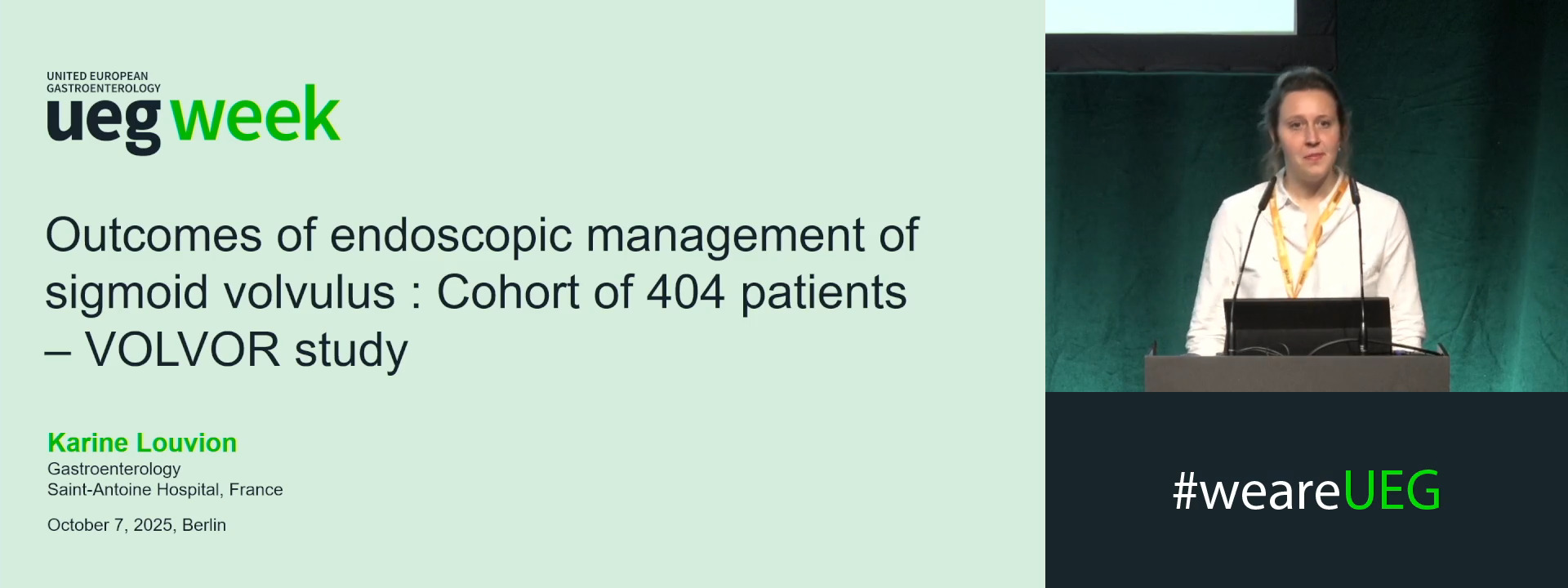
The study aimed to evaluate the outcomes of patients with sigmoid volvulus managed by endoscopic detorsion during out-of-hours emergency endoscopy shifts across multiple centers.
We conducted a retrospective, multicenter study (8 centers), including all patients who underwent endoscopy for suspected sigmoid volvulus during on-call digestive endoscopy shifts between March 2016 and December 2023. Procedures were performed by the POET group (Parisian On-call Endoscopy Team), a mobile unit composed of an endoscopist and a nurse, covering urgent endoscopy during nights and weekends in Paris and suburbs (6.9 million inhabitants), using a portable system (2).
Results
A total of 404 patients were included. Median age was 72 years (IQR 59; 83), 69% were male, 19% institutionalized, 40% had neurocognitive disorders, 26% had anatomical abnormalities of the colon and 45% had constipation. The most common presenting symptoms were abdominal pain (53%), bowel obstruction (17%), and constipation (20%). Endoscopic detorsion was successful in 92% of cases, with a 2% perforation rate and 89% of clinical success. Predictors of technical failure included ischemia at endoscopy (OR 0,16 [0,07-0,37], p<0,0001) and history of abdominal surgery (OR=0,44 [0,2;0,99], p=0,0463). Ischemia was independently associated with initial CRP ≥ 27 mg/L (OR=2,24 [1,11-4,54], p=0,0253), time to endoscopy ≥ 10h (OR=2,38 [1,28-4,39], p=0,0058), and radiological signs of severity (OR=4,13 [1,82-9,36], p=0,0007). All 24 patients with colonic necrosis at endoscopy died without emergency surgery, regardless of the success of detorsion (58% in this subgroup). In 28% of cases, endoscopy was performed for recurrence. Among patients with a first episode, recurrence occurred in 40%, with 50% occurring within 12 days. Endoscopic success was associated with a higher risk of recurrence (OR=4,39 [1,18-16,32], p=0,0271). In-hospital and 30-day mortality was <10%; overall mortality at the latest follow-up was 31% (median follow-up : 9 months, IQR 2-31).
Conclusion
Emergency endoscopic detorsion is highly effective with low morbidity. However, in the presence of colonic necrosis, endoscopic treatment is ineffective and uniformly fatal without surgical intervention. Optimal patient selection is therefore critical, and relies on early identification of predictive factors for ischemia. Volvulus recurrence is frequent and early, highlighting the need for systematic prophylactic treatment following successful detorsion. Elective surgery during the same hospitalization should be considered whenever possible. For patients with surgical contraindications, endoscopic sigmoidopexy may offer a viable alternative.
References
- Alavi K, Poylin V, Davids JS, Patel SV, Felder S, Valente MA, Paquette IM, Feingold DL; Prepared on behalf of the Clinical Practice Guidelines Committee of the American Society of Colon and Rectal Surgeons. The American Society of Colon and Rectal Surgeons Clinical Practice Guidelines for the Management of Colonic Volvulus and Acute Colonic Pseudo-Obstruction. Dis Colon Rectum. 2021 Sep 1;64(9):1046-1057. doi: 10.1097/DCR.0000000000002159. PMID: 34016826.
- Camus M, Becq A, Jaïs B; Parisian On-Call Endoscopy Team; Dray X. Resource-sparing urgent endoscopies by a mobile on-call team in the Paris area during the COVID-19 outbreak. Gastrointest Endosc. 2020 Aug;92(2):447-448. doi: 10.1016/j.gie.2020.04.021. Epub 2020 Apr 16. PMID: 32305344; PMCID: PMC7161514.