UEG's content platform for gastroenterology education bringing recordings, courses, guidelines, and more together in one place.
Trending on Gutflix
Rate for better recommendations!
Your feedback helps us show you more of what you like and less of what you dislike!
Log in to continue.
This content is part of Gutflix. Log in with your myUEG account, or create one free, to watch it.
Not sure what you can access? Learn more about account types.
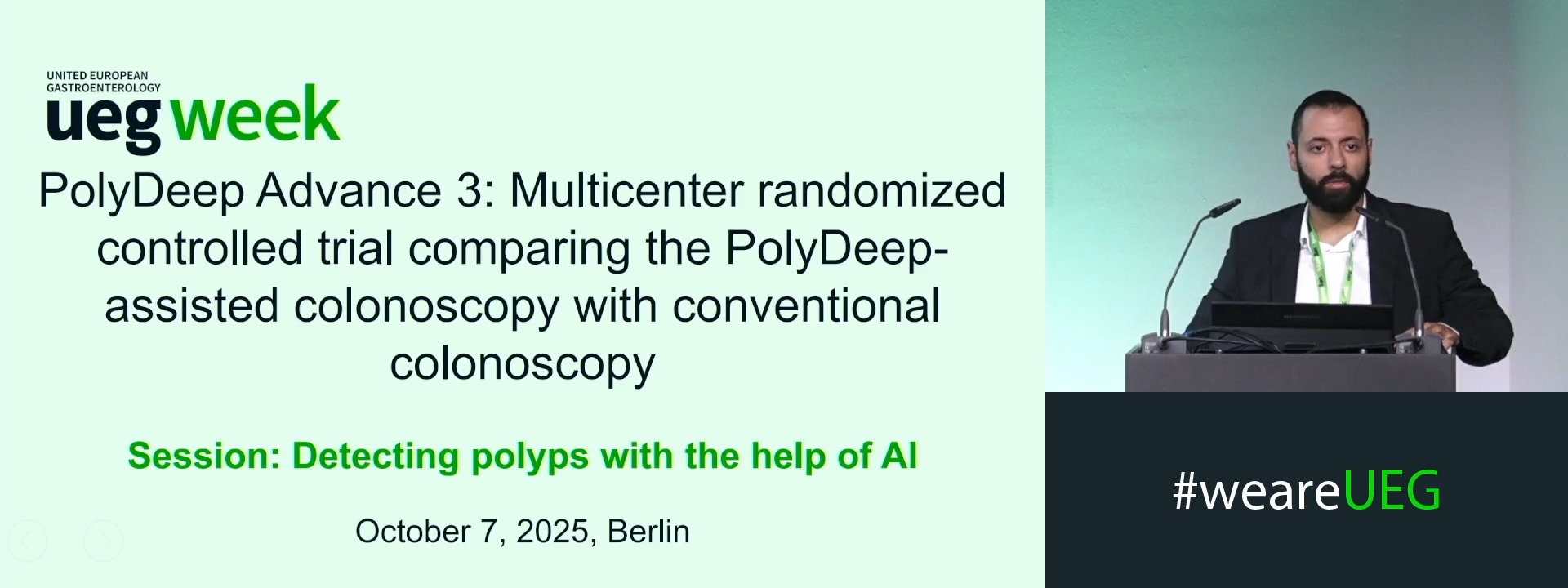
POLYDEEP ADVANCE 3: MULTICENTRE RANDOMIZED CONTROLLED TRIAL COMPARING THE POLYDEEP-ASSISTED COLONOSCOPY WITH CONVENTIONAL COLONOSCOPY
Pedro Davila-Piñón 1,2, Astrid Irene Díez Martín 1,2, Cristina Regueiro Expósito 1,2, Alba Nogueira-Rodríguez 3,4, Florentino Fdez-Riverola 3,4, Miguel Reboiro-Jato 3,4, Daniel Glez-Peña 3,4, Rubén Domínguez-Carbajales 5, Luisa De Castro Parga 6, Jesús Daniel Fernández de Castro 7, Pablo Vega 7, Miguel Telmo Galovart Araguas 6, Santiago Soto 7, Sara Alonso Lorenzo 6, Alfonso Martinez Turnes 6, Noel Pin Vieito 7, Sara Zarraquiños Martínez 7, David Remedios 7, Cristina Alejandra Sánchez Gómez 7, Raquel Souto Rodríguez 8, Franco Baiocchi 7, María José Iglesias Varela 7, Coral Tejido Sandoval 7, Alejandro Ledo 8, Laura Rivas Moral 7, Natalia Garcia Morales 6, Antonio Rodríguez 6, Manuel Puga 7, María Belén Castiñeira-Domínguez 8, Nereida Fernández Fernández 6, Arantxa Germade-Martínez 6, Enrique González 8, Indhira Miosotis 8, Romina Fernández Poceiro 6, Eloy Sanchez Hernandez 7, Hugo López-Fernández 3,4, Joaquín Cubiella 1,7
Affiliations
1 Research Group in Gastrointestinal Oncology, Ourense, Spain
2 Galicia-Sur Public Biomedical Foundation, Ourense, Spain
3 Universidade de Vigo, Ourense, Spain
4 SING Research Group, Ourense, Spain
5 Complexo Hospitalario Universitario de Ourense, Ourense, Spain
6 Hospital Álvaro Cunqueiro de Vigo - CHUVI, Vigo, Spain
7 Hospital Universitario de Ourense, Ourense, Spain
8 Hospital Montecelo - CHUP, Pontevedra, Spain