UEG's educational platform for gastroenterology education bringing recordings, courses, guidelines, and more together in one place.
Trending on Gutflix
Rate for better recommendations!
Your feedback helps us show you more of what you like and less of what you dislike!
Log in to continue.
This content is part of Gutflix. Log in with your myUEG account, or create one free, to watch it.
Not sure what you can access? Learn more about account types.
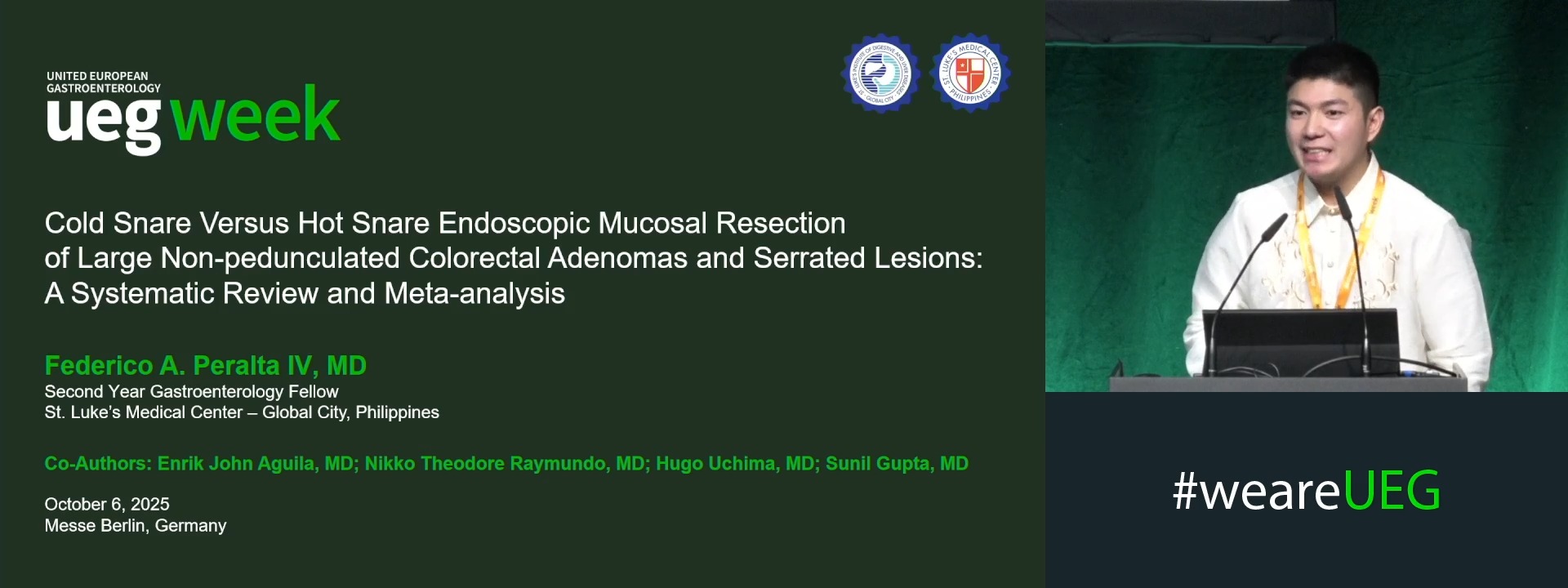
COLD SNARE VERSUS HOT SNARE ENDOSCOPIC MUCOSAL RESECTION OF LARGE NON-PEDUNCULATED COLORECTAL ADENOMAS AND SERRATED LESIONS: A SYSTEMATIC REVIEW AND META-ANALYSIS
Affiliations
1 St. Luke's Medical Center - Global City, Taguig, Philippines
2 St. Luke's Medical Center - Global City, Taguig, Philippines|||Ospital ng Maynila Medical Center, Manila, Philippines
3 Hospital Germans Trias i Pujol, Barcelona, Spain|||Teknon Medical Center, Barcelona, Spain
4 Westmead Hospital, Sydney, Australia, Ermington, Australia
Log in to continue.
This content is part of Gutflix. Log in with your myUEG account, or create one free, to watch it.
Not sure what you can access? Learn more about account types.
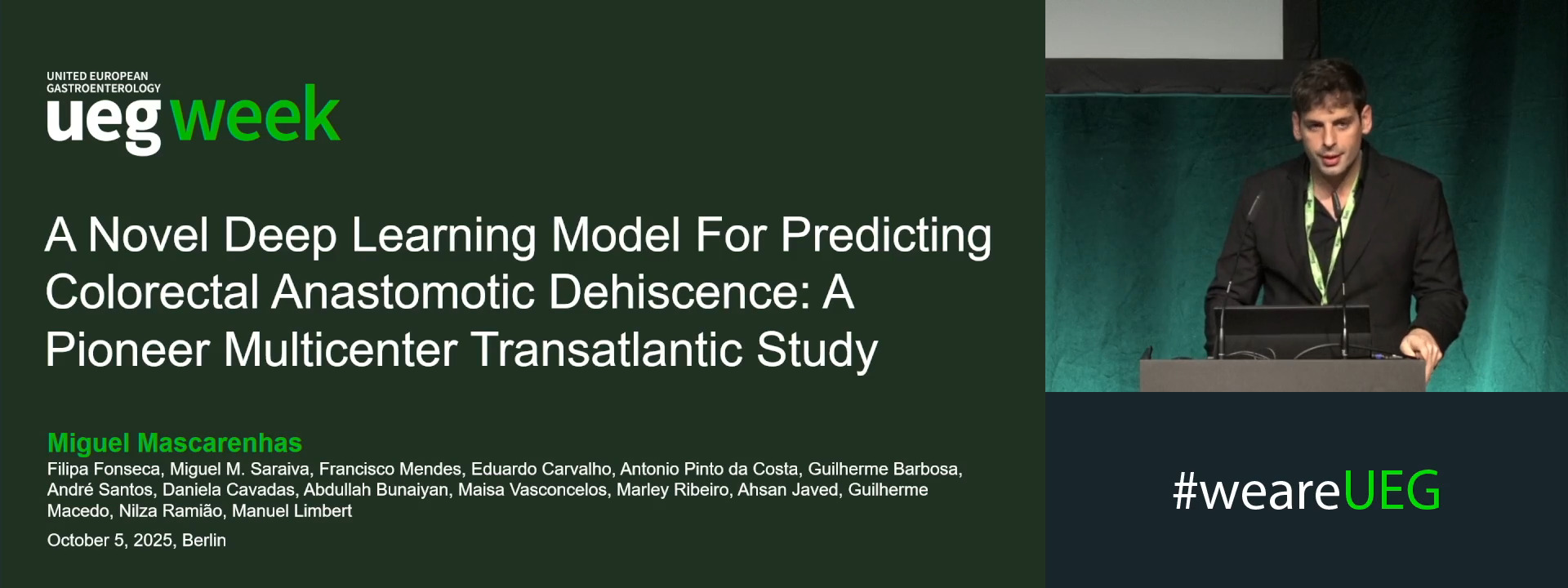
A NOVEL DEEP LEARNING MODEL FOR PREDICTING COLORECTAL ANASTOMOTIC DEHISCENCE: A PIONEER MULTICENTER TRANSATLANTIC STUDY
Miguel Mascarenhas-Saraiva 1, Francisco Mendes 1, André Martins dos Santos 2, António Miguel Martins Pinto da Costa 3, Filipa Fonseca 4, Eduardo Carvalho 5, Nilza Ramião 5, Guilherme Barbosa 5, Maisa Vasconcellos 6, Abdullah Bunaiyan 7, Maria Almeida 1, Joana Mota 1, Tiago Ribeiro 1, Miguel Martins 1, João Afonso 1, Pedro Cardoso 1, Francisca Pinheiro 2, Matheus Carvalho 3, Marcos Eduardo Lera dos Santos 3, Eduardo De Moura 3, Marley Feitosa 6, Ahsan Javed 7, Guilherme Macedo 1, Manuel Limbert 4
Affiliations
1 Centro Hospitalar Universitário de São João, Porto, Portugal
2 Faculdade de Medicina da Universidade do Porto, Porto, Portugal
3 Hospital das Clínicas da Faculdade de Medicina da USP, São Paulo, Brazil
4 Instituto Português de Oncologia IPO, Lisboa, Portugal
5 INEGI – Institute of Science and Innovation in Mechanical and Industrial Engineering, Porto, Portugal
6 Hospital das Clínicas da Faculdade de Medicina de USP - Ribeirão Preto, São Paulo, Brazil
7 Liverpool University Hospitals NHS Foundation Trust, Liverpool, United Kingdom
Log in to continue.
This content is part of Gutflix. Log in with your myUEG account, or create one free, to watch it.
Not sure what you can access? Learn more about account types.
For the endoscopist
Affiliations
1 Westmead Hospital Sydney, Westmead, Australia
Log in to continue.
This content is part of Gutflix. Log in with your myUEG account, or create one free, to watch it.
Not sure what you can access? Learn more about account types.
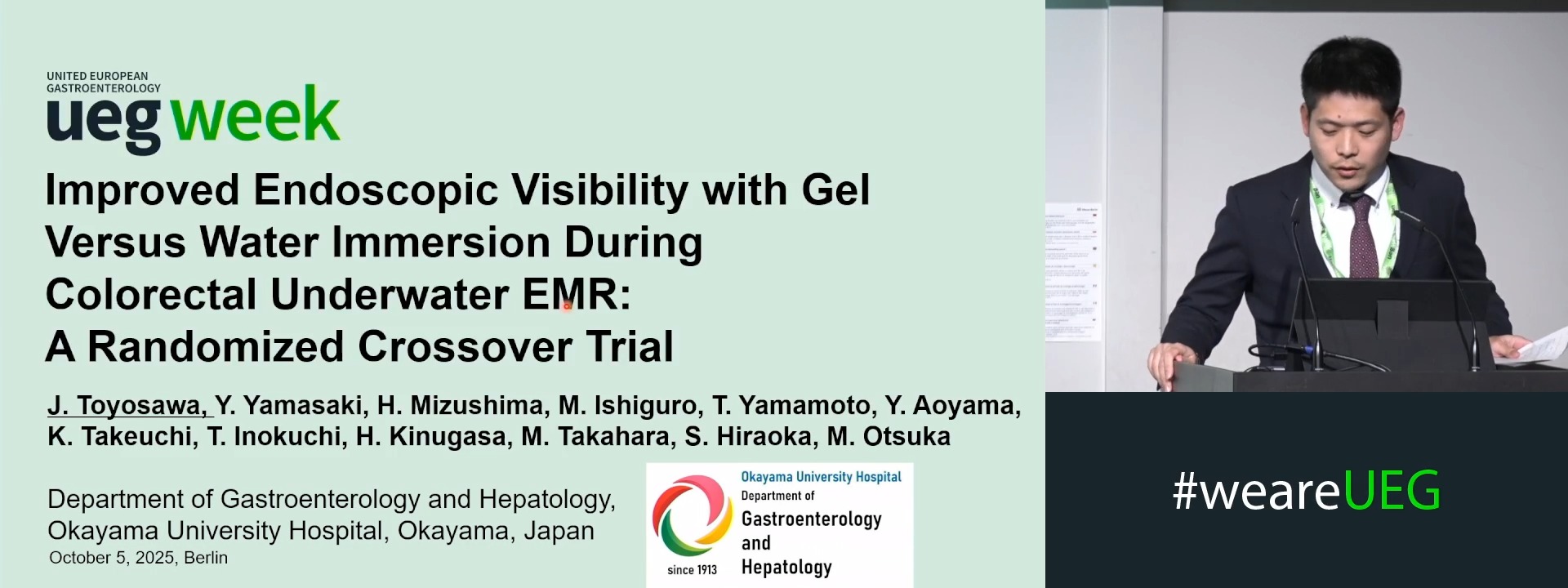
IMPROVED ENDOSCOPIC VISIBILITY WITH GEL VERSUS WATER IMMERSION DURING COLORECTAL UNDERWATER EMR: A RANDOMIZED CROSSOVER TRIAL
Junki Toyosawa 1, Yasushi Yamasaki 1, Hidetaka Mizushima 1, Mikako Ishiguro 1, Takashi Yamamoto 1, Yuki Aoyama 1, Keiko Takeuchi 1, Toshihiro Inokuchi 1, Hideaki Kinugasa 1, Masahiro Takahara 1, Sakiko Hiraoka 1, Motoyuki Otsuka 1
Affiliations
1 Okayama University Hospital, Okayama, Japan
Log in to continue.
This content is part of Gutflix. Log in with your myUEG account, or create one free, to watch it.
Not sure what you can access? Learn more about account types.
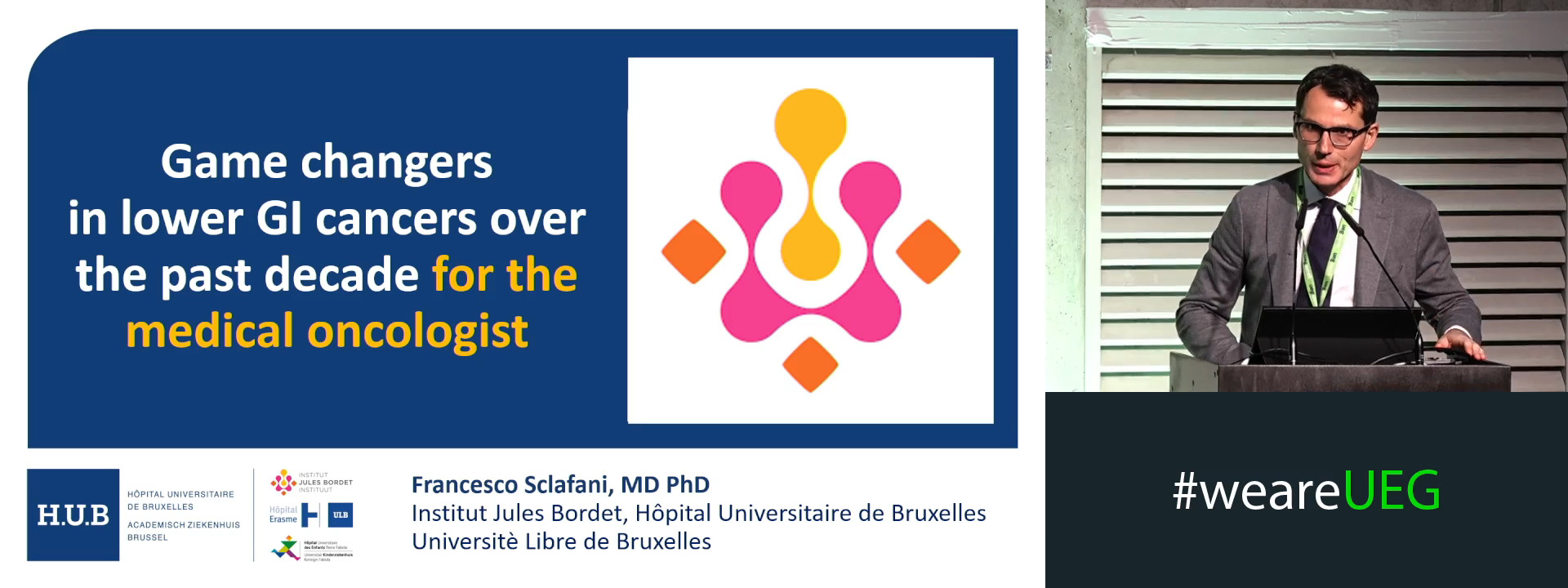
For the medical oncologist
Affiliations
1 Université libre de Bruxelles, Bruxelles, Belgium
Log in to continue.
This content is part of Gutflix. Log in with your myUEG account, or create one free, to watch it.
Not sure what you can access? Learn more about account types.
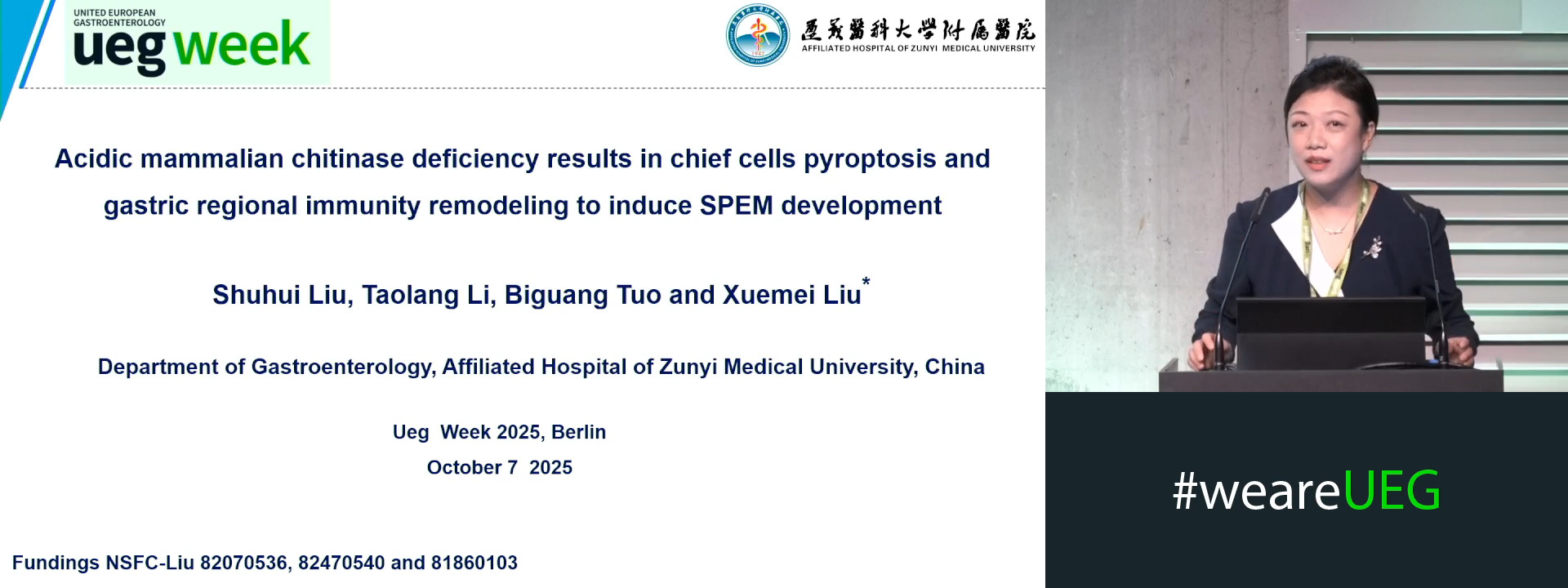
ACIDIC MAMMALIAN CHITINASE DEFICIENCY RESULTS IN CHIEF CELLS PYROPTOSIS AND GASTRIC REGIONAL IMMUNITY REMODELING IS THE NEW CELLULAR ORIGIN OF SPEM
Affiliations
1 Affiliated Hospital of Zunyi Medical University, Zunyi, China
Log in to continue.
This content is part of Gutflix. Log in with your myUEG account, or create one free, to watch it.
Not sure what you can access? Learn more about account types.
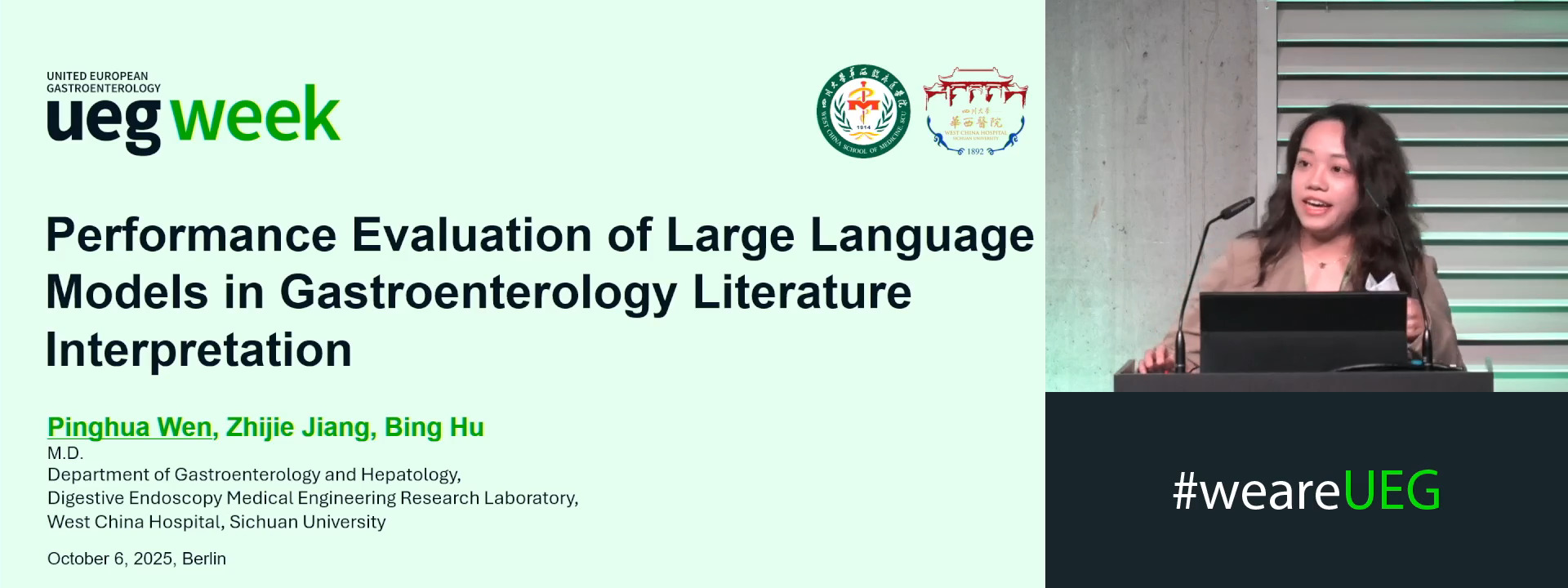
PERFORMANCE EVALUATION OF LARGE LANGUAGE MODELS IN GASTROENTEROLOGY LITERATURE INTERPRETATION
Affiliations
1 West China Hospital,Sichuan University, Chengdu, China